Noah Bennett was eleven years old the night his mother died.
Room 412. St. Mary’s Hospital. Queens.
The machines had been beeping for hours. Slower and slower. Noah sat on the edge of the bed holding her hand, memorizing it. The shape of her knuckles. The chipped polish on her thumb.
“Mom,” he whispered. “Mom, please.”
Sarah Bennett opened her eyes one last time. She was thirty-four. She looked seventy.
“Baby.”
“Don’t go.”
“Listen to me.” Her voice was paper. “Listen.”
He leaned closer.
“Promise me something.”
“Anything.”
“Sing for me. Every day. Don’t let my voice die with me. You keep it alive. You promise?”
He nodded. He couldn’t speak.
“Say it, Noah.”
“I promise.”
She smiled. Then she was gone.
By twelve, the house was gone too.
The hospital bills. The debt collectors. His father, David, drinking through the funeral money and then through his paycheck and then through his job.
By thirteen, Noah was sleeping behind the laundromat on Northern Boulevard.
The owner, Mr. Kaminski, let him warm his hands by the dryer vents in exchange for sweeping the floor. That was the closest thing to kindness Noah knew anymore.
He kept his promise. Every day.
Subway platforms. Empty alleys. A bench in Astoria Park at three in the morning. He sang his mother’s hymn until his throat cracked and then he sang it again.
Nobody stopped. Nobody listened.
Once, a woman in a fur coat dropped a five-dollar bill in front of him and kept walking. He used it for a hot dog. He cried while he ate it.
That was Wednesday.
Sunday night, he was digging through a dumpster behind The Regent Hotel on 57th Street when he heard the music.
Strings. Real strings. A live orchestra.
He climbed down off the dumpster and followed the sound. A caterer had propped open a service door with a folding chair. Warmth spilled out. Laughter. The smell of butter and roasted meat.
Noah’s stomach twisted so hard he almost doubled over.
He hadn’t eaten in four days.
He looked down at himself. Torn jacket. Duct-taped sneakers. Dirt on his hands and face. He knew what he looked like. He knew what would happen.
But his mother’s voice was in his head.
Sing for me. Every day.
He slipped inside.
The Regent Grand Ballroom stopped when they saw him.
Two hundred people in tuxedos and evening gowns. Champagne flutes frozen mid-toast. A string quartet on the raised platform trailed off, one confused note at a time.
A woman in diamonds turned to her husband. “Robert. Robert, look.”
“Jesus Christ. How did he get in here?”
“Someone call security.”
“Already on the way, ma’am.”
Noah stood at the back of the room. His hands trembled at his sides. Every eye was on him. He wanted to run. He wanted to disappear.
Instead, he raised both hands.
“Please.” His voice cracked. “Please, I don’t want money.”
Someone laughed. Sharp. Cruel.
“I can sing.” Noah’s throat was closing. “For a plate. That’s all. Just a plate.”
“Sing?” A man in a burgundy bowtie snorted. “Kid, this is the Halden Foundation Gala. You want a handout, there’s a shelter on 34th.”
“He’s filthy. Look at him.”
“Get him out.”
Two security guards in black suits started moving. Fast.
The first one, a heavyset man with a shaved head, grabbed Noah’s arm and twisted.
“Ow—please—”
“Let’s go, kid. Out the back.”
“Please, I just want to sing—”
“Wait.”
The voice cut through the ballroom like a blade.
Every head turned.
A man in his mid-sixties stood up slowly in the front row. Silver hair combed back. Tailored black tuxedo. Sharp jawline. Tired blue eyes.
Everyone recognized him. Richard Halden. Halden Properties. Net worth: two point four billion. The gala’s founder and largest donor.
The room went silent.
“Mr. Halden, we’ve got him,” the guard said. “We’ll take him out the service exit.”
“Let him go.”
“Sir, security protocol—”
“I said let him go.”
The guard released Noah’s arm and stepped back.
Richard set down his champagne glass on the linen tablecloth. He didn’t take his eyes off the boy.
He started walking.
He came down the center aisle slowly, past staring guests, past frozen waiters, past a woman who whispered “what is he doing” behind her hand.
When he reached Noah, he stopped. He studied the boy’s face like he was looking for something specific.
Then he crouched down. So they were eye level.
“What’s your name, son?”
“Noah, sir.”
“Noah what?”
“Noah Bennett.”
“How old are you, Noah Bennett?”
“Thirteen.”
Richard’s jaw tightened. “When did you last eat?”
Noah looked down at his sneakers.
“Wednesday.”
A gasp went through the crowd. It was Sunday.
Richard didn’t blink. “Where’s your mother?”
“Dead, sir. Cancer. Two years.”
“Your father?”
Noah swallowed. “He’s… he’s around.”
Richard understood everything from those three words. His mouth tightened.
He stood up and turned toward the stage. “Marcus. Bring me the microphone.”
The MC on stage, a slick man in a silver tie, stared. “Mr. Halden, we have a schedule—”
“Marcus. Microphone. Now.”
Marcus scrambled. A young production assistant jogged forward with a wireless mic and pressed it into Noah’s shaking hands.
Noah stared down at it like it might burn him.
“Noah,” Richard said gently. “Sing whatever your mother taught you. Take your time.”
“Here?” Noah whispered. “In front of—”
“Here. In front of everyone.”
Noah looked out at the room. Two hundred faces. Diamonds. Contempt. A few phones already recording.
He closed his eyes.
He heard his mother’s voice.
Don’t let my voice die with me.
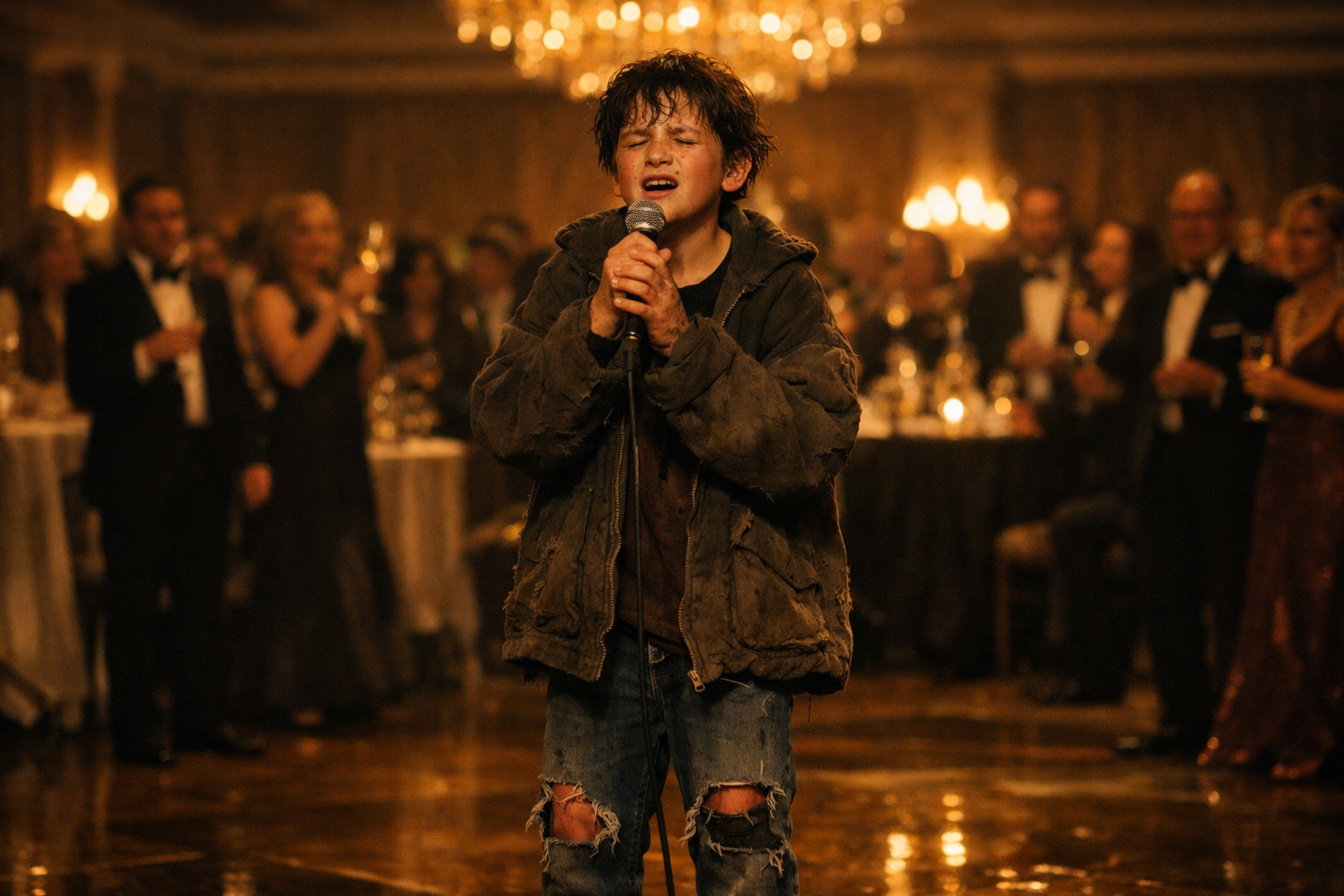
He opened his mouth.
The first note was raw and rough.
The second note wasn’t.
By the third, the ballroom had gone completely still.
Noah sang the hymn his mother taught him. The one her grandmother taught her. Amazing Grace, but slower. Heavier. Broken open at the seams.
His voice was untrained. It cracked in places. It scraped in others. But it carried something no vocal coach on earth could teach.
It carried her.
It carried every cold night behind the laundromat. Every hot dog eaten alone. Every time he sang to nobody in an empty subway station because he’d made a promise to a dying woman he loved more than his own life.
A woman in the third row covered her mouth with both hands.
A hedge fund manager in the back turned his face to the wall.
The MC on stage set down his notes and just listened.
Richard Halden stood two feet in front of Noah, and Richard Halden stopped breathing.
Because Noah’s voice—the timbre, the ache, the exact way he held the vowel on the word “grace”—was Daniel’s voice.
Daniel Halden. Fourteen years old. Killed by a drunk driver on the Long Island Expressway on a rainy Tuesday in October, three years ago last month.
Daniel, who sang in the choir at St. Bartholomew’s every Sunday for eight years.
Daniel, whose recorded voice Richard hadn’t been able to play since the day of the funeral because it hurt too much to be alive in a world where his son wasn’t.
The crystal champagne flute in Richard’s hand slipped between his fingers.
It shattered on the marble floor.
He didn’t hear it.
He didn’t feel the glass hit his shoe.
He watched Noah’s face. He watched a thirteen-year-old boy pour his dead mother’s love into a microphone in front of two hundred strangers. And he felt something crack open in his chest that had been sealed shut for three years.
Noah held the final note.
Then he lowered the microphone.
Silence.
Full. Complete. The kind of silence that only comes when a room forgets it’s a room.
Then a single sound.
Richard Halden was weeping.
Not silently. Not with dignity. He was standing in the middle of his own gala with tears running down his face and his shoulders shaking and a broken glass at his feet and he did not care.
He walked forward. Two steps. He dropped to one knee.
He pulled Noah into his arms.
Noah went rigid. Then he broke. He wrapped his thin arms around this stranger and sobbed into his tuxedo lapel like his heart had finally been allowed to open after two years of holding itself shut.
“My boy,” Richard whispered into his hair. “My boy, my boy.”
“I’m sorry,” Noah cried. “I’m sorry, I didn’t mean to—”
“Shh. Shh. You have nothing to be sorry for.”
Richard pulled back and gripped Noah’s shoulders with both hands.
“His name was Daniel,” Richard said. His voice was wrecked. “My son. He was fourteen. He sang like you. He sang exactly like you.”
Noah’s eyes went wide.
“He died three years ago. A drunk driver. I haven’t been able to listen to him sing since.” Richard wiped his face with the back of his hand. “I only came tonight because my wife begged me. She said it had been long enough.”
The room was silent. Watching. Not one phone was up now.
Richard stood. He turned to face the crowd.
His voice steadied. It became the voice of the man who had built a two-billion-dollar company from a single Bronx apartment building.
“Every person in this room. Listen to me.”
Nobody moved.
“This foundation raises money for at-risk youth. Every year we throw this gala. Every year we pat ourselves on the back for our generosity.”
He gestured at Noah.
“Tonight, an at-risk youth walked into our ballroom. Hungry. Cold. Alone. And most of you wanted him thrown into the street.”
Faces flushed. Someone looked at the floor.
“I’m pledging five million dollars to the Halden Foundation. Tonight. On the record.”
A wave of gasps.
“On one condition.”
He turned back to Noah.
“This boy gets everything. Housing. Medical care. Food. A vocal coach. A tutor. A real school. A real childhood.” His voice cracked. “And if he’ll allow me and my wife Elaine—we’d like to be part of that childhood. For as long as he wants us.”
Noah’s knees buckled.
Richard caught him.
“Why?” the boy whispered. “You don’t know me. You don’t—”
“Because you kept your promise to someone you loved,” Richard said. “And I’ve spent three years breaking mine. Daniel would want this. And Elaine—” he took a shaking breath, “—Elaine has been waiting a long time to love a kid again.”
Noah pressed his forehead to Richard’s shoulder and cried.
The room broke.
Not into applause. Into motion.
A woman in her fifties pushed forward, tears streaming. “Karen Rothstein. I own the Rothstein Conservatory. Full scholarship. Whenever he’s ready. Voice, piano, whatever he wants.”
A man behind her stepped up. “Michael Chen. Chen’s Steakhouse, three blocks over. Kid, you and Mr. Halden come by tonight. My chef will feed you until you can’t stand.”
A pediatrician handed Noah a business card. “Dr. Patel. My office, Tuesday morning. Full checkup. On the house.”
A woman in a green gown pressed a folded check into Richard’s hand. “For the foundation. Ten thousand. My son was fourteen too.”
Richard nodded. He couldn’t speak.
Noah stood in the middle of it all, holding Richard’s hand like it was the only thing keeping him on earth.
Elaine Halden was reading in bed when the front door opened at midnight.
She was fifty-eight. Silver hair. Reading glasses. A cardigan she’d owned for twenty years. She had not slept a full night since Daniel.
She heard voices in the foyer. Richard’s voice. And another. Higher. A boy’s voice.
She sat up.
“Richard?”
She came down the stairs in her slippers.
Richard was standing in the foyer with a filthy thirteen-year-old boy who was clutching a paper bag full of leftovers from Chen’s Steakhouse.
She stopped on the third step.
“Elaine,” Richard said. His voice was raw. “This is Noah. Noah Bennett. He needs a place to sleep tonight. And I need to tell you what happened.”
Elaine looked at the boy. She took in his hollow cheeks. His duct-taped sneakers. His eyes.
She came down the last three steps.
She crossed the foyer.
She knelt in front of him.
“Are you hungry, sweetheart?”
Noah nodded.
“Are you scared?”
Noah nodded again.
“Are you tired?”
Noah’s chin trembled. He nodded a third time.
Elaine cupped his dirty face in both her clean hands.
“Then let’s start with a bath. And then a bed. And then in the morning we’ll figure out the rest.”
Noah looked at Richard. Richard nodded.
Noah looked back at Elaine.
And then, for the first time in two years, he said the word he thought he’d never say to anyone again.
“Okay, ma’am.”
Elaine smiled. Her eyes were wet.
“You can call me Elaine.”
The next morning, over pancakes he ate too fast, Noah told them everything.
His mother. The promise. The house. His father. The laundromat.
Richard listened, jaw tight.
When Noah mentioned his father, Richard set down his coffee.
“Where is he now, Noah?”
“I don’t know. Last I saw him he was at a bar on Northern. Two weeks ago.”
“Did he hurt you?”
Noah looked at the table.
That was answer enough.
Richard picked up his phone. He walked into the next room. Elaine reached across the table and squeezed Noah’s hand.
“You are safe here, sweetheart. Nobody is going to touch you again.”
Noah’s eyes filled up.
By noon, Richard had called three lawyers, two social workers, and one judge who owed him a favor from 1998.
By the end of the week, Noah had a temporary guardianship order, a pediatrician, a therapist, and a bedroom on the second floor of the Halden brownstone with clean sheets and a window that looked out on a garden.
By the end of the month, David Bennett had signed away his parental rights in exchange for a small monthly stipend and a promise never to contact his son again. He took the money. He was drunk when he signed.
By the end of the year, Noah Bennett was legally Noah Halden.
Six months in, Elaine walked past his bedroom and heard him singing to himself.
She stood in the hallway and cried.
Later that night, she told Richard, “He’s healing.”
Richard nodded. “So are we.”
Two years later, Noah stood in the wings at Lincoln Center.
He was fifteen. He’d grown four inches. He’d gained thirty pounds. His voice had deepened but the ache was still there. Karen Rothstein said it was the ache that was going to make him great.
Tonight was his first sold-out solo showcase. Two thousand seats. Every one filled.
He wore a tailored black suit. His hair was cut clean. He smelled like the aftershave Richard had given him for his fifteenth birthday.
The stage manager touched his elbow. “Two minutes, Noah.”
Noah nodded. He looked out through the curtain.
Front row, center. Richard. Elaine. And between them, on the empty seat, a framed photograph of a fourteen-year-old boy with a shy smile and a choir robe.
Daniel was here too.
Noah took a breath.
He walked out.
The applause hit him like weather.
He crossed to the microphone. He looked out at the two thousand faces. He looked down at the front row.
He spoke first. He hadn’t planned to.
“This first song is for my mother, Sarah Bennett. Who taught me to sing.” His voice was steady. “And for my brother Daniel Halden. Who I never got to meet. But who made room for me anyway.”
Elaine’s hand flew to her mouth. Richard’s shoulders started shaking before Noah sang a single note.
Noah opened his mouth.
He sang his mother’s hymn.
Two thousand people wept.
When he finished and bowed, the standing ovation lasted seven minutes.
He looked at Richard and Elaine in the front row. He mouthed three words that were meant only for them.
“Thank you, Dad.”
Richard broke. He pressed his forehead against Elaine’s shoulder and he sobbed. Elaine held him and rocked him and looked up at their son on the stage and mouthed I love you back.
Backstage, a reporter from the Times caught him by the dressing room door.
“Noah. One question. What does it feel like to be adopted by the Haldens? To go from the street to Lincoln Center in two years?”
Noah thought about it.
He thought about his mother. He thought about a shattered champagne glass on a marble floor. He thought about Elaine kneeling in front of him in the foyer at midnight.
He smiled. Real. Full. The smile of a fifteen-year-old boy who was finally, finally safe.
“It feels like my mom kept her promise too.”
The reporter blinked. “Sorry?”
“She told me to sing every day. So her voice wouldn’t die.” Noah shrugged. “It didn’t. It found me a family.”
He walked into the dressing room and closed the door.
Because sometimes the child you save ends up saving you right back.
And sometimes the voice you thought you’d lost forever comes back—wearing a different face, singing the same song, exactly when you need it most.
Original fictional stories. AI-assisted creative content.