
The classroom smelled like chalk dust and old radiators. Twenty-eight kids wrestled with multiplication worksheets. One of them was failing all of them.
Jordan Cole sat in the front row — not because he was eager, but because the board blurred past ten feet and his grandmother couldn’t afford glasses. At ten, he was the smallest kid in fifth grade, wearing his cousin DeShawn’s old hoodie, sleeves swallowing his hands. His grades were a disaster. D in math. D in reading. Teachers passed him along because holding him back felt pointless. The school counselor had written in his file: limited academic potential.
What nobody knew was that Jordan wasn’t struggling with the work. He was bored by it. So bored that while the rest of the class whispered “seven times eight,” his pencil was filling a battered notebook with symbols that had no business being inside an elementary school.
Mrs. Dawson stopped beside him during the worksheet. She assumed he was doodling again. She looked down — and her expression changed.
She had a master’s degree. She couldn’t read a single line.
“Jordan,” she said carefully, “what is this?”
He looked up, polite and unhurried. “Lower bounds in network optimization. Two mathematicians argued about it for thirty years and neither one proved anything. I think I see why.”
She stared at him for a long moment. Then walked quietly back to her desk and sat down without saying another word.
The D’s stayed on his report card. Nobody updated his file.
Here’s the thing about the Harlan-Pierce debate: in 1993, a hotshot young professor named Dr. Victor Harlan published a theorem claiming there was an absolute ceiling in network optimization—a hard wall mathematics could not climb past. It shook the field.
Dr. Sandra Pierce at Stanford said he was wrong. There was no ceiling. Optimization had no fixed boundary.
Neither could prove the other right. The argument consumed careers, split conferences in two, and became the field’s most famous open wound. Dr. Pierce died in 2019 with it still unresolved.
And in a Chicago public library, an eight-year-old boy read about it and thought: Why don’t they just look harder?
Jordan lived with his grandmother Ruth—seventy-one, retired from the postal service, raising him since his mother died and his father went to prison. She didn’t understand the university textbooks stacked in the living room.
But she understood her grandson.
“You’re going to be something this world isn’t ready for,” she told him one night, watching him fill his fourteenth notebook with cramped, urgent handwriting.
“I just want to solve it, Grandma,” he said.
“I know.” She kissed his head. “That’s how giants start.”
Across the city, Dr. Harlan—now sixty-four, tenured, decorated—gave speeches at black-tie dinners and accepted honorary plaques. He had never, in forty years, mentored a Black doctoral student. Never cited a Black mathematician. He didn’t think of himself as a bigot. He just had standards.
When Jordan scored a perfect mark at the state’s regional math qualifier—highest ever recorded in Illinois history—Harlan reviewed the participant list. He saw the name of an underfunded South Side elementary school. He saw the age. Ten.
He made a phone call.
“There has to be an error in the scoring,” he told the coordinator.
“I’ve checked it three times, Dr. Harlan. The score stands.”
“Then check it a fourth time.”
“The rules are clear, sir. Jordan Cole has qualified.”
The phone call ended. Harlan sat at his desk for a long time.
Registration day at Northwestern’s annual youth mathematics championship glittered under chandeliers. The lobby was full of teenagers in private school blazers. Wealthy parents talked about summer programs in Switzerland. Coaches carried tablets loaded with practice simulations.
Ruth wore her church dress. Jordan wore the only collared shirt he owned—DeShawn’s, too big—and gripped his battered notebook against his chest like a shield.
Harlan sat at the head of the registration table, flanked by colleagues. He’d come early, curious to see the so-called miracle kid from the South Side. When Jordan stepped up to the table, Harlan looked him over slowly.
“A spelling bee might suit you better,” Harlan said, smiling at the adults beside him.
Jordan said nothing. He placed his registration form on the table.
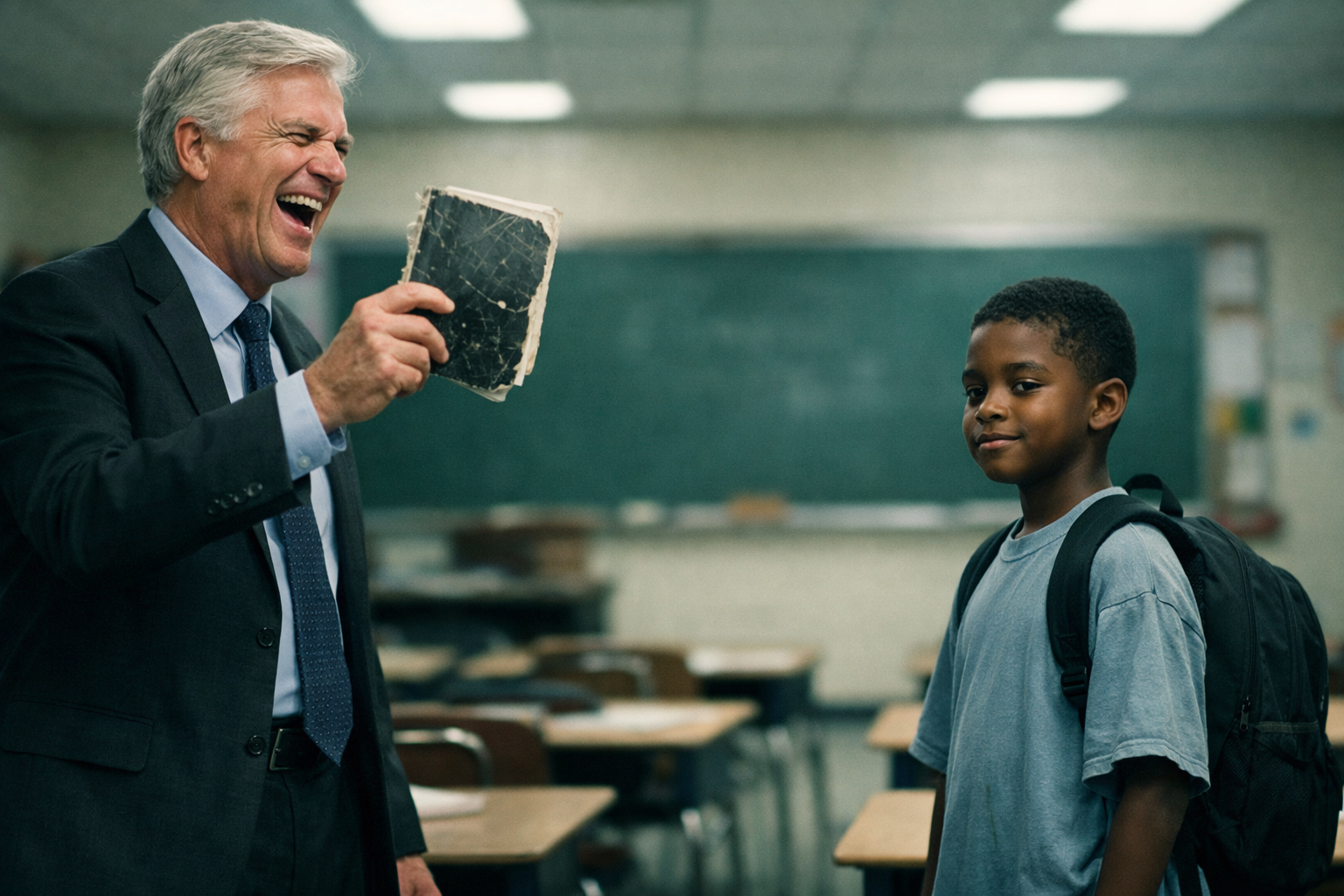
As he turned to go, his notebook slipped. Pages fanned across the marble floor. Harlan reached down, picked it up—and his smile froze.
He scanned a page. Then another.
Then he laughed. Out loud. Hard enough to turn heads across the lobby.
He held the notebook up so the room could see. “This child believes he can settle the Harlan-Pierce debate.” He shook his head, grinning. “A ten-year-old from—” he glanced at the registration form— “Lincoln Park Elementary.”
Laughter spread through the lobby. Parents. Coaches. Older contestants. The sound bounced off the marble and the glass.
Jordan stood very still.
He didn’t cry. He didn’t look at the floor. He looked directly at Harlan.
“The lower bound exists,” he said, voice quiet. “And I can prove it.”
The laughter got louder.
Ruth put her hand on his shoulder. He reached up and covered it with his own.
Round One: speed calculation. One hundred and fifty high school contestants spread across a testing hall. Time limit: forty-five minutes.
Jordan finished in eleven.
He set his pencil down, folded his hands, and waited while the room scratched and sweated around him.
Perfect score. Fastest in state history.
Murmurs started in the corridors before the results even posted.
Round Two: proof construction. Contestants were called to a large whiteboard, one at a time, to solve complex proofs while a panel observed. Most took the full allotted time. Some couldn’t finish.
When Jordan’s turn came, he dragged a chair to the board—quietly, without making a scene—climbed up, and started writing.
Halfway through, Harlan’s voice cut across the room.
“That method is incorrect.”
Jordan paused, pencil raised. He didn’t turn around immediately. Then he turned.
“Your method works, sir,” he said. “But it’s not complete. Mine finds a constraint yours doesn’t account for.”
The room went very quiet.
Dr. Carol Mays—respected in the field, one of Harlan’s former doctoral students—stood from the observer panel and walked to the board. She studied the work for several minutes without speaking.
Then she straightened up.
“He’s correct,” she said.
Harlan’s jaw tightened.
Jordan turned back to the board and wrote his final line. Then, almost to himself: “The same hidden constraint is what’s missing from the Harlan-Pierce debate. That’s why nobody’s closed it.”
Someone in the back of the room had been filming on a phone since Harlan’s interruption. The video was online before the round officially ended. By dinner, it had four million views.
10-Year-Old Corrects Famous Professor Mid-Round.
That evening, Harlan sat alone in his office with the door locked. Sweat soaked through his collar. His phone wouldn’t stop buzzing. Reporters. Colleagues. Former students asking if the video was real.
He had two choices.
He could call the boy’s proof elegant and get ahead of the story. Take the high road. Smile for the cameras.
Or he could make the problem in tomorrow’s final round something no ten-year-old—no high schooler, no adult in that room—could solve.
He opened his laptop. He drafted the new final-round question.
He replaced the standard championship problem with the full, unmodified Harlan-Pierce equation.
His logic was simple: live broadcast, 400,000 viewers, seven accomplished teenagers and one small child from a school nobody had heard of. The kid would freeze. He’d look exactly like what he was—a lucky kid who got a couple of problems right and got carried away.
Harlan hit send.
The grand final opened to a packed auditorium and a live stream already at 200,000 concurrent viewers. Eight contestants stood onstage—seven high schoolers and one kid with a superhero backpack buckled to his back.
Ruth sat in the front row of the audience, hands folded in her lap, perfectly still.
When the final problem appeared on the overhead screen, the room shifted.
A mathematician in the third row leaned to her colleague and whispered, “That’s the Harlan-Pierce problem.”
“That can’t be the question.”
“That’s the question.”
Onstage, the seven high schoolers stared at the screen. One girl pressed her lips together. A boy in a blazer slowly put his marker down.
Harlan leaned toward his microphone at the judges’ table. “Since one of our contestants has publicly claimed to know the answer to this problem, this seems like the appropriate moment for him to demonstrate that.”
Every head in the auditorium turned to Jordan.
Jordan looked at the screen.
He had seventeen notebooks on this problem. He had started two years ago, the summer he turned eight, working through it in the library while Ruth waited for him in the periodicals section.
He picked up his marker.
He started writing.
Halfway through, he stopped.
The marker hovered over the board.
There was a gap. A step he couldn’t bridge. A variable that didn’t resolve the way it should.
His chest tightened. The auditorium was completely silent. Online, viewers started typing.
He’s stuck. Poor kid. Harlan just stood there and watched him walk into a trap.
On the live stream, someone wrote: I feel sick watching this.
Jordan stared at the gap in his work. He heard, very faintly, the sound of shifting in seats. Someone coughing. The fluorescent buzz of the stage lights.
And then he heard something else—not from the room, but from somewhere underneath the noise.
They don’t see the giant inside you. But giants don’t need to be seen to be real.
He breathed.
He looked at the gap again.
And then—quietly, in the silence of his own mind—he understood.
The gap wasn’t an error. The gap was the proof. The variable he couldn’t resolve existed precisely because the lower bound required it to exist. The absence was the answer.
He started writing again. Faster.
When the timer sounded, each high schooler reported their result. Incomplete. Incomplete. Partial derivation, no conclusion. Incomplete. Could not resolve. Incomplete. Incomplete.
Harlan’s expression had softened into something that looked almost like relief.
Then Jordan stepped forward. Climbed the chair. Set his marker to the board.
“I’d like to present my solution.”
What followed lasted nine minutes. Jordan walked through the full anatomy of the Harlan-Pierce debate—Harlan’s original theorem, Pierce’s counter-position, the shared oversight in both scholars’ frameworks, and the hidden variable that tied the entire contradiction into a coherent resolution.
He wrote the final line. He set the marker down.
He turned to the auditorium.
“The lower bound exists,” he said. “Dr. Harlan was right about that. He was just missing one variable. Dr. Pierce was also right—without that variable, the bound appears not to exist. They were both correct. They were both incomplete.”
He paused, then added, with the frank honesty of a child who didn’t know there was a diplomatic version: “I don’t know why it took thirty years. The variable isn’t hard to find if you look from the right direction.”
The auditorium didn’t react for a full three seconds.
Then Dr. Mays stood up from the judges’ table. She walked to the board. She examined the proof for a long time, running her finger along lines, backtracking twice, checking references in her mind against what she was reading.
She turned to face the room.
Her voice was unsteady.
“The proof is valid.” She stopped. Started again. “The Harlan-Pierce debate is resolved.” Another pause. “By Jordan Cole. Age ten.”
The auditorium came apart.
Ruth didn’t cheer. She pressed both hands flat over her mouth and her shoulders shook.
Marcus, in the second row, stood up and yelled so loud a woman three seats over jumped.
Onstage, the seven high schoolers started clapping—slowly at first, then hard, then one by one they started smiling because some things are too large to be jealous of.
At the judges’ table, Harlan hadn’t moved.
His colleagues were watching him. The cameras were on him. He had 400,000 witnesses and no exit.
He stood up. He walked to the board. He checked the proof himself, line by line, because he was a mathematician and that was what mathematicians did and he needed it to be wrong.
It wasn’t wrong.
He stood there for a moment with his hand resting on the whiteboard, and the entire room waited.
“The proof is correct,” he said. His voice came out flat, scraped clean of everything.
A ten-year-old had done what he could not.
The sabotage didn’t stay secret long. Someone inside the organizing committee had seen the last-minute question swap. By the time the broadcast ended, the texts had already started.
Within two hours, the story had flipped:
Professor Substituted Unsolvable Problem to Humiliate Child—Child Solved It Anyway.
Northwestern’s dean called Harlan that night. The call lasted four minutes.
The following morning, Harlan was escorted to the stage of a press conference and asked to address Jordan directly.
Jordan sat in the front row in the same collared shirt, notebook on his lap.
Harlan stood at the microphone. He looked smaller than he had the day before. The posture was the same—straight, rigid—but something behind his eyes had gone quiet.
“I underestimated you,” he said. “I tried to make you fail. That was wrong.”
He stopped there. There wasn’t more.
Jordan looked up at him. His face was genuinely curious—not triumphant, not cold. Just curious.
“Why did you laugh at me at registration?” he asked. “Did you really think I couldn’t do it?”
Harlan opened his mouth. Closed it.
“I don’t know how to answer that honestly,” he finally said.
Jordan nodded slowly, as if that made sense to him. “My grandma says people who laugh at things they don’t understand are usually scared of them.” He paused. “I don’t think you should be scared of me. I just like math.”
The room was very still.
“You were right about the lower bound,” Jordan continued. “You just needed one more thing. That’s not failure—that’s almost. Almost is still close.”
He stood up, stepped forward, and extended his hand.
Harlan looked down at it for a moment. Then he shook it.
Cameras went off. The image ran in thirty-eight countries.
The solution was officially submitted to the Journal of Mathematical Theory the following week. The editorial board fast-tracked it with unanimous agreement—something that had never happened in the journal’s history.
It was published under the title:
“Resolution of the Harlan-Pierce Lower Bound Conjecture.”
Author: Jordan Cole, age 10. Lincoln Park Elementary School, Chicago, Illinois.
In the acknowledgments section, Jordan wrote one line:
Thank you to my grandmother Ruth, who always knew the giant was in there.
Northwestern offered Jordan a full scholarship—effective whenever he chose to enroll, on his terms, at whatever age he decided was right. Three other universities submitted formal letters within the week.
A foundation Jordan had never heard of called Ruth to say they were covering Jordan’s glasses, his school supplies, and a new apartment if the family wanted it.
Ruth sat at the kitchen table after the call and cried for twenty minutes straight.
When Jordan came in from the other room and saw her face, he went very still.
“Grandma? What happened?”
She looked up, wiping her face with both hands. “Nothing bad. Nothing bad.” She laughed through the tears. “Someone’s paying for your glasses.”
He stared at her. “That’s why you’re crying?”
“Yes.”
He thought about that for a moment. Then he sat down next to her and put his head on her shoulder.
“Can we also get the chocolate ice cream?” he said.
She laughed so hard she had to hold the table.
“Yeah,” she said, still laughing, still crying. “We can absolutely get the chocolate ice cream.”
The Cole Proof, as it became known in mathematics departments across the country, settled the Harlan-Pierce debate with a clarity that embarrassed no one more than the people who’d been fighting about it for thirty years.
Dr. Mays, in a widely shared interview, said it best:
“The variable Jordan identified was not obscure. It was not hidden in some advanced subdiscipline nobody had thought to check. It was sitting in plain sight inside both scholars’ original frameworks, quietly making both of them right and both of them incomplete at the same time. The only reason it took thirty years is that the people looking were too convinced of their own positions to look from a different direction.”
She paused in the interview, and then said: “A ten-year-old had no position. He just looked.”
Harlan resigned from his committee roles at Northwestern at the end of the semester. He didn’t disappear—he kept teaching, kept publishing—but he was quieter after that. More careful about the papers that landed on his desk. More careful about the names attached to them.
He never publicly addressed what changed in him.
But three years later, he submitted a co-authored paper to the same journal where the Cole Proof had been published. He had worked on it with two doctoral students—both of them Black women in their late twenties.
In the acknowledgments, he wrote one short line that nobody made much of at the time:
This paper was shaped, in ways I am still understanding, by a conversation I should have had thirty years earlier.
Jordan Cole was ten years old when he resolved a thirty-year mathematical standoff, became the youngest person ever published in the Journal of Mathematical Theory, and shook the hand of the man who had tried to humiliate him on live television—and meant it when he did.
He was also ten years old when he ate a double scoop of chocolate ice cream on the way home from the press conference, got it on his sleeve, and didn’t notice until Ruth pointed it out on the bus.
He was, in the end, both things at once.
The giant.
And the kid.
The world can ignore you for a while. It cannot ignore proof.
And sometimes, the smallest voice in the room is the one the room will be quoting for the next hundred years.
Original fictional stories. AI-assisted creative content.