The kitchen of Aura was hot, loud, and exactly the way I needed it to be.
I stood at the pass, scanning a plate of duck confit before nodding to the runner. My name was Maya Lin. Thirty years old. Executive chef and sole owner of the most sought-after table in the city.
I had built every inch of it myself. Burned fingers, sixty-hour weeks, a bank loan that had kept me awake for two straight years. I built it from scratch because at twenty-two, my mother had thrown me out with two suitcases and the advice that I was selfish, ungrateful, and would fail.
Her reason? I had refused to drain my savings to cover the credit card debt my older sister Chloe had racked up on designer shoes and luxury brunches.
“Chef.” Julian, my maître d’, appeared at the pass. He was a man who never looked rattled. Right now he looked rattled. “Two women at the host stand. They’re refusing the bar. They say they’re family.”
My stomach dropped.
I wiped my hands on my apron and pushed through the double doors.
The dining room of Aura was everything I had imagined when I was sleeping in my car at twenty-two. Low light, crystal stemware, the hum of people who had worked hard enough to afford a Tuesday night that felt like a celebration.
Standing in the center of my foyer, staring at my decor like they were pricing it, were Evelyn and Chloe.
My mother was fifty-five, tailored suit, posture that announced she owned every room she walked into. Chloe was twenty-eight, designer bag on her elbow, examining her nails with the focused boredom of someone who had never needed to be anywhere in her life.
Evelyn didn’t say hello. She didn’t look at me with any warmth or recognition.
She looked around the packed dining room and smirked.
“Well,” she said, loud enough for the nearest tables to hear. “It looks like you’ve finally made yourself useful, Maya.”
I stopped a few feet away. “What do you want?”
“Don’t be dramatic.” Chloe dropped her bag on the host stand. “We’re here to talk business.”
The word landed in my chest like a stone.
They thought I was a lucky chef. A scrappy success story with no teeth. Most importantly, they thought they were sitting on three million dollars worth of real estate—the ancestral family home my grandmother had supposedly left to Evelyn.
They had been hosting parties in that house for five years. They thought it was a fortress.
What they didn’t know was that this morning, I had listed it for sale.
And in the left pocket of my chef’s trousers was the original brass key to the front door. Their front door. My property.
“I don’t do business with people who threw me onto the street,” I said.
Evelyn waved a hand as if I’d mentioned a mild inconvenience. “Let the past go, Maya. Chloe is struggling right now. The job market is difficult.”
Chloe sighed theatrically. “Nobody respects creative direction anymore. I need a position with real responsibility. Something that plays to my strengths.”
Evelyn stepped closer. Her perfume was expensive and overwhelming.
“You’re going to sign the front-of-house management over to Chloe,” she said. It wasn’t a question. It was the voice she used when she expected doors to open. “Generous salary. Profit-sharing. She handles PR and VIP hosting. It’s the least you can do for your sister. Family helps family.”
I looked at Chloe. Chloe looked back at me with the mild expression of someone who fully expected this to be resolved in her favor before dessert.
I didn’t yell. I didn’t explain. I turned to the nearest busboy station and picked up a damp black canvas apron. It smelled like bleach and yesterday’s service.
I looked Chloe in the eyes and tossed it. It landed with a wet slap directly across the top of her five-hundred-dollar shoes.
Chloe shrieked and jumped back like it had teeth.
“I’m short a busser for the patio tonight,” I said. “Minimum wage, small cut of the tip pool if you don’t drop plates. You start now or you leave.”
“Are you insane?” Chloe stared at the apron on the floor. “I am not cleaning up dirty plates like some peasant.”
Evelyn’s expression collapsed. What had been polished and controlled became something ugly.
“She is precious,” she snapped, her voice cracking up into that shrill register I had spent years being afraid of. “You arrogant, ungrateful little bitch. How dare you.”
Then her hand shot out.
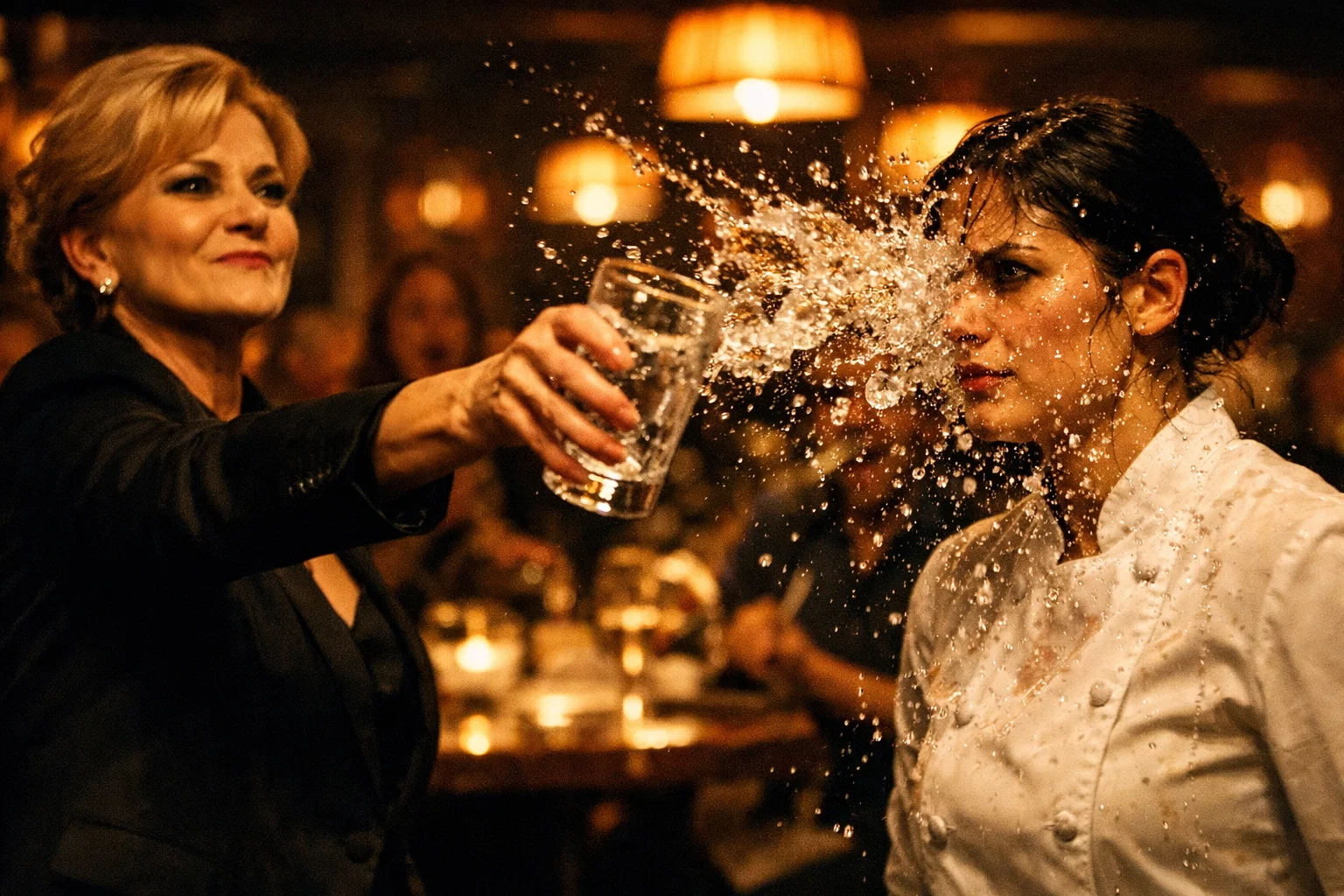
She shoved me—both palms, hard, into my shoulder—and as I stumbled back she reached across a passing waiter’s tray and grabbed a full glass of ice water. She hurled it directly into my face.
The dining room went silent.
Water ran from my eyelashes. It soaked into the collar of my chef’s coat. The only sound was the empty glass bouncing off the carpet.
I did not wipe my face. I did not call security. I did not move.
I closed the distance between us until I was inches from her. I let her see my eyes. There was nothing there she was going to be able to use.
“Get used to being homeless,” I said quietly.
Evelyn laughed—a short, sharp, dismissive sound. “Homeless. I live in a three-million-dollar estate, Maya. You cook for a living.” She turned and grabbed Chloe’s arm. “Come on. We’re leaving this trash heap.”
They walked out laughing.
I turned around, signaled Julian to comp drinks to the affected tables, and walked straight to my private office. I locked the door, picked up my phone, and called my real estate attorney.
It was time.
The conference room was forty floors up, floor-to-ceiling glass, the city spread out below like a map of everything I was going to build.
Mr. Sterling, senior partner, slid the closing documents across the mahogany.
“They truly believe the house belongs to Evelyn,” I said, tracing my grandmother’s signature on the original trust document. “They think I have no power.”
“Ignorance is not a legal defense.” Sterling adjusted his glasses. He was a man who admired the quiet efficiency of property law the way other men admired sports scores. “Evelyn Lin has been living at the property under tenancy at will. No lease. No rent. No claim to the title. Zero tenant protections under commercial zoning.”
I looked at the deed. One name on it. Mine.
Grandma Beatrice had not been a fool. She had watched Evelyn drain every person around her for thirty years. She had watched Chloe turn entitlement into a lifestyle. And before she died, she had quietly, legally, placed the family estate in a blind irrevocable trust with my name on it. She had let Evelyn believe otherwise because she knew I would eventually need the leverage—and the equity.
I had let them stay out of guilt that I no longer felt.
“The buyers?” I asked.
“Apex Development has been eyeing that acreage for two years,” Sterling said. “They want the land. They don’t care about the structure. Three million, full cash, already wired to escrow. The moment you sign, they petition the county judge for an emergency writ of possession—seventy-two hours—unauthorized squatters on a commercial demolition site. The sheriff executes the eviction.”
No thirty-day notice. No housing court. Just the unstoppable weight of corporate law and a clock ticking down.
I thought about the ice water hitting my face in my own restaurant.
I thought about sleeping in my car at twenty-two.
I thought about the way Chloe had looked at that apron like it was beneath her to touch.
I picked up the Montblanc pen.
I didn’t hesitate. I signed.
The stamp came down on the document with a heavy, final sound that echoed off the glass walls.
“It’s done,” Sterling said. “Sarah—” He pressed the intercom. “Dispatch the deed to Apex. File the writ with the county sheriff immediately.”
Miles away, in the sunlit kitchen of the ancestral home, my mother was browsing online furniture catalogs. My sister was posting a photo of her coffee.
They had no idea the wrecking ball had just been dispatched.
Seventy-two hours later, my phone lit up during lunch service.
EVELYN – CELL.
I handed the line to my sous-chef, walked to my office, and closed the door. I set the phone face-up on my desk and accepted the call on speaker.
“Hello, Evelyn,” I said.
“MAYA. WHAT DID YOU DO?”
It was not her usual controlled scream. This was something beneath that—raw, guttural, the sound of someone watching the ground disappear.
Behind her voice I could hear everything: heavy boots on hardwood floors, Chloe wailing at a pitch that could cut glass, the high mechanical whine of a power drill.
“There are police officers in my house!” Evelyn screamed. “They have guns! They’re holding a paper with your name on it! Fix this—tell them it’s a mistake—”
“It’s not a mistake,” I said. My voice was completely level. “I told you to get used to being homeless.”
“YOU CANNOT DO THIS. THIS IS MY HOUSE. MOM LEFT IT TO ME.”
“No,” I said. “She didn’t. Grandma Beatrice left the house to me in a blind trust. She did it because she knew you were a parasite. She knew you’d drain the estate to fund Chloe’s delusions. She knew you’d eventually throw me out. She gave me the house so I’d always have leverage.”
A man’s voice cut in behind her, deep and official. “Ma’am. Step away from the door. The locksmith is drilling the deadbolt. You have forty-five minutes to remove personal belongings before we physically remove you from the premises.”
“Maya, please.” And there it was—the word I had never in thirty years of living heard come out of Evelyn Lin’s mouth. Please. “Where are we supposed to go? We have nowhere to go. Chloe is crying. I’m your mother—”
“You stopped being my mother the night you kicked me out for refusing to pay your golden child’s debts.” I leaned back in my chair, staring at the ceiling. “I sold that property to Apex Development for three million in cash to fund my second location. They are bulldozing it next month.”
“BULLDOZING?” Chloe’s voice exploded through the speaker. She had apparently been listening. “My clothes! My shoes! Mom, they’re putting my Chanel bags in garbage sacks—”
“You wanted to run a business, Evelyn?” I said. “Start by figuring out how to manage your life from a motel room. Do not contact me again.”
I pressed end.
The call cut off on Evelyn’s sob, mid-sentence.
Miles away, in the wealthy suburb where I had grown up being told I would fail, Evelyn Lin dropped her phone onto the driveway concrete. She fell to her knees in the dirt, her silk bathrobe pooling around her, and watched two armed sheriff’s deputies stand guard while men in hardhats dragged black garbage bags of Chloe’s designer wardrobe out onto the lawn.
The brass deadbolt of the front door was drilled out and replaced with a commercial-grade padlock.
The fortress was gone. Sold out from under them by the daughter they had treated like a ghost.
Six months later, the distance between our lives was the kind of thing that felt almost too clean to be real.
Chloe sat on a sagging mattress in a twenty-dollar-a-night motel room off the interstate, trying to pin a polyester nametag to her chest. She had taken a job at a drive-through window. It was the first time in her twenty-eight years that anyone had expected her to show up somewhere on time and produce something in exchange for money. The adjustment had been brutal.
Evelyn sat in the corner, staring at a flickering TV. The tailored suits were gone. The expensive haircuts had grown out. The women from the country club—the ones she had hosted at lavish parties for years—had gone entirely silent the moment she lost the house. They had never loved Evelyn. They had loved her real estate. Without it, she was just an older woman asking for loans, and nobody was picking up.
Across town, the downtown district was lit up with electric, golden life.
I stood on the sidewalk in front of a massive renovated historic building—exposed brick, warm spotlights, two hundred people spilling out onto the street. I was holding oversized ceremonial scissors.
Tonight was the grand opening of Aura II.
The three million dollars from the sale had bypassed bank loans entirely. I had purchased the building in cash, designed a two-story culinary flagship, and booked it out six months before the doors opened. Behind me stood my sous-chefs, my managers, the bussers who had worked alongside me for years—the people who had shown up, every service, every night, without needing to be guilted into it.
I looked up at the custom neon sign bearing my restaurant’s name.
Funded entirely by the liquidation of the house where I had been told I would fail.
I searched myself for guilt. For that old thread of daughterly obligation. For anything.
I found nothing. Not a shred.
They had dug their own graves with their cruelty and their certainty that I would never be anything without their approval. I felt only the clean, weightless relief of someone who had finally stopped waiting for people to deserve her.
I smiled for the cameras. I closed the scissors. The red ribbon split and fluttered to the sidewalk as the crowd erupted into applause.
I didn’t know that at that exact moment, a begging letter from my mother was sitting in the mailbox of the original Aura location across town. Julian, my maître d’, would retrieve it within the hour, read the return address, and drop it directly into the industrial paper shredder without ever showing it to me.
Some doors close from both sides.
Two years later.
The kitchen of Aura was quiet after a record-breaking Friday service. Stainless steel gleaming, line empty, doors locked. I sat alone at the chef’s tasting table near the wine cellar with a glass of Pinot Noir I had been saving.
That afternoon, the James Beard Foundation had called. I had been nominated for Best Chef in the region.
I wasn’t a survivor anymore. I was a mogul with a nomination and two locations and a staff who stayed because they wanted to.
I reached up and touched the small silver locket at my collarbone. Grandma Beatrice had given it to me when I was ten years old.
She had known. She had drafted that blind trust knowing Evelyn would eventually do something unforgivable. She had put my name on those documents because she understood that a house can be either a sanctuary or a prison, and that the only way to know which it would be was to make sure the person with the key was someone who would use it wisely.
She hadn’t given me a home. She had given me a weapon. She had trusted me to know when to fire it.
I looked out at the empty dining room. Chairs tucked. Glasses polished. The faint glow of streetlights bleeding through the front windows.
This was my sanctuary. Not inherited. Not stolen. Built on burned hands and sleepless years and the quiet, stubborn certainty that I deserved to take up space in the world.
I raised my glass toward the empty room.
“You told me I’d be homeless, mother,” I said softly, to no one and to everything. “But you were wrong. I just built a house where you don’t have a key.”
I drained the glass, set it down, and walked to the back exit. The lights dimmed behind me. The steel door closed with a solid, final sound.
I locked it.
And walked into a future that was entirely, irreversibly mine.
Original fictional stories. AI-assisted creative content.