The sergeant didn’t bother hiding his impatience.
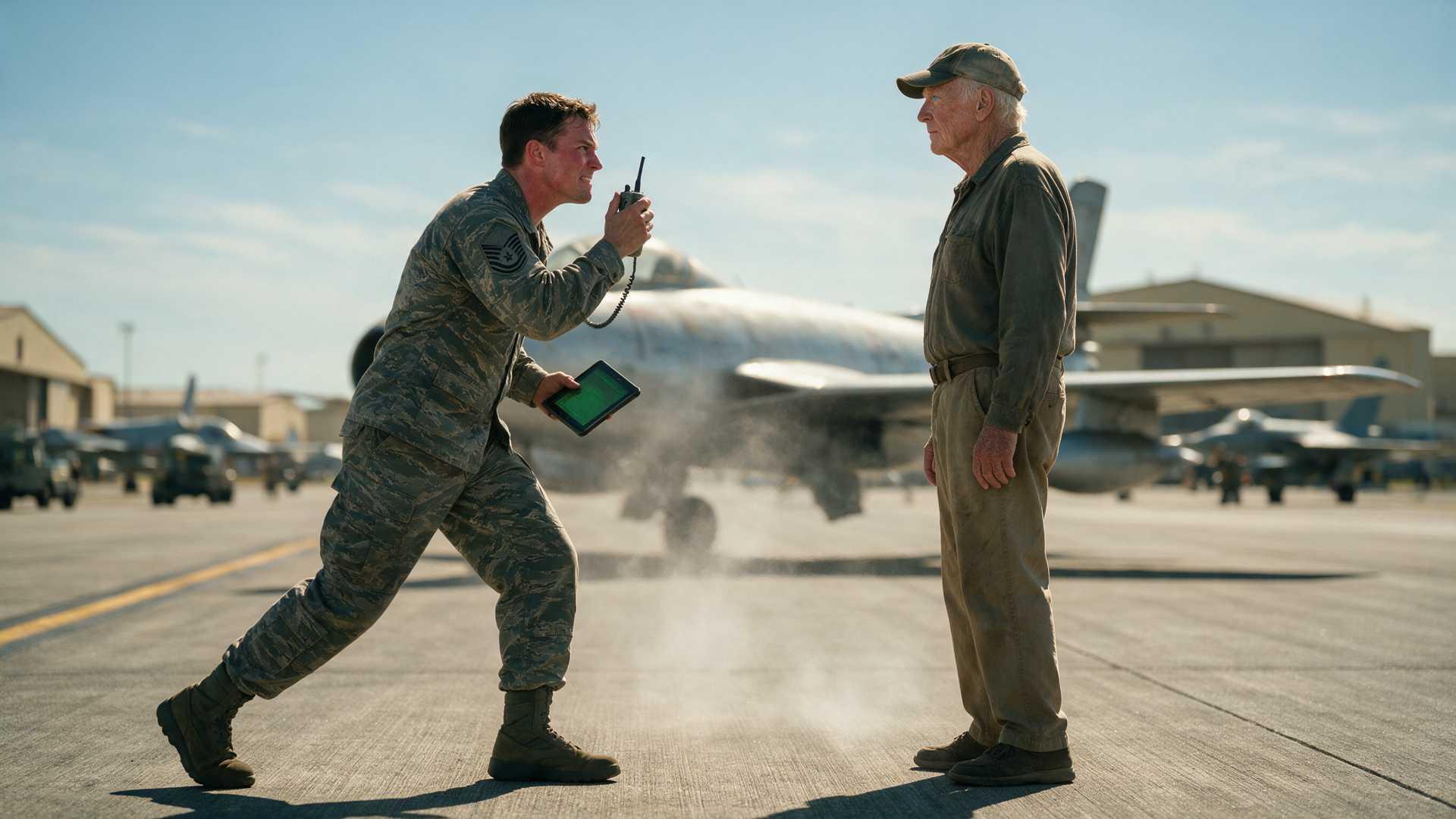
“Sir, I need you behind the barriers.” Bryce Dolan didn’t look up from his tablet. The screen was a wall of green—voltage bars, pressure charts, circuit confirmations. All of it screaming that the jet was perfect. All of it wrong.
Leo Keller didn’t move.
He stood with both palms flat against the silver flank of the F-86 Sabre, eyes closed, head tilted like a man listening for a voice in a crowd. Behind him, ten thousand spectators pressed against the metal barriers. The air reeked of unburnt kerosene and hot concrete. Somewhere overhead, a modern fighter left a thin white scar across the sky.
The Sabre’s engine turned once more—that heavy, grinding rotation full of mechanical hope—and died. A single cough of white smoke. Then silence.
Leo’s head tilted a fraction to the left. He’d heard that sound before. Not in a classroom. Not from a manual. He’d heard it in Korea, in 1952, with his fingers frozen stiff and a flashlight clenched in his teeth and boys waiting in the cold to climb back into the sky.
“It’s not the fuel pump,” Leo said.
Dolan spun around. His face was red. “With all due respect, sir—we have digitized schematics, a full diagnostic suite, and the original manufacturer specs. The system is green.”
“Your box checks if the wire isn’t broken,” Leo said. “It can’t hear the timing.”
From the open canopy above, Major Grant watched the old man in the faded baseball cap. The pilot’s gloves rested easy on the rail. “Stand down, Sergeant,” he said quietly. “Let him look.”
Dolan’s jaw tightened. But he stepped back.
Leo moved to a small, unassuming access panel just aft of the wing root. His thumbnail caught the edge. A tiny thread of amber fluid was already seeping from the seam, running down the polished aluminum like an old secret working its way out.
“The stubby flathead,” Leo said, without turning around. “Not the power driver. You touch those threads with a torque gun, you’ll strip the mount clean out.”
Dolan stared at the green tablet in his hand. He set it down.
He picked up the wooden-handled screwdriver.
It took four minutes to open the panel. The screws were frozen with sixty years of heat and cosmoline. Each one had to be coaxed, not forced—a quarter turn, a breath, another quarter turn. Leo talked him through it without raising his voice, one hand resting on the sergeant’s shoulder like ballast.
When the panel came free, the accessory bay opened up—dense and shadowed, braided fuel lines running over the gleaming black body of the reproduction magneto.
Dolan leaned in. “The wiring harness,” he said, pointing with his screwdriver. “It’s inverted. The secondary loom is pressed against the scavenging line. There’s your fault.”
Leo reached past him. His scarred fingers moved into the dark grease with the ease of a man navigating his own kitchen in the middle of the night. They bypassed the harness entirely and pressed against the back of the magneto housing where it met the engine block.
He held still. Three seconds. Four.
When he pulled his hand out, a single flake of silver metal—fine as a hair—sat in the black oil on his palm.
“The harness is a mess,” Leo said, holding the flake up to the light. “But it’s not why she won’t fire. This is. The cam heel’s been shaved. Reproduction parts—they used the right alloy but skipped the case-hardening. Every time the starter hit peak load, the spring pressure closed the point gap a little more. Your diagnostic box saw a closed circuit and called it healthy. But a closed circuit on a magneto just means the spark never stops. It means you’ve been getting a slow, wet leak instead of a clean snap.”
Dolan straightened slowly. “The gap is closed?”
Leo handed him the feeler gauge—the thin set, the ones still in their worn leather pouch. “Check it yourself.”
The thinnest blade wouldn’t enter the gap at all.
Dolan stood back. He looked at the crowd. He looked at the digital cart. He looked at Leo’s worn cap and pale eyes and the graphite permanently etched into the creases of his knuckles.
“We don’t have a replacement magneto,” Dolan said. “If the cam is gone—”
“Nobody’s towing her anywhere.” Leo reached into his shirt pocket and produced a small, flat stone. Gray. Worn smooth in the center where decades of tool steel had left their polish. “We’re going to give that cam its edge back. We’re going to make do with what’s already inside her.”
Dolan looked at the stone like it had spoken to him.
“You can’t stone a cam on the flight line. The tolerances—”
“Are what I’m going to hit,” Leo said simply. “To the thousandth.”
Major Grant had gone quiet in the cockpit. The crowd announcer’s voice boomed in the distance—something about a high-altitude demonstration—completely unaware of the quiet surgery taking place thirty feet away.
Leo guided Dolan’s hands into the dark. Slowly. The stone moved against the cam heel with a soft, rhythmic scraping—scritch, scritch—a delicate human friction against sixty years of mechanical drift. Every three passes, Dolan checked the clearance with the blade.
The first check: still closed.
The second: a faint catch at the very tip.
The third: the blade slid in.
The fourth: resistance. Clean. Measured. Exactly to spec.
“It’s open,” Dolan breathed. His shoulders dropped two inches. “The gap is true.”
“Circuit will break now,” Leo said, wiping his hand on his khakis. “Current backs up in the primary coil. When it drops, it throws a real spark. Not a leak. A snap.”
Dolan worked fast. He locked the bracket, rerouted the harness, secured the loom away from the scavenging line. His hands had stopped shaking. They moved in long, fluid arcs—by feel rather than checklist.
“Panel secured, sir,” he called to the cockpit.
Grant lowered his visor with a sharp click. “Clearing the line.”
The ground crew fell back. Leo and Dolan stood side by side on the empty tarmac. The auxiliary power unit began its high whine, full of renewed intention.
The starter engaged. The J47 began to turn.
For the first two seconds it sounded like failure—that same hollow, cold intake of breath through metal tubes. Dolan felt his stomach drop.
Then the newly cleared points snapped open at the top of the compression cycle, exactly on time.
The whoomph rattled the metal barriers and shook the hot air in Leo’s chest. A ten-foot spear of orange and electric blue flame erupted from the tailpipe. The sputtering vanished instantly, replaced by a deep, thunderous idle that flattened the dry grass at the edge of the runway and vibrated straight through the soles of Leo’s worn sneakers.
The Sabre was alive.
Dolan stood frozen, screwdriver still in his hand, staring at the exhaust as the heat shimmer rose off the wings like a living thing. He turned to look at Leo.
Leo wasn’t looking back. He was watching the silver skin shimmer in the heat of its own engine, a small, quiet smile breaking through the deep lines of his face.
The Sabre taxied to the main runway, slow and heavy and magnificent. From inside the bubble canopy, Major Grant raised one gloved hand and cut a sharp salute—not toward the crowd, but directly down at the oil-smeared patch of tarmac where Leo stood.
Leo felt the corner of his mouth twitch. He didn’t salute back. Mechanics and pilots had an older language.
The engine roared one final time, massive and singular, and the Sabre was gone—climbing straight into the blue until it was nothing but a silver needle stitching through clouds.
Ten minutes later, Grant’s utility vehicle cut across the apron. The major climbed out before it had fully stopped, flight suit unzipped, sweat-stained, and walked past every piece of digital equipment on the line to stop directly in front of Leo.
“Three-thirty-fifth Fighter Interceptor Squadron,” Grant said. “Kimpo Air Base. Fifty-two.”
Leo looked away from the sky and gave a slow nod. “We froze our fingers to the bones that winter. Dropped a nut in the snow, you didn’t find it till spring. You just reached for another and kept your wrench moving, because the boys upstairs didn’t have five minutes to waste.”
Dolan stepped forward. He stopped two feet short of Leo, chin nearly to his collar.
“Mr. Keller.” His voice caught. He forced it out. “I owe you an apology. I was looking at a green screen and I thought I was looking at the truth.” He paused. “What you did with that stone—I don’t think they teach that anymore. Anywhere.”
Leo rested his thick, gnarled hand on the young man’s shoulder. The modern fabric was synthetic and slick under his palm. But the heat beneath it was exactly the same as it always had been.
“Don’t stop trusting your tools,” Leo said. “They’re good tools. They see things my old eyes never will.” He held his gaze steady. “But once in a while—just turn them off. Sit on the tire, put your ear to the skin, and listen to what the iron is trying to tell you.”
Grant reached into his flight pocket and produced a folded sheet of letterhead—the Heritage Flight Foundation emblem slightly frayed at the edges.
“We have all the schematics,” Grant said. “Every technical data sheet digitized. A warehouse full of reproduction parts. What we don’t have is memory. The institutional knowledge that lives in a man’s hands.” He held out the paper. “We’d be honored if you’d come on as our senior technical advisor. We need someone who can teach these young crew chiefs the things the software can’t hold.”
Leo looked at the emblem on the page—the swept-wing silhouette he had first seen as a twenty-two-year-old with wind-burned hands on a frozen Korean runway. He looked up at the sky where the Sabre’s contrail was still dissolving into the blue.
He had spent forty years as a man whose language the world had forgotten.
“I think,” Leo said, his voice carrying an emotion he hadn’t let himself feel in a very long time, “I’d like that very much.”
Original fictional stories. AI-assisted creative content.