The Pain No One Wanted to Believe
For nearly a month, I had watched my sixteen-year-old daughter change in ways I could not explain.
Emery Whitmore had always been energetic. She played midfield for her high school soccer team, carried her camera everywhere, and somehow managed to talk for twenty minutes about a single photograph she had taken after school.
Then, almost overnight, that version of my daughter began to disappear.
She started waking up nauseated. Some mornings, she would stand over the kitchen sink with one hand pressed against her stomach, waiting for the discomfort to pass.
Other days, she would stop halfway down the stairs because the room suddenly seemed to spin.
At dinner, she barely touched her food.
Her clothes became looser. Her face lost its color.
The girl who used to complain there were not enough hours in the day began sleeping through entire afternoons.
I noticed every little change.
My husband, Graham, noticed them too.
He simply interpreted them differently.
“She’s stressed,” he said one evening after Emery left the dinner table early. “She has school, soccer, friends, exams. Teenagers go through phases.”
“This doesn’t feel like a phase,” I replied. “She says her stomach hurts every day.”
Graham leaned back in his chair.
“She also says she’s exhausted when you ask her to clean her room. You worry too much, Jocelyn.”
His tone was calm, almost reasonable.
That made it worse.
Because Graham was not shouting. He was not trying to be cruel.
He simply believed he was right.
And for years, that confidence had shaped almost every important decision in our family.
Watching My Daughter Fade
We lived outside Madison, Wisconsin, in a quiet neighborhood where most people knew one another by sight.
Our life had always seemed ordinary.
Graham worked in commercial insurance. I handled administrative work for a local architecture firm. Emery attended a public high school ten minutes from our house.
Nothing about our life suggested that something frightening could quietly enter it.
Yet each morning, I felt increasingly certain that something was wrong.
One Saturday, I found Emery sitting on the bathroom floor after taking a shower.
Her hair was wet, and she had wrapped herself in a towel, but she had not moved to get dressed.
“Sweetheart, what happened?”
She looked up at me.
“I got dizzy.”
I crouched beside her.
“Did you fall?”
“No. I sat down before I did.”
That answer frightened me more than I wanted to admit.
She had started planning around the dizziness.
That meant it had happened enough times for her to expect it.
That evening, I brought it up again with Graham.
“I want to make a doctor’s appointment.”
He barely looked away from his laptop.
“For dizziness?”
“For everything. The stomach pain, the nausea, the exhaustion, the weight loss.”
He finally looked at me.
“She’s sixteen. Hormones change. Stress changes. Appetite changes. If we react to every complaint like it’s an emergency, we’re teaching her that every uncomfortable feeling is a crisis.”
I understood the logic behind his words.
But I also understood my daughter.
And something inside me kept saying the same thing.
Pay attention.
The Night I Stopped Asking Permission
Three nights later, I woke shortly after midnight.
At first, I did not know what had disturbed me.
Then I heard a sound from the hallway. Soft. Almost like someone trying not to cry.
I slipped out of bed without waking Graham and walked toward Emery’s room.
Her door was partly open. She was curled beneath her blanket with both arms wrapped around her stomach. Her face looked pale beneath the glow of her bedside lamp.
When she saw me, she tried to straighten herself.
She could not.
“Mom?”
I crossed the room immediately.
“What is it?”
Her eyes filled with tears.
“It hurts more tonight.”
I sat beside her and touched her forehead. She did not seem feverish, but her skin felt cool.
“Where?”
She pressed her palm against the lower part of her abdomen.
“Here. And sometimes on the side.”
Then she looked at me with an expression I will never forget.
It was not dramatic. It was not exaggerated.
It was fear.
“Mom, I don’t think this is normal.”
Something inside me settled at that moment.
For weeks, I had been debating whether my instincts were stronger than Graham’s confidence.
That debate ended.
“Get dressed,” I told her gently.
She stared at me.
“Where are we going?”
“To get you checked.”
“Dad said—”
“I know what Dad said.”
I squeezed her hand.
“Tonight, I’m listening to you.”
The Hospital Visit
The following morning, after Emery had managed only a few hours of sleep, I drove her to Lakeshore Regional Medical Center.
Graham had already left for work.
I sent him a short message saying I was taking Emery to be evaluated.
He called within five minutes.
I did not answer. Not because I wanted to punish him. I simply did not have the energy for another argument.
At the hospital, the nurse asked Emery about her symptoms.
Nausea. Persistent abdominal discomfort. Dizziness. Fatigue. Reduced appetite. Unintentional weight loss.
The list sounded more serious when someone else wrote it down.
A physician named Dr. Nolan Greer examined her carefully.
He asked questions Graham had never asked.
How long had the discomfort lasted? Was it getting worse? Did it wake her at night? Did she feel full after eating only a small amount? Had she noticed any swelling?
Emery answered quietly.
I watched the doctor’s expression change. Not dramatically. Just enough.
He ordered blood work and imaging.
I tried not to read too much into that decision.
The Word “Mass”
Two hours passed before Dr. Greer returned.
He was not smiling, but he was not alarmed either. He had the careful, measured face of someone choosing his words in advance.
“We found something on the ultrasound,” he said. “There’s a mass on her right ovary. It’s large enough that I’m concerned about the blood supply to the ovary itself.”
I heard the words, but they did not land right away.
“A mass,” I repeated. “What kind of mass?”
“We won’t know for certain until we look more closely, and possibly until surgery. It could be a cyst that’s grown large. It could be something else. Right now, the size and her pain level are what worry me most.”
Emery’s hand found mine.
“Am I going to be okay?”
Dr. Greer looked at her directly, not at me.
“I’m going to do everything I can to make sure of that. But I need you to understand something. This kind of pain, the kind that makes you sit down before you fall — that’s your body telling you the ovary might be twisting. If that happens, it can cut off blood flow. That’s a surgical emergency.”
My stomach dropped.
“How long has this been building?” I asked.
“Based on the size we’re seeing, weeks. Possibly longer.”
Weeks.
I thought of every dinner Graham had waved away. Every “she’s fine.” Every “you worry too much.”
I called him. This time, he answered on the first ring.
“Jocelyn, what’s going on? Why didn’t you—”
“Graham. Stop talking and listen. Emery has a mass on her ovary. They think it might be twisting. She may need emergency surgery tonight.”
Silence.
Then, quieter than I had ever heard him: “I’m coming right now.”
Graham’s Arrival
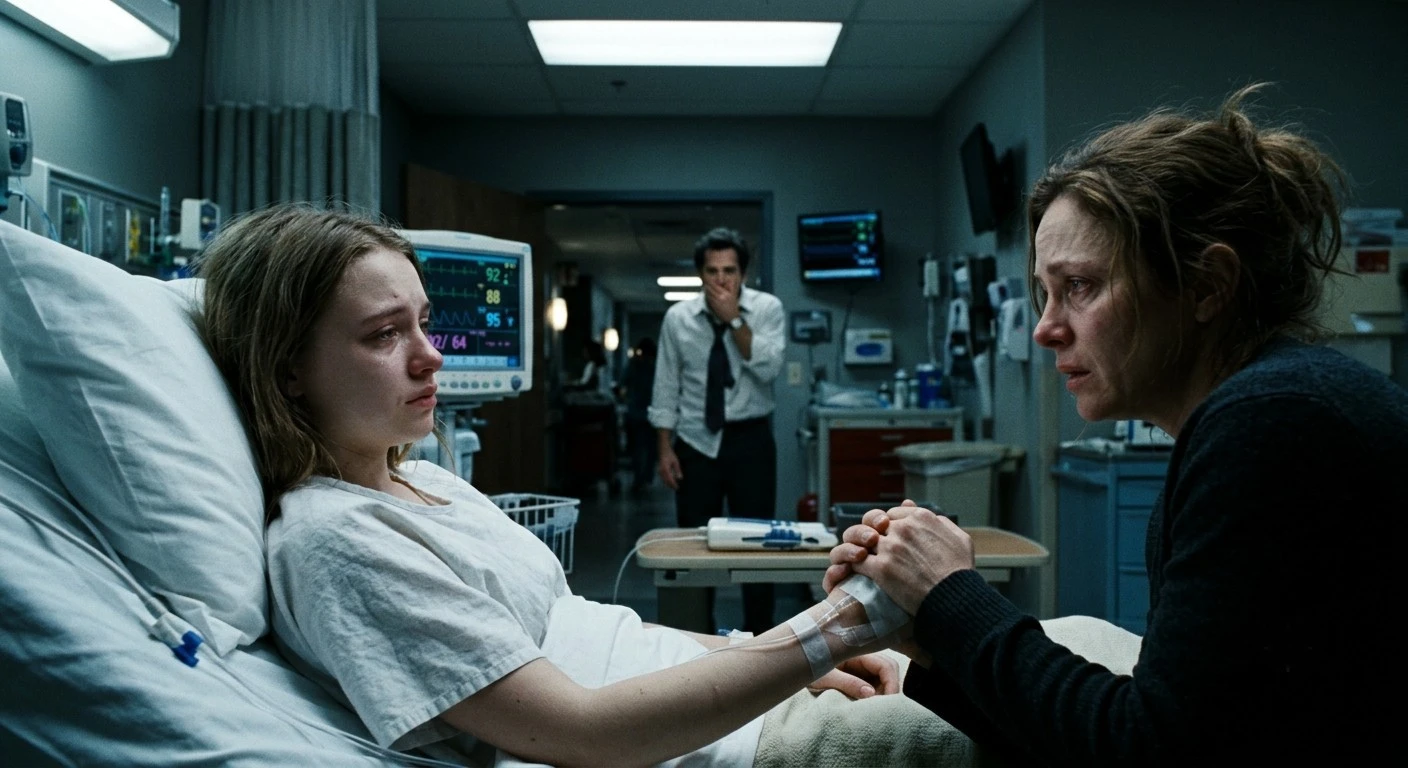
He reached the hospital in eighteen minutes. I know because I watched the clock the entire time, holding Emery’s hand while a nurse started an IV line.
Graham burst through the exam room curtain, still in his work clothes, his tie loosened halfway down his chest.
“Em.” His voice cracked on the single syllable.
Emery turned her head toward him, pale against the pillow.
“Hi, Dad.”
He crossed to the bed and took her other hand, careful of the IV.
“I’m sorry,” he said. “I’m so sorry, sweetheart.”
“You didn’t know,” she whispered.
“I didn’t want to know,” he said. “That’s worse.”
He looked at me over her head, and for the first time in eleven years of marriage, I watched Graham Whitmore look genuinely afraid.
“Jocelyn, I need you to tell me exactly what the doctor said.”
I did. Every word.
When I finished, he sat down hard in the chair beside the bed, elbows on his knees, hands pressed against his face.
“I told her to push through it,” he said, almost to himself. “I told her it was in her head.”
“Graham—”
“No.” He looked up. “Don’t soften it. I did that. While she was in actual pain, I told my daughter she was being dramatic.”
Emery’s voice was small. “Dad, it’s okay.”
“It’s not,” he said. “It’s really not. But I’m here now, and I’m not leaving this room.”
The Text Message
While we waited for Dr. Nandakumar, Emery’s phone buzzed on the bed beside her.
She glanced at it, then looked away, wincing as she shifted her weight.
“Who is it?” I asked.
“Paige. From the team.” Emery’s voice was small. “I told her I might miss the game Friday because of a stomachache. She just asked if I was being dramatic again.”
Graham’s head snapped up.
“Again? Who told her you were being dramatic before?”
Emery hesitated.
“You kind of did. At the barbecue. When I said I felt sick and you told Uncle Rick I was ‘milking it’ before a match I didn’t want to play.”
The color drained from Graham’s face.
“I said that in front of you?”
“You said it in front of everyone.”
He sat back in the chair like he’d been struck.
“Em, I am so sorry. I didn’t think—”
“You never think it’s real,” she said, and for the first time that night, there was an edge in her voice instead of just fear. “That’s the problem, Dad. It’s never real until someone else in a white coat says it’s real.”
The room went quiet.
I watched Graham absorb that, watched him realize that his daughter had been carrying not just physical pain but the added weight of not being believed, in front of family, in front of friends, for weeks.
“You’re right,” he finally said. “And when this is over, I’m going to fix that. Not just with you. With how I talk about you.”
Emery didn’t answer. She just closed her eyes, one hand still pressed against her side, and let the machine beside her bed keep counting her heartbeat in small green numbers.
The Surgeon’s Warning
By eight that evening, a surgeon named Dr. Priya Nandakumar came to speak with us.
She was direct in a way I appreciated.
“The ultrasound shows the ovary is enlarged and there’s reduced blood flow on Doppler imaging. That tells me it’s likely torsed, or partially torsed — twisted on itself. If we wait, the ovary can lose viability entirely, and there’s risk of infection and further complications.”
“You’re saying you need to operate tonight,” Graham said.
“I’m saying I strongly recommend it. This isn’t a situation where waiting buys us useful information. It buys us risk.”
Emery’s eyes were wide. “Will I still be able to have kids someday?”
Dr. Nandakumar’s expression softened, just slightly.
“That’s exactly why we’re moving quickly. The sooner we untwist and evaluate that ovary, the better our chance of saving it. If we wait, that chance drops. I’m not going to promise you an outcome, but I will tell you that acting now gives you the best possible odds.”
Graham reached for Emery’s hand.
“Do it,” he said. “Whatever she needs.”
“That’s her decision too,” Dr. Nandakumar said gently, looking at Emery. “It’s your body. I need you to say yes.”
Emery looked at me first, then at her father, then back at the surgeon.
“Yes,” she said. “Fix it.”
Waiting Room, 9:47 PM
They took Emery back just before ten.
I remember the exact time because I watched the double doors swallow her gurney and then looked down at my phone, as if the numbers on the screen could anchor me to something.
Graham sat beside me in the waiting room, elbows on his knees, staring at the floor.
“I keep thinking about all the times she tried to tell me,” he said. “The stairs. The dinners. That morning she stood at the sink.”
“Graham.”
“I dismissed all of it. Every single time.”
“You didn’t do this to her,” I said. “A cyst doesn’t grow because a father doubts his daughter.”
“No. But it grew for weeks while I told her to push through it. If something happens to that ovary tonight, that’s on me. Not on genetics. On me.”
I didn’t argue with him, because some of what he said was true, and I was too exhausted to pretend otherwise.
Instead, I said the thing I had been holding back for a month.
“I need you to understand something, Graham. This isn’t about being right tonight. It’s about what happens after tonight. If she comes out of surgery and tells you something hurts, you don’t get to decide for her that it doesn’t.”
He looked at me, eyes red.
“I know.”
“I need more than ‘I know.'”
“Then I promise you,” he said. “Never again. Not with her. Not with anything that comes out of her mouth about her own body.”
The Surgery
The surgery took just under two hours.
Dr. Nandakumar found us a little after midnight, still in scrubs, her mask pulled down around her neck.
“She’s stable,” she said first, because she must have seen our faces and known that was the only sentence that mattered in that moment.
Graham exhaled like he’d been holding his breath since ten o’clock.
“The ovary had torsed twice,” Dr. Nandakumar continued. “We untwisted it and there was good color return, which is what we want to see. There was a benign cyst, about the size of a plum, that caused the twisting. We removed the cyst and preserved the ovary.”
“Preserved,” I repeated. “So it’s—”
“It’s viable. We’re cautiously optimistic. We’ll be watching her closely, but this is the outcome we were hoping for.”
Graham’s shoulders dropped several inches.
“Can we see her?”
“Recovery in about twenty minutes. She did great.”
Graham turned to me the moment Dr. Nandakumar walked away.
“Twice,” he said. “It twisted twice. If we’d waited even one more night—”
“We didn’t wait,” I said. “I didn’t wait.”
He nodded slowly.
“No,” he said. “You didn’t. And I need to sit with that.”
Recovery Room
Emery was groggy when they let us in, an IV taped to the back of her hand, a warm blanket pulled to her chin.
“Hi,” she murmured, blinking up at us.
“Hi, baby.” I kissed her forehead.
Graham took her hand carefully.
“The doctor said it went well,” he said. “They saved everything. You’re going to be okay.”
“Told you it wasn’t in my head,” she said, voice thick with anesthesia.
Graham let out a sound that was half laugh, half something breaking.
“You told me,” he agreed. “You told me and I didn’t listen. I’m going to spend a long time making that right.”
Emery’s eyes were already drifting closed again, but her mouth curved slightly.
“Okay, Dad.”
I stood at the foot of the bed and watched them, my husband holding our daughter’s hand like he was afraid to let go, and I understood that something in our family had shifted permanently that night. Not gently. Not slowly. All at once, the way a bone sets after it breaks the right way.
The Fever
Four days after surgery, just as we’d started to relax, Emery spiked a fever of 101.4 overnight.
I found her sweating through her sheets at 2 a.m., her incision site warm to the touch.
“Graham.” I shook him awake. “Something’s wrong. She’s burning up.”
He was out of bed before I finished the sentence, already reaching for his phone to call the surgical line.
We were back at Lakeshore by three in the morning.
A resident examined the incision while Emery gritted her teeth against the poking and prodding.
“There’s some redness and warmth around the site,” the resident said. “It could be a minor infection. We want to rule out anything deeper before we send you home again.”
“Deeper meaning what?” Graham asked, and I noticed he didn’t flinch this time, didn’t try to talk anyone out of caution. He leaned in and asked exactly the kind of question he used to avoid.
“Meaning an abscess, or something involving the surgical site internally. We’re going to run bloodwork and get imaging to be safe.”
Graham nodded, then turned to Emery and took her hand.
“We’re not leaving until they tell us it’s nothing,” he said. “And if it’s something, we’re not leaving until they fix that too.”
Emery managed a weak smile despite the fever glazing her eyes.
“You’ve gotten really good at this hospital thing, Dad.”
“I’m learning,” he said. “Late, but I’m learning.”
The bloodwork came back a few hours later. Elevated white count, consistent with a superficial wound infection, nothing deeper. They started her on antibiotics and kept her overnight for observation.
By morning, her fever had started to break.
Graham sat in the vinyl recliner beside her bed the entire night, not sleeping, watching the numbers on the monitor the way other men watched football scores.
“You don’t have to stay awake all night,” I told him around five in the morning.
“Yes, I do,” he said, without looking away from Emery. “I have a lot of nights to make up for.”
Two Weeks Later
Emery recovered at home, resting on the couch with her camera within reach, though she was too sore to hold it steady for long.
Graham changed in ways that surprised even me.
He started asking questions instead of offering conclusions. When Emery mentioned a headache, he didn’t say “you’re fine.” He said, “Tell me more about it. When did it start?”
At dinner one night, three weeks after the surgery, he set down his fork and looked at Emery directly.
“I want to say something, and I want you to actually hear it, not just let me off the hook because it’s easier.”
Emery put down her own fork. “Okay.”
“You told me something was wrong. More than once. I decided I knew your body better than you did, and I was wrong. That mistake could have cost you your ovary. It could have cost you a lot more than that. I’m not going to pretend that’s a small thing.”
Emery’s eyes filled, but she didn’t look away.
“I was scared you’d never believe me,” she said.
“I know. And that’s the part that keeps me up at night. Not the surgery. The fact that my own daughter thought she had to convince me she was in pain.” He reached across the table for her hand. “That ends now. If you tell me something hurts, I believe you first and ask questions second. That’s the deal, for the rest of your life, not just this month.”
Where It Came From
One evening, while Emery slept upstairs, Graham sat across from me at the kitchen table with two untouched cups of coffee between us.
“I’ve been thinking about why I did it,” he said. “Why I kept brushing her off.”
“And?”
“My dad never let me be sick. Not once. I had the flu at fourteen and he made me go to school anyway because he said sickness was ‘ninety percent attitude.’ I broke my wrist sliding into second base and he told me to walk it off before we even got to the ER.” He turned the mug slowly on the table. “I think I decided somewhere along the way that toughing it out was just what you did in this family. And I passed that down to her without ever deciding to.”
“You didn’t have to pass it down,” I said. “You could have decided differently.”
“I know. I’m not trying to make excuses. I’m trying to understand it so I never do it again.” He looked up at me. “I called my dad yesterday, actually. Told him what happened with Em. Told him I finally understood why it bothered me so much when he did it to me.”
“What did he say?”
“He said I was being soft.” Graham’s mouth twisted, somewhere between a laugh and something sadder. “And for the first time in my life, I told him he was wrong. Out loud. To his face, basically, over the phone.”
“How did that feel?”
“Terrifying,” he admitted. “And right. Both at once.”
I reached across the table and put my hand over his.
“That’s the version of you Emery needs going forward,” I said. “Not the one who inherited his father’s silence. The one who’s willing to break it.”
“I’m working on it,” he said. “Every single day.”
The Follow-Up
At her six-week follow-up, Dr. Nandakumar reviewed the imaging with all three of us in the room.
“The ovary looks healthy,” she said, turning the screen toward us. “Good blood flow, normal size for healing tissue. I’m very pleased with how this turned out.”
“Because we didn’t wait,” Graham said quietly. It wasn’t a question. It was something he needed to say out loud, in front of a doctor, as if making it official.
Dr. Nandakumar glanced at him, then at me.
“Timing mattered enormously here,” she said. “Torsion that’s caught early has a much better chance of a good outcome. A lot of parents second-guess vague symptoms like this. The ones who act on them make all the difference.”
Graham nodded once, firmly, like a man accepting a verdict he’d already passed on himself weeks earlier.
In the parking lot afterward, he stopped beside the car and looked at me.
“I owe you an apology too,” he said. “Not just her. I made you argue for weeks to get her the care she needed. That shouldn’t have been a fight.”
“No,” I agreed. “It shouldn’t have.”
“I’m not going to ask you to forget it. I just want you to know I see it now. All of it.”
I looked at him for a long moment.
“Then show me,” I said. “Not with words. With what you do the next time one of us tells you something is wrong.”
Six Months Later
Emery returned to the soccer field that spring, slower at first, favoring her right side out of habit even after the doctors cleared her fully.
Graham came to every game. Not the way he used to, checking his phone on the sideline. He watched all ninety minutes, every time.
After one match, Emery jogged off the field, cleats muddy, cheeks flushed, camera bag already swinging back onto her shoulder out of pure habit.
“Dad, did you see that assist?”
“I saw all of it,” he said, and pulled her into a hug that lifted her off the ground for a second, careful of her side out of instinct that had become permanent. “I see everything now, Em. That’s the whole point.”
Emery laughed against his shoulder, the sound easy and full in a way I hadn’t heard in almost a year.
That night, after Emery had gone to bed, Graham found me in the kitchen.
“I looked it up,” he said. “Ovarian torsion. How common the delay is. How many parents dismiss it as stress or growing pains. How many girls don’t get to the hospital in time because someone in their life decided they knew better.”
“Why are you telling me this?”
“Because I want you to know I didn’t just apologize and move on. I made sure I’d never make that mistake again, with her or with anyone. I talked to our pediatrician’s office. I asked them to flag it in her chart, so if this ever happens again, no one waits.”
I felt something in my chest loosen that had been tight for the better part of a year.
“That’s the first time,” I said, “that you’ve done something about this instead of just saying something.”
“I know,” Graham said. “I’m done being a man who’s good with words and slow with action. She almost paid for that. I’m not letting it happen twice.”
Paige
A few weeks after Emery returned to school, her friend Paige showed up at our door on a Saturday afternoon, holding a bag of Emery’s favorite chips like a peace offering.
I let her in and called upstairs.
Emery came down slowly, still moving carefully, and found Paige standing awkwardly in the entryway.
“Hey,” Paige said. “Can we talk?”
They sat on the porch steps while I hovered just inside the screen door, close enough to hear.
“I heard what actually happened,” Paige said. “My mom told me. The surgery, the twisting thing. I had no idea it was that serious.”
“It’s okay,” Emery said.
“It’s not, though. I texted you that you were being dramatic. While you were probably sitting in a hospital room.”
Emery was quiet for a second.
“Yeah,” she admitted. “I was.”
Paige pressed her palms against her eyes.
“I feel awful. I should have just asked what was wrong instead of assuming you were skipping a game you didn’t want to play.”
“You didn’t know,” Emery said. “Neither did my dad, honestly, not for a long time. I think everybody just assumed if I could still show up and smile, I couldn’t be that sick.”
“That’s a really messed up thing to assume.”
“Yeah,” Emery said again. “It is.”
Paige nudged her shoulder gently. “So what do I do differently next time you say you don’t feel good?”
Emery thought about it.
“Believe me the first time,” she said. “Not the third.”
“Deal,” Paige said, and held out the bag of chips like a formal treaty. “Also, I brought a bribe.”
Emery laughed, a real laugh, the first I’d heard from her in what felt like months, and took the bag.
Watching from the doorway, I felt something ease in my chest. It wasn’t just Graham who had needed to relearn how to listen. It was everyone around her, an entire circle of people who had mistaken her strength for proof that nothing was wrong.
The Barbecue, One Year Later
The following summer, our extended family gathered at Graham’s brother’s house for the annual Fourth of July barbecue — the same event where, a year earlier, Graham had told Uncle Rick that Emery was “milking it” in front of a yard full of relatives.
Uncle Rick brought it up himself this time, clapping Graham on the shoulder near the grill.
“Hey, wasn’t Em all torn up last summer before that big tournament? Didn’t you say she was faking it to skip the game?”
The yard didn’t go silent exactly, but a few heads turned. Emery, setting down a plate of burgers a few feet away, went still.
Graham set down his spatula and turned to face his brother directly, loud enough for the whole patio to hear.
“I did say that, Rick. And I was wrong. Dead wrong. What she had was ovarian torsion. She needed emergency surgery a few weeks after that barbecue, and if my wife hadn’t overridden me and taken her to the ER, my daughter could have lost an ovary, or worse.” He glanced at Emery, then back at his brother. “So no, she wasn’t milking it. She was in real pain, and I was too stubborn to see it. I’ve told her that. I’m telling you that now, in front of everyone, because I said the wrong thing in front of everyone once, and I’m not going to let that be the last word on it.”
The patio was quiet for a moment. Then Uncle Rick, to his credit, nodded slowly.
“Didn’t know it was that serious, man. Good on you for saying so.”
Emery crossed the yard and stood beside her father, bumping her shoulder against his arm.
“You didn’t have to do that,” she said quietly.
“Yes, I did,” Graham said. “You carried that comment around for a year. I wasn’t going to let it sit there one more summer.”
Later that evening, as the fireworks started over the lake, Emery sat between us on a blanket, camera in her lap, capturing the bursts of color reflected on the water.
“Best Fourth of July,” she said, not looking up from the viewfinder.
“Why’s that?” I asked.
She glanced at her father, who had one arm around each of us.
“Because for the first time, nobody in this family had to convince anybody that something was wrong before it got taken seriously,” she said. “That’s worth more than fireworks.”
Graham pulled her a little closer.
“It’s the only way we’re doing it from now on,” he said. “I promise.”
Upstairs, faintly, I could hear Emery laughing at something on her phone, healthy and whole and sixteen and entirely herself again.
For the first time in a year, the house felt like it belonged to all three of us equally — not to Graham’s certainty, not to my worry, but to the truth we had both finally learned to listen to.
Hers.
Original fictional stories. AI-assisted creative content.