The wind off Fifth Avenue cut through wool coats and scarves.
Christmas lights strung the storefronts. Shoppers hurried past with bags and paper cups, breath fogging in the cold.
Inside the Mercedes-Benz showroom, it was warm. Marble floors. Soft gold light. A new S-Class sat under a spotlight like it belonged in a museum.
Samuel Grant stood beside it.
Seventy-eight years old. Gray overcoat, cuffs worn thin. A wool cap folded in his hands.
He didn’t touch the car. He just looked at it.
A salesman walked past him without a glance.
Then another.
A third one slowed, glanced at the coat, glanced at the shoes, and kept walking toward a couple by the GLE.
A woman near the window murmured to her husband, “I don’t think he’s here to buy.”
Her husband nodded without even looking up from his phone. “Probably just warming up.”
Samuel heard it. He said nothing. He’d heard versions of that sentence for most of his life, in one form or another, and he’d learned a long time ago that the people who said it rarely meant harm. They just weren’t paying attention.
A receptionist glanced at him from behind the front desk, hesitated like she might say something, then answered a ringing phone instead.
Near the S-Class, two young sales consultants stood a few feet away, half-watching him.
“You think he’s lost?” one of them whispered.
“Probably looking for the bus station,” the other said, and they both laughed quietly before turning back to their tablets.
Samuel’s expression didn’t change. He simply shifted his weight and kept looking at the car, the way a man looks at an old photograph.
Across the floor, Ethan Parker finished handing off keys to a young family. The father pumped his hand.
“You made this the easiest car purchase of my life,” the man said.
“That’s exactly what we’re going for,” Ethan said, smiling.
He watched them walk out into the cold, laughing about something, and then his eyes drifted back across the showroom.
He saw the old man standing alone.
Fifteen minutes. Nobody had approached him.
Ethan frowned slightly and glanced at the two consultants nearby, who were already moving on to another customer without so much as a second look at Samuel.
He remembered his grandfather’s voice. Never judge a man’s story by the coat he’s wearing today. You have no idea what chapters came before.
His grandfather had said that to him a dozen times growing up, usually about some stranger Ethan had written off too fast. It had stuck with him ever since the old man passed.
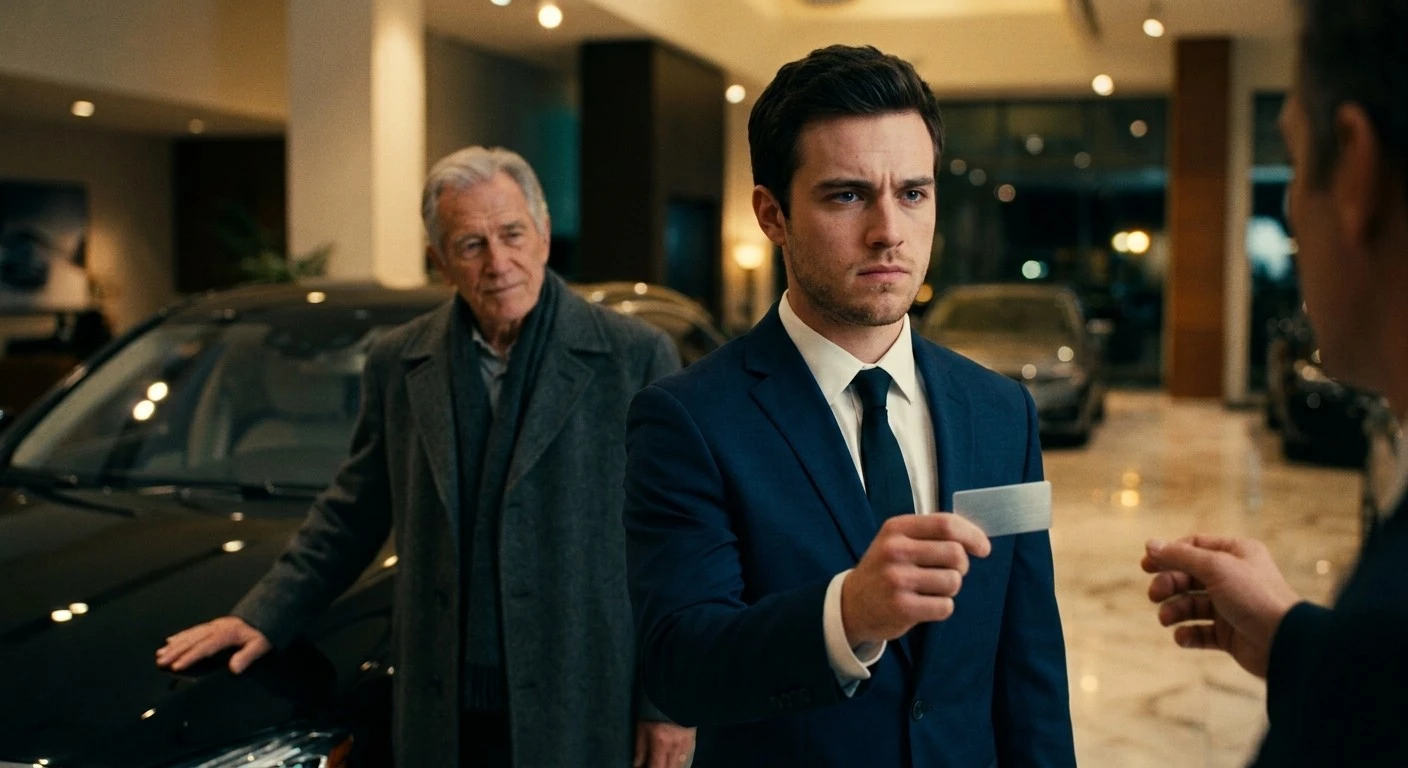
Ethan straightened his jacket and walked over.
“Good afternoon, sir.”
Samuel turned. “Good afternoon.”
“I’m Ethan. I work here.” He nodded at the S-Class. “Beautiful car.”
“The most beautiful I’ve ever seen,” Samuel said.
“Want to sit inside?”
Samuel hesitated. “I don’t want to waste your time.”
“You wouldn’t. Looking is where every good sale starts.”
Samuel laughed under his breath. “Haven’t sat in one of these in forty years.”
“Then today’s the day.” Ethan opened the driver’s door. “Please.”
Samuel lowered himself into the seat. His hands rested on the wheel — not gripping it. Just resting.
He closed his eyes for a second.
“This car brings back something?” Ethan asked.
“My wife loved Mercedes,” Samuel said quietly. “We always said we’d own one again someday.”
He paused.
“Life had other plans.”
Ethan didn’t rush him. He just listened.
A few feet away, another salesman muttered to a coworker, “He’s wasting time on a guy who can’t afford that car.”
Ethan heard it. He kept talking to Samuel like he hadn’t.
“You said your wife loved Mercedes,” Ethan said. “What was her favorite?”
“The old SL. Cream interior. She used to say it drove like a promise.”
“That’s a good line.”
“She had a lot of those.” Samuel ran a thumb along the edge of the steering wheel. “Margaret could turn a grocery list into poetry if she wanted to. Forty-six years of marriage, and I never once won an argument with her.”
Ethan laughed. “Sounds like she was the smart one.”
“She was the only one,” Samuel said. “I just had good taste in wives.”
“How long ago did you lose her?”
“Six years this March.” Samuel’s voice didn’t waver, but something in his eyes softened. “Some days it feels like six weeks.”
“I’m sorry.”
“Don’t be. I got forty-six years most men would trade everything for.” He patted the dashboard gently. “She’d have loved this one. She always said the black ones looked like they were keeping a secret.”
“What kind of secret?”
Samuel smiled. “That’s the thing about secrets, son. You don’t get to know until they’re ready to tell you.”
Ethan crouched slightly beside the open door, in no hurry at all. “Take your time. Nobody’s rushing you out of this seat.”
A few feet away, another salesman muttered to a coworker, not quite quiet enough, “He’s wasting his whole afternoon on a guy who can’t afford that car.”
Ethan heard it. He didn’t turn around. He kept his eyes on Samuel like the comment had never left anyone’s mouth.
“You said your wife loved Mercedes,” Ethan continued. “Did you two ever come close? To buying one, I mean.”
“Once,” Samuel said. “Nineteen eighty-nine. We stood in a showroom just like this one, in Queens, and a salesman looked at my work boots and decided we were window shopping. Told us, and I remember this exactly, ‘Maybe try the Toyota lot down the street.'”
Ethan’s jaw tightened. “That’s awful.”
“It was a long time ago.” Samuel shrugged, but there was steel behind the calm. “We bought a Buick instead. Good car. Just wasn’t the one she wanted.”
“I’m sorry that happened to you.”
“Don’t be sorry, son. Be different.” Samuel looked at him directly. “That’s worth more than any apology.”
Samuel looked at him. “Thank you, son.”
Then a voice cut across the showroom.
“Ethan.”
Charles Whitmore crossed the floor in a black suit and silver tie, the kind of walk that made rooms go quiet.
He stopped at the S-Class. Looked at Samuel’s coat. Looked at Ethan.
“What are you doing?”
“Helping a customer,” Ethan said.
“For twenty minutes?”
“Yes.”
“We have real buyers on the floor.”
“No one’s waiting for me.”
“That’s not the point.”
Samuel started to rise from the seat. “I apologize if I’ve caused a problem.”
“You haven’t,” Ethan said quickly.
Charles didn’t even look at him. “This isn’t your concern, sir.”
Samuel sat back down. Quiet. Watching.
Charles turned to Ethan. “You know how this business works. Our time goes where the money is.”
“Every customer is money,” Ethan said. “Or a chance at it.”
Charles laughed — short, sharp. “You really think he’s buying a two-hundred-thousand-dollar car?”
A couple nearby pretended to study a brochure. They were listening to every word.
“I don’t know why he’s here,” Ethan said. “It doesn’t matter.”
“It matters to this dealership.”
“It matters to us. Respect shouldn’t come with a price tag.”
Charles’s jaw tightened. “This is a luxury dealership. We’re not a charity.”
“I’m not running a charity. I’m doing my job.”
“You’ve always had this problem,” Charles said. “You care more about people than numbers.”
“Is that supposed to be an insult?”
“It’s a diagnosis.”
“Then I’ll wear it,” Ethan said.
Charles stepped closer, voice low but sharp enough to carry. “Last spring you spent an hour with a veteran on his SUV controls. Somebody else closed that deal while you were playing tour guide.”
“He asked for help. I gave it. That’s not a crime.”
“Last month you stayed forty-five minutes past closing explaining safety features to a family that wasn’t even ready to buy. They went to a competitor two weeks later.”
“They got a car that was right for them,” Ethan said. “That’s the job.”
“The job,” Charles snapped, “is closing deals in this building, with this badge, under this roof. Not running a charity for anyone who wanders in off the sidewalk.”
“He’s not a charity case. He’s a person.”
“He’s a distraction,” Charles said, jerking his chin toward Samuel without looking at him. “And you’ve got a pattern of choosing distractions over quota.”
“My numbers are fine, Charles.”
“Your numbers are average. Your instincts are the problem. You’d rather make someone feel good for twenty minutes than close a six-figure deal.”
“Maybe that’s why people trust me.”
“Trust doesn’t pay the lease on this building.”
“No,” Ethan said, “but it’s the only reason anyone walks back through that door a second time.”
Charles’s face reddened. “Don’t lecture me about this business. I’ve run this floor for eleven years.”
“Then you already know I’m right. You just don’t like hearing it from me.”
For a second, Charles said nothing. The silence between them felt heavier than anything either of them had said.
“You don’t get it,” Charles finally said. “We survive on sales.”
“We survive on trust,” Ethan said. “Sales come after.”
Silence.
Employees across the floor had stopped moving. A receptionist froze mid-step. Two techs came out from the service bay to see what was happening.
Charles held out his hand. “Give me your badge.”
Ethan’s stomach dropped. He thought about his mother, about the mortgage, about how proud she was to tell the neighbors her son sold Mercedes-Benz.
He unclipped the badge anyway.
“Charles. Please don’t do this.”
“Effective immediately,” Charles said. “You’re terminated.”
A woman near the SUV display whispered, “He got fired for being kind?”
Ethan set the badge in Charles’s palm. Three years. Gone in under three minutes.
He turned to Samuel. “I’m sorry we didn’t finish the tour.”
Samuel put a hand on the car’s roof. “Son, you already showed me everything I came here to see.”
“I did?”
“You showed me that real luxury isn’t in the car.” Samuel’s eyes were steady. “It’s in the character of the man selling it.”
Charles was already walking away, satisfied the matter was closed.
He had no idea it had just started.
Samuel reached into his coat and pulled out an old leather phone case. Nothing about it looked expensive.
He selected one contact.
Dealer Principal.
He raised the phone. “This is Samuel Grant. I’m at the Manhattan showroom.” A pause. “I’d like you to come down. Now.”
A voice answered fast. “Yes, Mr. Grant. Five minutes.”
Samuel ended the call and slid the phone back into his pocket.
He turned to Ethan, who was holding a small box — a notebook, his badge, a photo of his father.
“Don’t lose hope, son,” Samuel said. “Sometimes the people who judge you first don’t get to write the ending.”
Ethan didn’t understand. Not yet.
Four minutes later, the glass doors opened.
A black S-Class rolled up outside. A valet rushed forward. The rear door opened, and a man in a navy suit stepped out — early sixties, silver Mercedes-Benz pin on his lapel. Two executives followed him in.
The receptionist’s mouth fell open. “That’s — that’s Mr. Harrison.”
Salespeople straightened their jackets. Conversations died mid-sentence.
Even Charles froze.
William Harrison. Dealer Principal of the largest Mercedes-Benz group in New York. He didn’t show up anywhere without weeks of notice.
Charles hurried toward him. “Mr. Harrison, we weren’t expecting —”
William raised a hand, cutting him off. “Where’s Mr. Grant?”
“I — I’m sorry?”
“Samuel Grant. Where is he?”
Charles pointed, stunned. “Over there.”
William walked past him without another word.
He stopped in front of Samuel and broke into a wide, genuine smile.
“Samuel. It’s been too long.”
“It certainly has,” Samuel said.
They shook hands like old friends. Not business contacts. Friends.
Charles felt the blood leave his face.
He’d expected a customer he could turn away.
He’d just watched one of the most powerful men in New York luxury retail greet an old man in a worn coat like family.
William turned to the two executives behind him. “I want you to meet Samuel Grant.” He paused. “One of the finest mentors I’ve ever had.”
Samuel shook his head. “You’re giving me too much credit.”
“Not nearly enough.”
William faced the room — employees, customers, everyone frozen in place.
“Twenty-five years ago I was a nervous kid selling cars on commission. I thought this business was about horsepower and profit margins.” He looked at Samuel. “This man taught me it wasn’t.”
He kept going.
“I was twenty-six, broke, driving a used Honda with a cracked bumper, trying to sell luxury sedans to people who could smell my desperation from the parking lot. Samuel used to come into the dealership where I worked, back in Queens, just to talk to people. Not to buy. Just to talk.”
He glanced at Samuel, who was studying the floor with a faint, embarrassed smile.
“I asked him once why he kept coming back if he wasn’t buying,” William said. “He told me, ‘Because nobody else in this building will look me in the eye, and I want to see how long it takes you to notice that.'”
A ripple of quiet laughter moved through the crowd. Even Samuel chuckled.
“It took me three visits,” William admitted. “Three visits before I actually sat down and talked to him like a person instead of a maybe. And when I finally did, he didn’t buy a car that day either. He just told me something I’ve never forgotten.”
“What did he say?” one of the executives asked.
William looked at Samuel, as if asking permission. Samuel gave a small nod.
“He said, ‘Son, everyone who walks through that door is either buying a car or buying a feeling. If you only chase the first one, you’ll spend your whole career chasing the wrong thing.'”
The showroom was completely silent now. Even the phones at the front desk seemed to have stopped ringing.
“Samuel spent thirty years consulting on customer experience for manufacturers and dealer groups across this country,” William continued. “He never worked for us directly. But half of what we teach new hires in this company traces back to conversations with him, in dealerships just like this one, with people just like Ethan.”
Charles couldn’t breathe.
Old coat. Old shoes. No appointment. He’d read all of it as no sale.
Every assumption played back in his head like a slap.
Samuel spoke, quiet but clear. “William, I didn’t call you here for a speech about me.”
“I know,” William said. “I wanted you to see what I saw.”
Samuel put a hand on Ethan’s shoulder. “This young man welcomed me before he knew who I was. He never asked what I could afford. He never looked at my coat. He just treated me like a person.”
William turned to Charles. “Is that true?”
Charles’s throat was dry. “…Yes.”
“He spent twenty minutes with Mr. Grant?”
“Yes.”
“And you fired him because you assumed Mr. Grant wasn’t buying?”
“…Yes.”
William let the silence sit. Then, evenly:
“Did Ethan lie to a customer?”
“No.”
“Did he break policy?”
“No.”
“Did he disrespect anyone on this floor?”
“No.”
“Did he damage a vehicle, lose a sale that was actually his, cost this dealership anything at all?”
“No.”
“Then tell me,” William said, “what exactly did he do wrong?”
Charles opened his mouth. Nothing came out.
Because there wasn’t an answer. There never had been.
William let the question hang in the air a moment longer before turning to the small crowd that had gathered — customers who’d stopped pretending to browse, employees who’d stopped pretending to work.
“I want to ask everyone here something,” he said. “How many of you noticed Mr. Grant standing by this car before Ethan walked over?”
A few hands went up, slowly. The woman who’d whispered I don’t think he’s here to buy lowered her eyes.
“And how many of you thought about saying hello?”
The hands went down.
“That’s not an accusation,” William said. “It’s just true. All of us do it. We size people up in about four seconds, and most of the time we never find out how wrong we were.” He looked at Charles. “The difference is, some of us get caught.”
A young sales consultant near the back — one of the two who’d whispered about the bus station earlier — stared hard at the floor.
Samuel spoke up, gently. “I don’t say this to embarrass anyone. Truly. I’ve worn expensive suits into rooms and been treated like royalty. I’ve worn this coat into rooms and been treated like I might steal something. Same man. Different coat.” He shrugged. “People aren’t cruel, mostly. They’re just in a hurry, and hurry makes lazy judges of all of us.”
“Then why does it matter so much?” Charles asked, quieter now, almost to himself.
Samuel turned to him. “Because somebody has to slow down long enough to be the exception. Today, that was Ethan. Tomorrow, it could be you.”
Samuel looked around the showroom. “You can teach someone every spec on this car. Financing. Negotiation. All of it.” He glanced at Ethan. “You cannot teach a person to actually care about someone else. That’s character. It walks in the door already built, or it doesn’t walk in at all.”
William nodded slowly, then turned back to Charles.
“Charles. When Samuel walked through those doors, what did you see?”
Charles looked at the floor. “An old man,” he said, “who didn’t look like he could afford one of our cars.”
“And Ethan. What did he see?”
Charles looked over at the younger man, standing there with a cardboard box under his arm.
“He saw,” Charles said slowly, “a customer.”
“He saw a human being,” Samuel said.
Nobody argued with that.
William turned to Charles directly. “As of today, you’re stepping out of this management role. You’ll enter the leadership development program at corporate — the one for people who need to relearn what this brand is actually selling.”
Charles’s face went pale. “Mr. Harrison —”
“It’s not a punishment,” William said. “It’s a second chance. Use it better than you used the last one.”
Charles nodded once, silent, and stepped back from the group.
Then William turned to Ethan and reached into a leather folder one of the executives was holding. He pulled out a cream envelope with the Mercedes-Benz emblem pressed into the corner.
“This is yours.”
Ethan opened it slowly. His eyes moved down the page, then stopped.
Not a reinstatement.
A new contract. Senior Client Experience Manager — a role built for this flagship floor, mentoring every new hire, making sure nobody who walked through those doors was ever measured by their coat again.
At the bottom, a handwritten line: Luxury begins with how people are treated.
Ethan looked up, throat tight. “I don’t know what to say.”
Samuel smiled. “You’ve made that face twice today.”
A few people around them laughed — soft, relieved.
William held out his hand. “Say yes.”
Ethan laughed through it. “Yes. I’d be honored.”
The applause started slow and then filled the whole floor — customers, receptionists, techs who’d wandered out from the service bay to watch. Nobody was clapping for a promotion.
They were clapping because somebody had refused to fold.
Samuel stepped back from the crowd and put his cap back on.
“One more thing,” he said, and the room quieted again.
He looked at Ethan. “You said your grandfather taught you not to judge people by their coat.”
“He did.”
“Smart man.”
“He’d have liked you,” Ethan said.
Samuel smiled — the kind of smile that carried thirty years of stories nobody in that room would ever hear.
“Take care of this floor,” he told Ethan. “Not the cars. The floor. The people who walk across it.”
“I will.”
Samuel turned toward William. “Walk me out?”
“Always.”
As they crossed toward the glass doors, snow had started falling outside, catching the light from the showroom windows.
Charles watched them go. Then he looked at Ethan, still holding his new contract, still a little stunned.
He walked over. “Ethan.”
Ethan turned.
“I judged you the second I judged him,” Charles said. “I’m sorry. Not because Harrison made me say it. Because it’s true.”
Ethan looked at him for a long moment. Then he put out his hand.
“Then we’re done here,” Ethan said. “Clean slate.”
Charles shook it. Something in his shoulders let go — the first real breath he’d taken since the phone rang five minutes into the whole mess.
Behind them, through the glass, Samuel’s car pulled away into the falling snow.
The showroom lights came back up to their normal hum. Customers went back to circling the S-Class. A salesman laughed at something near the GLE display.
Ethan looked down at the badge in his hand — his old one, and the new contract folded beside it.
He clipped the old badge back onto his jacket.
The front doors opened. Cold air rushed in with a young couple, stomping snow off their boots, looking a little lost, a little unsure if they belonged in a room this polished.
Ethan set the contract down on the nearest desk and walked straight toward them, the same way he’d walked toward Samuel two hours earlier — like it had never once occurred to him to walk any other way.
“Good afternoon,” he said. “Welcome in. Let me show you something beautiful.”
The young man glanced at the young woman beside him, surprised at the warmth in the greeting. “We’re, uh — we’re just looking. We probably can’t afford anything in here.”
Ethan smiled. “Looking is where every good sale starts. Come on. I’ll show you around, no pressure at all.”
By evening, a customer’s shaky phone video of the confrontation had already made its way online — thirty seconds of Charles demanding a badge, Ethan quietly refusing to back down, and Samuel Grant, unnamed and unbothered, watching from beside the S-Class like a man who’d seen this movie before and already knew how it ended.
By the next morning, it had a million views.
By the end of the week, national news picked it up. Business schools used the exchange in leadership seminars. One line, in particular, kept getting clipped and reposted, printed on office whiteboards, quoted in training decks from companies that had nothing to do with cars:
“We survive on trust. Sales come after.”
Nobody in those clips knew Samuel Grant’s name. He preferred it that way.
Two days later, Charles found Ethan on the floor, helping an elderly couple compare trim packages on a C-Class. He waited until they’d finished, then walked over, hands in his pockets, looking smaller than Ethan had ever seen him.
“I start the leadership program Monday,” Charles said. “Out in New Jersey. Six weeks.”
“I heard.”
“I wanted to say something before I left.” Charles exhaled. “I’ve been doing this job eleven years, and somewhere in there I stopped seeing people and started seeing numbers with faces attached. I’m not proud of that.”
Ethan studied him for a second. “Why are you telling me this?”
“Because you’re the only person who ever called it out loud enough for me to actually hear it.” Charles held out his hand. “I’m sorry, Ethan. Truly.”
Ethan looked at the hand for a moment, then shook it. “Apology accepted. Go learn something out there.”
“I intend to.”
As Charles walked away, Samuel’s voice echoed in Ethan’s memory, calm as ever: the people who judge you first don’t get to write the ending.
He hadn’t understood it that afternoon. He understood it now.
The front doors opened. Cold air rushed in with a young couple, stomping snow off their boots, looking a little lost, a little unsure if they belonged in a room this polished.
Ethan walked straight toward them, the same way he’d walked toward Samuel two hours earlier — like it had never once occurred to him to walk any other way.
“Good afternoon,” he said. “Welcome in. Let me show you something beautiful.”
And for the first time all day, the showroom felt exactly like what it was supposed to be.
Original fictional stories. AI-assisted creative content.