The 911 Call That Changed Everything
The phone rang at 2:17 on a Tuesday afternoon. Dispatcher Maren Cole had answered ten thousand calls. This one made her stop typing.
“911, what’s your emergency?” she asked gently.
Silence. Then a small voice whispered, “It was my dad and his friend… please help me.”
Maren’s hand froze over the keyboard. In her fourteen years as a dispatcher, she had learned to hear the difference between a child being brave and a child being broken. This voice sounded scared, yes, but also—what was it? Careful. Thoughtful. Like a child assembling a puzzle and not quite getting the pieces to fit.
“Sweetheart, can you tell me your name?” Maren asked.
“Emily. I’m eight. My stomach hurts really bad… and it keeps getting bigger.”
The girl’s breathing was shallow, almost apologetic. Behind her, a cartoon played. No adults yelling. No footsteps. No one asking who she was calling. Just the sound of a child breathing, and the faint laugh track of a show no one was watching.
Maren’s pulse was already elevated, her fingers poised over the keyboard to begin the documentation that would determine how this call was classified and who would respond.
“Emily, are you safe right now? Is anyone hurting you?”
“No. Nobody’s hurting me. It’s my stomach. Inside.”
“Okay. Where are your parents, Emily?”
“Mom is asleep. She has bad days when her body gets too tired. Dad is at work.”
Maren kept her voice steady, though her mind was already running through the matrix of risk assessment. Unsupervised child. Unknown condition. Mention of father and friend. All of it raised flags.
“What did you mean when you said it was your dad and his friend? What do you mean by that?”
Emily hesitated. The pause stretched across the line. Maren had learned to read silence in a call the way other people read faces. This pause was thinking, not hiding.
“Mr. Ray brought food last week,” Emily finally said. “That’s when the pain started getting really bad. And Dad said we’ll go to the doctor tomorrow, but tomorrow keeps not coming. And I thought maybe Mr. Ray did something bad with the food. Or maybe Dad didn’t notice because he’s always tired.”
The wording caught Maren’s attention. That’s when the pain started. Not “he made me hurt.” Not an accusation with the weight of certainty behind it. An observation. A hypothesis. But delivered with the careful logic of a child trying to solve her own medical mystery.
Maren was already flagging the call for immediate dispatch, her fingers moving rapidly across the keyboard. Child reports abdominal pain, onset following meal provided by adult male. Mother incapacitated. Father at work. Child alone. The words on the screen looked exactly like what everyone would assume it meant. But something in Maren’s gut said listen longer.
“Emily, I need to ask you some important questions, and I need you to answer as best you can. Okay?”
“Okay,” Emily whispered, her voice so small Maren almost had to adjust the volume on her headset.
“Has anyone touched you in a way that made you uncomfortable? Anywhere that your swimsuit would cover?”
Maren held her breath. She’d asked this question hundreds of times. The answer usually told her everything.
“No,” Emily said immediately. “It’s just my stomach. The pain is inside. It’s been there for like… forever.”
“How long is forever for Emily? Can you tell me when it started?”
“I don’t know exactly. Before Mr. Ray came, I remember. But it got really, really bad after he visited. And I thought maybe he did something bad with the food, or maybe Dad didn’t see him do something because he was working.”
Maren’s mind was assembling the pieces, but they weren’t quite clicking together right. This didn’t have the shape of abuse. But it had the shape of a child in pain, being ignored. “What kind of food did Mr. Ray bring?”
“Turkey sandwiches. And fruit. Strawberries.”
“Did you eat all of it?”
“Some of it. But I didn’t eat as much after because my stomach started really hurting. So I thought the food was bad, and that’s why I got worse.”
Maren made a note. Child consumed portions of meal. Child experienced pain escalation following meal. Then she caught herself. She was filling in her own story, connecting dots the way a system was supposed to. But systems weren’t always right. She needed to listen to the girl’s actual story instead.
“Emily, sweetheart, I’m going to ask you something and I need you to answer really carefully. When your dad and Mr. Ray were together, did you see anything that made you scared? Anything that seemed wrong or bad?”
The girl was quiet for so long that Maren thought the line might have dropped.
“No,” Emily finally said. “Mr. Ray is nice. He just… he helps us.”
“Helps you how? Can you explain that?”
“He brings food because Dad says we’re behind on money. He doesn’t yell or anything. He’s never mean. He’s just… I think he’s sad. I think he lost someone.”
Maren felt something shift in her understanding. He’s just sad, I think. Not the words of a child describing abuse. The empathy in that sentence—that was a child describing an adult she felt sorry for. An eight-year-old who was already learning to read other people’s pain.
“Emily, let’s talk about your stomach pain. Can you describe it for me? Is it sharp like a knife, or dull like a bruise?”
“It’s like… like someone is pulling it tight. And sometimes it feels hot inside. And now it sticks out.”
“It sticks out?” Maren sat forward. That detail—that was medical. That was real and specific. “When did you first notice your stomach sticking out?”
“Last week maybe? It’s definitely bigger now. And it hurts when I move or when I eat. Sometimes it’s hard to breathe because it feels so full.”
Maren was flagging for medical now, not law enforcement. She was already seeing this differently—not as a crime, but as a crisis. “Emily, I’m going to send paramedics to you. They’re going to come with a truck. They’re going to be nice, and they’re going to help figure out what’s going on with your stomach. Okay?”
Emily’s voice became very small. “Will my dad be mad? Because I called?”
There it was again—not fear of the adults, but worry about their feelings. “No, baby. Your dad is going to be very glad you called. He’s going to be proud of you.”
Maren kept Emily on the line while the ambulance was dispatched. She kept her voice calm and steady, asking the girl gentle questions to keep her talking, to keep her breathing. What was your mom’s name? Sarah. What show are you watching? SpongeBob. What’s your best friend’s name? Maya. Do you like school? Sometimes. The mundane anchored the emergency. It made Emily feel like she was talking to a person, not a system. It kept her focused.
When the paramedics were two minutes out, Maren said, “Emily, I want you to go to the front door and unlock it if you can, so the nice people can come in and help you. Can you do that?”
“Yeah,” Emily said. There was the sound of her moving, small footsteps, a small grunt of effort. “It’s unlocked now.”
“You did exactly right. Stay right by the door. They’re almost there. Can you see them?”
“I can hear the truck. It’s loud.”
“That’s them. You’re going to be okay, Emily. You were so smart to call. You told someone you needed help, and that’s the bravest thing to do.”
When Emily hung up, Maren sat with the call in front of her. She had sent paramedics for a possible abuse case. She had opened a file. She had done her job. But she sat there anyway, listening to the recording, trying to figure out what she actually believed had happened. A child in pain. Parents too overwhelmed to notice. A kind adult who brought sandwiches. All of it adding up to a crisis that had nothing to do with crime.
The Hospital and the Assumptions
Paramedics found Emily sitting on the kitchen floor in a modest house on Maple Street, hugging herself. She looked smaller than eight years old. Her mother, Sarah, was asleep in the bedroom—had been asleep, mostly, for the better part of two days. Nolan Parker had three missed calls on his phone, which sat silent in his truck on a construction site across town. He’d put it there during a roof replacement job, one that didn’t pay nearly enough but paid more than he’d make if he checked his phone every five minutes and panicked.
Officer Caleb Brooks arrived seconds after the paramedics. He had worked cases like this before—the ones that turned out exactly as they looked, and the ones that looked terrible until you started asking the right questions.
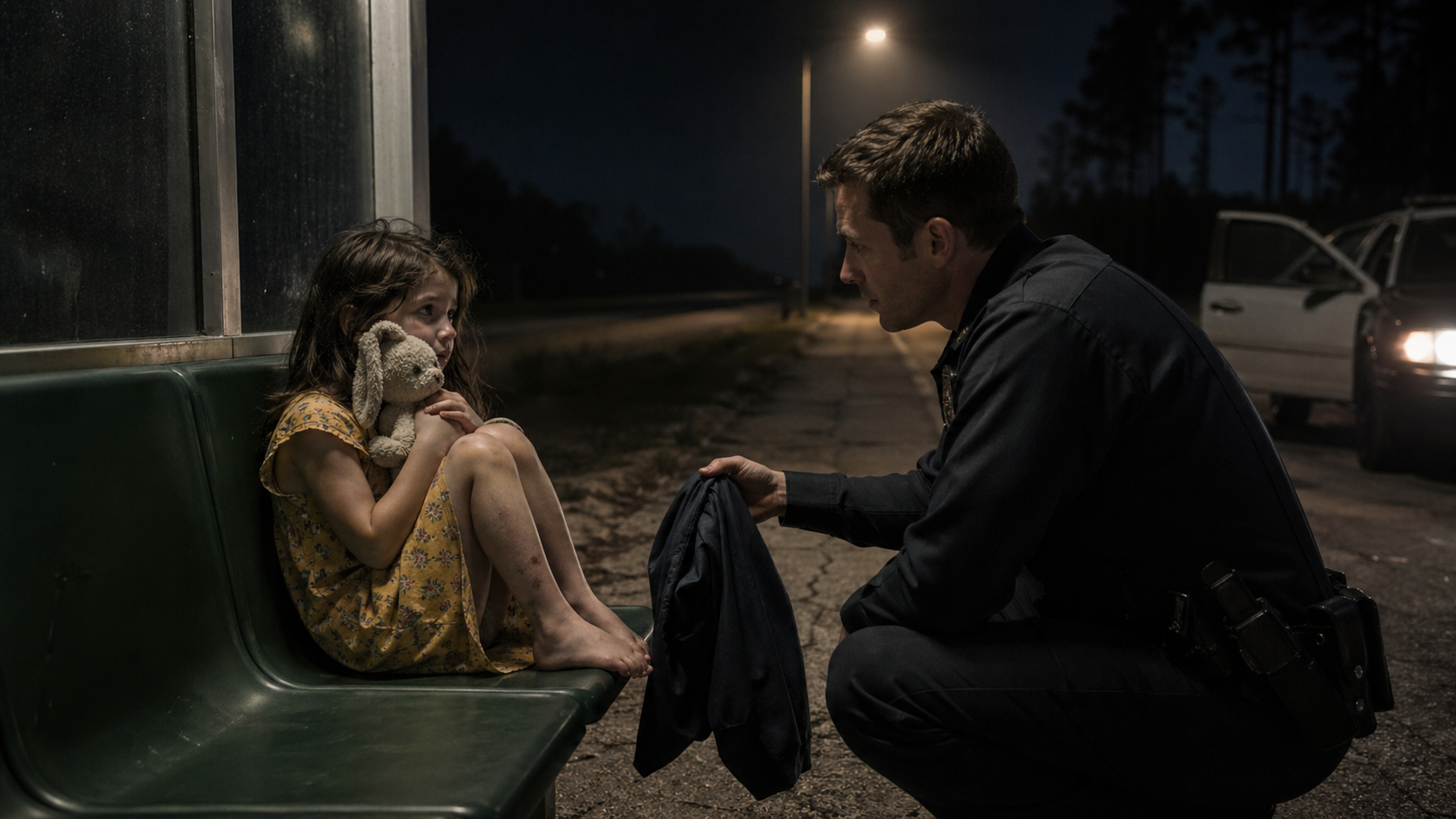
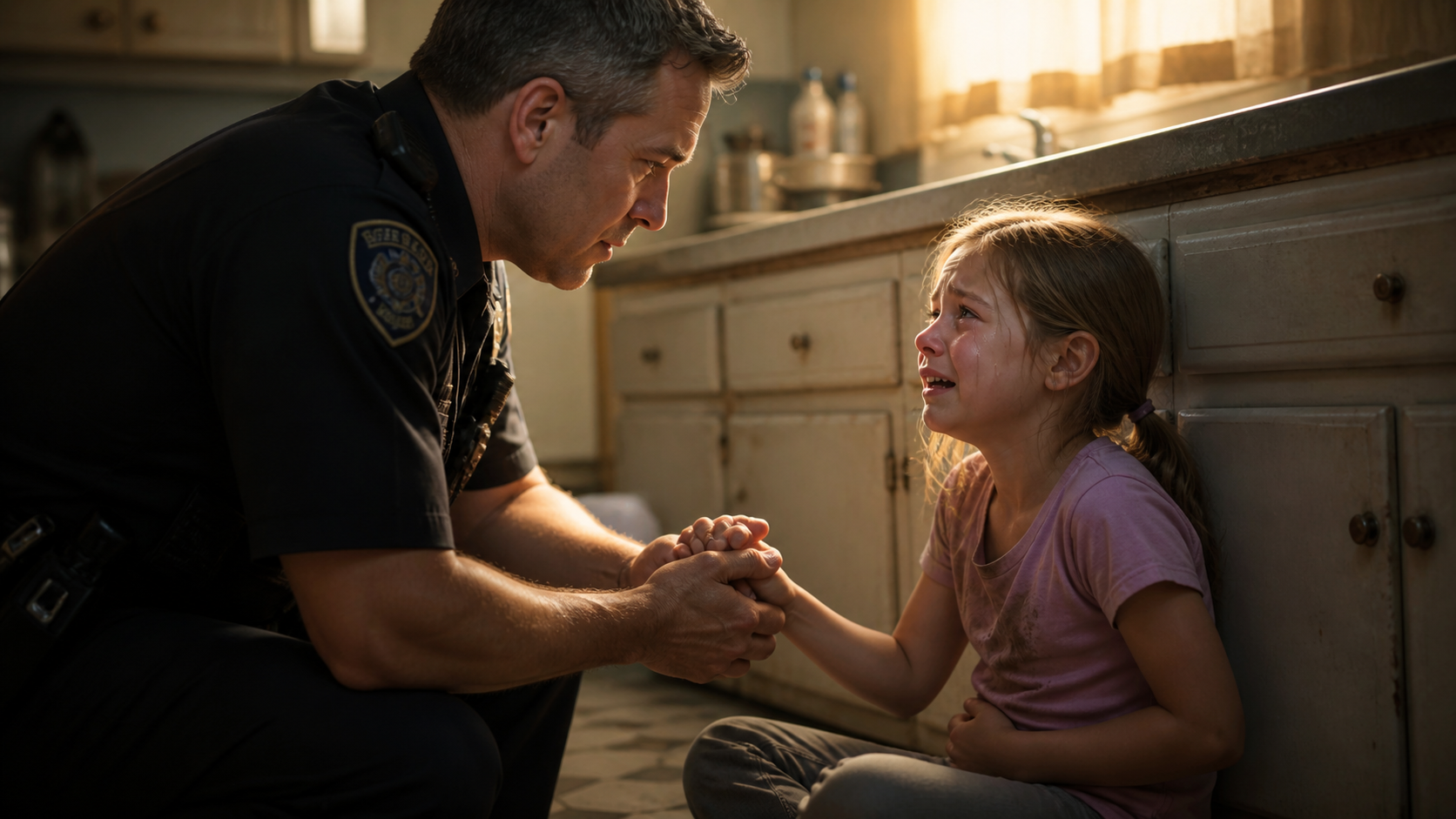
“Hi, Emily. I’m Officer Brooks. Can you tell me what’s going on?” He knelt down slowly, making himself smaller, less threatening. He had learned this too: a badge was intimidating when you were looming over a frightened child.
Emily’s eyes were wet. “I called because my stomach hurts. I didn’t want to get anyone in trouble.”
“I know,” Caleb said. “But your body was telling you something was wrong. You listened to it. That took courage.”
He asked her the same questions Maren had asked, but gently, slowly, watching her face. Emily’s answers were consistent. She was clear about what hurt. She was vague about what had happened, not because she was hiding something, but because nothing had happened—she’d just been in pain while adults around her had been too overwhelmed or too distracted to notice how serious it had become.
At the hospital, the examination began with suspicion.
The nurses exchanged glances when they heard Emily’s initial statement—“It was my dad and his friend.” Those glances turned into something else entirely when they began filling out incident reports. Emily’s mother was contacted and found to be unreachable initially; her phone was in another room, and she had been asleep for most of two days. Emily’s father was not immediately available. The pattern was starting to form in everyone’s mind—the story that abuse cases told.
The social worker who was called began filling out forms with language carefully chosen to document potential harm. Emily’s pediatrician was consulted. A detective was assigned. Everyone moved with the careful urgency of a system trying to protect a child from people who were supposed to love her.
Emily’s blood work came back. She had an infection—bacterial, serious, the kind that could have become life-threatening if it had gone undetected for much longer. Her abdomen showed inflammation and fluid accumulation. The tests were clear: this was medical, not physical trauma.
But the timeline kept nagging at everyone. When did the pain start? After the friend visited. When was the friend there? Last week. When did it get worse? After he left. The pieces seemed to fit a different kind of crime now—not trauma, but negligence. Possibly intentional poisoning.
The doctor pulled Caleb aside. “If this had waited another few days, we’d be looking at sepsis. If this had waited a week, she’d be critical. That little girl saved her own life by making that call.”
Emily’s mother, Sarah, was admitted upstairs. She had an autoimmune condition that had been diagnosed but poorly managed—the kind that caused extreme fatigue, pain, brain fog, and difficulty advocating for medical care. When she woke up and learned what had happened, she wept, not from guilt that she’d missed signs, but from the devastating realization that her illness had made her invisible to her own daughter’s crisis. She had been asleep while her daughter was slowly becoming septic. That was something she would never forgive herself for.
The Suspicion That Grew and Then Began to Crumble
For the first four hours, suspicion hung in the air like smoke.
The nurses exchanged knowing glances in the hallway. The social worker filled out forms with careful, deliberate language, each word chosen for maximum documentation and legal protection. Emily had mentioned “dad and his friend.” She had been afraid to call—or had she just been polite? She had hidden the pain—or had she just not known how to explain it to busy adults?
Everything, absolutely everything, added up to the wrong story.
A detective was called. His name was Morris, and he had worked cases like this before. He knew what abuse looked like. He knew what neglect looked like. He knew what poisoning looked like. He sat down with Emily in a room painted soft blue, the color supposed to be calming, and asked her to describe in detail everything that had happened when Mr. Ray visited.
Emily described the visit in careful detail. The nice way Mr. Ray said hello. How he hugged her dad. How he asked how she was doing in school. How he brought sandwiches and strawberries. The way he’d asked her to help him unpack the grocery bags. Nothing. Everything she described pointed to nothing but kindness.
“Did Mr. Ray ever ask you not to tell your parents about him visiting?” the detective asked.
“No. He always says hi to Dad. They pray together sometimes.”
“Pray?”
“At church. Mr. Ray goes to Dad’s church. Dad says Mr. Ray is going through something hard.”
Detective Morris sat back. He had been a cop for nineteen years. He knew what abuse cases looked like when you were building them. He knew what defense attorneys would say about inconsistent statements, about children being suggestible. This didn’t look like a case he could build. This looked like a child trying to solve her own mystery by pointing at the last thing that had changed before the pain got worse. The human mind did that—found correlation and called it causation.
But he still had to ask. “Has Mr. Ray ever been alone with you, Emily? Without your dad there?”
“No. Just for like a minute when he went to the bathroom and I helped him find where it was. But that was all.”
“Has he ever touched you in a way that made you uncomfortable?”
“No. He’s nice.”
“Has he ever asked you to keep secrets from your parents?”
Emily looked confused by the question. “No. I don’t keep secrets from Dad.”
Morris let it go. He wasn’t going to trap a truth out of a child. But he still had to talk to the father. That’s where the real answers would come.
A Father’s Panic
Then Nolan Parker arrived at the hospital.
He ran through the emergency entrance in work boots and a dust-covered shirt, his face gray with something beyond panic. He grabbed the front desk counter, and his voice came out hoarse.
“Where is my daughter? I got three missed calls. I was on a roof. My phone was in the truck.”
Caleb stepped forward. “She’s being treated. She’s stable.”
“What happened?” Nolan’s voice cracked. “Is she okay?”
“She called 911 herself,” Caleb said, watching the man carefully.
Nolan’s face went through a series of expressions. Confusion. Understanding. Horror. “What? No. No, she knew she could call me. Why didn’t she—” He stopped, and understanding crashed over him like a wave. “She was in pain and I wasn’t there.”
His voice became barely audible. “How long has she been in pain?”
“That’s something the doctor will discuss with you.”
Nolan covered his face with both hands. His shoulders shook. Not with anger. With the sound of a man realizing he had been one day away from losing everything.
“She told me her stomach hurt. I kept saying tomorrow. I thought it was a stomach bug. I thought we had time. I thought—” His voice became a whisper. “I thought I had one more day.”
Detective Morris was there, watching. The man in front of him didn’t look like someone who had poisoned his daughter. But Morris had learned not to trust first impressions.
The Friend Who Brought Food
Before Nolan saw Emily, Caleb asked about Raymond Bell.
“Ray’s from my church,” Nolan said, his hands still shaking. He was not defensive. He was just trying to answer. “He brings groceries sometimes because we’ve been behind on bills. Really behind. Last week he brought turkey sandwiches and some fruit. Emily must have thought the food had something to do with her pain getting worse.”
“Has he ever been alone with Emily?” Morris asked.
Nolan looked confused. “Alone with her? No. He drops it off, we talk, he leaves. He’s like—” Nolan paused, searching for the right word. “He’s like a grandfather to her. He asks about her school. He brings her books sometimes. He lost his wife last year and I think it helps him to feel useful.”
“Has he ever touched her in a way that—”
“No.” Nolan’s answer was immediate and certain. His eyes met Morris’s directly. “Ray’s a good man. He just lost someone. He comes to church to feel less alone. He brings us food because he can afford to and we can’t afford to turn it down. That’s all.”
Morris didn’t push further. He had gotten what he needed to assess whether to pursue this line. Nolan Parker didn’t sound like a man protecting someone. He sounded like a man telling the truth.
The detective interviewed Raymond Bell that evening—a quiet older man in his seventies with tired eyes and a grocery receipt folded in his wallet from the previous week. Raymond was sitting in his small apartment watching the news when the doorbell rang. He opened it to find a detective, and the blood drained from his face.
“I would never hurt that child,” Raymond said immediately, before Morris had even asked. “I swear to you. I only brought food because Nolan was drowning and too proud to ask for help directly. His wife is sick. His daughter needed things. I had a little money and nowhere else to put my love anymore. I didn’t think about how it would look.”
“How what would look?” Morris asked.
“A man bringing food to a family with a sick wife and a struggling daughter. I didn’t think about what anyone would assume.”
Morris asked him about the food, about where it came from, about whether he’d done anything to it. Raymond pulled out his receipt from the grocery store, dated the previous week. The same store where other families shopped. The same brands everyone bought. The same strawberries he’d bought for his dead wife’s favorite pie recipe, even though there was no one to bake for anymore.
Medical tests ruled out any kind of contamination or tampering. The infection Emily had was bacterial, not chemical. It had been developing for weeks, possibly for a month or more. The timing Emily remembered—when the pain got worse—was coincidental. Or perhaps not coincidental: children are more aware of their bodies when someone pays attention to them. Mr. Ray had asked how she was feeling. That attention might have made her more conscious of pain that had been building all along.
Neither her father nor her mother had harmed her. Neither had Raymond.
What Emily had was a treatable infection. What her family had was exhaustion. What her father had was guilt he would carry for years, the knowledge that he had said “tomorrow” once too many times.
The Room Where Everything Changed
When Nolan was finally allowed to see Emily, Caleb walked with him to the door.
“Go easy on yourself,” Caleb said. “You didn’t know. You’re here now.”
“That’s not good enough,” Nolan said, his voice hard.
“It has to be,” Caleb said gently. “For her sake.”
Nolan nodded and stepped into the room.
Emily looked fragile under the white hospital blanket. An IV ran into her small arm. Monitors beeped softly, tracking her heart, her oxygen, her fight back toward health. Her stuffed bear lay beside her pillow, worn and loved.
She turned her head when the door opened. “Daddy?”
Nolan rushed forward, then stopped, afraid to hurt her. He took her hand as gently as if she might break, and he did break—tears ran down his face.
“I’m here, Em. I’m so sorry.”
“Are you mad?” Emily asked.
Nolan’s eyes filled with more tears. “Mad? No, baby. I’m grateful. You were smarter than me.”
Emily reached for his hand with her other hand, holding him with both. “I thought Mr. Ray’s food made me sick.”
“No, sweetheart. Mr. Ray was trying to help us.” Nolan squeezed her hand carefully, afraid to cause her pain. “I should have listened sooner. When you said your stomach hurt, I should have taken you that day. Not tomorrow. That day.”
Emily stared at him for a long moment. “Mom didn’t know how bad it was.”
“No,” Nolan agreed.
“She would have helped if she could.”
Nolan kissed her hand. “I know that too.”
“So nobody did anything bad?” Emily asked.
“No, baby. Nobody did anything bad.” Nolan swallowed hard. “But I did something bad—I didn’t listen to you when you needed me to.”
Emily was quiet for a long moment. Then she said, “You’re listening now.”
Nolan kissed her hand again and didn’t let go.
The Casserole and the Apology
Emily stayed in the hospital for eight days. The doctor said they’d caught it in time—not by much, not with any margin to spare, but in time. With antibiotics, with care, with daily monitoring, she would recover. She would have a scar across her abdomen where they’d needed to manage the infection, but she would recover.
A social worker helped Nolan arrange medical appointments for Sarah, temporary home care assistance, additional antibiotics for Emily, and medical leave from work. He couldn’t afford the leave. He couldn’t afford not to take it.
Nolan pulled fewer shifts at work. It cost him money he didn’t have. It bought him back his daughter’s trust and his wife’s awareness and his life.
Mrs. Harlan, the neighbor who’d first whispered her suspicions to Caleb—the one who’d brought flowers and murmured about “those poor people”—came to the hospital with a casserole and an apology. She cried when she realized how wrong her assumptions had been.
“I’m so sorry,” she said. “I should have known better.”
Raymond Bell came with a new stuffed bear and cried when Emily hugged him. He’d been terrified that the police suspicion would follow him, that people would always wonder. When he realized he’d been cleared, when he realized Emily’s father still trusted him, he wept in the hospital bathroom for an hour.
“Will you still come visit?” Emily asked him.
“Of course,” Raymond said. “Of course I will.”
The Kind of Rescue That Doesn’t Make Headlines
One afternoon, as sunlight filled the hospital room, making it look almost beautiful, Emily looked at Officer Brooks and asked a question that had been bothering her.
“I thought calling 911 meant someone was in trouble.”
Caleb smiled. “Someone was in trouble. You were.”
“But like… trouble trouble? Like someone was hurting me?”
“Sometimes trouble means someone is hurting. But sometimes trouble just means someone needs help.” Caleb sat down in the chair next to her bed. “What you did was call someone because you knew something was wrong inside your body. That’s exactly when you’re supposed to call 911.”
Emily thought about that. She had been worried that she was causing trouble, that she was being dramatic, that she was worrying adults who already had too much to worry about. But what she’d actually done was reach out when she needed help. That was not causing trouble. That was bravery.
“So I did okay?” she asked.
Nolan, who was sitting on the other side of her bed, kissed her hand. “You did more than okay, Em. You saved yourself.”
Emily nodded, satisfied with a promise her father would spend the next twenty years keeping.
The Aftermath: What Everyone Learned
The town had expected a scandal. Expected a reveal. Expected a villain unmasked at the end.
What it got instead was something quieter and harder to face.
A little girl had been hurting. The adults around her had been too tired, too overwhelmed, too afraid, or too distracted to see how serious it had become. Her mother had been struggling with a chronic illness that made her unreliable. Her father had been working constantly, always saying tomorrow, always believing he had one more day. Her friend’s father had brought sandwiches and kindness and had been briefly suspected of poisoning her. None of them had done anything wrong on purpose. All of them had failed her anyway.
Her call did not destroy her family. It woke them up.
Emily was released from the hospital two weeks later. Nolan took time off work, actually time off, not just saying he would. Sarah began treatment for her autoimmune condition that was more aggressive than what she’d been doing. Doctors figured out a medication combination that gave her energy and stability she hadn’t had in years. Raymond Bell started visiting twice a week and teaching Emily about gardening. Mrs. Harlan started bringing actual meaningful help, not guilt-driven casseroles—she got Emily to her follow-up appointments, sat with Sarah during her treatments, brought groceries without announcing it.
The flowers by the porch were still there. This time, Nolan watered them with his daughter.
And when Emily looked up at him one afternoon and asked, “Tomorrow doesn’t mean never anymore, right?”
Nolan swallowed hard. “No, baby. Tomorrow means tomorrow. And when it matters, we don’t wait.”
Original fictional stories. AI-assisted creative content.