I was fourteen the day they took Caleb.
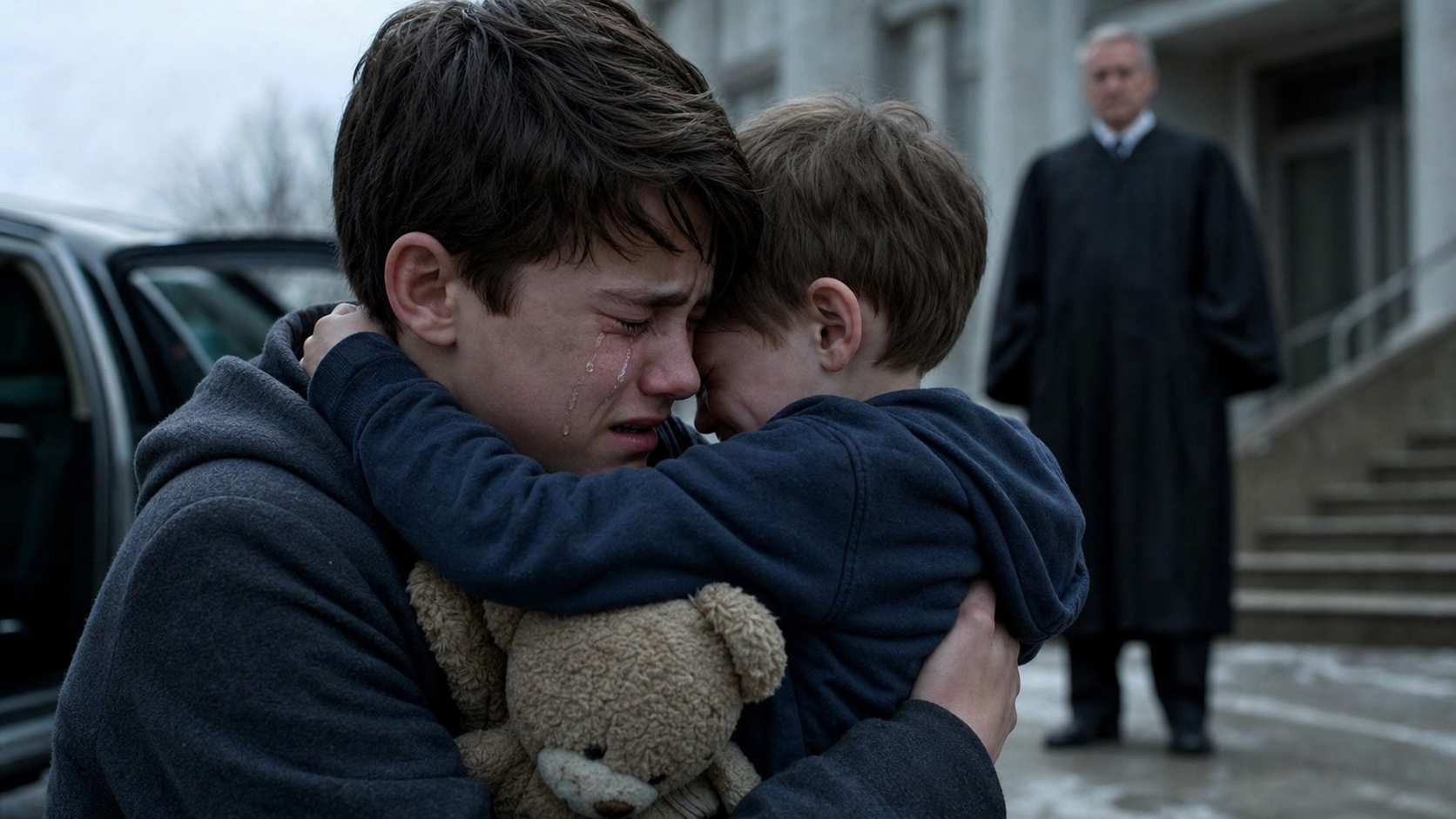
He was six. He had a stuffed bear under one arm and both hands locked into the front of my jacket like he was trying to hold the whole world in place.
“You’re coming too, right?” he asked.
I knelt down. Smiled like it didn’t hurt.
“This isn’t forever, buddy. I’m bringing you home. I promise.”
The caseworker put her hand on his shoulder. Caleb screamed. I’ll hear that scream until the day I die.
Eight years.
Eight years of foster homes for him. Eight years of group placements, then a basement apartment, then night shifts for me.
Every visit, same question.
“When can I live with you again?”
“Soon, buddy.”
“You said soon last time.”
“I know.”
He stopped believing me when he was nine. I saw the exact moment it happened. He just nodded instead of smiling.
That nod broke something in me that didn’t grow back.
By twenty-two, I was stocking shelves at 4 a.m., bussing tables at noon, and taking online classes at midnight.
Under my mattress, an envelope labeled Caleb’s Room. Wrinkled bills. Loose change. A photo of him with his dinosaur blanket.
Every dollar got the same question: Does this bring him home?
If no, it didn’t get spent.
I missed my own high school graduation because the diner was short-staffed and a double shift was three hundred dollars I needed for the deposit on something — anything — that looked like a real apartment.
My friend Marcus showed up at the diner that night with a piece of cake in a Styrofoam container.
“Couldn’t let it slide, man.”
“You didn’t have to —”
“Eat the cake, Mason.”
I ate it standing up, in the back, between orders. He sat on a milk crate and watched me.
“You good?” he asked.
“I’m good.”
“You’re lying.”
“I’m working.”
He nodded like that was the same answer.
The next supervised visit was at a county office that smelled like carpet cleaner and microwaved coffee.
Caleb, almost fourteen by then, was taller than I expected. He sat across from me with a coloring book he was way too old for, just to have something to do with his hands.
“How’s school?” I asked.
“Fine.”
“Fine good or fine whatever?”
“Fine whatever.”
I smiled. He didn’t.
“Caleb.”
“What.”
“Look at me, buddy.”
He looked up. His eyes were already older than mine had been at his age.
“You doing okay?”
“They want me to call them Mom and Dad.”
I kept my face very still.
“The Hanleys?”
“No. The other ones. The new ones. Before the Hanleys. The lady cried when I wouldn’t say it.”
“What did you say?”
“I said I had a brother.”
I reached across the table without thinking and put my hand on top of his. The supervisor in the corner cleared her throat. Physical contact rules. I pulled back.
“I’m coming, Caleb.”
“You always say that.”
“I know.”
“Stop saying it if it isn’t true.”
That one cut deeper than anything the courts ever did to me.
“It’s true,” I said. “I just need a little more time.”
He nodded. Didn’t believe me. Went back to coloring outside the lines on purpose.
Then came the meeting that almost ended me.
Denise Warren, the caseworker assigned to our file, sat across from me in a beige room with a flickering light.
“Mason. I’ll be honest with you.”
“Please.”
“The placement review board is leaning toward terminating reunification efforts.”
I felt the floor tilt.
“What does that mean?”
“It means Caleb gets placed for adoption. Permanently.”
“He has a family. He has me.”
“You’re twenty-two. You live in a basement studio. He needs his own room, his own bed, his own —”
“I’ll get it.”
“Mason —”
“I’ll get it. Tell me what I need. Write the list.”
She looked at me for a long second. Then she wrote.
I took that paper home and read it under the streetlight outside my building because I couldn’t wait to get inside.
My landlady was Mrs. Whitaker. Retired school secretary. Gray bun, sharp eyes, a way of pretending not to care while watching everything.
She knocked that night with a plate of oatmeal cookies.
“Court again?”
“They want to terminate.”
She set the plate down very carefully.
“Terminate what, exactly?”
“My right to get him back.”
She didn’t speak for a moment. Just looked around my one tiny room.
“There’s an empty bedroom upstairs,” she finally said. “Closet sticks. Needs paint. But it’s real.”
“Mrs. Whitaker, I can’t pay —”
“Did I ask you to?”
“I —”
“Don’t ruin my floors. Don’t pick an ugly color. And don’t insult me by arguing.”
I sat down on my mattress and put my face in my hands.
She let me. She didn’t say a word. She just left the cookies and went back upstairs.
I painted it blue. Caleb told me once, when he was seven, that blue made him feel calm.
Yard-sale bedframe. Scratched dresser. Mismatched curtains. Glow-in-the-dark stars on the ceiling because he used to count them out loud when he couldn’t sleep.
The dinosaur sheets I’d kept in a vacuum bag for six years.
The bear, washed twice, on the pillow.
When Denise inspected it, paint was still under my fingernails.
She walked through it slowly. Touched the desk. Looked at the closet.
“You did this yourself?”
“Yes, ma’am.”
“Mason, this is good. Really. But stability is more than a room. It’s income. School plans. Childcare. Medical. Transportation. Emotional support.”
“I know.”
“The other side has a lot of ammunition.”
“What other side?”
She hesitated.
“There’s a couple. They’ve fostered Caleb for the last fourteen months. They’re petitioning to adopt.”
The cookies in my stomach turned to stone.
“Caleb didn’t tell me that.”
“He doesn’t know yet. We don’t tell kids until the hearing date is set.”
“When’s the hearing?”
“Three weeks.”
The lawyer they assigned me through legal aid was a man named Coleman. Soft voice. Tired eyes. Honest.
“This won’t be easy,” he said.
“Tell me what we have.”
“You have something most people in your position don’t.”
“What?”
“A record of showing up. Every visit. Every birthday. Every court date. Eight years.”
“Is that enough?”
“Against a married couple with a four-bedroom house and two incomes? I won’t lie to you. It’s a hard sell.”
I nodded.
“Tell me what to do.”
“Sleep. Eat. Don’t show up to that courtroom looking like you’ve been crying for a month.”
I’d already been crying for a month.
The other side’s lawyer called me the following Tuesday.
Friendly voice. Calculated.
“Mason. I’m Greg Linwood. I represent the Garrisons.”
“Okay.”
“I just wanted to introduce myself. Talk through some options before things get adversarial.”
“I’m listening.”
“My clients are willing to allow you generous visitation. Holidays. Summer weekends. We could get something on paper, signed by the judge, before the hearing even happens.”
“In exchange for what?”
“You sign over your reunification rights voluntarily. Nice and clean. No fight. Caleb gets stability. You get to stay in his life as a brother, which is what you are.”
I gripped the phone so hard my knuckles hurt.
“Mr. Linwood.”
“Greg.”
“Mr. Linwood. I’ve been the only person in that kid’s life who never left. I’m not signing anything.”
“Mason —”
“Don’t call me again unless it’s through my lawyer.”
I hung up.
Then I stood in my kitchen and shook for ten minutes.
Then I called Coleman.
“Coleman. The other lawyer just tried to buy me out.”
“Of course he did. They’re scared.”
“They’re scared?”
“Mason. They wouldn’t be making offers if they thought they were going to win.”
I sat down on the floor.
“Say that again.”
“They wouldn’t be making offers if they thought they were going to win.”
I held onto that sentence like a rope for the next eleven days.
Two nights before the hearing, my phone rang. Unknown number. I almost didn’t answer.
“Mason? It’s Mrs. Hanley. Caleb’s foster mother.”
I sat down so fast the chair scraped.
“Is he okay?”
“He’s fine, honey. He’s fine. He just — he wrote something. For the judge. He asked me to help him spell the hard words.”
“What did he write?”
“I shouldn’t read it to you.”
“Mrs. Hanley. Please.”
A pause. I heard paper unfolding.
“He wrote that he sleeps better when he knows you’re nearby.”
I couldn’t speak.
“Mason? You there?”
“Yes, ma’am.”
“He also wrote that the other family is nice. That they have a dog.”
My throat closed.
“But he wrote one more thing. He wrote, I already have a brother. I just want to live with him.“
I put the phone down on the floor and cried the way I hadn’t cried since I was fourteen.
Mrs. Whitaker found me at the kitchen table at six in the morning. I hadn’t slept. I had three cups of cold coffee in front of me and a tie I didn’t know how to knot.
She sat down across from me without saying hello.
“You eat?”
“No.”
“Sleep?”
“No.”
“Mason.”
“I know.”
“Look at me.”
I looked at her.
“Whatever happens today,” she said, “you have already won.”
“That’s not true.”
“It is true.”
“Mrs. Whitaker —”
“That boy knows. He knows you came back. Whatever paper that judge signs, that boy knows.”
“I need the paper.”
“I know you do. But you don’t need it to be his brother. You already are.”
I put my forehead down on the table. She put her hand on the back of my head, the way no one had since my mother on her good days, and she let me stay like that until I could breathe again.
Then she made me eggs.
“Eat. Then go put on the tie. I’ll knot it. Your father didn’t teach you anything useful, did he.”
“He didn’t teach me anything at all.”
“Figures. Eat.”
The morning of the hearing, Mrs. Whitaker pressed a folded twenty into my hand.
“For coffee.”
“I don’t need —”
“Take it. Stop arguing with old women.”
The courtroom was small. Wood-paneled. Smelled like floor polish.
Caleb sat in the front row in a button-up shirt that was a half-size too big. His hair was combed flat except for one stubborn piece in the back.
I almost smiled.
The other couple sat across the aisle. Nice clothes. Nice posture. The woman kept dabbing her eyes with a tissue, performing for the judge before he’d even walked in.
Then Judge Pierce entered.
The other couple’s lawyer went first. He was good. Slick.
“Your Honor, my clients have provided Caleb with the first stable home he has known in years. Their household income exceeds two hundred thousand dollars. Their home has been inspected three times. They are prepared to offer Caleb every advantage —”
“Counselor,” the judge interrupted, “I’ve read your brief. Move on.”
He talked for forty more minutes anyway.
Then he called me to the stand.
“Mr. Reed. How many jobs do you currently hold?”
“Three.”
“Three. And how many hours a week, in total, do those jobs require?”
“Sixty-two on average.”
“Sixty-two hours a week. And in your remaining time, you propose to be a single full-time guardian to a fourteen-year-old boy.”
“I propose to drop one of them.”
“Which one?”
“The night shift. I’ve already given notice.”
“Effective when?”
“Two days ago.”
The room got quiet.
“Mr. Reed. You are aware that minors require constant supervision, transportation, medical care, school engagement —”
“I raised him from the time he was two until the day they took him. I changed his diapers when our mother couldn’t get out of bed. I made his lunches. I walked him to kindergarten. I know what he needs.”
“You were a child yourself.”
“I was a child who showed up. That’s more than my clients across the aisle did until eighteen months ago.”
Linwood’s face tightened. Coleman did not object. He didn’t need to. The judge was writing.
“No further questions,” Linwood said.
I stepped down. My legs didn’t quite work right, but I made it back to the table.
Coleman leaned over.
“You just did something good.”
“What?”
“You stopped being a kid who wants his brother. You became the man raising him.”
Then Coleman stood.
“Your Honor, my client is twenty-two years old. He has worked three jobs simultaneously for the past four years. He has completed every requirement set by the Department of Human Services. Every single one. On time. He has prepared a bedroom for his brother in a unit owned by a private landlord who has volunteered to act as a character witness today.”
The judge raised an eyebrow at that.
“Mrs. Whitaker?” he said.
She stood up in the gallery, smoothed her dress, and walked to the stand like she’d been planning it her whole life.
I hadn’t asked her to come. I hadn’t even known she would.
“State your name for the record.”
“Eleanor Whitaker.”
“And your relationship to Mr. Reed?”
“He rents from me.”
“That’s all?”
“No, Your Honor. He’s a young man I have watched for four years. He’s never been late on rent. Not once. He turns down overtime to make it to supervised visits with that boy. He saved for two years to buy a used car so he could drive that boy to a doctor’s appointment without taking a bus. I gave him the upstairs bedroom because I am eighty-one years old and I have learned to recognize a person of substance when I see one.”
The judge was quiet.
“Anything else?”
“Yes. The other couple is fine, I’m sure. But Caleb does not need fine. He needs Mason.”
She stepped down.
I watched the other lawyer write something fast on his legal pad.
Coleman stood up one more time.
“Your Honor. With the court’s permission, I’d like to enter one final piece of evidence. A letter, written by Caleb, to this court.”
Linwood was on his feet immediately.
“Objection. We have not been provided —”
“It was filed yesterday, counselor,” the judge said without looking up. “Sit down.”
Coleman walked the letter to the bench.
The judge read silently.
I watched his face. It didn’t change at first. Then, halfway down the page, his jaw shifted. Just a little. Just enough.
He set the letter down.
“For the record, the court will read this aloud. Caleb. If you would like to step out, you may.”
Caleb shook his head.
“I want to stay.”
The judge nodded.
He read.
“My name is Caleb Reed. I am almost fourteen. I want to live with my brother Mason. The Garrisons are nice and they have a dog named Biscuit. But my brother knows I don’t like the crust on my bread and I don’t like it when people clap too loud. He knows I had a nightmare every night for a year after they took me. He used to sit by my bed when our mom was sick and tell me a story about a kid who finds a door in the wall and the door leads home. He has been telling me that story my whole life. Please let him finish it.”
Mrs. Hanley was openly crying. The Garrisons were not looking at me. Linwood had stopped writing.
The judge folded the letter very carefully and set it on top of the file.
Then it was my turn.
My hands shook. My voice did not.
“Your Honor. I know I’m young. I know I don’t have a four-bedroom house. I know I don’t have two incomes. I know what it looks like on paper.”
I took a breath.
“But Caleb is not a project to me. He’s my brother. He’s the only family I have left. I know what scares him. I know he likes his sandwiches cut into triangles. I know he pretends he doesn’t like bedtime stories, but he listens to every word. I know he sleeps with his hand under the pillow because he saw me do it once when he was four.”
I looked at Caleb.
“I made him a promise eight years ago that I had no idea how to keep. I kept it anyway. I’m asking you to let me finish keeping it.”
The room was so quiet I could hear the radiator click on.
The judge took off his glasses.
“Caleb.”
Caleb stood up.
“Yes, sir.”
“Do you understand why we’re here today?”
“Yes, sir.”
“Is there anything you’d like to say?”
Caleb looked at the foster couple. He looked at Mrs. Hanley. He looked at me.
“Mason told me he would come back for me. He always does.”
The other woman, the one with the tissue, made a small sound.
The judge nodded once.
“This court has reviewed the petitions, the testimony, and the placement reports. The petitioners on behalf of the prospective adoptive family have presented a thorough case. However, the law requires that the best interest of the child be measured by more than material resources.”
I held my breath.
“The court finds clear and convincing evidence of a sustained, demonstrated bond between Caleb Reed and his biological brother Mason Reed. The court further finds that Mr. Reed has met every reunification benchmark set by the Department.”
I couldn’t feel my hands.
“Custody is hereby awarded to Mason Reed, effective immediately.”
For one full second, I didn’t move.
Then Caleb ran.
He ran across the courtroom, past the bailiff, past the lawyers, and slammed into me hard enough that I dropped to one knee just to absorb him.
“You said it wasn’t forever,” he sobbed into my shoulder.
I held him so tight my arms hurt.
“I meant it, buddy. I meant every word.”
Outside, the air felt different.
Not warmer. Not brighter. Just lighter.
The other couple walked past us on the courthouse steps. The husband gave me a small, tight nod. The wife wouldn’t look at me.
Mrs. Whitaker was waiting at the bottom of the steps with a tissue in one hand and her car keys in the other.
“Well?” she said.
Caleb answered before I could.
“I’m going home.”
She covered her mouth and laughed and cried at the same time.
That night, I opened the door to the blue room and stepped aside.
Caleb walked in slowly.
He saw the dinosaur sheets first. Then the bear on the pillow. Then he tilted his head back and saw the stars.
“You remembered.”
“I remembered everything.”
He sat on the edge of the bed and pulled the bear into his chest.
“Mason?”
“Yeah, buddy?”
“Can we have pizza?”
“Pizza, root beer, and the worst movie we can find on free streaming.”
He grinned. The same grin he had at six. It had been waiting in there for eight years.
“Mason?”
“Yeah.”
“Don’t go anywhere.”
I sat down next to him on the dinosaur sheets and put my arm around his shoulders.
“I’m not going anywhere. I’m exactly where I said I’d be.”
He leaned into me, bear and all, and finally — for the first time in eight years — he closed his eyes without checking the door first.
I stayed until he was asleep.
Then I stayed a little longer, just to make sure.
Mrs. Whitaker was on the porch when I came outside. Two mugs of tea on the railing. She handed me one.
“He sleeping?”
“Yeah.”
“Good.”
We stood there in the dark for a while. A dog barked two streets over. A car passed.
“Mrs. Whitaker.”
“Don’t get sappy on me, Mason.”
“Why did you do all this? Really. The room. The court. The tie.”
She took a slow sip.
“My son died when he was seventeen. Long time ago now. He used to sit at that same kitchen table where you sat this morning. I have spent forty-one years hoping someone would let me feed them eggs again.”
I didn’t know what to say.
“You don’t owe me anything,” she said. “Just raise that boy. That’s the rent.”
“I will.”
“I know you will. I knew the first time you carried my groceries up the stairs without being asked.”
She set her mug down.
“Goodnight, Mason.”
“Goodnight, Mrs. Whitaker.”
I stayed on the porch a few more minutes, looking up at the second-floor window where the glow-in-the-dark stars were doing their quiet work in a room with my brother sleeping in it.
Eight years.
Eight years to walk back across one parking lot.
Worth every step.
I went inside, closed the door, and locked it.
For the first time in my life, when I locked a door at night, my whole family was on the same side of it.
Original fictional stories. AI-assisted creative content.