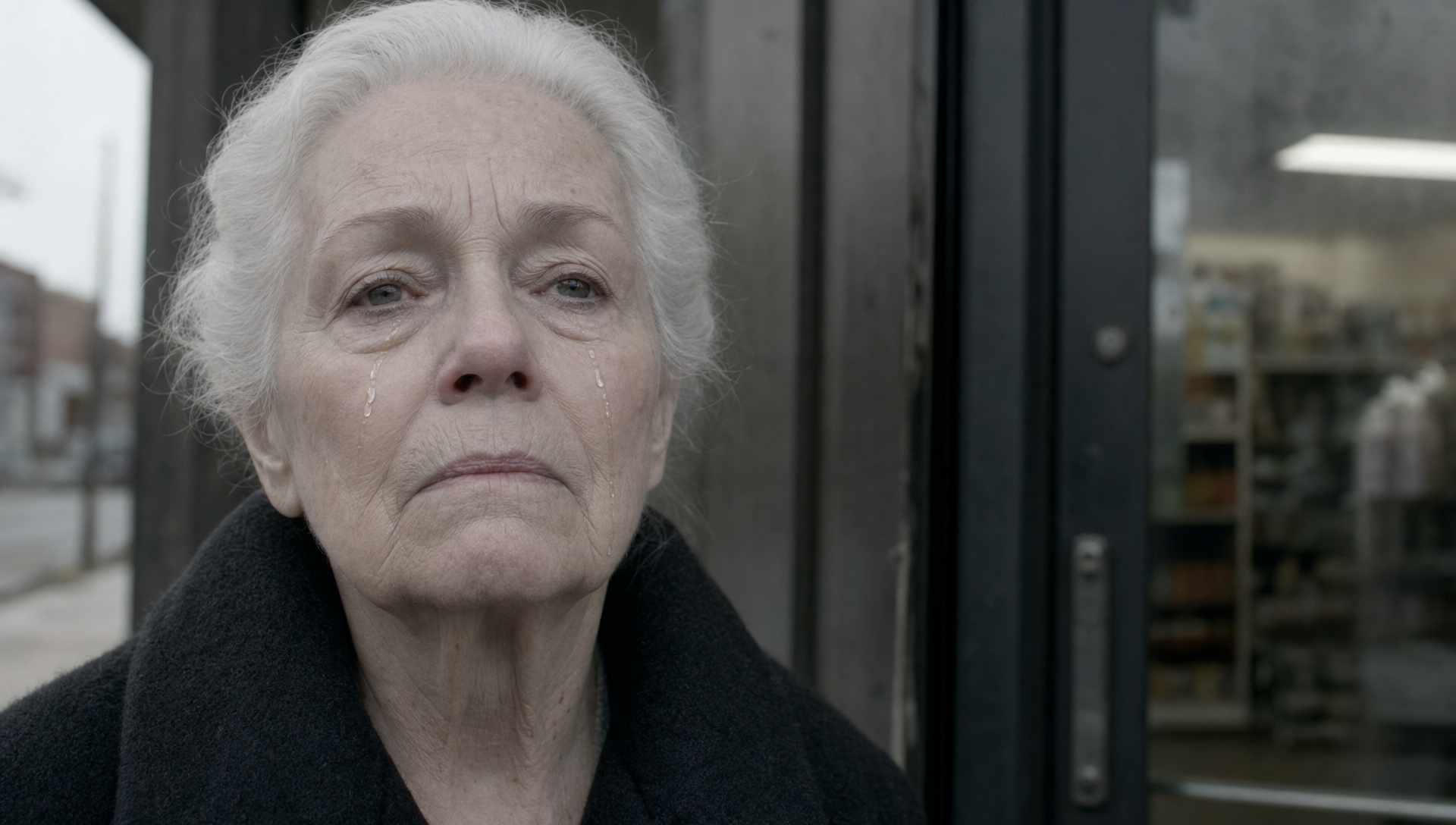
I am eighty years old. My bones ache when the weather turns cold, my joints creak when I climb stairs, and my snow-white hair sits pinned in a neat bun at the nape of my neck. I have not been in any kind of physical confrontation since a schoolyard scuffle in the third grade. So when a fully grown man’s closed fist connected with the side of my jaw and snapped my head backward, the first thing I felt wasn’t pain.
It was shock. Pure, cold, primitive shock.
The concrete floor of Oakhaven Municipal Market rushed up to meet me before my arthritic wrists could brace for the fall. My shoulder hit first. Then the side of my head. My teeth clicked together hard, cutting the inside of my cheek, and the immediate, hot taste of blood flooded my mouth.
I lay there for a second, ears ringing, the familiar sounds of the market completely swallowed by the high-pitched whine in my skull. The haggling vendors. The meat cleavers. The espresso machines. All of it — gone.
Then a hand grabbed the back of my head.
Not my coat. My hair.
Thick, manicured fingers wound into the careful bun at the nape of my neck, and Marcus Thorne yanked me backward across the wet concrete like I weighed nothing at all.
“Get up, you worthless old trash,” he said.
My name is Eleanor Vance. I have come to Oakhaven Market every Tuesday for fifty years. I know every vendor. I know that Jimmy the butcher saves the best cuts for weekend regulars, and that Elias — a Greek immigrant who has run his produce stall since the late seventies — always drops an extra peach into my bag when he thinks I’m not looking.
Today had started like every other Tuesday. I was at Elias’s stall, holding my faded green canvas bag, asking about the sweet corn price, when Marcus Thorne came down the main aisle with two private security guards in tactical vests.
He slammed an immediate eviction notice onto Elias’s scale.
Elias began to cry. He pleaded. He explained that his lease ran another six months, that he needed time to clear inventory. Thorne laughed — a cold, dismissive sound — and began physically kicking over the carefully stacked crates of bell peppers, clearing a path through the man’s life’s work.
I couldn’t just stand there.
I stepped between them. I planted my worn orthopedic shoes on the damp tiles, raised my chin, and looked directly into Thorne’s face.
“You have no legal right to do this,” I told him. “The municipal charter requires a thirty-day court order. You are vandalizing this man’s property.”
He looked at my worn coat, my practical shoes, my faded canvas bag, and made a decision about who I was.
“Mind your own business, grandma,” he sneered.
When I didn’t move, he pointed at my bag and lied to his guards. “I saw her take something. She’s stealing.”
“I did no such thing,” I replied.
“Open the bag.”
“No.”
There was something in that bag I hadn’t taken out of my home in years. I had brought it specifically to the city today for a very personal legal appointment at two o’clock. It was the most important thing I owned in this world. I was not about to let this man’s hands touch it.
“She’s a thief! Detain her!”
When his guards hesitated — clearly uncomfortable with the idea of roughing up an eighty-year-old woman over a hypothetical jar of jam — Thorne grabbed for the bag himself. I pulled back. There was a brief tug-of-war, and his temper snapped. He released the strap, pulled his arm back, and hit me.
He dragged me by my hair across the wet floor and threw me directly into Elias’s wooden crate display. A cascade of cabbages, potatoes, and overripe tomatoes came down on my shoulders. The wooden slats splintered against my ribs. I lay in the ruins of it, gasping, tasting blood, completely unable to stand.
Thorne stood over me, adjusting his gold watch. He didn’t look sorry. He looked satisfied.
The market was frozen. Dozens of people stood in the aisles, paralyzed. Jimmy the butcher had a meat cleaver gripped white-knuckled behind his counter. He took one step toward me, and one of the security guards immediately unclipped his holster. Jimmy stopped.
Nobody moved.
Thorne looked around at the watching crowd and made his next calculated move.
“Stolen valor,” he announced, raising his hands for the phones being held up. “This woman is carrying a stolen Medal of Honor. She attacked me when I tried to recover it. We are detaining her for the police.”
He pulled out his own phone and dialed 911. He spoke clearly, authoritatively, making sure his words carried over the hum of the refrigerators.
“Yes, police? Violent vagrant at Oakhaven Market. Assaulted a property manager. Currently in possession of stolen federal military property. Please hurry.”
He hung up with a satisfied smile.
I ignored the lie. My eyes were fixed on my torn canvas bag.
When Thorne had ripped it open, my things had spilled everywhere. But hidden in a false lining I had sewn myself — a secret pocket at the bottom — was something else. It had slid out during the chaos, coming to rest near a crushed green cabbage, half-hidden beneath a splintered slat of pine.
A thick, cream-colored envelope, sealed in heavy crimson wax. Embossed in gold across the top left corner: Whitman, Sterling & Cross – Attorneys at Law. The most ruthless corporate litigation firm on the East Coast.
That envelope was the reason I had come to the city today.
If Thorne saw that letterhead, the trap I had spent six months building would be ruined.
I shifted my weight, biting down a groan, and stretched my right hand toward the cabbage. My fingers brushed the heavy cream paper.
“Hold still,” Thorne commanded, stepping forward.
I grabbed the corner and pulled it against my chest.
“What is that?” He crossed the floor in three strides. “More stolen property? Hand it over.”
“No,” I rasped. “You have done enough.”
He reached for the lapels of my coat.
A heavy black combat boot stepped between us.
It was Miller, the younger security guard. He planted himself directly in front of me, crossed his arms over his tactical vest, and turned his broad back to me to face his boss.
“Step away from her, Mr. Thorne,” Miller said. The hesitation was completely gone.
“You’re fired,” Thorne snapped. “Get out of my way.”
“You can fire me,” Miller replied calmly. “But you are not touching her again. The police are coming. We wait.”
The police sirens arrived before Thorne could respond. Red and blue lights painted chaotic shadows through the high dirty windows, and two uniformed officers came through the heavy double doors.
Officer Brady — a heavyset veteran with a graying mustache — scanned the scene. His eyes moved from the frozen crowd to Thorne in his cashmere suit, and finally to me, bleeding on the floor behind a rogue security guard.
Thorne stepped forward immediately, hands relaxed and open, the civic-minded businessman.
“Thank you for coming, officers. I’m the property manager. She’s a vagrant who became violent. She attacked me when I tried to stop her from stealing. And when her bag tore open, she dropped this.”
He pointed at the concrete.
Brady followed his finger. He saw the blue ribbon. The thirteen stars.
The veteran cop went completely still. He clicked on a flashlight, crouched low, and examined the bronze star without touching it.
“Jesus,” Brady muttered. “It’s a MoH.”
Thorne sensed his advantage. “She was trying to fence it right here. I caught her, she assaulted me, I restrained her. I want full charges. Assault, trespassing, possession of stolen federal property.”
The rookie officer, Davis, stared at my face. “Sir. She looks like she’s eighty.”
“She fights dirty,” Thorne insisted.
Miller’s jaw tightened. He looked at Brady. “Officer, she didn’t—”
“He’s a disgruntled employee,” Thorne cut in. “I fired him three minutes ago for insubordination. He’s completely compromised.”
Brady sighed. He looked at me, and a flash of genuine apology crossed his face. But Thorne was the man in the suit. Thorne was the one mentioning the precinct captain. Brady made his decision.
“Mrs. Vance,” he said quietly. “I need you to put your hands behind your back.”
I didn’t fight. I understood exactly how the world worked. The man in the expensive suit gets the benefit of the doubt every single time. I slowly brought my arms behind my back, and the cold steel of the handcuffs closed around my wrists.
Thorne watched the cuffs click shut and smiled.
He leaned in close as Brady guided me toward the doors.
“Take the trash out,” he whispered, so only I could hear. “And tell your dead husband thanks for the souvenir.”
The back seat of a police cruiser is not forgiving. With my hands cuffed behind me, every pothole sent fresh pain screaming through my shoulder. I sat still and watched the city blocks move past the scratched window, my jaw throbbing in a slow, relentless rhythm.
In the front seat, Rookie Davis kept glancing at me through the wire mesh. “Take it easy on the turns, Brady. She’s bleeding pretty good. Maybe we swing by County General first.”
“Captain Reynolds approved direct transport,” Brady replied, his knuckles white on the wheel. “Thorne has the mayor’s office on speed dial. We follow protocol.”
Davis turned back to the windshield. He didn’t say anything else, but his jaw was tight.
I kept my eyes on the window. Beneath my heavy coat, pressed flat against my bruised ribs, I could still feel the thick, cream-colored envelope. It was still there. That was all that mattered.
The 44th Precinct was loud, fluorescent, and smelled of burnt coffee and floor cleaner. And standing at the main sergeant’s desk, chatting with a silver-haired Captain Reynolds, was Marcus Thorne.
He had beaten the cruiser here in his own luxury sedan. He was holding a styrofoam cup of coffee, playing the part of the shaken but civic-minded businessman.
When he saw me being led in, handcuffed, his smile widened. His eyes dropped to the steel at my wrists, and the satisfaction on his face was open and complete.
“Ah, the suspect has arrived,” Thorne announced. “As you can see, Captain, highly unstable. It took two of your best officers to manage her safely.”
Reynolds looked at my snow-white hair, my swollen jaw, the blood on my blouse. A deep frown crossed his face. He didn’t look like he believed Thorne. He did look like a man deeply aware of the political pressure standing next to him.
“Brady,” Reynolds said. “Holding Room B. Get the medic.”
Before they took me, a female officer in blue latex gloves conducted a pat-down. Her hands moved to my coat lining and stopped. She felt the rigid paper.
“What’s this?”
She pulled the envelope out into the fluorescent light. The wax seal intact. The gold letterhead gleaming.
Thorne stepped forward. “More stolen property. Open it.”
The officer hesitated. Every cop in the city knew that firm’s name.
“It is sealed legal correspondence addressed to my counsel,” I said, forcing my voice to project clearly across the booking area. “It is privileged. If you break that seal without a warrant, your department will face a federal liability suit by morning.”
The officer’s hands froze. She looked at Captain Reynolds.
“Mr. Thorne, I guarantee you this vagrant does not have a relationship with Whitman, Sterling & Cross,” Thorne scoffed. “She probably stole that envelope from a law office. Open it. It’s full of whatever cash she skimmed from the vendors.”
Reynolds stared at the gold embossed lettering for a long moment.
“Do not open it,” he said quietly, his tone shifting. “Log it unopened in her personal property bin. Holding Room B.”
They took me to a small, windowless room. A steel table. Two chairs. A black landline phone.
“Dial 9 for an outside line, Mrs. Vance,” Officer Brady said, and stepped out.
I sat alone.
My hands were shaking so badly I could barely lift the receiver. I punched in the number I had memorized months ago. It rang twice.
“David Harrison’s office.”
“This is Eleanor Vance,” I said. “I need him immediately.”
“Just a moment.” Three seconds of hold music. Then the deep, precise voice of one of the most feared corporate litigators on the East Coast.
“Eleanor. Where are you? You missed our two o’clock. I was about to call the hospitals.”
“I am at the 44th Police Precinct, David,” I said.
A beat of silence.
“Are you injured?”
“Yes. And under arrest.”
“Tell me exactly what happened.” The warmth left his voice, replaced by something precise and cold and dangerously focused.
I told him. Hair. Floor. Cabbages. Medal. Handcuffs.
The sound of a leather chair rolling, keys tapping rapidly.
“Did he touch you before you struck him?” David asked.
“I didn’t strike him, David. He grabbed me by my hair and dragged me across the floor.”
“Is the envelope intact?”
“Yes. They didn’t open it.”
“Eleanor.” His voice went completely flat. “You did everything right. I am leaving right now. Do not speak another word to the police. Do not answer any questions. Do not sign anything. I will be there in twelve minutes.”
The line clicked.
The precinct medic was a gentle young man. He cleaned the blood from my face, closed my split lip with a steri-strip, and gave me an ice pack for my jaw. I sat in the cold room, pressing the ice against my cheek, listening to Thorne’s muffled, furious voice outside the door.
He hadn’t left. He wanted to watch me get booked into a cell.
Ten minutes later, the door opened. Captain Reynolds stepped in, followed by Thorne hovering eagerly in the doorway.
Reynolds was holding a printed sheet of paper.
“Mrs. Vance,” he said, his voice softened considerably. “The Department of Defense query came back on the medal’s serial number.”
Thorne leaned forward, his smile bright. “Finally. Go ahead, Captain. Tell her what federal stolen valor carries.”
Reynolds turned and looked at Thorne with an expression of pure, undisguised contempt.
“Shut your mouth, Mr. Thorne,” he said, his voice cracking like a whip. Thorne blinked.
Reynolds looked at me. “The medal was awarded posthumously in 1966 to Captain Arthur Vance, 1st Cavalry Division, for conspicuous gallantry above and beyond the call of duty at the Battle of Ia Drang. You are listed as his sole surviving next of kin and legal custodian.”
He placed the plastic evidence bag on the table in front of me. The velvet box. The pale blue ribbon. Thirteen white stars.
“I am deeply sorry for how that item was handled, Mrs. Vance. You are not being charged with theft or stolen valor.”
Thorne’s face went through confusion, denial, and then a stubborn, ugly desperation.
“Fine,” he snapped, stepping fully into the room. “So the woman was married to a soldier fifty years ago. That changes nothing! She refused to vacate Vanguard property. She disrupted a lawful eviction and assaulted a property manager. I want her charged with criminal trespassing and aggravated assault right now!”
“Mr. Thorne,” Reynolds warned, “given the circumstances—”
“I own the building!” Thorne shouted, pointing at me. “Vanguard’s tax checks pay your salary, Captain. Book her. Right now. Or I will make sure you’re directing traffic in the freezing rain by next Tuesday.”
Reynolds’s jaw tightened. He was caught. He reached for his Miranda card.
“Mrs. Vance, I am formally charging you with—”
“You aren’t charging her with a damn thing.”
The voice came from the hallway. Not loud. Just cold, and precise, and completely immovable.
David Harrison stood in the doorway.
Late fifties. Custom-tailored navy pinstripe suit. Black leather briefcase. Two younger associates flanking him, each carrying thick legal binders, their faces professionally blank.
He looked at my jaw. My blouse. The ice pack in my hand.
A cold, lethal fury settled into his eyes.
“My name is David Harrison, Senior Partner at Whitman, Sterling & Cross,” he said, stepping into the room. He set a business card on the steel table. “I am this woman’s legal counsel. All questioning ceases immediately. If you have recorded a single word she has said since placing her in custody, I will personally have this precinct investigated by the Department of Justice before tomorrow morning.”
Reynolds blanched. “Mr. Harrison. We were just processing a formal complaint—”
“You are unlawfully detaining my client,” Harrison said. “Release her now, or the false imprisonment suit I file will bankrupt this city.”
Thorne stepped directly into Harrison’s path, puffing out his chest. “Hey. Pal. I don’t care who you are. That woman is a violent squatter. I am the regional director for Vanguard, and she is going to jail.”
David Harrison turned his head slowly and looked Marcus Thorne up and down. The look of a man examining an insect on his shoe.
“You are Marcus Thorne?” he asked quietly.
“That’s right,” Thorne sneered. “And you can take your briefcase and get out of my way.”
A slow, chilling smile spread across Harrison’s face. Devoid of warmth. The smile of a predator finding the trap successfully sprung.
“Brady,” Harrison said, turning his back on Thorne completely. “My client came in with a sealed legal envelope. Bring it here. Now.”
Brady practically ran to the property desk. He returned one minute later, holding the cream envelope carefully. The wax seal unbroken.
Harrison took it. Ran his thumb over the seal. Then, in the complete silence of the holding room, he snapped the wax open.
Thorne crossed his arms. “Whatever is in there isn’t going to save her from a trespassing charge.”
Harrison pulled a thick stack of heavy, watermarked documents from the envelope. He held the first page up so Thorne could see the bold black lettering at the top.
“Mr. Thorne,” he said, his voice filling the concrete space. “You cannot charge someone with criminal trespassing when they are standing on their own property.”
Thorne froze. “What? Vanguard Management owns Oakhaven Market.”
“No, Mr. Thorne,” Harrison said. “Vanguard holds a fifty-year operating lease. A lease that, according to Section 4, Clause 12 of the original deed, is subject to immediate, non-negotiable termination if the management physically assaults or illegally attempts to evict the property’s primary title holder.”
He dropped the documents onto the table next to the Medal of Honor.
“My client isn’t a vagrant,” Harrison said, staring into Thorne’s rapidly whitening face. “Her name is Eleanor Vance. And she owns the ground you are currently standing on.”
The fluorescent bulb hummed.
Ten full seconds of silence.
Thorne stared at the heavy watermarked paper, his eyes moving from the bold heading to the signature line at the bottom. The deep, arrogant flush of color began draining from his face. He let out a short, hollow laugh — the sound of a man trying to reject a reality already closing over him.
“This is a forgery,” he stammered. “I’ve seen the Oakhaven deed. It’s owned by a corporate preservation trust. Not some— not some—”
“The Oakhaven Historic Preservation Trust is a private, single-beneficiary entity,” Harrison said. “Established in 1968. My father drafted the original incorporation documents. The sole, exclusive beneficiary, with full executive control over all assets, is sitting in that chair.”
Captain Reynolds pulled the document toward him. He was a thirty-year veteran. He knew what ironclad legal paperwork looked like. He read the first paragraph. He traced the highlighted clauses. He looked at the signature at the very bottom.
Eleanor Vance. Primary Trustee.
He set the paper down slowly. He looked at me — my snow-white hair, the steri-strip on my lip, the ice pack trembling in my hand — and the precinct captain disappeared entirely, replaced by a man realizing he had just arrested the most significant property owner in his district.
“Mr. Harrison,” Reynolds started, his voice thick. “I want it on record that the precinct acted on a sworn complaint. We were told she was a violent trespasser—”
“I understand the sequence of events, Captain,” Harrison replied. “Which is why my legal action will be directed entirely at Vanguard Management and this specific employee.”
He turned back to Thorne.
“Let me explain it simply. Three years ago, Vanguard purchased the remaining duration of a fifty-year commercial operating lease. You thought you bought a building you could gut and gentrify. You didn’t do your due diligence on the covenants attached to that master lease.” He tapped the second file on the table. “You have the right to process legal, thirty-day evictions through civil court. You do not have the right to initiate physical, on-the-spot removals of legacy vendors. But most importantly, Section 4, Clause 12 states that any physical violence directed by management toward the primary title holder results in immediate, non-negotiable lease termination. With cause. Meaning Vanguard forfeits all equity, all future revenue, and the twelve million dollars in escrow for the renovation project.”
Thorne staggered backward. His shoulder hit the concrete wall.
“No,” he whispered. “No. The board… the renovation plan. We signed contracts. We hired demolition crews.”
“And you will need to call every single one of them,” Harrison said, “and explain that the deal is dead. Because you couldn’t resist the urge to put your hands on an eighty-year-old woman over a canvas bag.”
The pieces locked together on Thorne’s face in real time.
He looked at my ruined coat. My dirt-caked shoes. The sealed envelope, now open on the table.
“The two o’clock appointment,” he muttered. “You were coming to the city to see him today.”
I lowered the ice pack from my face. My jaw throbbed fiercely, but I kept my voice completely steady.
“I have walked the aisles of Oakhaven Market every Tuesday for fifty years, Mr. Thorne,” I said. “I know Elias. I know Jimmy. I know the bakers and the florists. They are not tenants to me. They are the people who built that neighborhood. When Vanguard took over the lease and began harassing my vendors and sending illegal eviction notices, I instructed Mr. Harrison to prepare a formal breach of contract filing. I had a six-month civil litigation process ready to begin. It would have cost hundreds of thousands in legal fees. Your corporate lawyers would have fought me every step of the way.”
I pointed a bruised, trembling finger at the documents on the table.
“But then you decided to put your hands on me. You dragged me across a concrete floor by my hair. You destroyed my property. You bypassed a three-year civil battle and handed me the legal right to terminate your lease effective immediately. You did my lawyers’ entire job in ten seconds of pure cruelty.”
Thorne’s hands were shaking now. He pulled his smartphone from his pocket. “I need to call Vanguard. I need to call corporate counsel. They can fix this. We can offer a settlement.”
“Call them,” Harrison said pleasantly. “Call the Vanguard board. Tell them you just cost them their flagship East Coast development project because you assaulted the landlord on camera in front of fifty witnesses. Let me know how eager their corporate counsel is to defend you. Because right now, Mr. Thorne, you are not just a fired employee. You are an uninsured, personal liability.”
Thorne’s phone clattered out of his hands. It hit the concrete and the screen spiderwebbed on impact. He didn’t even bend to pick it up.
He looked at Captain Reynolds, his eyes wide, his voice cracking. “Captain. You know me. We had a misunderstanding. She resisted. I was just securing the premises. You can’t let them do this.”
Reynolds did not blink. He looked at Thorne with thirty years of professional exhaustion and deep, personal contempt. This man in the cashmere suit had spent the morning threatening and bullying him into arresting an injured widow. The room had shifted, and Reynolds was not going to miss his chance.
“Mr. Thorne, the only thing I know right now is that you filed a false police report,” Reynolds said, his voice flat and heavy. “You claimed you were assaulted by a vagrant trespassing on your property. We now have verified legal documents proving she is the property’s title holder, meaning she cannot legally trespass. We also have a dozen market witnesses, plus your own security guard, who will testify that you initiated the physical contact.”
Reynolds turned to me. His demeanor was entirely respectful.
“Mrs. Vance, as the primary title holder of Oakhaven Market and as the victim of the physical altercation, how would you like to proceed?”
I looked at Marcus Thorne.
I saw the sheer terror in his face. He was a man who had built his entire identity on the power to crush people smaller than him. Stripped of his corporate backing and his false authority, he looked profoundly, almost pitifully small.
For one moment, I thought about walking away. I thought about going home, taking a hot bath, and letting Harrison handle the financial wreckage. I was exhausted. My bones ached. My hair was a tangled mess. The taste of blood still lingered at the back of my throat.
But then I looked at the plastic evidence bag on the table.
The pale blue ribbon. The thirteen white stars.
I thought about Arthur. I thought about the telegram that arrived in 1965 — the cold, devastating piece of paper that told me my husband was never coming home from the Ia Drang Valley. I thought about the government check that came months later, the military death gratuity and insurance payment. Blood money. The final, official reduction of a man’s life to a dollar amount.
I hadn’t spent a single cent of it on myself. In 1968, when the city threatened to bulldoze Oakhaven Market to build a concrete parking garage, I used Arthur’s money to buy the deed. I saved it because Arthur had loved this city and the people in it — the ones who worked with their hands and built things that lasted. I put the deed into a trust and kept myself hidden so the vendors would never treat me differently.
For fifty years, that market had stood as a silent, living memorial to my husband.
And Marcus Thorne had walked into Arthur’s memorial, dragged me through the dirt, and called my husband’s highest honor stolen garbage.
There would be no quiet settlement.
“I do not accept apologies from bullies,” I said, my voice cutting through the hum of the ventilation above us. “Captain Reynolds, I would like to formally press charges against Marcus Thorne for aggravated assault, battery, filing a false police report, and destruction of personal property.”
Thorne let out a choked gasp. “Eleanor. Please. Mrs. Vance. Look, I was under pressure from the board. Third quarter targets. They wanted the legacy tenants gone. I was doing my job. You know how business works.”
“I know exactly how business works, Mr. Thorne,” I replied, pulling my ruined coat tighter. “Which is why Vanguard Management will receive their formal eviction notice by courier tomorrow morning. But right now, we are handling the criminal matter.”
Captain Reynolds nodded slowly. He unclipped the heavy steel handcuffs from his duty belt. The metallic clink made Thorne flinch.
“Marcus Thorne,” Reynolds said. “Place your hands behind your back. You are under arrest for aggravated assault and filing a false police report.”
“You can’t do this!” Thorne yelled, backing into the corner. “I know the mayor! I golf with the district attorney! You cannot put me in a cell!”
Officer Brady, who had been standing silently in the doorway, stepped into the room. He grabbed Thorne’s expensive cashmere sleeve, spun him with surprising force, and pressed him face-first against the concrete wall.
“Hands behind your back, pal,” Brady said.
The steel cuffs ratcheted tight around Thorne’s wrists. The sound was deeply, thoroughly satisfying. It didn’t erase the throbbing in my jaw or the ache in my spine. But it settled something heavy in my chest that had been pressing there since I hit that cold floor.
Brady marched Thorne out through the door. As he went, Thorne looked back at me over his shoulder. His face was pale, his eyes wide, carrying the full weight of a man who had just watched his career, his freedom, and his future evaporate over ten seconds of blind, stupid cruelty.
The heavy steel door closed. The noise of the precinct cut off.
The holding room went very quiet.
David Harrison let out a long, slow breath. He carefully slid the watermarked deed back into its envelope and tucked it into his briefcase.
“Are you alright, Eleanor?” he asked softly. The shark had receded, replaced by the man who had been my trusted confidant for over a decade.
“I am old, David,” I whispered, pressing the ice pack to my cheek. “And I am very tired. But I am alright.”
He nodded. He understood completely. He reached over and gently opened the evidence bag, removing the dark blue velvet box. He didn’t touch the medal itself — he knew better. He simply placed the open box in front of me.
My hands trembled as I reached for it. My fingertips brushed the cold bronze star. I folded the pale blue ribbon carefully, nestling the medal back into the silk-lined indent. I closed the lid. The worn brass latch clicked shut with a soft, final sound.
“I will handle the Vanguard board,” Harrison said, packing his briefcase. “By the time they wake up tomorrow, they will know they have lost the lease, lost their investment, and are facing a civil suit for the actions of their regional director. Elias, Jimmy, and every vendor in that building are safe. Vanguard won’t come within a mile of it.”
“Thank you, David,” I said.
He helped me stand. My joints were stiff and my knees protested hard, but I found my balance. I didn’t need an escort to walk out of the 44th Precinct. I walked out under my own power, my chin raised, the cream envelope tucked under my arm.
The officers at the booking desk watched me go. Nobody stopped me. They parted and made a clear path to the heavy glass doors and the cool afternoon air of the city.
I hailed a cab on the corner. I sat in the back seat and watched the city blocks roll past, the afternoon sun throwing long golden shadows across the pavement.
My jaw would take weeks to heal. My back would ache through the rest of the winter. But as I rested my hand against my coat pocket and felt the solid, heavy square of the velvet box, I did not feel like a fragile old woman. I did not feel like a victim.
Marcus Thorne had looked at me and seen nothing. A disposable obstacle in worn orthopedic shoes, easy to sweep aside in the name of progress and profit. He never understood what the quietest people in the room are sometimes carrying. He never imagined that the woman in the faded green canvas bag had been holding this city’s history in her hands for fifty years, quietly, patiently, without a single word of recognition.
He had pushed her once.
That was all it took.
Original fictional stories. AI-assisted creative content.