“Take that off.”
Lieutenant Mason Reed’s voice cut through the cafeteria like a blade.
His fingers caught the silver badge pinned beneath Robert Kane’s maintenance collar and yanked. The metal snapped. A thin crack of sound traveled across sixty tables. Every fork stopped moving at once.
Robert’s hand rose too late.
His fingers closed around empty fabric where the badge had rested for almost forty years.
“You have no right to wear this,” Mason said.
He held the badge up to the light. An engraved trident caught the glare. A young petty officer near the wall went still.
Robert stared at the badge, not at the man holding it.
He knew every mark on that piece of metal. The thin scratch across its center. The dent near one edge that Mason’s thumb now covered. The bent clasp that still drew a bead of blood if you weren’t careful.
He knew all of it.
He also knew the silence pressing against him from sixty directions.
“Look at this,” Mason said, turning toward the room. “A janitor decorating himself with something he never earned.”
A few junior sailors shifted in their seats. One tightened his grip on a plastic fork until his knuckles whitened.
Robert kept both hands at his sides.
His breathing remained slow. Controlled. Only the small pulse beneath his jaw betrayed what that stillness cost him.
Mason watched him and smiled.
It was not a real smile. It carried the hard satisfaction of someone who had finally found a safe target — someone who couldn’t fight back without consequences.
“People like you love borrowed importance,” Mason said.
Robert finally looked at him.
“Give it back.”
His voice was low. Quiet in a way that had nothing to do with weakness.
Mason’s smile sharpened. “What was that?”
“You heard me.”
A chair leg scraped somewhere in the back of the room. The sound seemed enormous.
Mason stepped forward until the toes of his combat boots touched Robert’s worn work shoes.
“You do not give orders here.”
“I asked for my property.”
Mason glanced around the cafeteria. He wanted witnesses. He wanted agreement. Most of all, he wanted Robert to shrink.
Instead, the old man stood without apology.
That refusal unsettled him.
Mason’s jaw tightened. He rolled the badge across his knuckles — casual, almost playful.
“This is federal property now,” he said. “Worn under false pretense. I could have security up here in four minutes.”
“Then call them.”
Silence.
The junior officers behind Mason exchanged a glance. One of them looked away first.
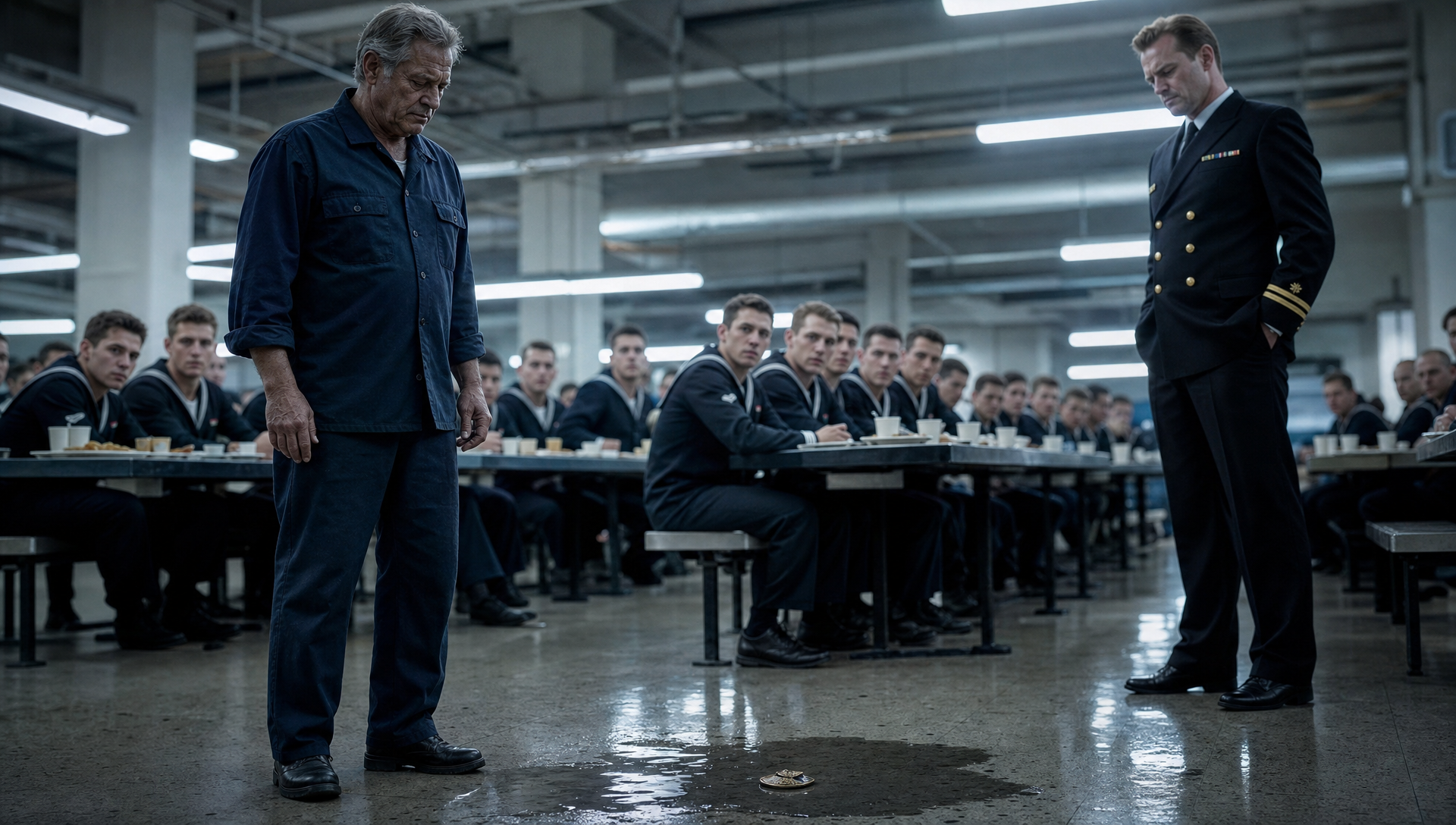
Mason’s face reddened. He turned toward the puddle beside the mop bucket — dirty water reflecting the white ceiling panels — and held the badge above it.
Several people stopped breathing.
Robert saw what was coming.
“Do not.”
The warning carried no volume. It carried something heavier than volume.
For one second, Mason hesitated.
Then pride closed around him like a fist.
He opened his fingers.
The badge dropped.
It hit the tile with a sharp metallic crack, then landed face-down in the gray water.
The sound traveled through the entire cafeteria.
Robert did not move.
Mason pointed at it. “This place is for warriors. Not for impostors.”
The words hung beneath the humming lights.
Robert looked at the puddle. A dark stain spread across the cloth near his boots. His right hand curled slowly. Then it relaxed.
He had buried men after hearing explosions louder than buildings falling. He had watched fear break disciplined voices in the dark. He had endured pain that left no visible scar.
But the small badge in dirty water reached somewhere those memories couldn’t.
It had been placed in his hands on a rain-soaked pier. The hands presenting it had trembled from exhaustion. Several men stood nearby with bandages beneath their uniforms. One of them could barely stay upright.
Robert had never forgotten their faces.
He had never worn the badge for praise.
He wore it because forgetting felt like betrayal.
Mason saw only an old janitor staring at the floor.
He mistook grief for surrender.
“Pick up your mop,” Mason said.
Robert stepped toward the puddle. The sailors watched him bend. No one spoke. No one challenged the lieutenant. That silence pressed against Robert’s back like a hand.
His knees protested as he lowered himself. He ignored the pain.
His fingers moved toward the badge.
Mason shifted. The toe of his polished boot caught the yellow bucket.
Robert saw the motion from the corner of his eye — too late.
Mason kicked it.
The bucket shot sideways with a rattling crash. Dirty water surged across the floor and struck Robert’s hands, flooded over his shoes, spread in a wide gray sheet.
Sailors jerked backward. A tray fell near the wall.
Robert caught the rolling bucket before it hit a seated cook. The impact twisted his shoulder. Pain flashed down his arm.
He kept the bucket upright.
Mason looked down at him.
“Leave it,” he said. “That is where it belongs.”
Robert remained crouched.
Water dripped from his sleeves.
His breathing changed. Not faster. Deeper.
He reached into the puddle. His fingers found the badge. When he lifted it, water ran through the engraved lines of the trident.
He wiped it against his sleeve. Rubbed until the metal showed through.
Then he rose.
The room felt smaller when he stood.
Mason expected embarrassment. He found something else entirely.
Robert’s face held no panic. No pleading. No confusion. Only a measured disappointment that made Mason feel, briefly, like he was the one being judged.
The lieutenant covered that feeling with contempt.
“You should be grateful I’m not calling security.”
Robert turned the badge over in his hand.
“Do you know who this badge belonged to?” he asked.
The question changed something in the room.
Mason’s smile faded for half a second. The young petty officer near the wall looked up again. A senior chief at the far table stopped pretending to eat.
Robert waited.
Mason glanced around. He sensed the attention shifting — away from him.
He stepped closer. “Should I?”
“His name was Chief Petty Officer Daniel Reeves,” Robert said.
His voice hadn’t risen. It didn’t need to.
“He was twenty-six years old. He went into the water before I did. He came out after me. He didn’t complain about either.”
The petty officer near the wall set his tray down.
“Daniel handed me this badge on a pier outside Coronado. He said he wanted me to keep it because he was afraid of losing it overseas.” Robert’s thumb moved across the trident. “He was right to be worried. He didn’t come back.”
Something shifted in Mason’s posture. A tightening around the eyes.
“That’s a very convenient story,” he said.
“It’s the only one I have.”
“And you expect me to take the word of a maintenance worker.”
“I don’t expect anything from you,” Robert said. “I’m telling you who he was so that when you think about this later — and you will — you’ll know exactly what you dropped on the floor.”
The silence in the cafeteria had changed quality. It was no longer the silence of shock.
It was the silence of men deciding something.
Mason heard it. His jaw tightened.
“I am a lieutenant in the United States Navy,” he said. “You are a janitor. Whatever you were — whatever story you’re selling — it doesn’t change what you are right now.”
“No,” Robert agreed. “It doesn’t.”
He reached for his work shirt. He pinned the damaged badge back where it belonged — slightly crooked now, the clasp bent — and looked at Mason without anger.
“It changes what you are.”
Mason opened his mouth.
The cafeteria door opened first.
The sound was ordinary — the soft hydraulic hiss of a heavy door on its hinge. But the reaction was not ordinary. Sailors straightened. Forks lowered. Two junior officers behind Mason went rigid.
Rear Admiral Patricia Holloway walked in.
She was not in her dress uniform. She wore a working jacket and reading glasses pushed up on her forehead. She was carrying a coffee mug and a folder, the way she did every Tuesday when she ate lunch with the enlisted staff.
She stopped inside the door.
Her eyes moved across the room. The spilled water. The overturned bucket. Robert’s soaked sleeves. Mason’s expression. The badge pinned crookedly on the old man’s chest.
She didn’t speak immediately.
That silence was its own language.
“Lieutenant Reed,” she said finally.
Mason turned. His face changed completely.
“Admiral Holloway.” He straightened. “Ma’am, I was addressing a situation—”
“I see that.”
She crossed the cafeteria slowly. Sailors moved back without being asked. She stopped in front of Robert and looked at him directly.
“Mr. Kane.”
Robert nodded once. “Admiral.”
She knew his name.
Mason blinked.
Holloway looked at the badge — the bent clasp, the slight tilt, the water stain still drying at its edges — and something moved across her face.
“Daniel Reeves,” she said quietly. Not a question.
“Yes, ma’am.”
She was quiet for a moment. Then she looked at Mason.
“Lieutenant. Walk with me.”
It was not a request.
Mason followed her to the far side of the cafeteria. Holloway spoke quietly. The sailors nearest the wall could see Mason’s face changing — the color draining, the confidence collapsing inward, the careful performance he had spent months constructing coming apart in about ninety seconds.
She spoke for three minutes.
Mason said nothing back.
When she finished, she returned to Robert.
“Mr. Kane. I apologize for this.”
Robert shook his head. “It’s not yours to apologize for.”
“I’m doing it anyway.”
She looked at the badge again.
“I served under Daniel’s father,” she said quietly. “Before the Gulf. He talked about his son the same way you talk about him.” She paused. “I didn’t know you’d served with him.”
“Most people don’t know. I prefer it that way.”
“Why?”
Robert looked at the badge for a moment.
“Because if people knew, they’d treat me differently. And I don’t want to be treated differently. I just want to do my work.”
Holloway studied him. The kind of studying that took years to learn.
“You could have stopped this,” she said. “One sentence. ‘I’m a retired Senior Chief.’ This would have ended differently.”
“Yes, ma’am.”
“Why didn’t you?”
Robert was quiet.
“Because a man who only respects you after he learns your rank,” he said, “didn’t learn anything worth respecting.”
Holloway was quiet for a long moment.
Then she nodded.
“Fair enough.”
She turned back to the room. Sixty sailors were watching her with the particular stillness of people who understand they are witnessing something they will remember.
“As you were,” she said.
The cafeteria began to breathe again. Slowly.
Forks moved. Coffee cups finished their journey to waiting mouths. Conversations resumed — quieter, careful, in low tones that suggested people were talking about what they had just seen.
Mason Reed had not returned to the room.
A senior chief walked by Robert’s table with a clean towel. He set it down without comment. A cook came out from the kitchen with a fresh mop head and exchanged it without being asked.
Small things. They added up to something.
Robert sat down at the end of one of the long tables — not because he needed to rest, but because his shoulder was beginning to argue with him.
He set the badge on the table in front of him.
The trident caught the light.
A young petty officer — the one from the wall, the one who had looked at him with recognition and fear — came and sat across from him. He was maybe twenty-two. His uniform still had the stiffness of someone who hadn’t worn it long enough to break it in.
He didn’t say anything at first.
Just looked at the badge.
“Is it true?” he finally asked. “Chief Reeves?”
“Yes.”
“I heard about him at A School. They told us about the mission.” The young man hesitated. “They didn’t say anyone survived.”
“Most didn’t.”
“But you did.”
“I did.”
The petty officer looked down at his hands.
“How do you do this?” he asked. “Come in every day. Clean the floors. After everything.”
Robert looked at him.
“The floor needs cleaning,” he said.
The petty officer looked up.
“That’s it?”
“The pipes need fixing. The drains need clearing. The people eating here need a clean room to eat in. That’s real work. It matters.” Robert picked up the badge. “A man I respected once told me that service isn’t the uniform. It’s what you do when no one’s watching and there’s nothing in it for you.”
The young man was quiet.
“Chief Reeves told you that?”
“His father did. At a funeral.” Robert turned the badge over. “Daniel was still in diapers. His father buried a teammate and said it standing over the grave. I was twenty-three. I never forgot it.”
A petty officer two tables away had stopped eating entirely.
The young man across from Robert looked at him differently now — not with pity, not with the complicated awe of someone who had learned a secret, but with the steadier look of someone trying to understand something real.
“What happened to the lieutenant?” he asked.
“That’s above both of our pay grades,” Robert said.
He stood.
His shoulder ached. His shoes were still damp. He had three more work orders before four o’clock — a stuck drain in the officer mess, a flickering panel in the east corridor, a water pressure complaint in the senior enlisted quarters.
He tucked the badge carefully into his breast pocket. The clasp was bent beyond repair, but he had a jeweler on Rosecrans who could fix it for less than ten dollars. He’d been there three times before. The man knew the badge by name.
He picked up his mop.
“Sir,” the young petty officer said.
Robert paused.
The young man stood up and came to attention.
It was not a regulation gesture. It wasn’t required. No one had ordered it, and no senior officer was watching.
It was just a man deciding something.
Robert looked at him for a moment.
“Carry on,” he said.
He walked back to the drain near the serving counter.
The cook who had asked him to check it earlier — a broad-shouldered woman named Theresa who had worked the station for eleven years — watched him pull out his tools.
“You need anything?” she asked.
“Wrench would help.”
She produced one from a drawer behind her in about four seconds.
He worked the drain loose, cleared the blockage — a clot of grease and a plastic wrapper that had no business being there — and had it sealed again in under seven minutes.
“Good?” Theresa asked.
“Good.”
She nodded.
“Lunch is over, but I can heat something up if you—”
“I’m fine.”
“You sure? You look like someone drop-kicked your morning.”
Robert almost smiled.
“Someone tried,” he said.
He rinsed his hands at the prep sink and dried them on a clean side towel Theresa provided without being asked.
He gathered his tools.
As he passed the main cafeteria floor, he noticed the long tables were almost clear now. A few stragglers finished their meals. A junior officer was wiping down the far counter. The floor where the bucket had spilled was already dry — someone had cleaned it while he was at the drain.
The badge was still in his pocket.
He pressed one hand to the outside of his shirt, briefly, over the place where it rested.
He walked through the cafeteria door and into the east corridor.
Three hours later, the water pressure complaint in the senior enlisted quarters turned out to be a corroded valve joint — the kind that gives out quietly for months before anyone notices. He replaced it from the parts cart, bled the line, and tested the pressure twice.
He was sealing the access panel when he heard boots on the floor behind him.
He didn’t turn around immediately.
“Mr. Kane.”
He turned.
Mason Reed stood alone in the corridor.
He was not in his uniform. He wore a plain collared shirt, civilian trousers. His face looked like something that had been pressed flat.
Robert waited.
Mason’s jaw moved. He seemed to be having a private argument he was losing.
“I want to say something,” Mason said.
“All right.”
“I was wrong.”
The words came out like they had been pried loose with difficulty.
“Not just incorrect. Wrong.” He looked at the wall briefly, then back. “I didn’t know who you were. And I’m aware that’s not — that it shouldn’t matter. But I didn’t know, and I should have—”
“You should have treated me the same either way,” Robert said.
Mason went quiet.
“Yes,” he said. “That’s what the admiral said.”
“She’s right.”
A long pause.
“I know.”
Robert studied him. There was a difference between a man performing regret and a man feeling it. The difference usually showed up in the eyes. Mason’s eyes looked like someone had taken something out of them.
“What happens now?” Robert asked.
“The promotion board review has been postponed. Pending an inquiry.” Mason’s voice was flat. “I may be reassigned. I don’t know yet.”
He said it without looking for sympathy.
Robert nodded.
“I want to see the badge,” Mason said. “I want to see the whole thing. If that’s — if you’re willing.”
Robert reached into his breast pocket.
He held the badge out in his palm. The trident ran clean across its center. The scratch was visible in the light. The bent clasp caught the corridor fluorescents at a small angle.
Mason looked at it for a long time.
He didn’t touch it.
“Chief Petty Officer Reeves,” he said quietly.
“Yes.”
“I’m sorry for what I did to it.”
Robert looked at the badge.
“He would have told you it was just metal,” he said. “He was wrong about that, but he would have said it.”
Mason looked at him.
“What would you tell me?”
Robert closed his fingers around it.
“That it wasn’t just metal today,” he said. “But I’ll carry it anyway.”
He put it back in his pocket.
Mason straightened slightly — not a salute, not a performance, just a man standing up straighter than he had been.
“Thank you for your service,” he said.
It was a sentence Robert had heard a thousand times. It had meant a hundred different things across those thousand repetitions. Empty words at airport gates. Awkward gratitude in parking lots. The careful, sincere weight of it from men who had also served.
He had learned to receive it simply.
“Take care of your people,” Robert said. “That’s all it was ever about.”
He picked up his tool cart.
The access panel was sealed. The pressure was restored. The valve joint would hold for another decade at minimum.
He walked the corridor back toward the maintenance bay, tools rattling softly in the cart.
The badge rested in his pocket.
The clasp was still bent. He would take it to the jeweler on Saturday. The man’s name was Victor. He charged eight dollars for a clasp repair and always asked about the badge without pressing for the story.
Robert had told him some of it, once. Not all. Some things stayed between the people who had been there.
He turned off the maintenance bay lights at the end of his shift.
He signed his work orders. Checked his next day’s schedule. Noted the leaking line in Building C that he’d already ordered parts for.
He hung his work shirt on the hook by the door.
The badge was still pinned to it, slightly tilted on its bent clasp.
He straightened it as much as he could with his thumb.
Not perfect.
But readable.
The trident was clear.
That was enough.
Original fictional stories. AI-assisted creative content.