The fluorescent lights in the underground parking garage buzzed like trapped insects. It was 6:47 p.m. and the structure was almost empty — just a few luxury sedans, a distant elevator hum, and Maya Vance, eighteen years old, moving quietly between the columns with her grey backpack slung over one shoulder.
She wasn’t browsing. She wasn’t lurking. She was cutting through the fastest route to the elevator so she could drop her father’s credentials at the security desk before his 7 p.m. briefing.
She never made it past column C.
“Hey. Stop right there.”
Officer Piaimitten’s voice bounced off the concrete. Maya stopped and turned slowly — hands visible, posture careful, every instinct trained by years of watching her father navigate exactly these kinds of moments.
“Can I help you, Officer?”
“What are you doing down here?” He was already moving toward her, hand resting on his belt. “This lot is permit only.”
“I know. I’m dropping something off for my father. He works in the building upstairs.”
Piaimitten looked her over — grey hoodie, sneakers, backpack, brown skin, quiet voice. He had made his decision before she finished the sentence.
“ID.”
“Of course.” She reached for her pocket.
“Slowly.”
She produced her student ID. He glanced at it without reading it.
“What’s in the bag?”
“Books. A laptop. My dad’s credentials — he forgot them.”
“Open it.”
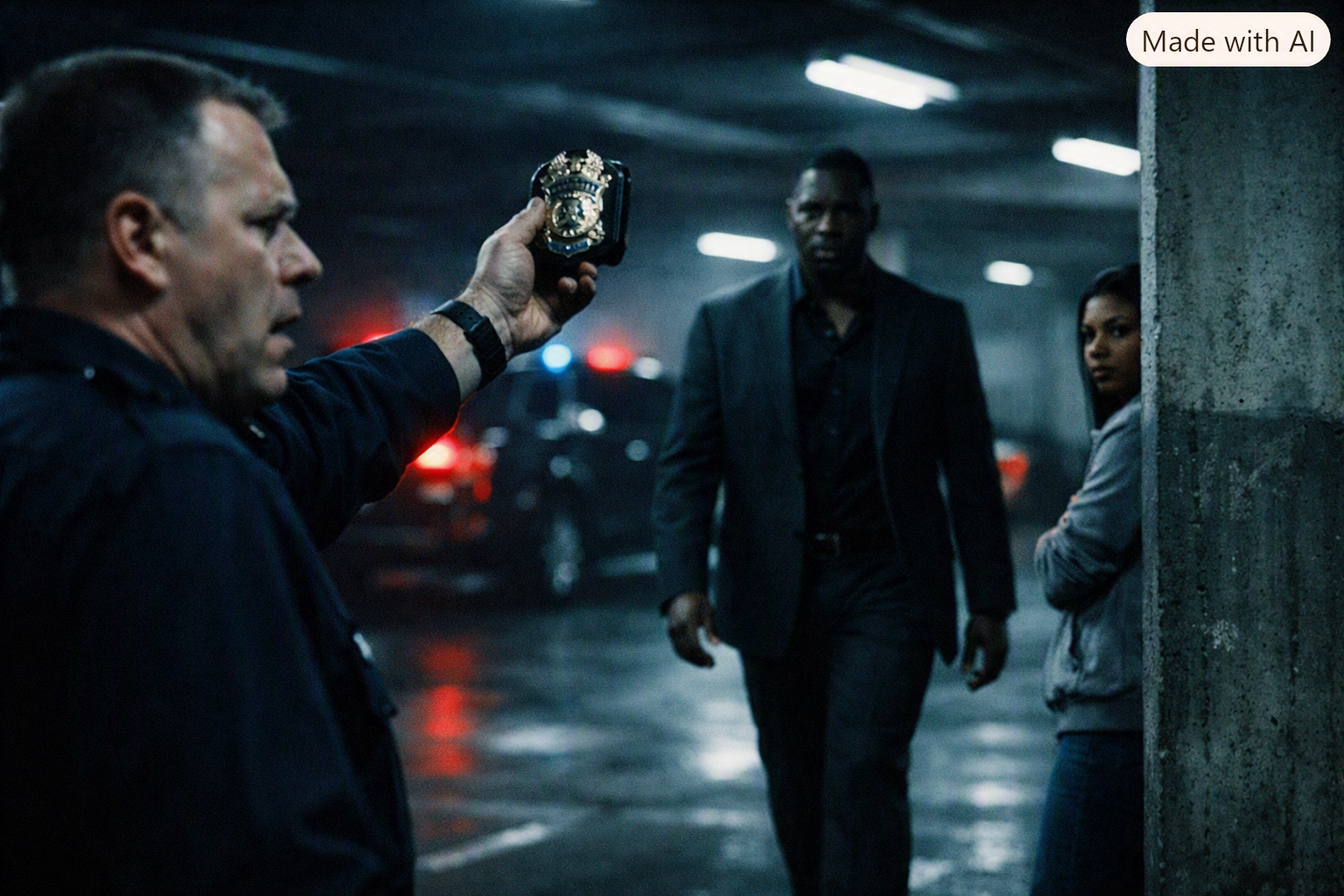
She unzipped the backpack and held it toward him. He didn’t wait — reached in himself, fingers brushing past her notebook and water bottle until they closed around something heavy. Cool metal. A solid shield, silver and gold, embossed with a federal seal.
Piaimitten’s hand paused.
He pulled it out. Turned it over. Read the name.
Marcus Vance. Federal Director. United States Department of Homeland Security.
Before he could speak, the air in the garage changed.
A low mechanical roar rolled down the entry ramp. Then headlights. Then a second pair. Two black SUVs swept into the bay, tires squealing on polished concrete, red and blue lights strobing silently against the pillars.
Four doors opened at once.
The man who stepped out of the lead vehicle did not run. He didn’t need to. He walked with the particular calm of someone who had long ago stopped feeling the need to prove anything. Dark suit. No tie. Eyes fixed on Piaimitten like two points on a compass.
Marcus Vance stopped three feet from the officer.
He looked at his daughter — her back pressed to the column, her breathing controlled but fast, a red mark already forming above her wrist from where Piaimitten had grabbed her.
Then he looked at the man holding his shield.
“You have a problem with my daughter?”
The garage went absolutely silent.
Piaimitten’s mouth opened. Nothing came out.
Marcus held out his hand. Piaimitten placed the shield into it without a word.
“Maya.” Marcus stepped between them, his back to Piaimitten now, his full attention on her. He checked her wrist with two fingers — clinical, precise, furious under the surface. “Are you okay?”
“I’m fine, Dad.”
“You’re not fine. Did he touch you?”
She hesitated for half a second. That was enough.
Marcus turned back to Piaimitten. When he spoke, his voice was very quiet. That was the most dangerous version of it.
“Officer, physically restraining a minor without cause, in an empty structure, based on no observable threat — that is not procedure. That is a liability.” He paused. “And it is not something I am going to let go.”
Piaimitten tried to salvage it. “Director, sir, we’ve had three break-ins in this garage in the past month—”
“Her name is on the building’s visitor log. She was buzzed in by security. Her ID places her as a student, not a suspect.” Marcus tilted his head. “What exactly triggered your assessment, Officer?”
Piaimitten had no answer.
One of the federal agents behind Marcus was already pulling out a phone, timestamping the moment. Another had moved to the pillar and was photographing the scuff marks Maya’s backpack had left on the concrete when she was shoved.
“Dad, it’s okay,” Maya said quietly, coming to stand beside him. “Let’s just go.”
Marcus looked at her. He nodded once. He put his arm around her shoulder.
As they walked toward the elevator, Piaimitten stood alone in the bay, the sound of his own breathing suddenly very loud.
Marcus had driven fast and said very little on the way home. Maya knew that silence. It was the kind that meant he was processing, organizing — deciding what needed to happen next rather than what felt satisfying right now.
Over dinner — pasta he’d made too quickly, sauce from a jar he didn’t bother to warm — she watched him eat and said, “You’re going to call Captain Henderson, aren’t you?”
“In the morning.”
“You don’t have to—”
“Maya.” He set down his fork. “He put his hands on you.”
“I know.”
“There’s security footage. There are four federal witnesses. And there’s a mark on your wrist.” His voice stayed level. “This isn’t about punishing one officer. It’s about the pattern that makes officers like him think they can do this.”
She was quiet for a moment, turning her fork in her hands. Then: “What scared me wasn’t just him. It was how fast he decided who I was. He looked at me and the case was closed.”
Marcus leaned back in his chair. “That’s the most dangerous kind of judgment. The kind that moves before the mind does.”
“How do you deal with that? In your work?”
He thought about it. “You build frameworks that slow people down. Make them account for their assumptions before they act on them.” He paused. “And you make it costly when they don’t.”
Maya nodded slowly. “Both parts,” she said.
“Both parts,” he agreed.
Captain Henderson reviewed the footage the next morning in his office with the blinds drawn. He watched it twice without speaking. The third time, he stopped it at the frame where Piaimitten’s forearm was across Maya’s shoulder, pressing her back against the pillar.
He closed the laptop.
“This is indefensible,” he said. “I want to be clear — I am not protecting this.”
“I’m not asking you to protect it,” Marcus said. “I’m asking you to address it through proper channels. IA review, retraining, community service component if the board sees fit. I’m not here to end a career. I’m here to make sure this doesn’t happen again — to her or to anyone else.”
Henderson studied him. “You could have made this a federal matter. You could have walked in here with a lot more leverage.”
“I know.” Marcus stood. “I chose not to. What happens next is up to you and your board.”
He left Henderson sitting with the laptop closed on his desk and the weight of the footage still running behind his eyes.
The internal affairs review took eleven days. Piaimitten was placed on administrative duty pending the outcome. During those eleven days, he sat through three interviews, reviewed his own body camera footage — the camera he had turned off three minutes before the encounter, a fact the investigators noted in writing — and came to understand, slowly and without comfort, exactly how far outside procedure he had gone.
On the twelfth day, he sat outside the hearing room in a plastic chair with a paper cup of coffee going cold in his hands.
He heard footsteps in the corridor. Looked up.
Marcus Vance was walking toward him. No agents. No suit jacket. Just a man in a button-down shirt carrying two coffees from the machine down the hall.
He stopped in front of Piaimitten and held one out.
Piaimitten stared at it. Then took it.
“You lost your judgment in that garage,” Marcus said. Not unkindly. Not kindly either — just directly, the way you speak to someone you’re choosing to take seriously. “When fear and suspicion replace duty, you become the threat.”
Piaimitten looked at the floor. “I know.” A pause. “I misjudged her. I had already decided before I said a word.” He exhaled. “I’m sorry, Director. That doesn’t mean much, but I am.”
Marcus looked at him for a long moment. “It means something when you follow it with different behavior.” He picked up his own cup. “That’s the part that’s up to you.”
He walked away down the corridor as the hearing room door opened and Piaimitten’s name was called.
The board handed down its ruling three weeks later: mandatory suspension, required participation in a community dialogue program, and a 90-day retraining track with an implicit bias focus. No termination — but no path forward without documented change.
Marcus brought the ruling home and set it on the kitchen counter without comment.
Maya read it, then looked up. “Is this enough?”
“No,” Marcus said simply. “Which is why I’m working with Henderson on something broader.” He pulled out a chair. “I want to talk to you about it.”
He laid out the framework he and Henderson had been drafting — a district-wide de-escalation protocol built around three core principles: pause before contact, account for assumption, document your reasoning. The program needed a name. It needed community input. It needed, ideally, a youth voice on the advisory board.
Maya listened. Then she said: “I want to speak at the panel.”
Marcus looked at her carefully. “You don’t have to. You’re not obligated to—”
“I know I’m not obligated.” She folded her hands on the table. “I want to. Because I have something to say and I think it’ll land differently coming from me than from you.” A small pause. “No offense.”
“None taken,” he said. “You’re probably right.”
The community panel was held in a conference room at the Central Precinct on a Thursday afternoon. Folding chairs, a long table, bad overhead lighting. About forty people — recruits, officers, a few community organizers, two city council aides in the back row.
Maya walked in with her notes in her hand and immediately saw Piaimitten sitting in the third row.
She held his gaze for exactly two seconds. Then she sat down at the table and opened her notebook.
When it was her turn to speak, she didn’t use her notes.
“I want to talk about the moment just before contact,” she said. “Not during. Before. Because that’s where most of these situations are actually decided.” She paused. “When Officer Piaimitten saw me in that garage, I think he was already afraid of something. And fear, when it doesn’t have anywhere to go, turns into force.”
The room was very still.
“I’m not interested in vilifying him. I’m interested in the mechanism. The moment where an assumption becomes an action before there’s been a single word of conversation.” She looked around the room. “Every person in this room has done that. So have I. The difference is whether you have enough structure around you to slow that moment down.”
After the panel, she stood in the hallway drinking water from a paper cup when she heard her name.
“Miss Vance.”
Piaimitten was across the hall, hands in his jacket pockets, keeping his distance.
“I owe you a direct apology,” he said. “Not through a board. Not through a statement. To your face.” He didn’t look away. “I let years of bad calls and burnout make me into someone I didn’t plan to be. What I did to you was wrong. Not a mistake — wrong.”
Maya listened without interrupting.
“I heard you in there,” he said. “The mechanism thing.” A pause. “You named it better than anyone has in three years of training.”
She let the silence sit for a moment. Then: “Apology accepted, Officer. Just remember that the next person you encounter has a story you haven’t read yet.”
He nodded. “Yes, ma’am.”
She walked away down the hall with her notes still in her hand, and Piaimitten stood alone at the wall for a moment, feeling something shift — small, uncomfortable, and real.
The program that Marcus and Henderson built together was called the Vanguard Initiative. It rolled out across the district over four months, then spread to two neighboring counties. The core framework was simple: three documented pauses before physical contact, mandatory self-audit questions logged in real time, and quarterly review sessions with youth community boards.
It wasn’t a revolution. It was a ratchet — turning the mechanism one notch at a time toward something more accountable.
Six months after the parking garage, the city held a ceremony honoring the program’s implementation. The auditorium held maybe three hundred people. Captain Henderson gave the opening remarks. Two council members gave longer ones.
When Marcus stepped to the podium, he scanned the front row until he found Maya — her grey backpack on the seat beside her, her hands folded, watching him with the calm, alert attention that had always made him prouder than he knew how to say.
He bypassed the prepared remarks entirely.
“True security isn’t built on power,” he said into the microphone. “It’s built on accountability. On restraint. On the courage of young people who look at broken systems and say — this can be better, and I’m willing to say so out loud.” He looked at his daughter. “One of those young people is sitting in the front row.”
Maya received the Youth Leadership Commendation at the end of the ceremony. She stood at the podium with the certificate in her hands for a moment before she spoke.
“I didn’t do anything extraordinary,” she said. “I told the truth about what happened to me. The extraordinary part was that people listened.” She paused. “That’s the part worth protecting.”
At the back of the auditorium, Officer Piaimitten stood in dress uniform among his colleagues. When the applause started, he brought his hands together and did not stop until everyone else already had.
On a warm evening in late June, Maya and Marcus sat on the front porch with glasses of iced tea, watching the neighborhood go quiet. She was two weeks from leaving for university — criminal justice, pre-law track, a school four states away.
“I used to think being strong meant never letting anyone see you were scared,” she said, watching a neighbor walk a dog down the empty sidewalk. “Like if you could just hold it together all the way through, that was strength.”
“And now?”
She turned her glass slowly in her hands. “Now I think strength is being scared and still saying what’s true. Still walking into the room.” She leaned her shoulder into his arm. “The garage scared me. The panel scared me more. But the panel was the right thing.”
Marcus was quiet for a moment. Then he said, “You know what scared me?”
She looked up.
“That I wasn’t there.” His voice was even, but she heard what was under it. “That you were alone in that garage and I was in a briefing and you were handling it by yourself because that’s what you’d learned to do.” He exhaled. “I taught you resilience before I taught you that you could call me.”
“I did call you,” she pointed out. “Eventually.”
“You called me after.”
“That’s still calling.”
He laughed — a short, real sound — and put his arm around her shoulder.
They stayed on the porch until the streetlights came on.
Move-in day was a Saturday. Marcus loaded her bags into the trunk — the grey backpack last, nested on top of everything else, a little scuffed along one side where it had scraped the concrete column.
He didn’t throw it out. She didn’t ask him to.
They drove past the Central Precinct on the way to the highway. Through the chain-link fence, a new recruit class was running drills in the courtyard — stopping, pausing, two-step protocols, log your reasoning before you act. One of the training officers watching them from the sideline was Piaimitten.
Maya didn’t say anything. Neither did Marcus.
Outside her dorm, he lifted her bags to the curb, and then he held her — both arms, no words, the kind of hug that doesn’t try to mean anything specific because it means everything.
“I’m proud of you,” he said finally, against her hair. “You changed more than you know.”
She pulled back and looked at him. “We both did.”
She picked up her backpack, slung it over one shoulder, and walked through the dorm entrance with her head up.
Marcus stood beside the car and watched until she disappeared around the corner. Then he stood there a little longer, hands in his pockets, in no particular hurry to leave.
He had built thirty years of career out of protecting people from the outside.
His daughter had just taught him what the inside looked like.
Original fictional stories. AI-assisted creative content.