“Don’t take the first bite!”
The words cut across the ballroom like a fire alarm.
Maya Vance burst through the service doors in a flour-dusted apron, one shoe half off her foot, chestnut hair flying across her face. She was eight years old and she was terrified.
Three hundred guests in evening gowns and tuxedos turned at the same moment.
Roman Sokolov stood at the center of the room, a gold ceremonial knife raised above the top tier of a six-layer black wedding cake. The man was forty-five, built like someone who had never once backed down from anything, jaw like carved stone. He had not lowered the knife.
His dark eyes fixed on the child.
The musicians stopped.
“Who are you?” he asked.
Maya opened her mouth. Nothing came out.
Then Sarah Vance appeared from the service corridor, white apron twisted around her waist, face white with exhaustion and something worse — fear.
“Maya.” She reached for her daughter.
Maya pulled back. “Mom, no. He can’t eat it.”
The murmur that moved through the guests was the kind that doesn’t stop on its own.
At Roman’s side, Elena Rostova — ivory gown, pearl earrings, the composed smile of a woman who had spent years practicing it — turned toward security.
“Remove them,” she said pleasantly.
Two guards moved forward.
Maya looked straight at the cake.
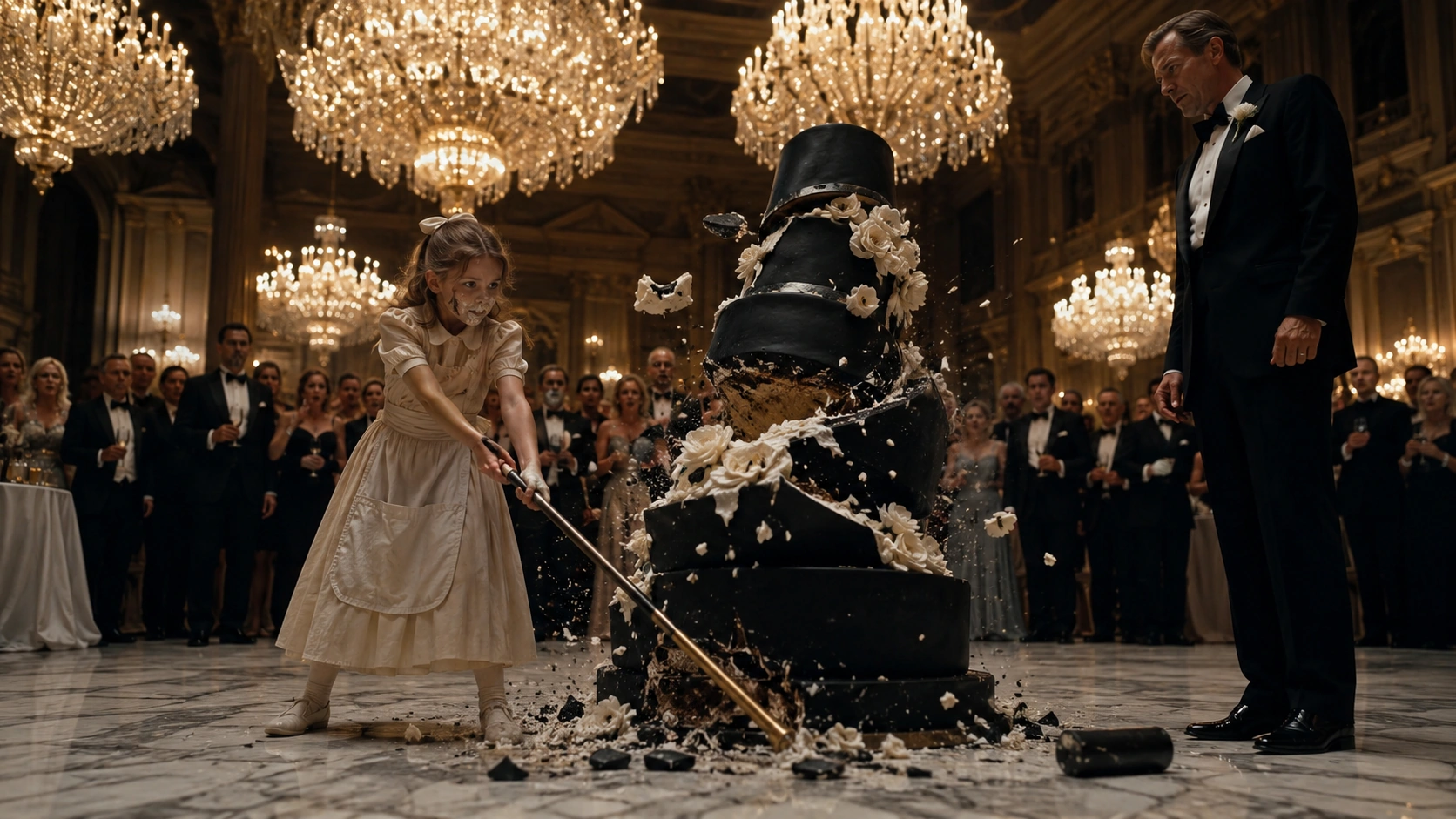
Then she spotted the brass fireplace poker beside the ceremonial hearth and grabbed it with both hands before Sarah could get to her.
“Maya, don’t—”
The child swung.
The poker connected with the second tier. Black fondant cracked. Sugar flowers exploded across the silver table. Guests stumbled backward as a dark cylindrical object rolled out of the ruined cake and came to rest against Roman’s shoe.
The room went so quiet you could hear a champagne flute tip against someone’s ring.
Elena’s smile didn’t fall.
It flickered. Just for a second.
But Roman saw it.
Her eyes hadn’t widened in confusion. They’d widened in recognition.
“Get her out of here,” Elena said, and the warmth was completely gone from her voice.
“He can’t touch it either,” Maya said.
Roman stepped between the child and the cake immediately.
“Everyone stay back.”
His security team formed a perimeter. Guests pressed toward the walls. Near one of the chandeliers, Roman’s longtime lawyer and closest friend, Julian Cross, stood absolutely still — his hand had stopped halfway to his jacket pocket.
Roman noticed.
He noticed everything.
“Julian,” he said quietly. “Don’t move.”
Julian’s hand dropped.
Roman turned to Maya.
“Where did you get the idea something was wrong?”
The girl reached into her apron pocket with shaking hands and held up a cracked phone.
“I heard her voice,” Maya whispered.
“Whose voice?”
Maya pressed play.
Static. Then a woman’s voice, slightly muffled — unmistakably Elena’s.
“The second tier. Once Roman takes the ceremonial bite, the room will empty. Cross will handle the documents before midnight.”
A man’s voice replied, distorted by distance. “What about the girl?”
Elena again. “She heard nothing.”
Maya stopped the recording.
Every person in the ballroom seemed to breathe at exactly the same time.
Roman turned toward his bride with an expression that had no warmth left in it whatsoever.
Elena laughed softly.
It was the worst possible response.
“Roman.” She tilted her head. “You cannot believe a damaged recording from a child who has been hiding in a kitchen.”
“My daughter doesn’t lie,” Sarah said.
Elena looked at her as though seeing her for the first time. “And you are?”
“Catering staff.”
“She’s my mom,” Maya corrected.
Roman’s gaze moved between them. Something about Sarah’s face bothered him in a way he couldn’t name. Not recognition exactly. The edge of it.
Julian stepped forward, recovering his composure.
“This reception should be cleared. We can’t risk—”
“You will not move,” Roman said.
Julian stopped.
Roman gestured to his head of security. “Lock the doors.”
“You cannot imprison three hundred people,” Elena said.
“I can secure my own house.”
He crouched to Maya’s level — this powerful, severe man going to one knee on a marble ballroom floor.
“You pressed record because you were making a video of the cake?”
“For Mom. I wasn’t supposed to be in the main hall.” Maya swallowed. “I heard Mrs. Rostova talking behind the wine shelves with Mr. Cross. My phone was already running.”
“What did you see Cross do?”
“He took something small from his pocket. He gave it to the cake decorator.”
The pastry chef across the room shook his head frantically. “It wasn’t me. I delivered the cake at six. Someone entered the prep room after the safety inspection.”
Police arrived within twelve minutes. The cylindrical object was carefully contained. Guests were moved into the adjoining gallery. Elena and Julian were placed in separate rooms under guard.
Roman brought Maya and Sarah to the private library.
He poured water. Didn’t drink any of it.
“Tell me why Elena looked at you like you were the bigger threat in the room.”
Sarah’s face closed. “She doesn’t know me.”
“She knows something about you.”
“That’s not the same thing.”
“Sarah.” His voice was quiet but it didn’t leave room for evasion. “I have watched people hide things from me for thirty years. I know the difference between someone protecting themselves and someone protecting information.”
Maya looked up at her mother.
“Mom. Should I tell him?”
Sarah’s hand gripped her shoulder.
“Tell me what?” Roman asked.
Maya lowered her voice to a stage whisper. “Mom has a picture of you. In the blue box. The one we’re not supposed to open.”
The library went very still.
“What picture?” Roman asked.
“It has nothing to do with tonight,” Sarah said.
“Your daughter possesses a recording that implicates my bride and my lawyer. Elena went pale when she saw you. You are standing in my house and you have a picture of me in a box you hide from your child. Everything has something to do with tonight.”
Sarah’s exhausted face filled with pain.
“You won’t like the answer.”
“I haven’t liked a single answer since that child came through my door.”
Before Sarah could respond, the detective entered.
“The object has been identified.”
Roman stood. “What is it?”
“Not an explosive. It was designed to release a fast-acting sedative vapor when exposed to heat.”
Sarah exhaled.
“The ceremonial candles beneath the cake,” Roman said.
“That’s our current theory. The concentration would have caused dizziness and likely loss of consciousness in people nearest the table. Not fatal under normal conditions, though guests with certain vulnerabilities could have suffered serious complications.”
Roman looked at Maya.
The child had not just ruined a cake.
She had kept a room full of people from becoming helpless.
The detective set an evidence sleeve on the desk. Inside was a tiny flash drive, found inside the cake’s central support column.
Julian’s unease suddenly made complete sense.
The sedative was the distraction. The flash drive was the point.
“What’s on it?”
“We’re processing it now.”
Twenty minutes later, the answer came back.
Property transfers. Medical authorizations. A corporate voting agreement, every page bearing Roman’s forged signature, transferring temporary control of Sokolov Holdings to Elena if Roman became medically incapacitated in the first thirty days of their marriage.
Roman put the tablet down slowly.
“I never signed this.”
Elena, brought back in under guard, kept her composure. “A recording from a child and documents of unknown origin aren’t evidence.”
“My team believes the signatures were digitally reproduced,” the detective said.
Roman turned the screen toward her. “You planned to incapacitate me in front of three hundred witnesses and take my company.”
“I planned nothing.”
“Then explain Julian’s name on every authorization.”
He ordered Julian brought in.
Julian entered the room calmly. He looked at the documents on the desk. He looked at Elena.
Then he said, quietly: “I told you not to keep copies.”
The words landed like a building coming down.
Elena stared at him. “You fool.”
Roman’s face had become stone.
“What was supposed to happen?” he asked.
Julian loosened his tie. The performance was done.
“The vapor would cause confusion. You would appear to collapse. A private medical team — arranged by Elena, financed separately — would remove you through the service entrance under the guise of a medical emergency. By the time you recovered, the documents would be filed.”
“You intended to leave me alive.”
Elena’s voice was brittle. “A dead husband creates investigations. An exhausted husband recovering from a public medical episode creates sympathy and buys time.”
Roman looked at her for a long moment.
Then he looked at Sarah.
“Now you’ll tell me.”
Sarah had been standing in the doorway. She came into the room.
“Twenty-nine years ago,” she said, “your father didn’t buy this estate from the Waverly family.”
Roman frowned. “That’s what the deed states.”
“He bought it from my grandmother.”
The room was absolutely silent.
“My mother worked here after the sale,” Sarah continued. “She managed your father’s correspondence, household accounts and charitable foundation.”
“I don’t remember her.”
“You knew her as Anna Vale.”
The name hit Roman like a physical thing.
Anna Vale. The woman who had raised him after his own mother disappeared when he was four. She had dressed his childhood injuries, taught him piano, read to him when he was sick. Then, when Roman was sixteen, Anna vanished. His father told him she had stolen money and fled the country.
Roman had believed him.
He had spent twenty-nine years hating her for leaving.
“Anna was your mother?” he said.
Sarah nodded.
He looked at her face again — really looked — and saw it. The curve of the eyes. The particular stillness that Anna used whenever she was about to say something he didn’t want to hear.
“What happened to her?”
Sarah’s voice broke. “She found that your father had been routing charitable funds into private accounts. When she threatened to expose him, he had her accused of theft. The records were forged. She had no way to fight it.”
“She tried,” Roman said quietly.
“She tried until she died. Three months after she disappeared from this house.”
Roman turned away.
Anna hadn’t abandoned him.
She had spent the last months of her life trying to protect him from his own father.
“Why didn’t you come to me when I inherited the company?”
“I did. I was seventeen the first time. His lawyers told me they would accuse my mother publicly and take me into state custody if I kept pursuing it.” Sarah paused. “Later, when you took over, I tried three more times. Letters, a formal filing. Everything disappeared.”
Roman looked at Julian.
“You intercepted them.”
Julian didn’t answer. He didn’t need to.
Elena said, from the corner, “This is very moving, but it has nothing to do with me.”
“It has everything to do with you,” Sarah said.
She reached into her apron and set a small brass key on the desk.
“Six months ago, I found the location of my mother’s hidden ledgers. I came back to cater a foundation dinner. I was checking an old service map in the kitchen when I saw notations in my mother’s handwriting.” Sarah’s eyes moved to Elena. “She came into the kitchen while I was reading it.”
“I saw a staff member going through private property,” Elena said flatly.
“You saw the words Roman’s true inheritance written beside the pantry wall. And you had six months to figure out what that meant before the wedding.”
Roman was very still. “What inheritance?”
Sarah looked at Maya.
“My grandmother didn’t sell this estate outright. She created a conditional trust. Your father could use the property, but legal ownership would pass according to a sealed clause — to Anna Vale’s eldest living descendant.”
Roman followed her gaze.
To Maya.
No one spoke.
The eight-year-old who had come running through the ballroom in a kitchen apron.
The child who had grabbed a fireplace poker and smashed a cake to save a man she didn’t know.
She owned the house they were standing in.
“That’s impossible,” Roman said.
“No,” Julian said quietly. “It isn’t. My father buried the trust amendment on behalf of Roman’s father. When Elena found Sarah’s markings, she made me investigate. What I found confirmed it.”
“You could have told me,” Roman said.
Julian’s smile was hollow. “And admit that my family’s legal practice was built on fraud?”
“So you planned another fraud.”
“I planned to survive.”
Roman crossed the room in four steps and stopped directly in front of him.
“You planned to drug me in front of three hundred people. In my own home.”
“In a house that isn’t legally yours.”
Roman didn’t move. “In the house that contains every person I care about. Including a child.”
Julian had no answer for that.
Maya pulled at Sarah’s sleeve.
“Does this mean the house is ours?”
Sarah crouched beside her. “It means lawyers will need to look at everything.”
Maya considered this seriously. “Can we still live in our apartment?”
Something broke loose in Roman’s chest. Not quite laughter. Not quite grief. The child had just learned she potentially owned one of Chicago’s grandest estates, and her first concern was whether she could go home to the small apartment where her mother could hear her from every room.
He looked at Maya.
“You can live wherever you choose,” he said.
Elena stepped forward. “You are going to throw away everything — your company, your reputation, your life — because of a frightened child and a servant with a grudge?”
Roman turned.
“No. I am going to lose what was never mine because the truth was buried from people who deserved it.”
Police led Elena from the library. As she passed Sarah, she said, very quietly, “You think you won?”
Sarah looked at her without flinching. “My daughter kept you from winning. That’s enough.”
Julian paused at the doorway under guard.
“One more thing,” he said.
Roman waited.
Julian looked at Sarah. “Anna didn’t hide the ledgers only to expose what Roman’s father stole. She hid proof of who Roman’s mother was.”
Sarah went completely still.
Roman’s voice came out barely above a whisper. “Who was she?”
Julian nodded toward Sarah.
She was already shaking her head. “No.”
But Roman had already seen it. The way Julian had looked at her. The way Anna’s letter had been addressed to Roman. The way Sarah had carried a picture of a man she claimed not to know inside a box she kept hidden.
“What was your mother’s full name?” Roman asked.
Tears slipped down Sarah’s face.
“Anna Sokolov Vale.”
Roman gripped the desk. “My father’s sister.”
Sarah nodded.
Anna hadn’t been just an employee or a caregiver. She had been his aunt. The original estate had come from her branch of the family. But Julian had said the ledgers held proof of Roman’s biological mother — and Anna was his father’s sister, not his mother.
He said it before she did.
“My father had an affair.”
Sarah nodded slowly. “With a young housekeeper. When she became pregnant, he paid her to disappear. Anna refused to let the baby be sent away. She raised you herself.”
“Who was the housekeeper?”
Sarah turned toward the portrait above the fireplace. A large painting of Roman’s father in his prime — and barely visible in the background, half hidden behind him, a young woman in a gray uniform.
Roman had walked past that portrait every day of his life. He had never once looked at her.
Sarah said the name softly.
“Margaret Vance. My grandmother.”
The relationships crashed together all at once.
Sarah was Anna’s daughter — which made her Roman’s cousin by blood, through Anna’s side of the Sokolov family.
And Sarah was also the granddaughter of Roman’s biological mother — which made Maya his closest living blood relative.
Two families. Two buried secrets. Both hidden in the same house, behind the same kitchen wall, under the same chandeliers.
Maya stepped close to Roman and looked up at him.
“So are you my uncle?”
No one had an answer.
Roman lowered himself into a chair. For the first time that evening, the powerful, composed, undefeated man looked completely lost.
Maya moved toward him carefully, the way you approach someone who might be fragile.
“You can be my cousin if uncle feels too old,” she offered.
Sarah made a sound between a sob and a laugh.
Roman looked at this child. The one who had risked everything on a cracked phone and a fireplace poker. The one who owned the house he was sitting in. The one who was, in every way that mattered, his family.
“Cousin is fine,” he said.
By dawn, the guests were gone.
White roses wilted in empty vases. Champagne had gone flat. The ruined black cake sat sealed behind police tape, the broken fondant still scattered across the silver table.
Elena Rostova and Julian Cross were arrested before sunrise. The investigation expanded fast — medical contractors, financial advisers, three partners at Julian’s firm, two offshore accounts that had been open for decades.
But the most important discovery came from behind the kitchen wall.
Using Anna’s brass key, investigators opened a narrow iron compartment in the original stonework. Inside: ledgers. Letters. Photographs. The sealed trust amendment. And one envelope, addressed in careful handwriting to Roman.
He opened it alone. Then he wasn’t alone anymore — Sarah stood across the kitchen with Maya sleeping against her shoulder, and he read it again with them in the room.
My dearest boy,
If you are reading this, I failed to protect you in person. I hope I succeeded in leaving you the truth.
Your father taught you that power means possessing what others cannot take from you. He was wrong. Power means returning what should never have been stolen.
The house belongs to my daughter’s descendants. The company shares hidden in the Vale trust belong partly to you and partly to them. Do not repeat our family’s mistakes by fighting over either. Build something honest together — or walk away from all of it.
At the bottom, a single final line.
Sarah will recognize whether you became your father.
Roman set the letter on the table.
“What do you see?” he asked.
Sarah understood the question. Not what she saw in the documents.
What she saw in him.
“I see a man standing in a kitchen he never truly owned,” she said, “deciding whether losing it makes him smaller.”
Roman looked around the room. The morning light was coming through the windows. The mansion no longer felt like proof of anything he’d built. It felt like evidence of what had been hidden.
He placed the letter down.
“Transfer the estate to Maya.”
“The court hasn’t ruled yet.”
“It will.”
Sarah stared at him. “You don’t know that.”
“I know the documents are real. I know she should never have needed to run through a ballroom to stop adults from destroying each other.”
Sarah’s eyes filled.
“What about you?”
“I have other properties.”
“That isn’t what I meant.”
Roman looked at Anna’s letter.
“I don’t know yet,” he said honestly.
Six months later, Sokolov House reopened under a new name.
The Anna Vale Center for Families and Legal Advocacy occupied the ground floor. Its attorneys helped workers, single parents and young people fight fraud, coercion and financial abuse. The cases they took on in the first three months included fifteen workers whose wages had been stolen by shell companies connected to Julian’s firm.
The upper floors remained a residence.
Not Roman’s alone.
Sarah had insisted the mansion be placed in a protected family trust so that no single person could ever use it as leverage again. Roman agreed. He resigned as chief executive of Sokolov Holdings during the federal investigation, then returned six months later after the board voted to restructure and repay the funds diverted over decades. He sold three luxury properties to fund the restitution.
Society columns called it the collapse of an empire.
Roman called it a correction.
Elena accepted a plea agreement. Julian, hoping for leniency, disclosed every hidden account his father’s firm had maintained. Neither of them delivered the final revelation.
That came on the morning Maya’s guardianship trust was officially approved.
Roman, Sarah and Maya gathered in the mansion library with investigators and attorneys. A clerk unsealed the final document found behind the kitchen wall.
It wasn’t another deed.
It was a marriage certificate.
Anna Vale had secretly married Roman’s biological mother, Margaret Vance, in a private ceremony — recognized only years later through amended records and sworn testimony. They had built a life together in secret, protecting each other in a time when Roman’s father could have destroyed them both.
Margaret hadn’t abandoned Roman.
She had been forced out after threatening to expose his father’s crimes. Anna had raised the boy because Margaret trusted her more than she trusted anyone alive.
The last item in the iron compartment was a letter from Margaret herself.
Roman. I did not leave because I loved you too little. I left because your father promised that if I stayed, Anna and Sarah would disappear from your life as completely as I did.
Roman couldn’t finish reading it aloud.
Sarah took his hand.
Maya climbed into the chair beside him.
For several minutes none of them spoke.
Then Maya asked the question no lawyer, detective or powerful executive had thought to ask.
“Why did everyone keep hiding things?”
Roman looked at the portraits on the walls.
“Because they thought the truth would destroy the family.”
“But the secrets did that.”
“Yes.”
She leaned against him.
“Then we won’t have secrets.”
Sarah brushed Maya’s hair from her forehead. “Some things can stay private.”
“Private is different,” Maya said. “Private doesn’t hurt people.”
Roman looked at her.
At eight years old, she understood what two generations of wealthy adults had refused to learn.
That evening, the three of them walked into the old banquet hall together. The chandeliers were warm overhead. The wedding decorations were gone. So was the black cake. In their place, a long wooden table covered in drawings made by children whose families had received help from the new center.
Maya had drawn the mansion with every door open.
Roman stood beside her.
“Do you miss the apartment?”
“Sometimes.”
“Why?”
“It was small enough that Mom could hear me from every room.”
Roman was quiet for a moment.
Then he ordered the private wing redesigned — not grander, but warmer. Connected rooms. Fewer locked doors.
Sarah smiled. “You don’t have to change everything she mentions.”
Roman looked at Maya, who was arranging crayons by length with complete seriousness.
“She stopped me from eating a poisoned wedding cake. I take her opinions seriously.”
“It wasn’t poisoned,” Maya corrected without looking up. “It was sleepy air.”
“My mistake.”
Maya looked toward the spot where Elena had stood in her wedding gown.
“Did she ever love you?”
Sarah glanced at Roman, worried.
The question landed.
But not the way it once would have.
“I think she loved what she could become standing beside me,” he said.
“That’s not the same thing.”
“No.”
Maya picked up a black crayon and snapped it cleanly in half.
Roman raised an eyebrow.
She placed the two pieces on the table.
“I didn’t like that color anyway.”
Sarah laughed.
Roman did too.
The sound rose toward the chandeliers and filled the silence that had ruled the room on the night of the ruined wedding.
Outside, evening settled over Chicago.
Inside, the mansion no longer belonged to the most powerful person in the room.
It belonged to a child who had run from the shadows in a kitchen apron and flour-dusted cheeks — who had lifted her voice when every adult stayed silent, and swung a fireplace poker at the one beautiful thing that had been hiding the truth.
And beneath the same chandeliers where a bride had nearly stolen an empire, Roman finally understood the lesson Anna had left inside the wall.
A family is not protected by wealth, walls or silence.
It is protected by the first person brave enough to say: Don’t take the first bite.
Original fictional stories. AI-assisted creative content.