The rain had been falling on Millbrook since early afternoon.
By seven o’clock the gutters were running and the sidewalks shone under the streetlights. Most people had gone home. The ones who hadn’t needed somewhere warm.
That’s what Parker’s Café was for.
Emily Carter had worked there almost three years. Twenty-four years old, carrying four plates at once, remembering six coffee orders without writing a single one down. She knew which customers needed silence and which ones needed someone to notice them.
Walter Bennett needed silence.
He’d been coming in for six weeks. Always alone. Always the same corner booth by the rain-streaked window. Always wearing the same faded navy coat.
By week four, Emily had noticed something else.
He counted his money before ordering.
Not casually. Carefully. Sometimes twice.
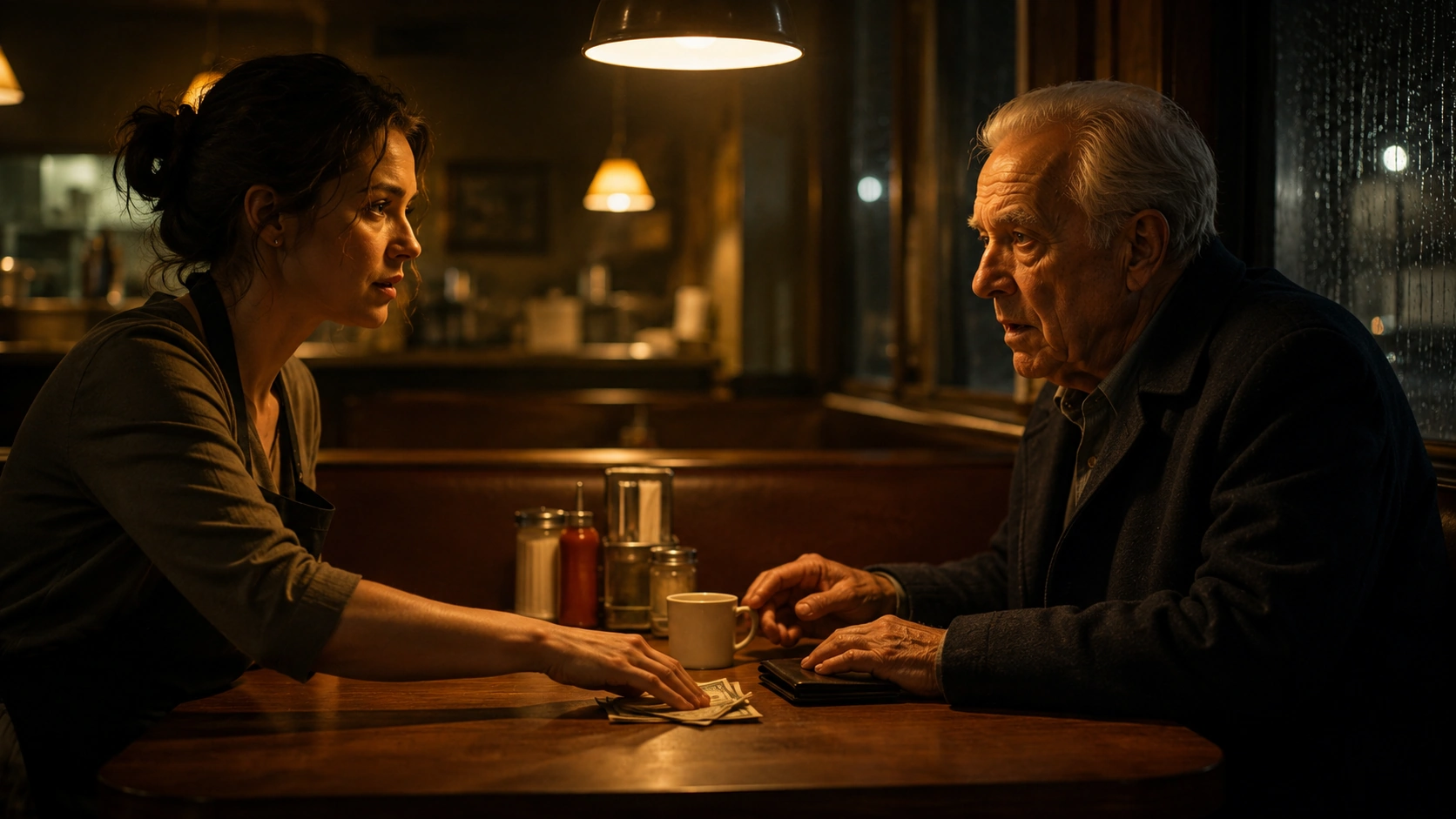
That evening, she set down his usual — eggs, toast, roasted potatoes — and watched his hand go to his coat.
The old leather wallet opened under the pendant light. A few dollar bills. Some coins.
He counted them. Then again. His hand went still.
“Emily…”
She looked at him.
“I’m a little short tonight.”
She glanced toward the counter. Mrs. Parker was busy with receipts, back turned.
“How short?” Emily said quietly.
Walter gave a tired smile. “Enough.”
He started pushing the plate away. Emily stopped it with one hand. With the other, she pushed his money back.
“Keep it. Dinner’s on me.”
Walter stared at her. Not with the relief she expected. With something quieter. Almost like pain.
“Why are you always kind to me?”
Emily shrugged. “Because nobody should have to sit hungry.”
For a strange second it felt like he wasn’t just listening. He was studying her answer. Filing it somewhere.
Then the voice came from behind her.
“You can’t keep doing this.”
Emily turned. Mrs. Parker stood beside the table, arms crossed. The café went quiet. A few customers near the counter stopped moving.
“I’ll pay for his meal,” Emily said.
“That isn’t the point.”
“He’s hungry.”
“And this is a business.”
Walter kept his eyes down.
Mrs. Parker looked at Emily. “How many times have we discussed this?”
“Twice.”
“Three times.”
Emily said nothing.
“You gave away coffee last Tuesday.”
“To a woman waiting for the bus.”
“You paid for someone’s breakfast two weeks ago.”
“He forgot his wallet.”
“And now this.”
“I said I’ll cover it.”
Mrs. Parker shook her head. “Then this is your last shift.”
The café went dead silent.
Emily froze. Someone near the counter slowly lowered a coffee cup.
Walter looked up. Mrs. Parker turned away.
Emily took a breath.
“Okay.”
That surprised everyone. Even Mrs. Parker, who stopped walking.
“You’re not going to argue?”
“What would it change?”
Nothing. They both knew it.
Emily took her order pad from her apron, placed it on the counter, reached into her pocket, and set enough money by the register to cover Walter’s meal. Then she walked back to his booth.
“Eat while it’s warm.”
“You just lost your job,” Walter said.
She forced a small smile. “I’ll find another one.”
“Because of me.”
“Because of a decision I made.”
Walter closed his wallet slowly. And then something shifted. It was barely visible. His shoulders straightened. The exhaustion drained out of his expression and something composed replaced it.
He reached inside his faded coat and removed a smartphone.
Emily blinked.
Mrs. Parker noticed. So did two customers at the counter.
Walter raised the phone to his ear. His voice didn’t get louder or harder. It just became certain.
“It’s me.”
A pause.
“I found her.”
Emily’s smile disappeared.
“Yes.” Another pause. “Don’t call ahead. Come here.”
He lowered the phone.
“Walter?”
For a long moment he said nothing. Then he looked at the untouched plate.
“May I finish my dinner?”
Emily almost laughed from pure confusion. “Who did you call?”
Walter picked up his fork. “Someone who has been waiting a long time to meet you.”
“What does that mean?”
He took a bite. His hands were no longer trembling.
Twenty minutes later, headlights swept across the wet windows. Then another pair. Then another. Three dark SUVs pulled up along the curb.
The café went completely silent.
Men and women in business clothes stepped into the rain. A woman in her sixties led the group, raincoat over her arm, leather portfolio in her hand. She came through the door and her eyes found Walter immediately.
“Mr. Bennett.”
Emily’s stomach dropped.
Mrs. Parker turned from the counter. “Mr. Bennett?”
The woman approached the booth. “We came as quickly as we could.”
Walter nodded toward Emily. “This is Emily Carter.”
The woman froze. The look on her face wasn’t surprise. It was recognition.
Emily stepped back. “How do you know my name?”
Walter set down his fork.
“Because I knew your father.”
The café closed early that night.
Mrs. Parker turned the sign herself. She didn’t argue about it.
Emily sat across from Walter while his team waited outside in the rain like they’d been told to. The woman with the portfolio — Rebecca Shaw, general counsel for something called Bennett Community Holdings — stood near the door at a respectful distance.
Emily had already searched the name on her phone.
Bennett Community Holdings. Commercial properties, apartment complexes, grocery stores, neighborhood businesses across a dozen states.
She looked at the worn coat.
“You’re Walter Bennett.”
“Yes.”
“You’re a billionaire.”
Walter shifted. “On paper.”
“You told me you couldn’t afford dinner.”
“I was carrying only a few dollars.”
“That’s lying with extra steps.”
Rebecca turned away fast. Emily could tell she was hiding a smile.
Walter sighed. “You sound like your father.”
“Don’t use him to get out of this.”
That stopped him.
“You came here for six weeks pretending to struggle,” Emily said. “Why?”
Walter looked toward the rain. “Because I wanted to see who you had become.”
“You could have asked me.”
“Yes.”
“But you ran a test instead.”
He didn’t deny it.
“How did you know my father?”
Walter set his fork down. Twenty-two years ago, he told her, Bennett Holdings had been smaller and he had been relentless. Careless. An electrical fire broke out in one of his warehouses. Walter was inside. Daniel Carter — maintenance electrician, a man who had already gotten out safely — learned the owner was still trapped and went back in. He dragged Walter through smoke until firefighters reached them.
Walter survived. Daniel suffered lung damage.
He refused money. Refused a settlement. Refused every form of compensation except one request.
Make the building safer.
“Your father,” Walter said, “was the first person who ever looked at me after saving my life and asked for nothing for himself.”
Emily swallowed.
“Years later, we became friends.”
“Why didn’t he tell me?”
“He didn’t like powerful people.”
Despite herself, Emily almost smiled. “That sounds like him.”
Walter reached inside his coat again. This time he removed a small envelope. Emily saw the handwriting from across the table and her knees nearly gave.
EMILY.
Just her name. Her father’s hand.
“Where did you get that?”
“He gave it to me six months before he died.”
“You’ve had this for eight years?”
“Yes.”
“And you held it?”
“He asked me to wait until you had become someone capable of making your own decisions.”
Emily touched the envelope. Didn’t take it. “What’s inside?”
“I don’t know. I never opened it.”
She looked at him for a long moment. Then she took it.
The letter was two pages, handwritten on lined paper, in the careful cursive her father used for anything he considered important.
My Em,
If Walter is giving you this, it means he finally stopped thinking he knows everything.
Emily laughed out loud through sudden tears. Walter looked at his hands.
I don’t know how old you’ll be when you read this. I hope you’re stubborn. I hope you’re kind. But most of all, I hope you understand that kindness without judgment is rare — and kindness without structure can destroy the person doing the giving.
She read that sentence twice.
Walter will probably offer you something. He solves emotional problems with financial machinery. Don’t let him decide what you need. Make him listen first.
Emily looked up at Walter. “This is very accurate.”
“I’m aware.”
At the bottom, her father had written:
There is one thing I want you to do, if you ever get the chance. Build a place where people don’t have to lose their dignity just because they’re having a hard month.
Love, Dad.
Emily folded the letter slowly and held it.
Walter watched her. “I want to help you build it.”
“Build what exactly?”
“I don’t know.”
“You don’t know?”
“Your father specifically told me to stop deciding things for you.”
From across the room, Mrs. Parker stepped forward. Her voice was quieter than usual. “Emily — you can have your job back.”
Emily turned. “No.”
“I overreacted.”
“You didn’t fire me because you were angry.” Emily kept her voice even. “You fired me because I broke your rule. And I did break it.” She looked around the café. “But the real problem is that every time an employee here tries to help someone who can’t pay, they have to choose between being decent and keeping their job. I’m not the first person you’ve had this conversation with. I know that.”
Mrs. Parker didn’t answer. She didn’t need to.
Emily looked at Walter. “And throwing billionaire money at it won’t fix that either.”
“What would fix it?”
Emily looked down at her father’s letter.
“I don’t know yet,” she said. “But I’d like to find out.”
Three months later Emily was sitting in a boardroom forty floors above downtown Chicago, and she hated almost everything about it.
The glass table. The bottled water sorted by brand. The phrase “community-facing impact architecture,” which a man named Martin Cole had already used three times without explaining what it meant.
Walter sat at the far end. He looked different here. Not because he wore expensive clothes — Emily had made him promise not to change his appearance when they visited neighborhood businesses. But in the boardroom, everyone knew who he was. That changed how they laughed at his jokes and how quickly they agreed with him and how fast criticism evaporated the moment he seemed to approve of something.
Emily hated that most.
The program was called Open Table. Participating diners could provide meals to customers temporarily unable to pay. Employees could authorize a limited number of meals without risking their jobs. Customers who later wanted to repay could contribute anonymously to the fund. No humiliation. No proof of poverty. No photographs. No social-media campaigns. Just food.
Walter loved it.
The board didn’t.
Martin leaned back in his chair. “It invites abuse.”
Emily looked at him. “So do return policies.”
“That’s different.”
“Why?”
Martin frowned.
“You’ll trust someone with a thousand-dollar television return,” Emily said, “but a twelve-dollar meal requires an investigation?”
A few executives shifted. Martin looked at Walter. “This isn’t funny.”
“No,” Walter said. “But that was.”
The pilot launched over Martin’s objection.
For a while, it worked.
Then a local reporter discovered Walter’s involvement. Headlines appeared overnight.
BILLIONAIRE’S SECRET KINDNESS TEST. WAITRESS FIRED FOR FEEDING “HOMELESS” TYCOON.
Walter hated the coverage. Emily hated it more. Because Walter had never been homeless. And now strangers online were praising a billionaire for pretending to struggle, while barely mentioning the workers who actually faced poverty every week.
Then came the backlash.
She’d staged it. She’d known who he was. She was “the billionaire’s charity mascot.”
Emily stopped reading. Walter didn’t. That was his mistake.
One morning he walked into her temporary office carrying a tablet. “You need to respond.”
“No.”
“They’re questioning your credibility.”
“Let them.”
“This could damage the program.”
Emily looked up. “Walter. Put the tablet down.”
He did.
“You’re doing it again.”
“Doing what?”
“Trying to control everything.”
“I’m trying to protect you.”
“No. You’re trying to control what people think. There’s a difference.”
Walter’s face tightened. “That’s not fair.”
“Is it? You gave me authority over Open Table.”
“Complete authority.”
“You gave me authority you own. If tomorrow you decide you hate the program, what happens?”
“I wouldn’t.”
“That isn’t what I asked.”
Walter went quiet.
Emily looked out the window. “I don’t want this built on your generosity. I want a system that survives you.”
That sentence landed differently than the others. Walter sat down.
Emily continued. “Employees need protection written into policy — not favor, policy. Stores need a real budget they actually control. Community organizations need seats on the oversight board. And the fund can’t depend entirely on Bennett money.”
Walter stared. “You’ve been planning this.”
“For weeks.”
“Why didn’t you tell me?”
“Because I knew you’d try to improve it.”
Despite himself, he smiled. “That is deeply insulting.”
“It’s accurate.”
Six months later, Parker’s Café was closing.
Emily heard from a former coworker. She drove over that same evening. The place looked exactly the same — same booths, same counter, same rain against the glass — except half the lights were off and Mrs. Parker was sitting alone at a corner table.
“I heard about the program,” she said.
Emily sat across from her. “Why didn’t you apply?”
Mrs. Parker laughed, but there was nothing in it. “After what I did to you?”
“That’s not an answer.”
“I was ashamed.”
She looked exhausted in a way that had nothing to do with one bad night. Her husband had died and left her in debt, she said. The café had already been struggling. Every free meal she’d ever watched an employee give away had scared her — not because she was cruel, but because she’d stopped seeing a hungry person. She’d been seeing another bill she couldn’t cover.
“That doesn’t excuse what I did to you,” she said.
“No,” Emily said. “It doesn’t.”
A long silence.
“How far behind are you?”
Mrs. Parker told her. It was worse than Emily had expected.
She didn’t call Walter.
Instead she brought Parker’s Café into the Open Table pilot under the same terms as every other location. No special treatment. No rescue check. No announcement. Financial counseling. Vendor renegotiation support. Access to the community stabilization fund.
Six months later the café was profitable again.
At the annual Bennett Holdings board meeting, Martin Cole proposed shutting Open Table down.
The program had grown to eighty-seven locations. Meal redemptions were higher than projected. Costs had increased.
Martin stood at the front of the room. “We have proven the concept. We should transfer it to charitable partners and return our focus to core operations.”
Walter looked at Emily.
Emily stood. She had no slides. No presentation. Just a manila folder.
She set it on the table.
“These are letters.”
Martin sighed. “Emily—”
“From employees.”
She opened the first one. A cashier in Ohio had used Open Table for a mother whose card was declined after she’d spent her last money on her son’s medication. A server in Georgia had used it three times in one week during a factory layoff that hit the surrounding neighborhood. A manager in Michigan had written that for the first time in twelve years, he hadn’t had to look away when someone had to leave without eating.
The room was quiet.
Martin straightened. “These are individual cases—”
“They’re people,” Emily said. “And they stopped being invisible the moment someone in that building had permission to see them.”
She closed the folder.
“You want to hand this off. I understand why. It’s easier. Cleaner on a balance sheet.” She looked around the table. “But the reason it works is because it’s ours. The employee isn’t calling a charity hotline and waiting three days. She’s making a decision in thirty seconds, with dignity, without paperwork, and without anyone losing face.”
Martin started to speak.
“I’m not finished.”
He stopped.
“Transfer it and you transfer the liability. You also transfer the trust. And trust is the only thing that makes this different from a photo op.”
The room held its breath.
Martin looked at Walter.
Walter looked at the folder.
“Call the vote,” he said quietly.
Open Table stayed.
On the last cold evening of that December, Walter came back to Parker’s Café.
He sat in the same corner booth by the window. The same pendant light overhead. Emily brought him coffee without asking.
He looked better than he had three months ago, when a cardiac episode had put him in the hospital for six days and scared everyone who knew him into silence.
“You nearly died,” Emily said, sitting across from him.
“I’m aware.”
“Rebecca told me not to let you stay out late.”
Walter looked offended. “You’re taking orders from my lawyer?”
“Absolutely.”
They sat for a moment.
A teenager came in alone, hood still damp, hesitating near the entrance. One of the new staff — a young woman Emily had hired herself — looked up, smiled, and nodded him toward a booth. No forms. No question. She brought him soup.
Nobody applauded. Nobody filmed it. Nobody was congratulating Mrs. Parker, who had seen it from the counter and simply gone back to her receipts.
Walter watched the whole thing.
“You’re smiling,” Emily said.
“I’m allowed.”
“You nearly had a heart attack.”
“I’m eighty-two. Smiling is legally required.”
Emily looked at the teenager, who was eating slowly, shoulders finally down.
Walter looked at the window. “You know what your father told me once?”
“Here we go.”
Walter ignored her. “He said the best kind of good deed is the one that becomes ordinary.”
Outside, rain moved across the glass. Inside, everything was the same as any other Tuesday. Plates moving. Coffee poured. People talking. The teenager eating alone without shame.
“I think he was right,” Emily said.
“He usually was.”
A while later, the boy approached the register. He reached into his jacket and placed two crumpled dollars in the wooden jar near the door.
Mrs. Parker looked at him. “You don’t have to.”
“I know.” He smiled. “For somebody else.”
Then he walked out into the rain.
Emily stared at the two dollars.
Walter quietly lifted his coffee. “That,” he said, “is a better return than anything my company ever produced.”
Emily laughed. “Careful. You’re becoming sentimental.”
“At eighty-two it’s legally required.”
At the door, Walter stopped and looked back at the booth by the window.
“Emily.”
“Yes?”
“Thank you for dinner.”
She knew he wasn’t talking about tonight.
“You paid me back,” she said.
Walter shook his head. “No.” He looked around the café. “I thought helping someone meant giving them something. Your father taught me otherwise.”
Emily waited.
“Sometimes helping someone means trusting them with the chance to change you.”
She opened the door. Cool air came in. Walter stepped onto the wet sidewalk.
Behind them, Parker’s Café stayed warm and lit.
Inside, the teenager’s two dollars waited in the wooden jar.
Maybe tomorrow they’d buy someone coffee. Maybe breakfast. Maybe they’d sit untouched for weeks.
It didn’t matter.
Because if someone walked through that door hungry, embarrassed, or just having the worst month of their life — they would not have to prove they deserved to eat.
Someone would simply say: Sit down. You’re okay. We’ve got you tonight.
And somewhere, Emily believed, Daniel Carter would have smiled.
Not because his daughter had become important.
Not because she’d met a billionaire.
But because she had taken one small act of kindness — and helped make it ordinary.
Original fictional stories. AI-assisted creative content.