The street had gone quiet in that particular way streets do when something impossible is happening in plain sight.
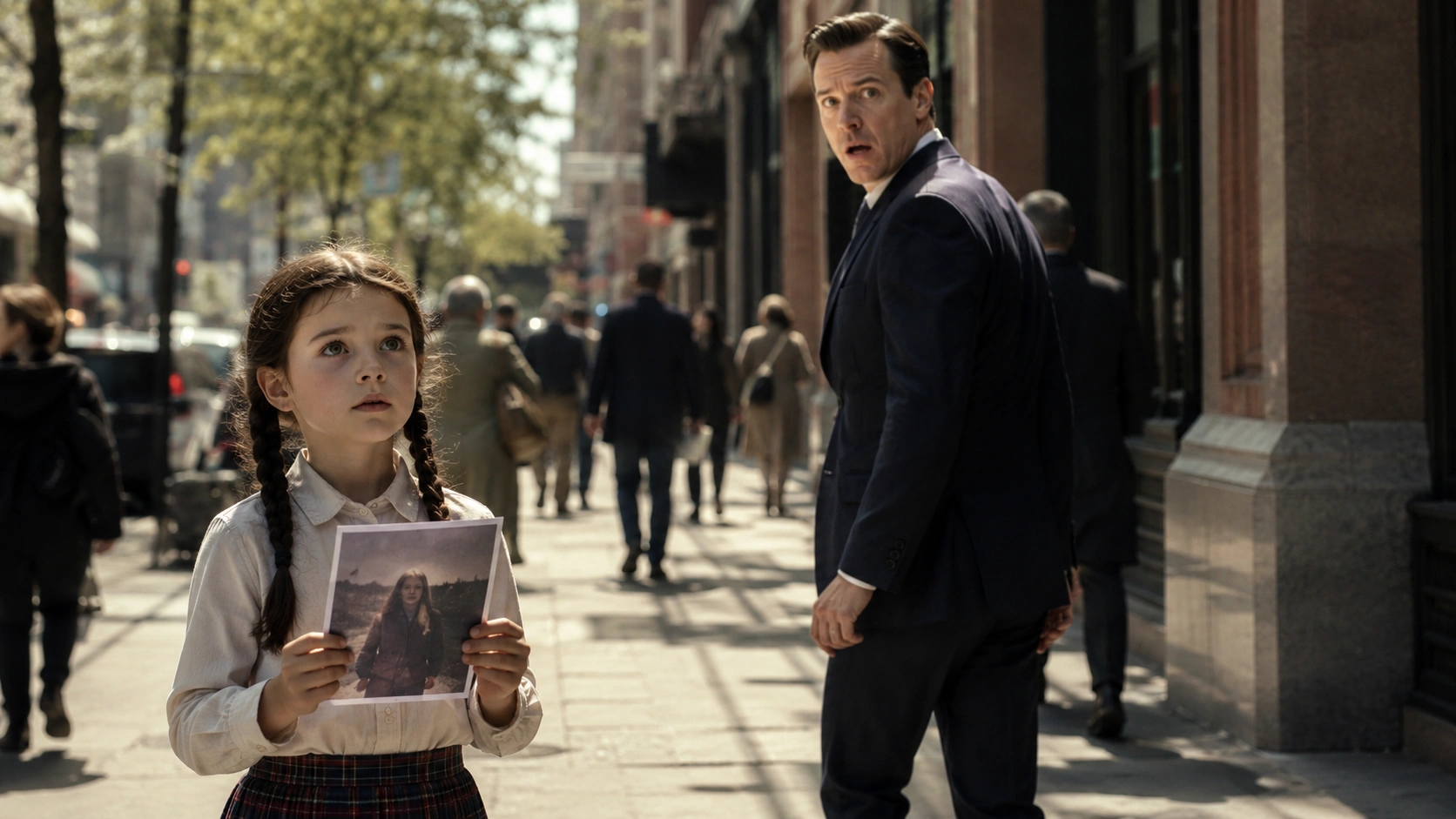
Daniel Hale had been walking back from his car, keys still in hand, when the little girl stepped directly into his path. She was maybe seven, maybe eight, with dark braided hair and a plaid skirt that had been pressed with care. She was holding a photograph.
“Are you Daniel?” she asked.
He stopped. “What?”
“My mom showed me your picture.” She held up the photograph. “She said I’d know you by your eyes.”
Daniel looked down at the photo and felt the ground tilt.
It was him. Younger. Laughing. Standing outside a church in a gray suit, squinting into the sun.
His wedding day.
He hadn’t seen that photograph in eleven years.
His hand lifted toward it, then stopped in midair, trembling. He swallowed hard.
“No,” he whispered, more to himself than to her. “No… that can’t be.”
The girl held it steady, watching him with calm, patient eyes that struck him like a fist to the chest. He recognized those eyes. He had spent eleven years trying to forget them.
“She told me if I ever saw you,” the girl said, “I should give this back.”
His voice barely worked. “She? Your mother?”
The girl nodded.
He took the photograph with shaking fingers and turned it over. On the back, in faded blue ink, were words he knew by heart. Words he had read so many times in the weeks after the funeral that they had worn grooves in his memory.
If he ever finds you, let him see her eyes first.
His knees nearly buckled.
That was Elena’s handwriting. His wife’s handwriting. He had memorized every loop of it from the letters she used to leave him — on the bathroom mirror, tucked into his coat pocket, folded inside his lunch. He would have recognized her script in a burning building.
His mouth opened. No words came.
He looked at the child again — really looked at her. The shape of her mouth. The way her brow creased very slightly when she was watching him. The softness behind her eyes that wasn’t childlike naivety, but something older, something she had inherited.
His whole face broke open.
“What’s your mother’s name?” he asked. He already knew. He was terrified to hear it confirmed.
The girl answered quietly.
“Elena.”
He closed his eyes.
A tear slipped down before he could stop it. He pressed the back of his hand to his mouth. Eleven years. Eleven years of a grave with no body. Eleven years of sleeping on one side of the bed. Eleven years of telling himself that grief fades, that people rebuild, that he had done everything right, had followed every therapist’s advice, had let himself move through it.
Eleven years of being wrong.
“Elena,” he repeated. The name came out broken, like it had lived inside his chest the whole time, waiting to be torn open.
“She said you thought she died,” the girl whispered. “But she had to hide.”
He stared at her.
“Why?”
The girl’s lower lip trembled. For a moment she looked exactly her age — small and uncertain and carrying something much too heavy for her. “Because bad people were looking for you. She said if she came back, they’d use her to find you. And when she tried to come back anyway…” She paused. “She got sick.”
The words hit him in the throat.
He crouched down in front of her, his expensive coat against the dusty sidewalk, not caring who passed or who saw. She was eye level with him now. He needed to see her clearly.
“Where is she?” he asked. His voice was barely a voice. “Please. Where is she right now?”
The girl’s eyes filled.
“At home,” she whispered. “She’s waiting.”
He let out a breath that had been held for eleven years. He covered his mouth with his hand and looked away for a moment, blinking hard, trying to hold himself together in front of this child who was watching him with those eyes, those impossible familiar eyes.
Then the girl reached into the pocket of her plaid skirt and pulled out a fine silver chain. On the end of it hung a small ring. Simple. Plain. White gold.
“She told me to show you this too,” the girl said.
Daniel looked at it — and shattered completely.
It was his wedding ring.
The one he had placed on Elena’s finger twelve years ago, standing in front of sixty people and a priest who had mispronounced his middle name. The one he had last seen on her hand in the hospital photograph the police had shown him. The one that was supposed to have been buried with her — because they never found her body, only her car, only her scarf, only a few feet of tire marks on a bridge railing above a river.
He had buried an empty grave.
He had mourned a woman who was still alive.
And standing in front of him was the daughter he never knew existed.
He couldn’t speak for a long moment. He just knelt on the sidewalk and stared at the ring turning slowly on the chain, catching the afternoon light.
The girl let him look. She seemed to understand, the way children sometimes understand things without being taught, that some moments require silence.
Finally he looked up at her.
“What’s your name?” he asked softly.
“Lily,” she said.
He almost couldn’t say the next thing. His throat kept closing on it. “How old are you, Lily?”
“Seven and a half.”
He did the math instantly. He had always been fast with numbers. It had served him well in business and wrecked him in grief — his mind unable to stop calculating the weeks, the months, the exact number of days since the funeral.
Nine months before the accident. She would have known. She might have been about to tell him.
He pressed his hand flat against the sidewalk to steady himself.
“Lily,” he said. “I need you to take me to her.”
The girl looked at him for a long moment. Searching his face with those eyes — Elena’s eyes — measuring him the way children measure adults when they’ve been taught to be careful.
“She said you’d say that,” Lily finally said.
“What else did she say?”
A small pause. “She said if you cried, you were really you.”
He laughed — a short, raw, surprised sound — and realized his face was wet.
“Then I guess I passed,” he said.
The girl almost smiled. She held out her hand.
He took it.
She led him six blocks east and three blocks south, through a neighborhood he had never had reason to visit, past a bakery and a laundromat and a small park where two pigeons argued over a pretzel. She walked with purpose, a seven-year-old who knew exactly where she was going, swinging his hand once as if they had always done this.
He was completely undone.
He kept his face forward and breathed steadily and tried not to think too far ahead, because every thought that got more than thirty seconds into the future collapsed under its own weight. He focused on the sidewalk. On her small hand in his. On the sound of her sneakers against the pavement.
They stopped outside a narrow three-story building with window boxes and a green door. It looked like every other building on the block. It looked like nowhere in particular.
Lily let go of his hand and turned to face him at the bottom of the steps. Her expression had shifted into something careful.
“She’s on the second floor,” she said. “Room four.” She hesitated. “She doesn’t know I came to find you today.”
Daniel’s chest tightened. “She sent you, though. With the photograph.”
“She told me what to do if I ever saw you,” Lily said. “She didn’t tell me to go looking.” A pause. “I looked.”
He stared at his daughter.
“You found me on purpose,” he said.
She lifted her chin. Just slightly. The gesture was so familiar it stopped his heart — Elena had done the same thing every time she was right about something and knew it.
“She’s getting worse,” Lily said quietly. “The doctors say maybe three months. Maybe less.” Her voice stayed steady with the particular steadiness of a child who has been holding herself together for too long and has gotten very good at it. “I thought you should know.”
He sat down on the bottom step without meaning to. Just dropped, suddenly, like his legs had made a decision without him.
Three months.
Elena was alive and he had three months.
He had wasted eleven years.
“Lily.” His voice was rough. “I want you to know something.” He looked at her directly. “Whatever happened, whatever reasons she had — I’m not angry. I just need you to know that. I need her to know that.”
Lily studied him for another long moment.
Then she said: “Room four,” and went up the steps ahead of him.
He stood outside the door for longer than he should have. He could hear the faint sound of a television from somewhere down the hall. Someone cooking. Ordinary life going on in all directions around the door that was about to change everything.
He knocked.
A pause. Footsteps. The sound of a latch.
The door opened, and Elena stood in the frame.
She was thinner than he remembered. Her hair was shorter, and there were shadows under her eyes that spoke of real fatigue, not just a few bad nights. She was wearing a blue sweater he didn’t recognize, holding a mug of tea with both hands.
She looked at him, and all the color left her face.
“Daniel,” she said. It came out barely above a breath.
“Elena.”
Neither of them moved.
Lily appeared at Elena’s hip. “I found him,” she said, in the tone of someone reporting the completion of a task.
Elena looked down at her daughter. Some complicated mixture of emotions moved across her face — gratitude and terror and an exhausted kind of relief that had nowhere left to run.
“I see that,” she said softly.
“You should have done it a long time ago,” Lily said. Then she ducked under Elena’s arm and went back inside, leaving them alone in the doorway.
They talked for four hours.
Elena told him everything. The warning she had received from a man she trusted, two weeks after their wedding — a man who worked for the people who had wanted Daniel dead for reasons that went back years before they had ever met. She had believed it. The threat had been specific and credible and she had been twenty-six and terrified. She had made the choice alone, in forty-eight hours, to disappear.
“I tried to come back three years later,” she said. “I found out you had moved, that you seemed safe. I made it as far as your city.” A pause. “That’s when I found out about the cancer.”
She said it plainly. Stage two, lymphoma. Treatable, then. She had told herself she would wait until she was better. Better became manageable, manageable became stable, stable stretched into years of appointments and small victories and quiet terror, always the calculation: am I well enough, is it safe enough, does he deserve to know or does he deserve the clean life he has built.
“I know it was wrong,” she said. “I’m not asking you to forgive it. I made choices that weren’t mine to make.”
He was quiet for a moment.
“Did you think about me?” he asked. He wasn’t asking it as an accusation. He genuinely needed to know. “In those years. Did you think about what it was like for me?”
Her eyes filled. “Every day.”
“Then why didn’t you—”
“Because I was afraid,” she said. “Not of the threats. Those stopped mattering years ago.” She looked at her hands. “I was afraid you had healed. I was afraid you had found something good and I would blow it apart. And then I was afraid you’d be angry. And then too much time had passed and it just became—” Her voice broke slightly. “It became the thing I would do tomorrow. Until tomorrow ran out.”
He sat with that.
“How long have you been sick again?” he asked.
“Fourteen months.”
“And Lily knows?”
“She knows I’m sick. She doesn’t know how much.” Elena glanced toward the other room. “She’s smarter than I deserve.”
“She found me,” he said.
“I know.” A long pause. “I’m glad she did.”
The light in the room shifted as the afternoon wore on. At some point Lily came in and sat beside Daniel on the couch without asking, tucking her feet up under her, and began drawing in a small notebook she produced from somewhere. She didn’t say anything. She just settled, in the way children settle when they have decided something.
Elena watched from across the room.
“She asked me once why she didn’t have a dad,” she said quietly. “I told her some dads are people you haven’t met yet.”
Lily, without looking up from her drawing, said: “I told you that was a weird answer.”
Daniel laughed. It came out unexpected and real, filling the small room. Elena’s face did something complicated — a smile that hurt on its way up.
“There are things I have to tell you,” he said, still looking at Elena. “About me. About the past eleven years. Some of it is good. Some of it—” He stopped. “I made choices too. While I thought you were gone. I need you to know everything.”
She nodded. “I know.” A pause. “I looked you up. I know about the company. I know about—” She stopped.
“About Claire,” he said.
A silence.
“It was two years,” he said. “We didn’t — it didn’t work. She knew something was still—” He stopped again. “She said I was in love with a ghost.”
Elena said nothing.
“She was right,” he said.
Lily, still drawing, said: “This is a lot of adult talking.”
“Yes,” Daniel said. “It is.”
“Are you going to stay?” she asked. She was asking the notebook as much as she was asking him.
He looked at Elena.
Elena looked at him.
“That’s not a decision I can make alone,” he said carefully.
Lily put down her pencil. She looked at him with a directness that would have been startling in a forty-year-old.
“She’s sick,” she said. “She needs someone.” A beat. “I need someone too.”
The room was very quiet.
Daniel leaned forward, elbows on knees, and looked at his daughter — the word still enormous in his head, daughter, a word he had given up on — and said: “Then I’m staying.”
That night, after Lily was asleep, Daniel and Elena sat at the small kitchen table with cold tea and the kind of quiet that exists between two people who have already said the biggest things and are now in the long, patient work of figuring out what comes next.
“I need to know about the treatment options,” he said. “Everything. Who your doctors are, what they’ve tried, what they haven’t. I have resources. I want to use them.”
“Daniel—”
“Don’t,” he said quietly. “Don’t tell me it’s too much or that you don’t want to be a burden. You don’t get to make that call alone anymore.”
She looked at him. Her eyes were tired but steady.
“Okay,” she said.
“And we’re getting a lawyer,” he said. “For Lily. I want to be on record. Whatever happens, she has protection.”
Elena was quiet for a moment. “You’re already thinking about if something happens to me.”
“I’m thinking about everything,” he said. “That’s my job now.”
She was silent.
“Elena.”
She looked at him.
“I’m not here because I forgive you,” he said. “I’m here because I love you. I never stopped. Those are two separate things and I need you to know the difference.”
She closed her eyes. One tear ran down, quick and quiet.
“I know,” she said.
“We’re going to fight like hell,” he said. “For as long as we have. And whatever time that is—” His voice held. “I’m not wasting it.”
She opened her eyes and looked at him across the small table in her small kitchen, in the apartment where she had lived quietly for years, waiting for courage that kept arriving late.
“You really didn’t hate me,” she said. It wasn’t quite a question.
“Not even close,” he said.
The silence that followed wasn’t empty. It was the specific silence of two people choosing, deliberately and with full knowledge of what it will cost, to begin again.
Six weeks later, Daniel sat in the waiting room of a hospital he had come to know well, in a chair he had come to think of as his, with a paper cup of bad coffee and a children’s book Lily had insisted he read before she went in for her own checkup.
The book was about a caterpillar who took a very long time to become a butterfly and was worried she had missed her moment.
She hadn’t.
His phone buzzed. He looked at it.
A text from Elena’s oncologist: Scan results are in. I’d like to speak with you both together. I think you’ll be pleased.
He read it twice.
Then he put the phone in his pocket, picked up the book, found his page, and waited.
Not with dread.
With the specific, hard-won patience of a man who has learned that some things that seem finished are only paused — and that the difference, when you finally understand it, is everything.
When Elena came through the door, Lily at her side, he stood up.
Lily looked at the book in his hand. “You finished it?”
“Last page,” he said.
She looked satisfied.
Elena looked at his face and read what was in it. She stopped walking. Her hand found her daughter’s shoulder.
“Good news?” she asked.
“Good news,” he said.
The word settled in the room like something that had always intended to land there.
He crossed to them, and for the first time in eleven years, he put his arms around both of them at once, and held on.
Original fictional stories. AI-assisted creative content.