The night shift does things to your head.
Drive the same dark stretch of Interstate 80 long enough, and the shadows start moving. Trees become people. Deer become monsters.
But the two eyes catching my high beams at 3:15 AM were no trick of the dark.
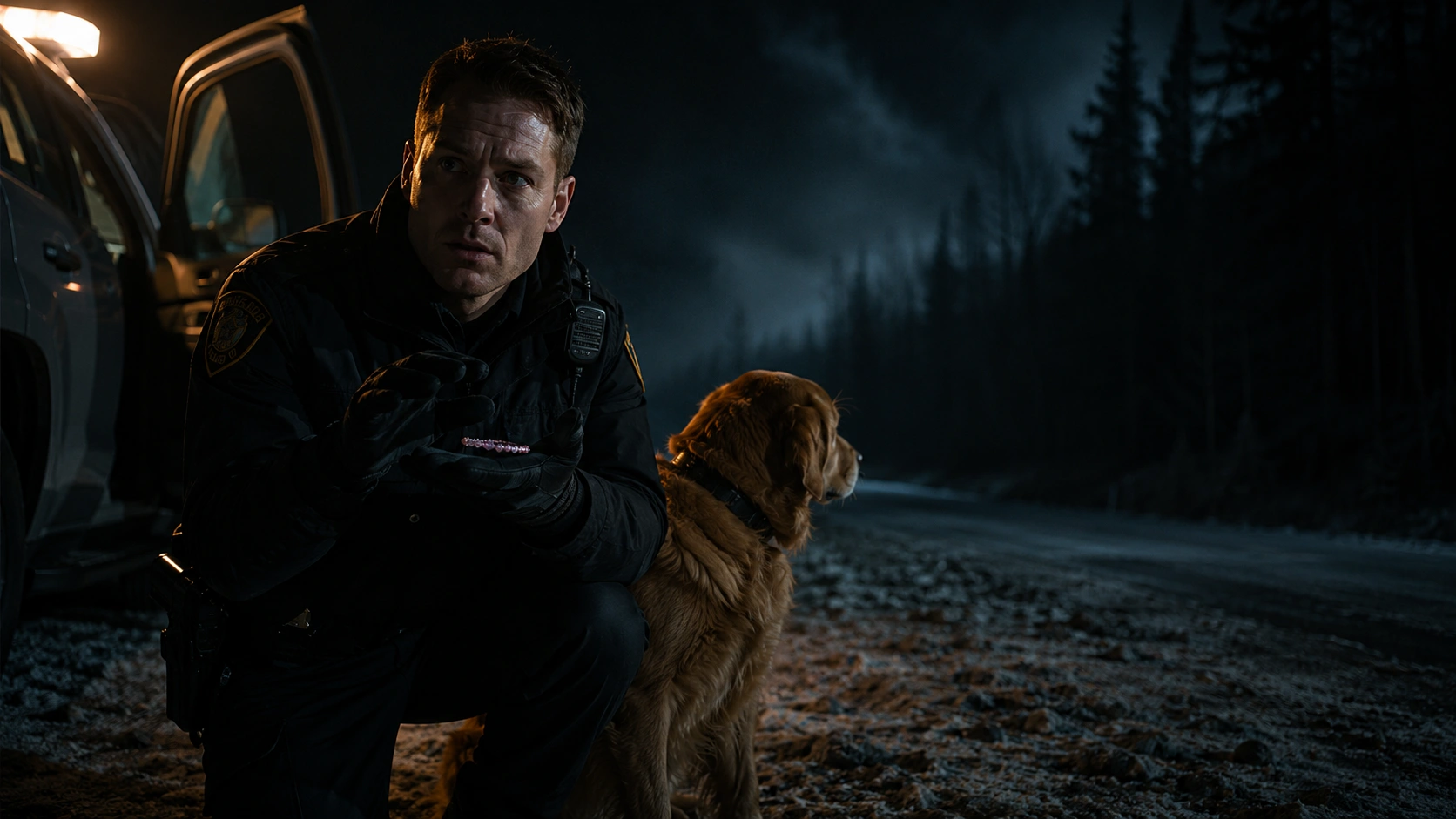
I tapped the brakes, felt the cruiser fish-tail on the frosted asphalt, and pulled onto the shoulder. I grabbed my Maglite, stepped into the biting cold, and swept the beam across the road.
A Golden Retriever stood twenty feet from my bumper.
His coat was a wreck—matted fur, burrs, streaks of grease. He held his back right leg completely off the ground. And around that leg was a bandage unlike anything I’d ever seen on an animal: layer after layer of white medical gauze, sealed tight with industrial silver duct tape.
“Hey there, buddy,” I called softly. “Come here.”
He hesitated, tail tucked. Then the warmth radiating from the idling cruiser pulled him forward. He hopped over on three legs, whimpering.
When I knelt beside him, the smell hit me—not just wet dog. Something sharper. Chemical. Wrong.
I carried him to the front seat, cranked the heat, and examined that bandage under the dome light.
The wrapping was insanely tight. The paw below the tape was cold and swollen.
This wasn’t a healing job. Someone had tried to cut off the dog’s circulation.
“I’m getting this off you,” I muttered, pulling my trauma shears.
Layer after layer of industrial tape. The dog watched me the whole time—wide-eyed, still, patient—as if he understood what I was doing.
When I finally pulled the last layer of gauze away, I froze.
No wound. Not even a scratch.
What I found instead was a folded index card sealed in a plastic sandwich bag, pressed flat against the dog’s unbroken skin.
And next to it, a child’s pink plastic bracelet. Cheap pony beads. The kind you’d find in a craft kit.
My hands started shaking.
I opened the bag. Unfolded the card. The writing was thick black marker, jagged and rushed, like someone’s hand had been trembling when they wrote it.
I read it out loud to no one.
“He took us both from the rest stop on Route 80. I don’t know where we are. It’s an old hunting cabin with a green roof. He is going to hurt my daughter tomorrow. I put this on the dog and chased him out the window while he was sleeping. Please. Follow the dog back. Please hurry.”
At the bottom, two names.
Sarah & Chloe. 6 years old.
I stared at the pink bracelet sitting on my center console. The dog stared out the passenger window—straight into the wall of dark trees lining the highway—and let out a low, sorrowful whine.
He hadn’t escaped. He’d been sent.
I grabbed my radio.
“County, this is Unit 41. I need an emergency 10-33. Code 3 backup to my location, mile marker 142, westbound I-80.”
The radio crackled. Dispatcher Brenda’s voice came back, steady but tight. She’d heard something in mine.
“Copy, Unit 41. Nature of your emergency?”
“Possible abduction. Adult female and a six-year-old child. Distress note recovered from a stray animal. Suspect is armed and dangerous. Victims in an unknown structure, north of the highway.”
Silence. Ten full seconds.
“Nearest backup is forty-five minutes out, Miller. Do not break the tree line without tactical support. Maintain your perimeter.”
I looked at the clock. 3:22 AM.
The note said tomorrow. Dawn was three hours away.
“Brenda,” I said quietly. “There is a six-year-old in those woods. Track my GPS. I’m going dark.”
I turned the radio volume to zero.
The silence in the car was total. Just the heater. Just the sound of the dog breathing.
I popped the trunk and walked back to my gear. Bypassed the riot helmet. Grabbed my patrol AR-15, chambered a round, slung it across my back. Three extra mags went into my cargo pockets.
I was going to walk alone into a stranger’s territory in complete darkness, hunting a man I’d never seen, with zero floor plan and no backup within range.
Every instructor I’d ever had would have pulled my badge.
But I have a seven-year-old daughter asleep at home. If she was out here, I would want a cop who didn’t wait.
I opened the passenger door.
The dog didn’t hesitate. He hopped out into the cold.
“Find them,” I said.
His nose dropped to the gravel. One tight circle. Then he looked up at the tree line, looked back at me once, and stepped into the dark.
I followed.
The moment we crossed the first row of trees, the highway vanished like it had never existed.
No orange glow. No road noise. Just freezing fog and dead silence and the crunch of my boots on frosted leaves.
The terrain was brutal—steep, slick with black ice, every step a small gamble. The dog was struggling. Three-legged movement on a muddy hillside in the cold, going back to the exact place he’d escaped. And he didn’t stop once.
Twenty minutes in, he froze.
Hackles straight up. A deep growl vibrating in his chest.
I dropped to one knee, killed the flashlight, raised the rifle into darkness.
Crunch.
A footstep. Heavy. Off to our right.
I held still. Hand over the dog’s muzzle. The freezing rain needled my cheeks.
One minute. Two. Five.
Nothing moved.
I exhaled slowly. “Keep going,” I whispered.
We pushed down into a ravine, crossed a half-frozen creek—the cold water hit my knees like a hammer—and climbed the opposite bank. That’s when the dog’s pace changed. Nose plastered to the mud. Locked onto something.
I shined the flashlight on the bank.
A boot print. Size twelve or thirteen. Pressed deep. And beside it, smaller marks—a dragging pattern.
My stomach turned.
We crested the ridge and pushed through a wall of dead pine.
The wind hit my face first. Then the smell.
Woodsmoke. Someone burning dry oak.
I tried the radio one more time. Dead static. The ravine walls had killed every signal. Nobody knew exactly where I was.
I was completely alone.
Then the dog stopped. His body went rigid.
Through the freezing fog, a hundred yards out, I saw it.
A small, dark structure wedged between two boulders. Rotting black timber walls. And on the roof—a single dirty yellow bulb glowing behind a boarded window, casting just enough light to show the color of the corrugated metal.
Dark green.
An old hunting cabin with a green roof.
I crouched behind a fallen tree, scanning the perimeter. No vehicles. Just a woodpile and a rusted propane tank.
I stood, moved to advance—
And that’s when I heard the scream.
A child’s voice. High-pitched, muffled, raw.
The scream of a six-year-old who thinks she’s about to die.
I ran.
I hit the porch at full sprint, didn’t slow, didn’t check the knob.
I kicked the door directly beside the deadbolt.
It exploded inward.
The smell rolled over me instantly—stale beer, unwashed bodies, kerosene, and the sharp copper scent of fresh blood.
“Police! Hands up! NOW!”
The room snapped into focus.
One man. Massive—six-four, close to two-eighty, greasy thermal shirt, matted hair. He was holding a heavy steel tire iron in his right hand.
At his feet, backed into the corner, was a woman—Sarah. Clothes torn, face badly bruised, bleeding from a gash on her forehead. Her wrists were bound with the same gray duct tape I’d cut off the dog’s leg. She had thrown her entire body over a small, shaking figure beneath her.
Chloe. The little girl was clutching a stuffed animal so tightly her knuckles were white.
The tire iron had been raised above his head.
I had kicked that door exactly two seconds before it came down.
“Drop the weapon!” I screamed, red dot centered on his chest. “Drop it right now!”
He looked at my badge. Looked at the rifle. Ran the math.
And then he smiled.
“You’re alone, piggy,” he growled. “Heard your radio. You got no signal out here.”
He was right. But he forgot about something.
A blur of matted golden fur shot past my legs.
Cooper hadn’t stayed outside.
He saw the man standing over Sarah and Chloe, and every ounce of the exhausted, limping, frightened stray dog vanished. He launched himself through the air—straight for the arm holding the tire iron.
His jaws locked onto the man’s forearm with a snarl I’d never heard from a dog that size.
The momentum carried both of them into the dining table. Beer bottles exploded across the floor.
“Get off me!” the man roared.
I dropped the AR-15 to its sling, pulled my Glock, and closed the distance in two strides. As the man swung his free fist at the dog’s ribs, I drove my steel flashlight hard into the side of his knee.
A wet pop.
He went down screaming.
“Back off!” I shouted at Cooper.
The dog released, backed up—and planted himself directly between the man and the corner where Chloe was hiding. Still snarling. Still guarding.
I stepped onto the man’s chest and pressed the muzzle of my Glock to his forehead.
“Move one muscle,” I said quietly, “and they will be scrubbing you out of these floorboards for a week.”
The fight left him like air from a punctured tire.
“Okay. Okay. I’m done.”
I cuffed him—tight—and frisked him. Hunting knife on his belt, key ring in his pocket. Both went across the room.
Then I turned to the corner.
Sarah was staring at me like she couldn’t decide if I was real. Her whole body was shaking so hard her teeth rattled.
I dropped to my knees in front of them, hands open.
“Sarah,” I said softly. “My name is Officer Miller. You are safe. Nobody is hurting you anymore.”
The wall holding her together collapsed.
She sobbed—a single, ragged sound like something tearing—and pulled Chloe tighter.
I cut the duct tape off her wrists. The moment her hands were free, she wrapped her arms around her daughter.
“It’s over, baby,” she wept, kissing Chloe’s hair. “It’s over.”
The little girl slowly lifted her face.
She looked at my uniform. Then at my face. Then past me.
She reached her tiny hand out and pointed.
Cooper was limping toward her.
He bypassed me completely—went straight to the little girl—and pushed his big head under her arm with a soft whine.
Chloe grabbed him around the neck and buried her face in his dirty fur.
“Good boy, Cooper,” she cried. “You brought him. You’re such a good boy.”
Sarah looked up at me, blood on her cheek, eyes red. “He snatched us from a rest stop bathroom. Knife at my back, threw us in his truck. I was tied up in here for two days.” She paused, swallowed hard. “But he kept Cooper in the truck bed. When he fell asleep, I got one window open. I used his tape—the same tape from my wrists—wrapped my note around a bag, tied it to Cooper’s leg.” She stroked the dog’s ear. “And I told him to run.”
She reached out and rested her hand on his back. “I didn’t think he’d make it. He’s old. His leg has bad arthritis.”
“He made it,” I said, my throat tight. “He found exactly the right car.”
We had a cuffed suspect, two survivors, an injured dog, no radio signal, freezing rain, and forty-five minutes until backup even started moving.
We had to get out. Now.
“Can you walk?” I asked Sarah.
She took my hand, stood, winced on her left leg—but stood.
“Listen to me,” I said. “We cannot stay here. I’m walking you back to my cruiser. It’s rough terrain, but there’s heat and a working radio. Stay directly behind me. Don’t stop for anything.”
I hauled the suspect up by his collar. He cried out as his knee took weight.
“Walk,” I said. “Or I leave you bleeding in the snow.”
He walked.
I slung the AR-15, clicked on the flashlight, and we filed out into the sleet.
Fifty yards from the cabin, just reaching the dead pines, the suspect stopped.
“Keep moving,” I said, shoving him with the flashlight.
He didn’t move.
Then he started to laugh.
Low. Slow. The laugh of a man who knows something you don’t.
“You think I live out here alone, piggy?”
My blood turned to ice water.
Cooper planted his feet in the mud. Hackles up. He wasn’t looking at the cabin.
He was looking straight up the hill.
And he started barking—frantic, savage, terrifying.
I swung the flashlight up the slope.
Two figures stood at the top of the ravine, blocking the only path back to the highway.
Both were holding hunting rifles.
Both were aimed directly at us.
The first shot split the silence like an axe.
A chunk of bark exploded off a pine trunk three inches from my face.
“GET DOWN!”
I grabbed Sarah’s collar and threw her and Chloe into the deep runoff ditch at the base of the ravine. I dove in behind them, dragging Cooper down into the freezing mud.
Two more shots. The slugs tore through the brush above our heads, snapping branches that fell down onto us.
“Don’t move! Keep her face down!” I yelled, pressing my palm over the back of Chloe’s head.
Sarah had curled herself completely over her daughter, silent now, past screaming.
Through the tangle of roots I could see muzzle flashes from behind the boulders at the ridge.
“Leave our brother and walk away!” a voice boomed down the ravine. “Or we bury all of you out here!”
The cuffed suspect was already laughing, crawling uphill toward his brothers on his stomach through the mud.
“Told you, piggy!” he wheezed. “You’re dead out here!”
I assessed. Two elevated shooters with high-powered hunting rifles. No radio. No backup. A freezing, traumatized child, an injured mother, and an old dog in a ditch.
If we stayed, they’d flank us within minutes. If we ran, they’d cut us down on the open slope.
One option left.
I wiped sleet from my eyes and unslung the AR-15. Round in the chamber, selector to fire, red dot burning hot in the scope.
I looked at Sarah. “Cover her ears. Now.”
She nodded, pressed both palms over Chloe’s head.
I rolled onto my stomach, pushed the barrel through a gap in the frozen roots, and rested the handguard on solid earth.
Through the curtain of sleet, a dark silhouette shifted from behind the left boulder—raising a long barrel to fire.
I settled the dot, exhaled halfway, and squeezed.
Three rounds, controlled. The figure jerked backward, the hunting rifle tumbling down the rocks, and he disappeared behind the ridge.
“Get him!” the second shooter screamed, his voice cracking.
He opened up blind from behind the right boulder—bolt-action, as fast as he could cycle. Rounds chewed the mud around the ditch. A root above my head snapped and whipped against my helmet.
I pressed my face into the dirt.
Something slammed into me from the right.
The cuffed suspect had rolled to his side. He was using his good leg to push himself up, trying to drive his full body weight onto my rifle barrel.
Before I could reach my sidearm, Cooper exploded out of the ditch.
Despite the cold, despite the leg, despite everything—the old dog hit the suspect in the chest like a freight train. His jaws clamped onto the man’s jacket and pinned him back into the mud. The suspect thrashed and kicked, but Cooper held. Every inch a sixty-pound anchor.
“Good boy!” I shouted.
The second shooter paused to reload.
Two seconds of silence.
I pushed up, settled the red dot on the man’s shoulder as it peeked past the right boulder—and fired twice.
Sparks off the rock. The second round found its mark.
A sharp cry of pain. The rifle dropped. The man staggered back into the tree line, crashing through brush, fleeing.
The silence that rolled back into the ravine was total and heavy.
I held my position for sixty seconds, scanning the ridge. Nothing moved.
“Clear. Move. Now.”
I helped Sarah up, scooped Chloe into my left arm—she buried her face in my tactical vest, her small body shaking—and hauled the suspect to his feet.
“Last hundred yards,” I told him. “Move.”
He moved.
The final stretch was agony. The adrenaline was gone, leaving behind just cold and weight. My boots felt like concrete. My hands were too numb to feel the rifle.
But then we pushed through the last wall of dead pine—and the highway appeared.
Not just my cruiser.
The entire stretch of I-80 lit up red and blue in the fog. Three State Police cars, two county SUVs, and a fire department ambulance parked diagonally across every lane.
Brenda hadn’t waited forty-five minutes. She had pulled every unit from three surrounding counties and pinged my GPS.
A dozen flashlights swung onto us.
“Hold your fire—it’s Miller! Unit 41!” a voice boomed over the PA.
Officers in heavy winter gear sprinted toward us. They grabbed the suspect, slammed him against a cruiser hood.
Two paramedics rushed out with thermal blankets, wrapped Sarah in one, completely cocooned Chloe in another.
I handed the little girl to the medic. She reached back for me once, then let go.
“We got her, Miller,” the medic said, running her toward the open ambulance. “We got her.”
I stood on the shoulder of the road in the freezing rain. My chest was heaving. My hands were shaking so badly I had to set the rifle down on my trunk just to stop from dropping it.
Something leaned against my right leg.
I looked down.
Cooper.
He was soaked through to the skin. His injured paw hovered off the ground. His head hung low. But his eyes—those big, soulful brown eyes—were looking straight up at me.
I lowered myself to my knees on the wet asphalt. I didn’t care about the mud or the cold or the other officers watching.
I wrapped both arms around his neck and buried my face in his wet, dirty fur.
“You did it, buddy,” I whispered, and felt my voice break. “You saved them. You saved your whole family.”
Cooper let out a long, slow sigh.
He rested his heavy chin directly on my shoulder and closed his eyes.
Three Months Later
Both brothers were indicted on federal charges: kidnapping, aggravated assault, and attempted murder of a law enforcement officer. They took a plea deal to spare Sarah and Chloe from testifying. Neither will ever walk free again.
Sarah and Chloe moved to the coast—closer to her family, far from these woods. A fresh start.
They couldn’t take Cooper with them.
He was nearly twelve years old. The trauma, plus severe arthritis in both back legs, meant he needed a stable home, low-impact and medically consistent. Something Sarah couldn’t guarantee while rebuilding her life from the ground up.
She asked me if I knew anyone who could take him.
I didn’t even think about it.
Right now I’m on my back porch. The sun is out. My daughter is running through the sprinklers in the yard, laughing at the top of her lungs.
And lying next to my chair, his big gray muzzle resting on my foot, is Cooper.
He sleeps about eighteen hours a day on a massive orthopedic bed in the living room. His muzzle is completely silver. His tail thump is slow but reliable.
Sometimes when I look at him, I think about that frozen stretch of highway. How close I came to driving past him. How easy it would’ve been to assume that bandage belonged to some caring owner and keep moving.
A piece of duct tape and a pink plastic bracelet.
That was everything standing between two lives and absolute nothing.
I reach down and scratch him behind the ears.
He thumps his tail once against the deck boards. Lets out a soft grunt.
I’ve received commendations. Medals. A handshake from the mayor.
But looking at this old, limping, gray-muzzled dog who crossed a freezing highway in November to save the people he loved—
He’s the only real hero I’ve ever met.
Original fictional stories. AI-assisted creative content.