Elijah Carter stood outside the glass doors of Carter Memorial Hospital for a long moment before he went in.
His cardigan was thin at the elbows. His shoes were cracked at the soles. Under his arm he carried a brown leather folder, softened with twenty years of handling.
It had been his wife’s folder once.
Margaret had held it the day the architects broke ground. She’d held it the day the first patient walked through these doors for free. She was gone now, but the folder still smelled faintly of her perfume if he pressed his face close enough.
He never told anyone that. It felt too private, too much like the last piece of her he had left.
Twenty years ago, their daughter Ruth had died in a crowded public clinic, waiting for a doctor who never came fast enough, because the woman at the desk had taken one look at their coats and decided they weren’t worth rushing for.
Margaret had gripped his hand in that waiting room, her voice breaking.
“One day,” she’d whispered, “build a place where no one is turned away because they look poor.”
She didn’t live to see the ribbon cut. Cancer took her four years before opening day.
But every year, on her birthday, Elijah came back. Quietly. Dressed like nobody. Just to make sure the promise was still breathing.
He pushed open the doors.
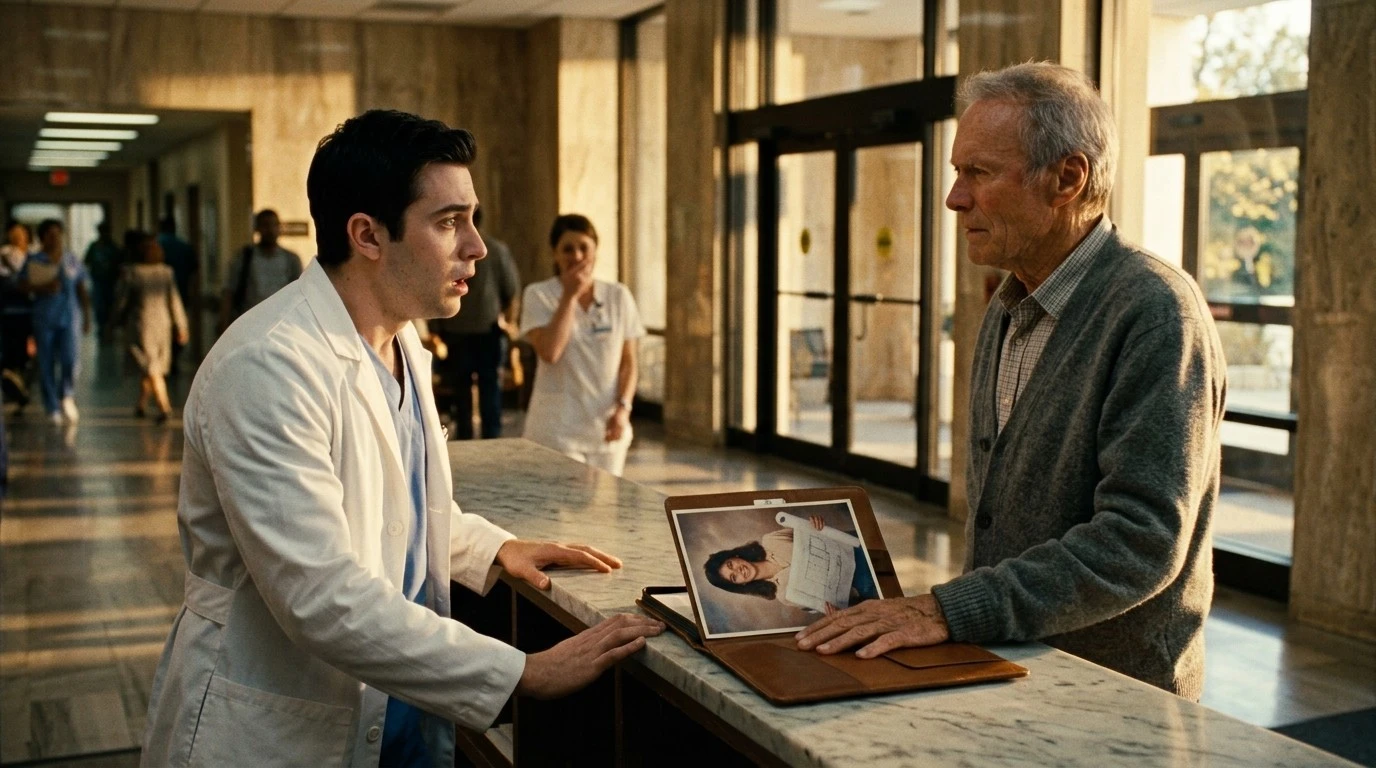
The lobby was bright, marble-floored, hushed with the particular silence of expensive buildings. A young doctor in a spotless white coat stood at the reception desk, scrolling through a tablet.
He looked up. He saw the cardigan. He saw the shoes.
His hand slapped flat against the desk.
“Sir, this is a private hospital. The charity clinic is two blocks down.”
The words rang out across the lobby. A nurse behind the desk stopped typing. An elderly woman in the waiting chairs lowered her eyes like she was embarrassed for him.
Elijah said nothing. He tightened his grip on the folder.
“Good afternoon, Doctor,” he said, calm.
The doctor gave a short laugh, more scorn than humor.
“I don’t have time for this. Leave before I call security.”
Elijah’s eyes drifted past him, toward the elevators. A little boy in a hospital gown sat curled against his crying mother, clutching a thin blanket, watching the scene the way children watch things they don’t understand but still feel.
Something in Elijah’s chest folded in on itself.
His daughter had looked like that once. Small. Frightened. Waiting for an adult to notice her.
He set the folder on the counter. The sound was quiet, but it landed like a verdict.
“My name is Elijah Carter.”
The doctor rolled his eyes. “I don’t care whose name it is—”
Elijah opened the folder.
Inside: the original ownership certificate for Carter Memorial. Beside it, a photograph — Margaret, young, laughing, standing in front of an empty construction lot with blueprints hugged to her chest.
“I own this hospital.”
The color left the doctor’s face in one long drain, like someone had pulled a plug.
“Sir — I didn’t know who you were.”
Elijah’s eyes were wet, but his voice didn’t shake.
“That’s exactly the problem, Doctor. You needed to know my name before you decided I deserved to be treated like a human being.”
The nurse pressed a hand over her mouth. The little boy by the elevators lifted his head, curious despite the fear.
Elijah turned toward the child, then back.
“Now,” he said quietly, “you’re going to explain to me why that boy’s mother says you refused to admit him until she proved she could pay.”
The doctor’s hand started to shake.
Across the lobby, the mother pulled her son tighter against her chest, terrified to even be looked at. The marble floors and the chandeliers had already taught her that her fear counted for less here than everyone else’s comfort.
Elijah walked to her slowly.
“What’s your son’s name?”
“Samuel,” she whispered. “He can’t breathe right. I begged them to take him back.”
Samuel coughed weakly into her shoulder, a wet, rattling sound that made Elijah’s jaw tighten.
He turned on the doctor.
“You made a sick child wait?”
The doctor stepped out from behind the desk, all his earlier arrogance gone, replaced by something closer to panic.
“Sir, we have procedures. She didn’t have insurance verification. I was protecting the hospital.”
Elijah looked at him like he’d never heard anything crueler in his life.
“This hospital exists because someone protected a policy instead of protecting my daughter.”
The lobby went dead silent. The nurse’s eyes filled.
Elijah lifted the photograph from the folder. Margaret, younger, hopeful, holding the future in her arms before she knew how short her own future would be.
“My wife sold her wedding ring to start the first free-care fund,” he said, voice trembling now. “She believed an empty pocket should never be a death sentence.”
Samuel’s mother started to cry, silently, her shoulders shaking.
The doctor looked around the lobby and realized, all at once, that every patient and every staff member had heard every word.
“I’m sorry, Mr. Carter. I made a mistake.”
Elijah shook his head slowly.
“No. A mistake is a wrong signature. You looked at me and saw someone beneath you. You looked at that boy and saw a bill before you saw a child.”
The doctor swallowed hard, said nothing.
Elijah turned to the nurse.
“Get Samuel upstairs. Now. Everything covered by the Margaret Carter Fund.”
The nurse moved before he finished the sentence, rounding the desk without hesitation.
As she reached for Samuel, the boy lifted his pale face toward Elijah.
“Are you a doctor?”
Elijah knelt beside him, blinking hard.
“No, son.”
“Then why are you helping me?”
Elijah looked down at the photograph trembling in his hand.
“Because someone I loved made me promise that kids like you would never be left waiting again.”
Samuel’s mother pressed both hands over her mouth, sobbing now without trying to hide it.
Behind them, the young doctor tried to edge toward the hallway.
“Not yet,” Elijah said, without turning around. “Call the board. I want him suspended before Samuel reaches the third floor.”
Word moved through Carter Memorial faster than any elevator.
By the time Samuel was settled into a pediatric room with a pulse monitor clipped gently to his finger, three more nurses had already found reasons to walk past the nurses’ station where Elijah stood waiting for the hospital administrator.
One of them, an older nurse named Dolores who’d worked at Carter Memorial since its second year, hovered near the desk until Elijah caught her eye.
“Mr. Carter,” she said carefully, “can I tell you something? Off the record?”
“Please.”
“This isn’t the first time Dr. Reyes has turned someone away for insurance reasons. It’s the third time this year. I reported the first two.”
Elijah went very still.
“Reported them where?”
“To administration. To Mr. Vance.”
Elijah’s jaw tightened. Daniel Vance was the hospital’s chief administrator — a man Elijah had hired six years ago on the recommendation of a board member, a man who ran quarterly numbers like a man running a company, not a hospital.
“And what did Mr. Vance do with your reports?”
Dolores looked down at her shoes.
“Nothing, sir. He told me insurance pre-verification was policy. That the fund couldn’t cover every walk-in or we’d go under.”
Elijah felt something cold settle into his stomach, the specific cold of realizing a wound was deeper than the first cut.
“Get me Mr. Vance,” he said. “Now.”
Daniel Vance arrived within ten minutes, suit pressed, tablet in hand, a smile already assembled on his face like he’d rehearsed it in the elevator.
“Elijah! I heard there was a — a misunderstanding downstairs. I want you to know Dr. Reyes is one of our best young—”
“Sit down, Daniel.”
The smile faltered.
Elijah didn’t raise his voice. He never had to.
“Dolores tells me this is the third denied admission this year over insurance verification. She reported the first two to you personally.”
Vance’s tablet lowered an inch.
“Elijah, you have to understand the financial pressure the fund is under. If we admit every uninsured walk-in without verification, we lose the operating margin that keeps this hospital open at all.”
“That fund,” Elijah said quietly, “was built with my wife’s wedding ring and every dollar I’ve earned since. Tell me the exact number, Daniel. Tell me the number where you decided a child’s life stopped being worth it.”
Vance’s mouth opened. Nothing came out.
“There is no number,” Elijah said. “There was never supposed to be a number. That was the entire point of this building.”
“Elijah, I was protecting—”
“You were protecting a spreadsheet.” Elijah’s voice finally cracked, just slightly, just once. “While a boy sat in a hallway unable to breathe.”
Vance’s face had gone the same pale color the young doctor’s had, twenty minutes and one floor below.
“What do you want me to do?”
“I want a full audit of every denied admission for the last three years. I want every name. And I want you gone from this hospital by Friday.”
“Elijah, please — I have a family—”
“So did I,” Elijah said. “So did the family in that clinic twenty years ago. Nobody protected them either.”
By evening, the story had already slipped past the hospital walls the way stories do — a nurse texting a cousin, a patient posting online, a local reporter named Priya Anand catching wind of it through a tip line she kept for exactly this kind of thing.
She arrived at Carter Memorial just as the sun dropped low and orange through the lobby’s tall windows, notebook in hand, press badge clipped to her blazer.
“Mr. Carter? Priya Anand, Channel 9. Is it true you suspended a doctor and your own administrator today?”
Elijah stood near the elevators, still holding the folder, still not having eaten since morning.
“It’s true.”
“Can you tell me why?”
Elijah looked toward the pediatric wing, where somewhere behind those doors Samuel was breathing easier with a mask feeding him oxygen and his mother finally allowed to stop being afraid.
“Twenty years ago my daughter died because someone decided she wasn’t worth helping quickly,” he said. “I built this hospital so that would never happen to anyone else’s child. Today I found out it happened anyway. So I fixed it.”
Priya’s pen moved fast across her notepad.
“Some people are going to say you’re punishing people for following hospital policy.”
“Then the policy was wrong,” Elijah said. “And I’m the only one with the power to say so out loud.”
The medical board hearing came four days later, faster than anyone expected, because Elijah insisted on it and Elijah, as it turned out, still knew exactly which doors to knock on.
Dr. Reyes sat across the long table, his white coat replaced by an ordinary blazer, his hands folded so tightly his knuckles had gone bloodless.
“Dr. Reyes,” the board chair said, “you’re aware of the allegations. Three documented refusals of care pending insurance verification, one involving a minor in acute respiratory distress.”
“I was following hospital protocol,” Reyes said, voice thin.
“The hospital’s actual charter,” Elijah said, from his seat at the far end of the table, “requires immediate treatment regardless of ability to pay. That protocol you followed was never mine. It was quietly rewritten by an administrator protecting a budget line.”
Reyes’s eyes flicked toward him, something like desperation flashing through.
“Mr. Carter, please. I have loans. I have five years of training. One mistake—”
“Three mistakes,” Elijah corrected. “Three children who mattered less to you than a form.”
Reyes’s composure finally broke.
“You don’t understand what it’s like! Every denial I get blamed for, every admission I approve without verification comes out of my department’s numbers—”
“I understand exactly what it’s like,” Elijah said, and something in his voice made the whole room go quiet. “I understand what it’s like to stand in a waiting room while someone decides your child isn’t a priority. I’ve understood that for twenty years. What I don’t understand is how you found yourself on the other side of that desk and did it anyway.”
Reyes had no answer.
The board chair looked down the table.
“Given the documented pattern and the severity of the third incident, this board moves to revoke Dr. Reyes’s admitting privileges at Carter Memorial, pending a full state licensing review.”
The gavel came down soft, but it landed like the loudest sound in the room.
Two weeks later, Samuel went home.
He walked out of Carter Memorial on his own two feet, a little unsteady, his mother gripping one hand and a stuffed dinosaur gripping the other. Elijah met them in the lobby — the same lobby, the same marble floor, but somehow it looked different now, lighter.
“Mr. Carter!” Samuel said, grinning with the particular wideness only kids manage. “I can breathe all the way now. Watch.”
He took an enormous, theatrical breath and let it out with a whoosh, proud of himself.
Elijah laughed — really laughed, for the first time in longer than he could remember.
“That’s the best thing I’ve heard all year, Samuel.”
Samuel’s mother stepped forward, eyes bright.
“Mr. Carter, I don’t know how to ever repay—”
“You don’t,” Elijah said gently. “That was never the deal.”
He knelt to Samuel’s height one more time.
“Can I ask you something?”
Samuel nodded seriously.
“When you’re older, and you see somebody who looks like they don’t belong somewhere — somebody in old shoes, somebody nobody’s paying attention to — what are you going to do?”
Samuel thought about it hard, the way kids think about things that actually matter to them.
“I’m gonna ask them their name,” he said.
Elijah’s eyes filled, and this time he let them.
“That,” he said, “is exactly right.”
That night, alone in his small house, the one he’d refused to trade for anything grander even after the hospital made his name known across the state, Elijah sat at his kitchen table with the leather folder open in front of him.
Margaret smiled up at him from the old photograph, young and certain, holding a future she never got to see finished.
The news was already running the story on the late broadcast — a hospital owner in a thrift-store cardigan, a fired doctor, a suspended administrator, a little boy who could finally breathe. Priya Anand’s segment ended with the words “Carter Memorial: The Hospital That Turned Its Own Rules Inside Out To Save A Child.”
Elijah didn’t watch it. He didn’t need to.
He touched two fingers to the photograph instead, the way he did every year, the way he’d done for two decades.
“I kept your promise today,” he whispered. “I’m sorry it took me finding a crack in it to prove it was still standing. But it’s standing, Margaret. It’s still standing.”
Outside, the hospital lights stayed on all night, the way they always did, the way Margaret had insisted they would — a building that never went dark, so that no one arriving in the middle of their worst hour would ever have to stand outside wondering if anyone inside was awake enough to care.
They were. Elijah had made sure of it. And now, for the first time in twenty years, he finally believed the promise would hold even after he was gone — because somewhere in that hospital, a boy named Samuel had just learned exactly what to do the next time he saw someone the world had decided to overlook.
END.
Original fictional stories. AI-assisted creative content.