“Stay away from my daughter.”
The father’s voice was low, but the whole ballroom heard it.
Under the golden chandeliers, a barefoot boy stood frozen with one hand half-raised toward the girl in the wheelchair.
His cheeks were dusty. His shirt was too big. His torn pants stopped above his ankles, and his bare feet looked painfully out of place on the polished floor.
But he didn’t step closer.
He lowered his hand.
“I won’t hurt her,” he said quietly.
The girl looked at him from her wheelchair, her pink dress folded neatly over her knees. She looked tired in a way no child should look tired, like everyone had already decided what her life could not be.
The boy glanced at her father.
“May I ask her something?”
The father hesitated.
Then the girl slowly nodded.
The boy looked only at her.
“Do you want to try?”
A long silence filled the ballroom.
The girl’s fingers tightened around the wheelchair arms.
Her eyes filled with fear.
And hope.
Her father whispered, “No… please.”
But she reached for the boy’s hand.
He held it gently, with both of his.
Then, trembling hard, she pushed herself up.
Her legs shook beneath her.
She nearly fell.
The boy steadied her.
A woman in the crowd gasped.
The father’s hand rose to his mouth as his daughter stood in front of him for the first time in years.
He could barely breathe.
“How…”
The girl looked at him, crying softly through a tiny smile.
And the boy whispered, “Because she asked me to come.”
The father’s face changed.
“What did you say?”
The girl was still shaking, her small hand locked around the boy’s. Every breath seemed difficult, but she stayed on her feet.
The boy looked down, suddenly afraid.
“Her mother,” he said softly. “She asked me.”
The father went still.
The crowd behind him disappeared into silence.
“My wife died three years ago,” he whispered.
The boy nodded.
“I know.”
From the pocket of his torn pants, he pulled out a folded photograph. The edges were worn. The paper was soft from being opened too many times.
The father took it with trembling fingers.
It was his wife.
Sitting on a hospital bench beside the same barefoot boy.
On the back, in handwriting he recognized instantly, were five words:
Find my daughter. Make her believe.
The father’s knees nearly gave out.
The boy’s voice broke.
“She found me outside the hospital. I was hungry. She gave me food. Then she told me about a little girl in a pink dress who used to dance in the kitchen.”
The girl began to cry harder.
“I remember that,” she whispered.
The boy looked at her gently.
“She said one day you would forget you were brave. And if I ever got invited into a room full of music, I should ask you one question.”
The father closed his eyes, tears slipping down his face.
“Do you want to try?”
The boy nodded.
The girl took one tiny step.
Then another.
Her legs trembled. Her breath shook. The boy held her like he was holding something more fragile than glass.
The father covered his mouth and broke silently.
It wasn’t a miracle.
It wasn’t magic.
It was a child believing in another child before the world could tell them both no.
And beneath the chandeliers, with the whole ballroom watching, the girl took her first dance step since losing her mother.
Then the room exploded into whispers.
Phones came up. A reporter near the bar muttered, “Get this. Get all of this.”
Because the gala wasn’t just a birthday party. It was the Whitfield Foundation’s annual fundraiser, and half the city’s press corps was standing three feet from a miracle.
The father, Daniel Whitfield, didn’t notice the cameras. He was already on his knees in front of his daughter, Lily, holding both her hands.
“You’re standing,” he said. “You’re standing, baby.”
“I know,” Lily laughed through tears. “Don’t let go.”
“Never.”
But across the room, a woman in a sharp navy suit was not smiling.
Vivian Cross — Daniel’s late wife’s older sister, and the Foundation’s Chief Financial Officer — stared at the boy like he was a stain on her carpet.
She crossed the floor fast, heels clicking like a countdown.
“Security,” she snapped. “Get that boy out of here.”
Two men in black suits moved in.
Daniel stood, blocking them with his body.
“Nobody touches him.”
“Daniel, he’s clearly trespassing,” Vivian hissed. “Look at him. He probably wandered in from the street for the food.”
“He gave my daughter her legs back.”
“He gave her a push,” Vivian said coldly. “Physical therapists have been trying that for three years. Are we crediting a beggar now?”
The boy flinched at the word but didn’t move.
Lily’s small hand tightened around her father’s sleeve.
“Aunt Vivian, stop,” she said, her voice shaking but firm. “He’s my friend.”
“You don’t have friends who sleep on grates, sweetheart.”
The room went quiet in a different way now — uncomfortable, tense.
Daniel’s jaw locked.
“Vivian. Not tonight.”
“Then when, Daniel? When he’s living in the west wing? When he’s on the foundation’s payroll?” She gestured sharply at the boy. “What’s your name?”
“Eli,” the boy said quietly.
“Eli what?”
“Eli Sparrow.”
“No last name that means anything,” Vivian said under her breath, just loud enough. “Convenient.”
Daniel’s voice dropped, dangerous and quiet.
“That’s enough.”
Vivian smiled thinly, the kind of smile that never reached the eyes.
“Fine. Enjoy your miracle.” She turned to the crowd, voice suddenly warm and public. “Isn’t this wonderful, everyone? Little Lily is finding her strength again. Let’s give her a round of applause.”
The room clapped, uncertain, cameras still rolling.
But Vivian’s eyes stayed on the photograph in Daniel’s hand.
She wanted a closer look at it. She wasn’t going to get one tonight.
Three hours later, the gala was over. The chandeliers were dark. Daniel sat in his study with the photograph on the desk in front of him, and Eli sitting stiffly across from him in a chair too big for a barefoot boy.
“Where do you live, Eli?”
“Different places.”
“You don’t have a home.”
“I have places,” Eli said. “The library on Ninth Street. The church kitchen on Tuesdays. Behind the Realto Diner, they leave the door unlocked some nights.”
Daniel felt something twist in his chest.
“How old are you?”
“Eleven. I think.”
“You think.”
“Nobody’s ever asked before.”
Daniel looked at the photograph again — his wife, Claire, sitting in a hospital gown, laughing next to a much younger, thinner version of the boy in front of him.
“Tell me about her. About that day.”
Eli’s shoulders dropped, like the memory was heavy to carry but he’d been carrying it a long time anyway.
“She was in for chemo. I used to sneak into the hospital cafeteria because they didn’t check as hard at lunch. She caught me stealing a roll off her tray.”
“That sounds like Claire.”
“She didn’t yell. She just… scooted the tray toward me. Said, ‘Take the whole thing, I wasn’t going to eat it anyway.'” Eli’s voice cracked. “She talked to me every Tuesday after that. For six weeks. Until she stopped coming.”
Daniel closed his eyes.
“She never told me about you.”
“She said it was a secret. Between us.” Eli reached into his other pocket and pulled out a second folded paper, more careful this time, like it was the last one and he couldn’t lose it. “She wrote this the week before she stopped coming.”
Daniel unfolded it.
A letter. Claire’s handwriting, shakier near the end but unmistakably hers.
Dear Eli,
If you’re reading this, I didn’t get better. I need you to do something for me, and I know it’s a strange thing to ask a child.
I have a daughter. Her name is Lily. She’s going to be in an accident — the same one that will take my legs before it takes anything else. I don’t know when. I don’t know how you’ll find her. But the doctors say some children believe things adults have stopped believing. I think you’re one of them.
When you find her — and you will — don’t tell her I sent you right away. Let her trust you first. Then ask her one question: Do you want to try? She’ll know what it means. I’ve asked her that question every day of her life.
Take care of my girl, Eli. I think you two were always going to need each other.
— Claire
Daniel read it twice. Then a third time. His hands wouldn’t stop shaking.
“She knew,” he whispered. “She knew about the accident before it happened.”
“She said the doctors told her the tumor was pressing somewhere it shouldn’t. That it gave her… dreams. Warnings. She didn’t understand it either. She just believed it.”
Daniel looked up at the boy properly for the first time — really looked.
“Why didn’t you come sooner? It’s been three years since she died.”
Eli’s eyes dropped to the floor.
“I didn’t know where to find you. I didn’t know your last name until tonight, when I saw the gala announced on a TV in a shop window. Whitfield Foundation. Family photo. I recognized Lily’s face from the one Claire kept in her hospital room.” He swallowed hard. “I walked eleven miles to get here tonight.”
“Barefoot.”
“My shoes fell apart in June.”
Daniel put his face in his hands.
“I’m sorry,” he said, muffled. “I’m so sorry, kid.”
“For what?”
“For every year you needed somebody and nobody came.”
Vivian Cross did not sleep that night.
She sat in her penthouse with a glass of wine going warm in her hand, staring at nothing, running numbers that had nothing to do with money and everything to do with fear.
Because if Lily Whitfield walked — really walked, publicly, permanently — the trust clause activated.
Claire’s will had stipulated that upon Lily reaching full mobility and cognitive independence, control of forty percent of Foundation voting shares — shares Vivian had been managing, borrowing against, and quietly bleeding for three years — would transfer to a guardianship account controlled jointly by Daniel and an independent auditor.
An auditor would look at the books.
An auditor would find the shell consulting contracts. The “grant disbursements” to companies that didn’t exist. Four years of careful, patient theft dressed up as foundation overhead.
Vivian picked up her phone and called a number she hadn’t used in eight months.
“It’s happening,” she said when the line picked up. “The girl stood up tonight. In front of press.”
A pause on the other end. “That’s not possible. The neurologist’s report said—”
“I don’t care what the report said, Marcus. I paid you to write a report that kept her classified as non-ambulatory for the guardianship clause. That report is now a problem.”
“Vivian, if this comes out—”
“It won’t come out. Not if you help me handle the boy.”
“What boy?”
“The one who did this. Eleven years old, homeless, no family, no lawyer, no one who’ll believe him over us. I want him gone before Monday’s board meeting.”
Monday morning, two police officers arrived at the Whitfield estate with a report of theft.
Daniel met them at the door himself, Eli standing just behind him in a clean shirt for the first time in longer than he could remember.
“Mr. Whitfield,” the older officer said, “we received a call reporting that a minor matching this description stole jewelry from a guest at Saturday’s gala.”
Eli went pale.
“I didn’t take anything.”
“Search my study,” Daniel said flatly. “Search his room. Search him. Go ahead.”
The officers exchanged a look but did it — carefully, professionally, apologetically. They found nothing. No jewelry. No missing item was even formally reported by name; the “guest” who allegedly called it in refused to give a statement when contacted.
“Who filed this complaint?” Daniel asked, arms crossed.
The younger officer checked his notes. “Anonymous tip. Female caller. Described the boy specifically enough that we had to follow up.”
Daniel’s stomach turned cold.
“Vivian.”
He found her in the Foundation’s glass-walled boardroom an hour later, rehearsing a slide deck like nothing had happened.
“You called the police on an eleven-year-old.”
“I protected this family’s reputation,” Vivian said without looking up. “A strange child appears out of nowhere, and suddenly he’s living in the guest wing? People will ask questions, Daniel.”
“People are already asking questions. Good ones. Like how my daughter is walking for the first time in three years.”
“Coincidence and physical therapy.”
“He had a letter from Claire, Vivian. Written before the accident. Before the diagnosis was even confirmed publicly.”
That got her attention. Her pen stopped moving.
“Let me see it.”
“No.”
“Daniel, if that letter references trust provisions, foundation matters, anything financial—”
“It’s about our daughter. Not the foundation.” Daniel stepped closer to the table. “But you know what’s interesting? I had our family lawyer pull Lily’s medical file this morning. The one from three years ago. The one that classified her prognosis as permanent.”
Vivian’s face didn’t move, but her knuckles went white around the pen.
“And?”
“Dr. Aldridge’s original notes, the ones before the final report was filed, say ‘guarded but potentially responsive to intensive intervention.’ Somebody changed the language in the final version. Somebody with signature access to the file.”
“Doctors revise their language all the time.”
“Not usually to match the exact wording needed to satisfy a guardianship clause in my late wife’s will, Vivian. I had the estate attorney compare both documents this morning. Word for word.”
The room went silent except for the hum of the air conditioning.
“You should be careful with accusations,” Vivian said quietly.
“You should be careful with confessions,” Daniel said back. “Because that’s what you just gave me.”
That night, Eli sat with Lily on the porch steps, both of them wrapped in the same blanket, watching the sun go down over the estate’s gardens.
“Is your aunt going to hurt you?” Lily asked.
“She’s tried twice already.”
“She’s not really family,” Lily said. “Not like you.”
Eli looked at her, surprised. “I’ve known you three days.”
“My mom knew you for six Tuesdays and picked you for me. That’s family enough.” Lily flexed her fingers slowly, watching them like they belonged to someone else. “Do you think I’ll walk on my own? Without holding anyone’s hand?”
“I think you already are,” Eli said. “You’re just still scared of falling without someone catching you.”
“Aren’t you scared of anything?”
Eli thought about it for a long moment.
“I’m scared they’ll believe her over me,” he admitted. “She has a name people trust. I have a photograph and a letter, and I found out today those can be called fake pretty easily if the right lawyer says so.”
Lily reached over and took his hand — steadier this time than the ballroom.
“Then we’ll make sure they can’t say that.”
The board meeting was held Thursday. Daniel had requested an independent forensic auditor review the Foundation’s last four years of disbursements, citing “routine transparency ahead of the guardianship transfer.” Vivian had objected loudly in every private conversation and said nothing at all in the official record, which itself told Daniel everything he needed.
The auditor’s preliminary findings took six days.
Eleven shell vendor accounts. Two point three million dollars in “consulting fees” paid to companies with no employees, no offices, and no service history. Three of them registered to addresses that traced back to Vivian’s personal accountant.
And buried in the medical vendor files: a single payment, disguised as a “research grant” to a private clinic, made out to one Dr. Marcus Aldridge — the same neurologist who had written Lily’s original prognosis.
Daniel brought the findings to the full board himself, Eli sitting quietly in the gallery seats reserved for family, Lily beside him in her wheelchair, though she barely used it now except for long days.
“Before we begin,” Daniel said, laying the auditor’s report on the table, “I want to address something publicly, because it’s already going to be public whether I want it to be or not.”
Vivian sat rigid at the far end of the table, her lawyer beside her.
“Three years ago, my wife Claire wrote a letter to a homeless child she met during her cancer treatment, asking him to find our daughter one day and help her believe she could walk again. That letter predates her death, predates her diagnosis becoming terminal, and was independently authenticated this week by a forensic document examiner, whose full report is attached as exhibit two.”
Murmurs around the table.
“That boy is Eli Sparrow. He is eleven years old. He has no family, no home, and until Saturday night, no reason to trust that adults keep their promises. He kept a dying woman’s promise for three years. I intend to formally adopt him.”
Vivian’s lawyer started to object. Daniel raised a hand.
“I’m not finished. Exhibit three is a forensic comparison of two versions of my daughter’s neurological file from three years ago — the draft and the filed version — showing language changes that conveniently kept her classified in a way that delayed the guardianship transfer specified in my wife’s will. Exhibit four is a financial trail connecting eleven fraudulent vendor payments, totaling two point three million dollars, to accounts controlled by our CFO’s personal accountant. One of those payments went directly to the neurologist who altered my daughter’s file.”
The room had gone completely, brutally silent.
Vivian stood up so fast her chair scraped back hard against the floor.
“This is a coordinated smear,” she said, voice too loud, too fast. “That child could have written that letter himself. Children lie. Poor children lie especially well, they have to survive—”
“Vivian.” Daniel’s voice cut through hers like a blade. “The handwriting expert confirmed Claire’s handwriting with a ninety-nine percent confidence match against six known samples. The letter references a private conversation between Claire and Eli about our kitchen, about Lily dancing, about details you couldn’t have known to forge because you were never once in that hospital room. You said you were ‘too busy with the Foundation’ to visit your dying sister, if you’ll recall.”
Something in Vivian’s face finally cracked.
“I built this Foundation,” she said, quieter now, almost to herself. “I built it while Claire was sick and you were falling apart and nobody else was holding anything together.”
“You didn’t build it, Vivian. You embezzled from it. For four years. While a child slept on a grate three miles from this building because nobody came looking for him.”
Two men in plain suits stood up from the back of the boardroom — auditors from the state attorney general’s office, quietly invited that morning once the fraud pattern had been confirmed.
“Ms. Cross,” one of them said, stepping forward, badge already visible. “We’d like you to come with us to answer some questions about the Whitfield Foundation’s financial disclosures.”
“Daniel.” Vivian’s voice broke for the first time, real fear in it now instead of control. “Daniel, please, we’re family.”
“You called the police on an eleven-year-old boy for the crime of having nothing,” Daniel said. “You forged a child’s medical file to steal from your dying sister’s estate. You are not the family I have left.”
They led her out through the boardroom’s glass doors. Nobody spoke until the elevator chime confirmed she was gone.
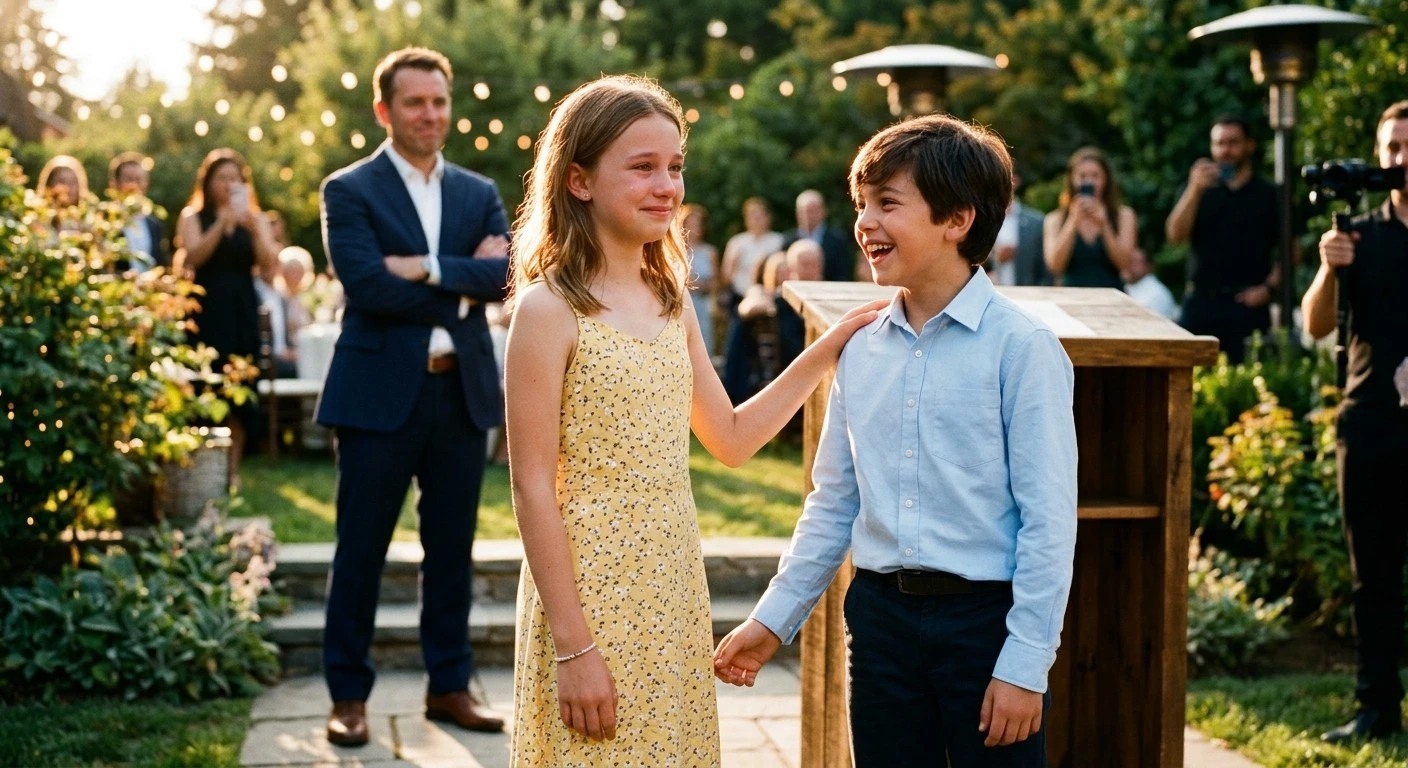
Six weeks later, the Foundation held a small press event — no chandeliers this time, just a modest garden reception, sunlight instead of gold light, and no illusions to maintain.
Lily walked to the podium herself, no wheelchair, one hand resting lightly on Eli’s shoulder more out of habit than need.
“My mom used to say bravery isn’t a feeling,” Lily told the small crowd of reporters. “It’s a decision you make before you’re ready. She made that decision for me before I even knew I’d need it.” She looked down at Eli, who was wearing shoes now, real ones, standing a little straighter than he used to. “And she made it for him too.”
A reporter raised a hand. “Eli, is it true the adoption was finalized this week?”
“Yesterday,” Eli said, and for the first time since the ballroom, he smiled without flinching. “I have a last name now. Whitfield.”
“And Vivian Cross?” another reporter asked. “Any comment on the fraud charges?”
Daniel stepped up beside his children — both of them, now — and answered without hesitation.
“The state attorney general’s office filed twenty-two counts of embezzlement, wire fraud, and falsification of medical records last week. Ms. Cross is currently out on bail awaiting trial, and the Foundation has fully cooperated with the investigation. Every dollar recovered is going back into the children’s mobility program my wife started before she died — the same program that will now be run, in part, by two people who understand exactly what it means to be given a chance nobody thought you’d get.”
Lily squeezed Eli’s hand.
“Do you want to try?” she whispered to him, the question flipped back for the first time.
Eli laughed — really laughed, the sound still a little unfamiliar in his own throat.
“Every single day,” he said.
And under the open sky, with cameras rolling and no chandeliers left to hide behind, a father who had almost lost everything watched his two children stand together in the sunlight — not because a miracle had happened to them, but because somebody, once, had kept a promise when it would have been easier not to.
Original fictional stories. AI-assisted creative content.