Mara called at 12:08 a.m.
I almost didn’t answer.
Caleb was asleep beside me. Rain hit the window. The nursery monitor glowed green — empty, because Noah was at his grandparents’ for the weekend.
I picked up. “Mara?”
Her voice was flat and fast. “Turn off every light. Go to the attic. Lock the door. Don’t tell Caleb.”
“What are you talking about?”
“Now, Elise.”
I looked at my husband’s back. Steady breathing. Nothing wrong.
“You’re scaring me.”
“Good,” she said. “Move.”
I slid out of bed. In the hallway, Caleb stirred.
“Elise?”
“Getting water,” I said.
He didn’t answer.
I killed the hallway light, the kitchen light, the lamp Caleb always left burning. My hands shook.
At the attic stairs, Mara whispered, “Do not hang up.”
I climbed. Dust. Old boxes. I latched the door behind me.
“Stay off the phone light,” she said. “Stay away from the window.”
Then the call dropped.
For a full minute, nothing happened.
Then Caleb’s voice, downstairs. Not sleepy. Calm.
“Lights are off,” he said.
A second man answered. “Then she knows.”
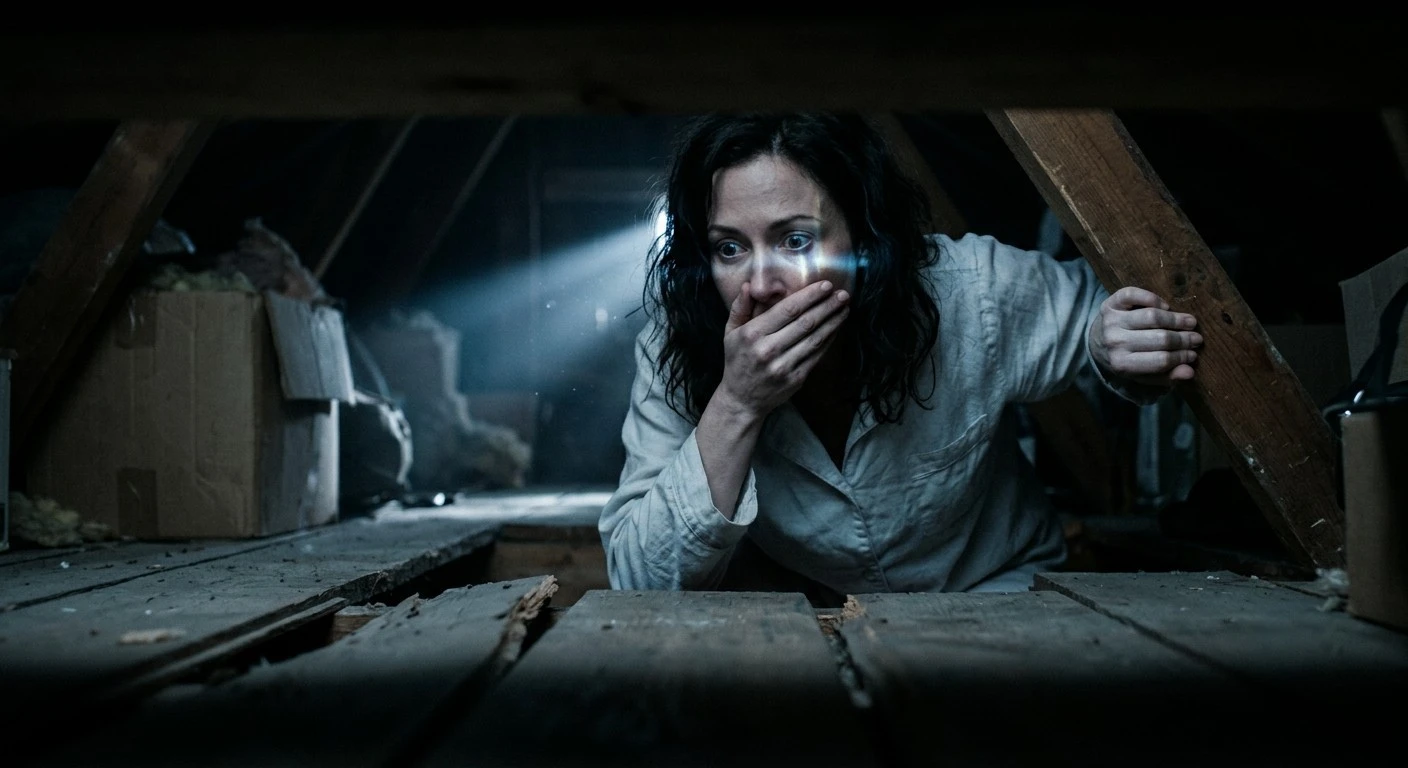
I clamped a hand over my mouth.
Through a crack in the floorboards I could see the hallway. Caleb stood there in sweatpants, my laptop under one arm. Beside him, a stranger in a black raincoat held out a small case.
Caleb opened it.
Three passports.
One with his photo. One with Noah’s. One with mine.
None of them had our names.
The stranger tapped my photo with a gloved finger. “She travels as Anna Vale. The boy is Daniel. You stay Michael Grant.”
“You said she wouldn’t be part of this,” Caleb said.
“She became part of it when she copied the files.”
I had copied nothing. Not knowingly.
Caleb snapped the case shut. “How much time do we have?”
“Forty minutes. Maybe less.”
“And if she’s already out?”
“Then we find her before Northbridge does.”
My stomach dropped at the word. I’d heard it before — buried in old bank statements Caleb said were work jargon. I’d believed him.
The stranger’s phone buzzed. He checked it, jaw tightening. “Bureau’s pinged a car three blocks out.”
“FBI?” Caleb’s voice cracked for the first time.
“Move the bags. Now.”
Footsteps scattered below me. A closet door. The clink of something heavy being dragged.
I pressed my back to the cold rafters and made myself small.
Ten minutes later, headlights swept the ceiling through the round attic vent. Not one car. Several.
A voice, amplified, filled the street. “FEDERAL AGENTS. COME OUT WITH YOUR HANDS VISIBLE.”
Caleb’s voice, downstairs, gone thin. “Elise’s up there. She doesn’t know anything.”
“Sit down,” the stranger snapped. “Both hands on the table.”
Glass broke at the front of the house. Boots on hardwood. Someone shouted a name that wasn’t mine — Anna Vale — like they already knew the fake one.
The attic door rattled.
“Elise Morrison.” A woman’s voice, steady, unfamiliar. “FBI. It’s safe to open the door.”
My hands wouldn’t work. I fumbled the latch twice before it gave.
An agent in a windbreaker crouched at the top step, weapon lowered. Behind her, more lights, more boots.
“Is my husband—”
“He’s in custody,” she said. “You’re safe. Your sister sent us.”
I sat down hard on a Christmas box. “Mara sent you?”
“She’s the one who flagged this house six hours ago.”
Downstairs, I heard Caleb’s voice again, no longer calm. “Elise! Elise, I can explain—”
I didn’t go down right away.
I sat in the attic and listened to my marriage get arrested one floor beneath me.
They walked me out past a driveway full of black SUVs. Neighbors stood in bathrobes behind police tape. Someone had a phone up, filming.
Caleb sat handcuffed in the back of a sedan, staring straight ahead. He didn’t look at me. Or he couldn’t.
A woman in a Bureau windbreaker met me at the curb. Late thirties, tired eyes, my sister’s jaw.
“Mara?”
She pulled off a comms earpiece and hugged me hard enough to hurt.
“You could have told me you worked a case on my own house,” I said into her shoulder.
“I didn’t know it was your house until nine tonight.” She pulled back, hands on my arms. “Elise — Northbridge isn’t identity theft. It’s a smuggling and fraud ring. They build clean identities, drain the real ones, and disappear people who become liabilities.”
“Liabilities.”
“People who ask too many questions.” She looked at me. “You were about to become one.”
I sat down on the curb because my legs stopped working.
“Caleb’s real name isn’t Caleb Morrison,” Mara said quietly. “It hasn’t been for six years.”
The debrief took four hours. A conference room, bad coffee, an agent named Reyes who spoke slowly, like I might shatter.
“Your husband — the man you married as Caleb Morrison — recruited into Northbridge as a document courier,” Reyes said. “He married you two years into the operation.”
“Why marry me at all?”
“Because a stable family made him invisible,” Reyes said. “A wife. A son. A mortgage. Nobody investigates a man who coaches Little League.”
I thought of every Saturday morning game. Every juice box. Every normal thing.
“The passports,” I said. “Why us? Why Noah?”
“Exit contingency,” Reyes said. “If the operation collapsed, he had thirty minutes to disappear with a new family under new names. Tonight it collapsed.”
“Would he have taken Noah?”
Reyes hesitated. That was the answer.
“Would he have taken me?”
“Only if you didn’t ask questions,” Mara said from the doorway. “The moment you did, you became a witness. And witnesses in Northbridge don’t stay quiet for long.”
I understood, slowly, sickly, what “disappear” meant when it wasn’t about passports.
“He was going to erase me,” I said.
“He was never going to let that happen,” Mara said. “That’s why I called.”
Caleb requested to see me once, before arraignment. I almost didn’t go.
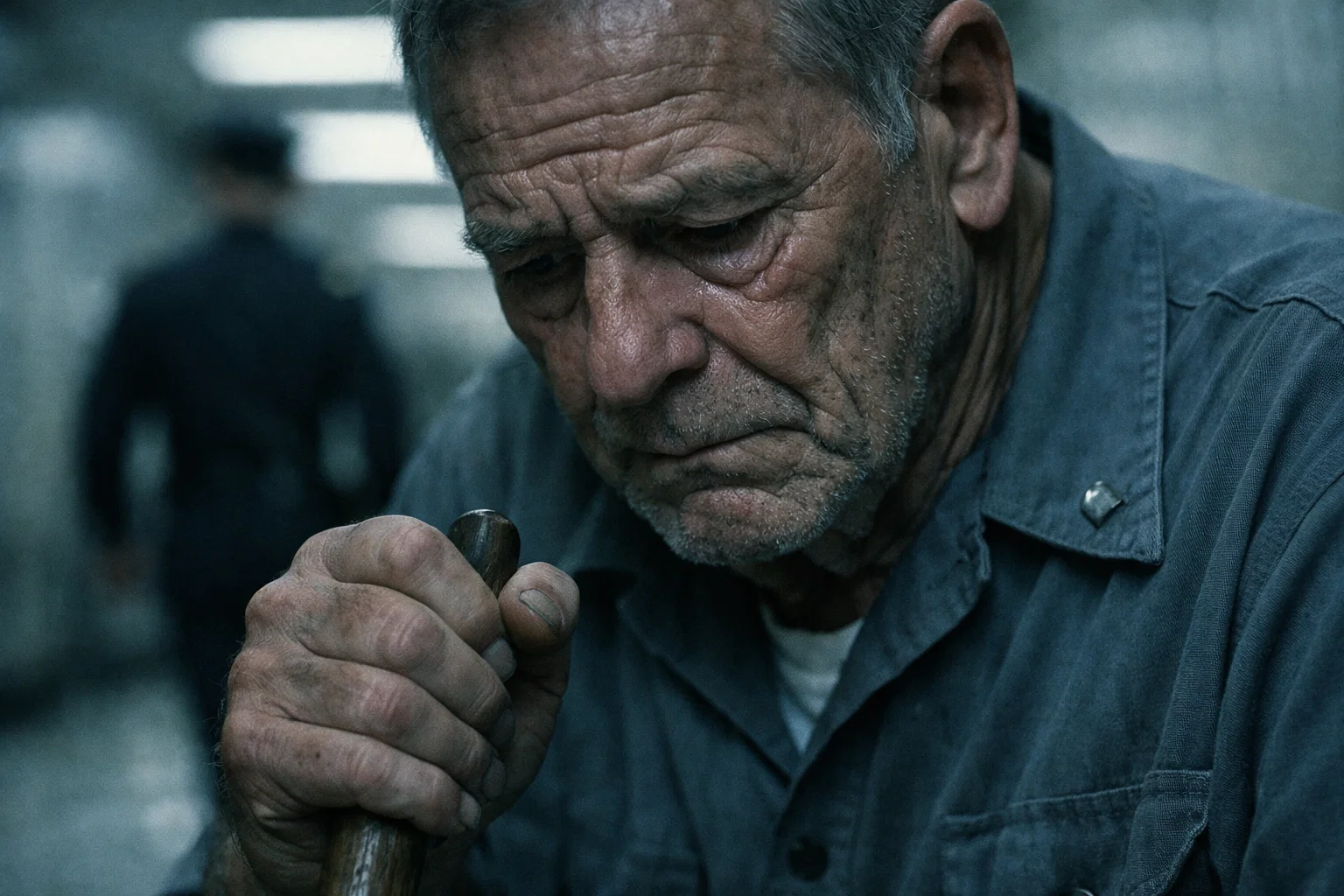
He looked smaller in an orange jumpsuit. Tired. Human. That was the worst part — he still looked like my husband.
“I never wanted you scared,” he said through the glass.
“You had a passport with my face on it and a fake name for our son.”
“I was going to protect you.”
“By stealing my identity.”
“By keeping you alive when it fell apart.” His hands trembled around the phone. “I do love you, Elise. That part was never fake.”
“You don’t get to keep that word,” I said. “Not after this.”
“Elise—”
“You used our marriage as a hiding place,” I said. “You used our son as a fallback plan. There’s no version of love that survives that.”
I hung up the phone before he could answer, and I didn’t look back walking out.
Discovery took months. Reyes walked me through it in pieces, because the whole truth arrived faster than I could carry it.
Caleb — real name Michael Voss — had helped move nine falsified identities in three years. Two belonged to people who later turned up dead in states they’d never lived in. Northbridge didn’t just fake passports. It rented out lives, then ended them when they stopped being useful.
“You’re saying he watched people disappear,” I said.
“I’m saying he built the paperwork that let it happen,” Reyes said. “Whether he watched — that’s for the jury.”
At trial, the prosecution played a wiretap from the night of the raid. Caleb’s voice, calm, discussing whether I was “a risk worth managing.”
Managing.
Like a spreadsheet line.
I sat in the gallery and did not cry. Mara sat beside me and gripped my hand hard enough to leave marks.
The jury took six hours.
Guilty on all eleven counts.
The judge handed down twenty-two years, no parole eligibility before fourteen.
Caleb didn’t look at me when they read it. He looked at the table, the same way he’d looked at that passport case in our hallway — irritated, not afraid.
I finally understood the difference between those two expressions. Fear meant he thought he might lose something. Irritation meant he already had.
The divorce was fast. The custody hearing wasn’t.
Northbridge’s lawyers tried to argue Caleb — Michael — deserved supervised visitation as a “nonviolent offender.” Reyes testified for three hours about the wiretap, the exit passports, the two names found in a landfill outside Richmond.
The judge granted full custody to me. Zero contact, pending appeal, which never came. Michael Voss stopped fighting for anything eleven days into his sentence, once his own network stopped paying his legal bills.
Karma, if you want a clean word for it, showed up as an invoice nobody paid.
Noah asked about his father exactly once, seven months later, at the kitchen table over cereal.
“Is Dad ever coming home?”
“No,” I said. “He hurt people, and now he has to answer for that far away from us.”
“Did he hurt us?”
I chose the true answer over the easy one. “He put us in danger to protect himself. That’s a kind of hurting.”
Noah chewed for a while. “Aunt Mara stopped him.”
“Aunt Mara stopped him.”
“Good,” he said, and went back to his cereal, seven years old and already understanding more than I wanted him to.
Mara moved in for the first month. She slept on the couch with her service weapon on the coffee table and complained about my mattress every single day.
One night, after Noah was asleep, she sat with me on the porch steps.
“You’re allowed to grieve him,” she said. “The man you thought you married.”
“He never existed.”
“He existed enough for you to love him. That part was real, even if he wasn’t.”
I looked at my hands. “How do I trust that I’ll ever see someone clearly again?”
“You already are,” Mara said. “You saw him clearly the second it mattered. Through a crack in the floorboards, in the dark, terrified — and you still didn’t run to him. You ran to protect Noah.”
“I ran because you told me to.”
“You obeyed,” she said, “because some part of you already knew.”
I let that settle. It didn’t fix anything. It helped anyway.
“Maybe he loved you in some broken compartment of himself,” she said. “Maybe he didn’t. Either way, he chose to use you. You don’t need to solve his heart to trust your own.”
That sentence became the beginning of peace.
I kept a handful of old photographs. Not because Caleb deserved a place in them, but because Noah’s first steps were still Noah’s first steps. My laughter was still mine. Betrayal changed the meaning of the marriage. It didn’t own every second I’d lived inside it.
Years passed.
Noah grew tall. He stopped asking whether someone would come to change his name. At twelve, he added Mara’s surname as his own middle name. At fifteen, he built a school project on identity fraud and won a state competition with it. At seventeen, he stood in the attic of our new house, helping me hang Christmas lights, and caught me staring at the floorboards.
“You okay?”
“Yes.”
He waited.
“No,” I said. “But I will be.”
He nodded and moved a box closer so our shoulders touched.
Mara arrived with pizza, complaining about the stairs the way she always did. We ate among half-strung lights while rain tapped the roof.
Not the same house. Not the same storm. No armed men below us. No false passports. Just three people under bare rafters, telling the truth.
Later, Noah found the old phone charger I’d grabbed the night Mara called, still tangled in a drawer.
“Why did you take this?”
“I wasn’t thinking.”
“You were running for your life and you remembered your charger?”
Mara laughed so hard she nearly dropped her plate. I threw a napkin at her. For the first time, the attic became part of a funny story, not only the place my marriage had ended.
On the tenth anniversary of the Northbridge raid, Mara retired. We held dinner in the backyard. Former agents came, including the tactical commander who’d once tried to keep me in a vehicle while my house filled with strangers.
Noah gave a short speech. He held up a small blue plastic button — off the pajamas he’d worn the week everything changed.
“I used to think being brave meant not being scared,” he said. “My mom was scared. My aunt was scared. I was scared. They acted anyway.” He looked at me and set the button in my palm. “This was the first blue thing I ever found. You told me to keep looking closer. I still do.”
My throat closed. Mara raised her glass. “To looking closer.”
Later, on the porch steps, she asked, “Do you ever wish you hadn’t answered?”
I knew which call she meant. 12:08 a.m. Her name glowing beside a man who wasn’t who he said he was.
“No.”
“Even knowing everything?”
I watched Noah laughing across the yard, seventeen and safe and entirely his own person.
“If I hadn’t answered, the lie would still be running.”
She leaned her shoulder into mine. “I’m sorry I shouted at you that night.”
“You saved my life.”
“I still shouted.”
“You were always bossy.”
She smiled. “You’re welcome.”
That night, after the guests left, I carried an old navy passport case upstairs — the one that had once held three false identities, kept as evidence, later returned to me by a prosecutor who understood I needed to be the one to decide what happened to it.
I opened it.
Inside, where the fake documents had been, I placed three things: Noah’s blue button, a note Mara once wrote me about telling the truth, and the key to our new front door.
Then I closed the lid.
The object built to erase us became a box holding everything nobody could take: my son’s name, my sister’s honesty, my own door.
Outside, the porch light clicked off. Noah called goodnight from his room. Mara’s car disappeared past the trees.
I stood under the attic rafters one more time and looked down through the floorboards.
No conspiracy below me. No stranger in a raincoat. No husband speaking in a voice that wasn’t his.
Only a quiet hallway in a house where everyone inside it knew exactly who they were.
I latched the attic door — not to hide, this time, but because I was ready to sleep. And for the first time in ten years, the dark meant nothing more than night.
Original fictional stories. AI-assisted creative content.