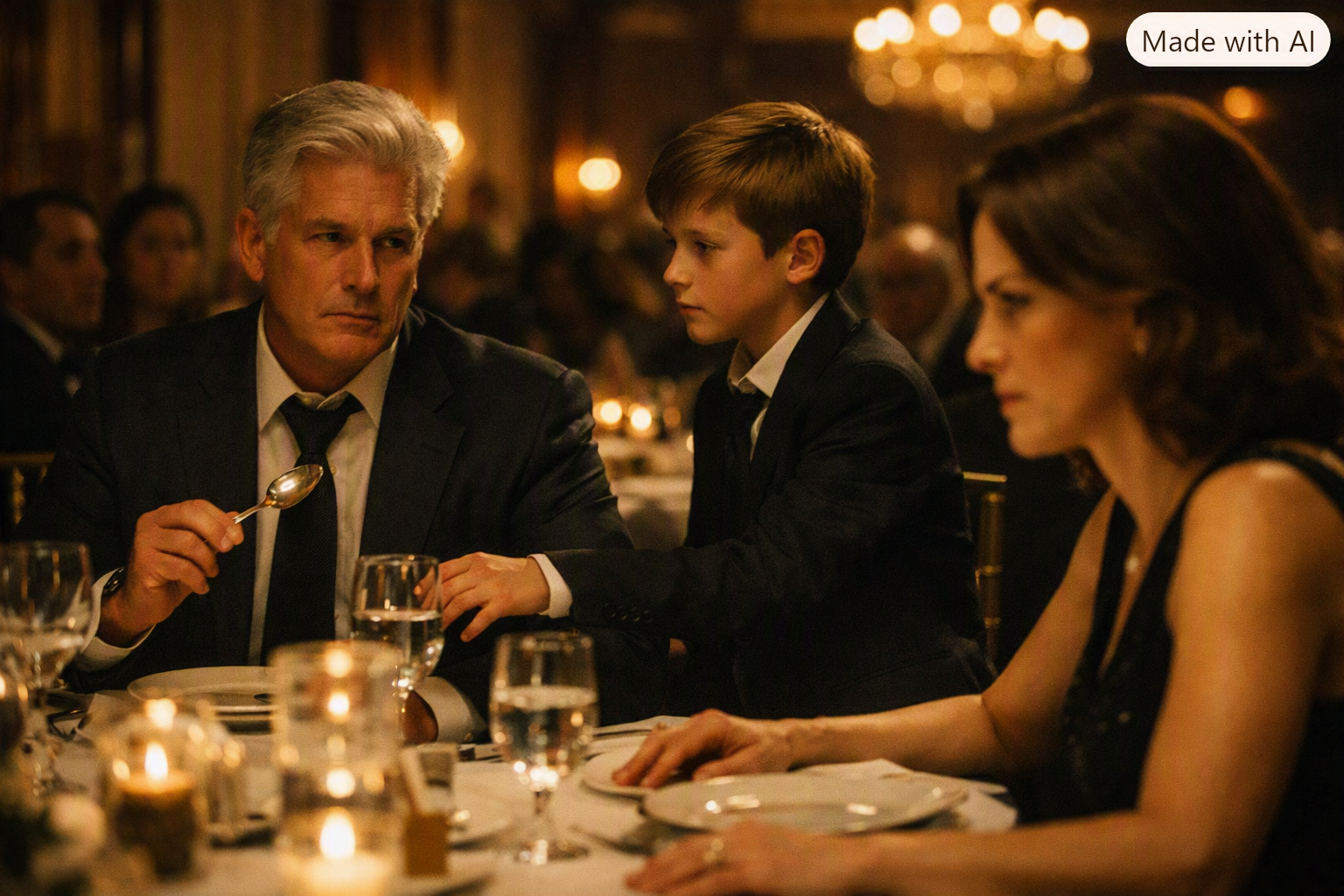
The crystal chandelier above Michael Anderson’s head threw gold light across two hundred guests, and not one of them noticed the boy.
Not at first.
The hall was everything money could buy — long white tables draped in silk, servers moving in precise lines, the low hum of wealth talking to itself. Michael sat at the center of it all, fifty years old tonight, founder of Anderson Financial Group, a man who had never once been caught off guard.
He lifted his spoon.
A hand grabbed his wrist.
Michael froze.
He looked down.
A boy. Maybe twelve. Filthy jeans, torn jacket, dark hair stuck to his forehead with sweat. Eyes too old for his face — the kind of eyes that come from sleeping outside.
“Sir,” the boy said quietly. “Don’t eat that.”
Michael didn’t move.
Around him, conversation stopped. Glasses lowered. Two hundred heads turned toward the center table.
“What did you just say?” Michael asked.
The boy swallowed. His grip didn’t loosen.
“Don’t eat the food.”
Victoria’s chair scraped the floor as she stood.
“Security.” Her voice was immediate. Controlled. The voice of a woman who managed rooms for a living. “Get him out of here.”
Two guards started moving.
Michael raised one hand. “Stop.”
They stopped.
He looked at the boy. “Why?”
“Because I saw her.” The boy glanced sideways at Victoria. “She put something in it.”
The room made a sound — not quite a gasp, not quite silence. Something between the two.
Victoria laughed. It came out wrong. Too fast, too light.
“Michael. He’s homeless. He probably wandered in off the street.”
“I’m not homeless,” the boy said. “I mean—” He stopped. “I sleep outside sometimes. That doesn’t mean I’m lying.”
Michael looked at his plate. The food sat there, untouched. Braised short rib, his favorite. The dish had been requested specifically. Victoria had insisted.
He thought about that.
“I’m not crazy,” the boy said again. He was talking to the whole table now, desperate, his voice cracking at the edges. “I saw her go into the kitchen. She made everyone leave. Then she opened something from her purse and she put it in a specific plate. Then the waiter brought it to you.”
Victoria’s expression shifted.
It was a small shift. Almost nothing.
But Michael had been watching her face for eighteen years.
“Victoria,” he said.
“This is embarrassing, Michael.”
“Eat the food.”
The table went absolutely quiet.
Victoria blinked. “What?”
“If there’s nothing wrong with it—” Michael slid the plate toward her — “eat it.”
She didn’t move.
Seconds passed.
Nobody looked away.
Victoria’s fingers found the edge of the table. Her knuckles went white.
“I’m not hungry.”
“You always love this dish.”
“Michael, I—”
“Eat. The. Food.”
She didn’t.
Daniel Reeves, Michael’s oldest friend, leaned forward from three seats down. “Mike. I’m calling someone.”
“Good.”
Daniel already had his phone out.
Victoria sat back down. Her jaw worked silently. She was calculating something — Michael could see it, could see the same look she got before she walked into rooms where she wanted something. The managed calm. The performance.
Only right now it was failing.
“What’s your name?” Michael asked the boy.
“Noah.”
“Noah.” Michael kept his eyes on Victoria. “Tell me exactly what you saw.”
Noah talked fast, like he was afraid someone would cut him off. He’d been outside looking for food. He knew event halls sometimes left catering near the service entrance. He’d slipped through a door. He’d stayed hidden because he didn’t want to get caught. And then he’d seen a woman in an expensive black dress walk into the kitchen and ask the staff to step out.
“She said she needed a minute,” Noah said. “Said she wanted to check on the birthday cake. The chef left.”
Every eye in the room turned to the head chef, who had drifted in from the kitchen doorway.
The chef’s name was Raymond. He’d worked with Michael’s event team for six years. He looked like a man who very much did not want to be standing where he was standing.
“Chef Raymond,” Michael said. “Did my wife enter the kitchen tonight?”
Raymond looked at Victoria.
“Yes, sir.”
“Did she ask you to leave?”
A pause.
“Yes.”
Victoria stood again. “I went to check the cake! The presentation wasn’t what I’d asked for. I didn’t want to embarrass him in front of the whole team, so I asked for a moment.”
Michael looked at Raymond. “Is that what happened?”
Raymond cleared his throat. “She didn’t mention the cake.”
“That’s a lie—”
“She walked straight to the main service trays,” Raymond said. His voice was careful. Flat. “I noticed because it was unusual. But she’d asked me to step out, so I did. I assumed there was a reason.”
A murmur moved through the room.
Michael looked at his plate again. He looked at the boy. He looked at Victoria.
She was still standing.
And she was afraid.
Not embarrassed. Not offended. Afraid. There was a difference, and Michael knew it, and he could see it now in the set of her shoulders, the way her eyes kept moving to his plate like she wished it would disappear.
“Daniel,” Michael said.
“Already on with them.”
“Thank you.”
Victoria stepped toward him. Her voice dropped. “Michael. Can we please go somewhere private and—”
“No.”
“Michael—”
“Sit down, Victoria.”
She sat.
Noah stood near the edge of the table, arms at his sides, watching all of it. He looked like he wasn’t sure if he’d done something right or something terrible.
A man in a gray suit — Michael’s attorney, Lawrence Chen, who had been seated near the back of the room — made his way to the table. He’d heard enough to understand the situation. He crouched beside Michael’s chair.
“Don’t touch the plate,” Lawrence said quietly. “Don’t let anyone touch it.”
“Already figured that.”
“Good.” Lawrence straightened and looked at Victoria. He’d known her for twelve years. His expression didn’t change. “Mrs. Anderson, I’d strongly advise you not to say anything further until—”
“I didn’t do anything!” Her composure broke, just for a second. Just enough. “I don’t know what that boy thinks he saw, but I did not—”
“Then eat the food,” Noah said.
He said it quietly. He wasn’t being rude. He was just stating the obvious.
Victoria looked at him.
He looked back.
“I’m twelve,” he said. “I’m not trying to get you in trouble. I just didn’t want him to die.”
The word landed in the room like a stone into still water.
Die.
Nobody had said it out loud yet. Noah had just said it. And suddenly it was real in a way it hadn’t been thirty seconds ago — real enough that three women at the far table audibly gasped, real enough that Michael’s brother, seated two places down, pushed back his chair and stood up.
“What is going on?” his brother, James, demanded.
“Sit down, James.”
“Michael, what—”
“Sit. Down.”
James sat.
Michael was very calm. He had the particular calm of a man who had processed a lot of information in a short window and was now operating entirely on that processing. His body was still. His hands were folded on the table. He was looking at his wife of eighteen years.
He was looking at her the way you look at a stranger.
“How long?” he asked.
“Michael—”
“How long have you been planning this?”
“I wasn’t planning—”
“Victoria.” His voice didn’t rise. It didn’t have to. “I’m only going to ask calmly for a little while longer. I need you to understand that.”
She pressed her lips together.
The police arrived eleven minutes later.
Two officers, then four. A detective named Reeves — no relation to Daniel — who took one look at the scene and started asking very quiet, very deliberate questions. The plate was photographed in place before anyone touched it. Then it was bagged. Victoria’s purse was asked for. She refused. The detective looked at her patiently.
“Ma’am. I can get a warrant in about twenty minutes. Or you can cooperate now and we can figure out what actually happened here.”
Victoria looked at Lawrence, who shook his head fractionally.
She handed over the purse.
The detective went through it methodically. There wasn’t much — phone, cards, lipstick, a folded receipt. Then, tucked into an interior zipper pocket, a small amber glass vial. Empty. The kind you’d find in a compounding pharmacy. No label.
He held it up in a gloved hand.
The room went completely still.
Victoria stared at it.
“Ma’am,” the detective said. “Is this yours?”
She didn’t answer.
Michael looked at the vial. He looked at his plate. He looked at his wife.
“Victoria,” he said. “Why?”
She shook her head.
“Victoria.”
Nothing.
Then Noah — still standing at the edge of things, still clutching his own arms like he was cold — pointed to something else.
“There,” he said.
The detective followed his finger. The small dessert plate beside Victoria’s setting. A delicate porcelain thing with a swirl of chocolate mousse. Victoria had barely touched it.
But there was a residue at the rim. A faint powdery smear, like something had been tapped against the edge.
Victoria lunged for it.
Michael grabbed her wrist.
Not hard. He just held her.
“Don’t,” he said.
She stopped fighting immediately.
And then, in front of two hundred people, in the middle of his own birthday party, Michael Anderson watched his wife’s face collapse.
Not into anger. Not into denial.
Into exhaustion.
Like she’d been holding something up for a very long time and had just, finally, let go of it.
“I wasn’t trying to kill you,” she said.
The room was so quiet you could hear the chandelier hum.
“What?” Michael said.
“I wasn’t trying to kill you.” Her voice was flat. Emptied out. “I just needed you unconscious. For a few hours.”
“Why?”
She looked at the table.
“Victoria. Why?”
She looked up at him, and for a second he saw the woman he’d married — not the composed, elegant creature she’d become, but the woman from before all of that, the woman with the quick laugh and the opinions about everything and the way she’d grab his hand without thinking in the middle of a movie.
He saw her, and then he didn’t.
“Because you were leaving me,” she said.
Michael said nothing.
“I know about the lawyer meetings. I know about the will.” She wiped her cheek with the back of her hand. “You were going to cut me out. Give everything to charity. Leave me with the prenup settlement and nothing else.”
“That’s not—” Michael stopped. Restarted. “That’s not what was happening.”
“Your assistant told Marcus.”
“What?”
“Marcus Finley. His wife is my friend. She told me everything.”
Michael closed his eyes briefly. Marcus Finley was a mid-level partner. His wife was a woman named Claire who played tennis with Victoria on Tuesday mornings.
He opened his eyes.
“I was updating the will,” he said slowly. “I was restructuring some charitable giving. It wasn’t—”
“You were meeting with a divorce attorney.”
The words fell between them.
“Michael.” Daniel’s voice, low and careful. “Don’t say anything else without—”
“It was a consultation,” Michael said. He wasn’t talking to Daniel. He was talking to Victoria. “I hadn’t decided anything.”
“You had lunch with him twice.”
“I was thinking.”
“About leaving me.”
He didn’t answer.
Victoria nodded once, like that confirmed something.
“I couldn’t lose everything,” she said. “Eighteen years. The house, the accounts, the—everything I built here.” She wasn’t crying anymore. She’d moved past it. “So I just needed a little time. A few hours where you weren’t aware. Enough time to move the accounts.”
“Move the accounts.”
“Some of them.”
“To where?”
She shook her head.
Lawrence stepped forward. “I don’t think—”
“To where, Victoria.”
“It doesn’t matter now.”
The detective held up a hand. “Actually, Mrs. Anderson, it matters quite a bit. We’re going to need you to come with us.”
Victoria stood. She smoothed her dress. She picked up her clutch — not the purse, which was already bagged — and she looked at Michael one more time.
“I didn’t want you dead,” she said again. Like she needed him to know that. Like it made a difference.
“I know,” he said.
“I just couldn’t—” She stopped.
“I know.”
One of the officers stepped forward.
Victoria walked out of her own birthday party — his birthday party, their party — between two police officers, and the room parted for her like water, and nobody said a word.
Silence held for a long moment.
Then James said, “Michael.”
“I’m fine.”
“You’re not fine.”
“I’m fine, James.” Michael straightened his jacket. He looked around the room. Two hundred faces, most of them people he’d known for years. Some of them looking at him with pity. Some with shock. A few — the honest ones — with something closer to fascination.
He’d deal with all of it later.
Right now he turned toward the boy.
Noah was standing near the service door, watching the police lead Victoria out. He looked like he was trying to figure out if he was supposed to leave. Like he’d maybe stayed too long at a party he hadn’t been invited to.
Michael walked over.
“Noah.”
The boy looked up.
“You saved my life.”
Noah’s jaw worked. “I don’t know that for sure.”
“The lab will.” Michael glanced toward the bagged plate. “But you and I both know what we saw.”
Noah shrugged. It was a small, uncomfortable shrug. The kind you do when you’re not sure if you’re allowed to accept something.
“Why’d you do it?” Michael asked. “You could’ve just left. Nobody knew you were there.”
Noah thought about it. He looked genuinely puzzled by the question, like he’d never actually considered not doing what he did.
“Because you were about to eat it,” he said finally.
“That’s not really an answer.”
“I know.” Noah looked at the floor. “My mom used to say that if you see something wrong happening and you can stop it, you stop it. That’s just what you do.”
Michael was quiet for a moment. “Where’s your mom?”
Noah’s face tightened. “She died. Last year.”
“I’m sorry.”
“It’s okay.”
It wasn’t okay. Michael could see that. But he didn’t push it.
“Have you eaten today?”
“This morning.”
“What’d you have?”
“Some crackers.”
Michael turned toward the kitchen. The chef — Raymond, who was still hovering near the doorway, unsure what his role was in any of this — looked up.
“Whatever he wants,” Michael said. “Full meal. Whatever he wants.”
Raymond nodded and disappeared into the kitchen.
Noah looked uncertain. “You don’t have to—”
“I know I don’t.”
“I wasn’t expecting anything. I just—”
“Noah.” Michael put a hand briefly on the boy’s shoulder. “Just let someone feed you.”
Noah closed his mouth.
He ate at the main table — the center table, Michael’s table — while the police finished their work and the guests slowly collected themselves and the evening moved into whatever strange territory it had decided to occupy. A few guests left. Most didn’t. Some of them drifted toward Michael with careful, well-meaning things to say, and he listened and nodded and said thank you, and eventually they drifted away.
He sat beside Noah and watched him eat a cheeseburger.
Not because he’d ordered anything elegant. Not because the kitchen had suggested it. Because Michael had asked what he wanted, and that was what he wanted, and Raymond had made it happen in twelve minutes flat.
Noah ate like someone who wasn’t sure when the next opportunity would be.
Michael watched him and thought about eighteen years and a wife who’d decided that was worth poisoning someone over, and a boy who’d decided it was worth risking himself to stop it.
He thought about which of those two things surprised him more.
He was still thinking about it when Noah finished eating and wiped his mouth with a linen napkin and looked across the table.
“Is there more?” Noah asked.
“Whatever you want.”
Noah considered. “Could I have some of the dessert? Not—” He stopped. “Not that one. A different one.”
Michael almost smiled. “Of course.”
Raymond brought a proper slice of the birthday cake — vanilla, three layers, the one Victoria had insisted on ordering from a bakery in Tribeca — and Noah ate it like it was the best thing he’d ever had.
Maybe it was.
“Okay,” Noah said when he was done. He pushed the plate back carefully. “Thank you.”
“Don’t thank me.”
“I’m going to anyway.”
Michael nodded.
Daniel appeared at his shoulder and bent down. “Lawrence wants five minutes. And the detective needs a formal statement.”
“Tell them both ten minutes.”
“Yeah.” Daniel stayed where he was. He looked at Noah. “You did a brave thing tonight, kid.”
Noah shrugged.
“A really brave thing,” Daniel said again. Then he walked away.
Michael looked at the boy.
“Do you have somewhere to go tonight?”
Noah hesitated. The hesitation was its own answer.
“There’s a hotel next door,” Michael said. “I’ll get you a room.”
“I can’t—”
“It’s my birthday.” Michael’s voice was quiet. “Let me do one useful thing tonight.”
Noah looked at him for a long moment.
“Okay,” he said.
“Okay.”
Michael stood. He looked around the hall — the silk tablecloths, the chandelier, the flowers that had cost more than Noah had probably eaten in the past month, the hundred people still watching him carefully. He thought about the spoonful of food he’d almost eaten. He thought about Victoria’s face when she’d said I didn’t want you dead, the specific way she’d needed him to believe it.
He thought about what he was going to do tomorrow, and the day after, and what eighteen years meant when they ended like this.
He thought about all of it.
Then he looked at Noah.
“Come on,” he said. “I’ll walk you over.”
Noah stood up from Michael Anderson’s birthday table and followed him toward the door.
Behind them, the room slowly exhaled.
The next morning, the lab results came back.
The substance in Michael’s food was a sedative compound — high dose, enough to render a healthy adult unconscious for six to eight hours. Enough time, as Victoria had said, to move accounts. The forensic accountants found the wire instructions on her laptop. Three accounts. Eight million dollars. Routed to a private holding company in the Cayman Islands registered under her college roommate’s maiden name.
It had been in preparation for four months.
Victoria was charged with poisoning with intent, fraud, and conspiracy.
She made bail.
Lawrence filed the divorce papers the same afternoon.
Michael sat in his office that evening and read through everything slowly. The wire instructions. The timing. Four months. She’d been planning this since January, which meant she’d known about the attorney consultations in December, which meant someone in his circle had been passing her information for at least that long.
He made a list of who knew. He would deal with that separately.
He thought about December, what he and Victoria had been like in December. Christmas dinner, the ski trip in Colorado, the night they’d stayed up late watching old movies because neither of them could sleep. He’d been happy, or something close to it. Or something that had looked like happiness from the inside.
He wasn’t sure anymore which parts had been real.
At six o’clock his assistant knocked.
“Mr. Anderson. There’s a boy here. Says you told him to come by.”
Michael looked up.
“Send him in.”
Noah came in wearing the same torn jeans and the jacket, but he’d clearly showered. His hair was clean. He looked like a different person and exactly the same person.
“I wanted to say thank you again,” Noah said. “For the room.”
“Sit down.”
Noah sat across the desk. He looked around the office with careful eyes — the kind of eyes that measured things, that noticed exits and counted people and didn’t waste attention.
Smart kid, Michael thought. Quiet smart. The kind you didn’t notice until you needed to.
“What happened to your mom?” Michael asked.
“She got sick.” Noah’s voice was even. “She’d been sick for a while. But she got worse last year. Then she died.”
“Your father?”
“Not around.”
“Anyone else?”
“An aunt. But she’s—” Noah stopped. “She has her own problems.”
Michael nodded.
“How long have you been on your own?”
“Eight months.”
Eight months. Twelve years old. Eight months.
Michael was quiet for a moment.
“You said your mother told you to stop things when you can.”
“Yeah.”
“She taught you that.”
Noah looked down. “She taught me a lot of things.”
“She was right about that one.”
“I know.”
Michael leaned back.
He thought about what he was doing. He thought about whether it was the right thing or just the thing that felt right, and whether that distinction mattered right now, and he decided that right now it didn’t.
“I talked to Lawrence today,” he said. “My attorney.”
“Okay.”
“There’s a private school in Connecticut. Boarding. Good academics, good support. A scholarship program for kids from difficult circumstances.” He paused. “I made a call.”
Noah went very still.
“There’s a spot available for next semester,” Michael continued. “If you want it.”
The boy didn’t move.
“Noah.”
“Why?” Noah’s voice was quiet.
“Because you’re twelve and you’re sleeping outside and you’re clearly not stupid, and someone should do something about that.”
“You don’t know me.”
“I know enough.”
“You don’t owe me anything.”
“I don’t,” Michael agreed. “And yet.”
Noah stared at the desk.
Michael waited.
“What about now?” Noah asked finally. “Before next semester.”
“Guest suite upstairs. As long as you need.”
Noah shook his head slowly. “Why would you do all this?”
“Because yesterday you walked into a room full of strangers and grabbed a billionaire’s wrist and told him not to eat his food. That took something.” Michael met his eyes. “I don’t want that to get wasted.”
Noah was quiet for a long moment.
Outside the window, Manhattan moved through its ordinary evening. Horns and sirens and the low churn of the city doing what cities do. The chandelier was gone. The party was over. The food was in an evidence bag in a police laboratory somewhere across town.
None of it had been ordinary.
“Okay,” Noah said.
“Okay?”
“Okay.” He looked up. His eyes were wet, but his face was steady. “Thank you.”
“Don’t thank me yet.”
“I’m going to anyway.”
Michael smiled for the first time since the party.
“Fair enough.”
Three weeks passed before the preliminary hearing.
Michael spent most of them in his office or in Lawrence’s conference room, working through the financial forensics. The accountants found more than the three accounts Noah had pointed toward. There were six in total — a second layer discovered behind the first, routed through a shell company registered in Delaware with a generic name that meant nothing. The company had been opened fourteen months ago. Two months before Michael had ever spoken to a divorce attorney.
Which meant Victoria hadn’t been reacting.
She’d been planning.
Michael sat with that for a long time. He thought about fourteen months ago — a weekend in the Hamptons, a dinner they’d had at the Italian place on Newbury where she’d ordered the lamb and they’d shared a bottle of Barolo and laughed about something he couldn’t remember anymore. He thought about fourteen months ago and tried to find the seam in it, the moment where one life had become something else wearing the same face.
He couldn’t find it.
Lawrence told him that was normal.
“People compartmentalize,” Lawrence said. “They’re capable of genuinely loving something at the same time they’re working to destroy it.”
“That’s not a comfort.”
“It’s not meant to be. It’s just true.”
Michael looked at the financial documents spread across the conference table.
“Fourteen months,” he said.
“Yes.”
“She had fourteen months to change her mind.”
Lawrence was quiet.
“And she didn’t.”
“No.”
Michael nodded. He gathered the papers.
“Okay,” he said.
He handled it quietly. The press found out anyway — they always did — but he declined every interview request and Lawrence’s public statement was two sentences. Michael’s business partners reached out one by one, carefully, each of them trying to be both supportive and invisible at the same time in the way that wealthy men did when they were afraid proximity to scandal might be contagious. Michael thanked them and moved on.
His brother James called three times a week.
The third call was the one that mattered.
“I want to apologize,” James said.
“For what?”
“I knew something was off with her. I’ve known for a couple of years. I didn’t say anything because I didn’t want to be wrong.”
Michael was quiet.
“I should’ve said something,” James said.
“Yeah,” Michael said. “You should’ve.”
“I’m sorry.”
“I know.” Michael leaned back in his chair. “I knew too. I just didn’t want to be right.”
They both stayed on the line for a moment, saying nothing.
“How’s the kid?” James asked finally.
“Good. He starts next semester.”
“You’re really doing the school thing.”
“I’m really doing the school thing.”
James made a sound — not quite a laugh. “You always were better at the instinct stuff than the logic stuff.”
“That’s not a compliment.”
“It’s not an insult either.”
Michael looked out the window. “He sent me an email yesterday. About a history project.”
“Yeah?”
“He wanted to know if I knew anyone who’d been through a lawsuit. For primary sources.”
James laughed. A real one this time. “What did you say?”
“I said I might know someone.”
Six months later, the trial began.
Victoria’s attorney argued diminished judgment, financial anxiety, the pressure of a deteriorating marriage. The wire instructions were explained as preparation, not execution — she’d never actually transferred the funds. The sedative, the defense said, had been impulsive. A moment of panic, not a calculated plan.
The prosecution introduced the four months of communications. The offshore account. The forged signature on the wire instructions. The lab results showing the sedative concentration was calibrated for a man of Michael’s exact weight.
Calibrated.
That word did a lot of work in the courtroom.
The jury deliberated for two days.
Victoria was convicted on two of three counts. The judge gave her four years, suspended to eighteen months with a monitored release program. Her attorney called it a win. Michael’s attorney called it appropriate. Michael sat in the gallery and felt something — not satisfaction, not grief. Something in between that didn’t have a clean name.
Lawrence touched his elbow after the verdict.
“You okay?”
“Yeah.”
“You sure?”
“No.” Michael stood. “But I’ll get there.”
Outside the courthouse, reporters. He’d expected that. Daniel ran interference while Lawrence walked Michael to the car. The cameras followed, and the questions followed, and none of it touched him the way they wanted it to.
He thought about eighteen years.
He thought about Connecticut.
Noah had started school in February. Michael got a brief email every few weeks — formal, polite, the careful writing of a kid who was used to not asking for much. Doing well in math. Had made two friends. Joined the debate team.
He’d included a joke at the end of the last one. A bad one, about a lawyer and a birthday cake. Michael had laughed at it more than it deserved.
He got into the car.
Daniel slid in beside him. “Where to?”
“The office.”
“Michael.”
“The office, Daniel.”
“It’s four in the afternoon.”
“I know what time it is.”
Daniel looked at him. “Take the day.”
Michael looked out the window. The city slid past. Normal afternoon, ordinary Thursday, the kind of day that would mean nothing to anyone who hadn’t lived through yesterday’s version of it.
“Fine,” he said.
“Fine?”
“Take me home.”
Daniel leaned forward and changed the address. Then he sat back.
They drove in silence for a while.
“He’s doing well,” Daniel said. Not a question.
“Who?”
“You know who.”
Michael watched the buildings pass. “Yeah. He is.”
“Good kid.”
“Yeah.”
Daniel nodded.
Michael thought about a twelve-year-old with a hand on his wrist and eyes that didn’t flinch. He thought about because somebody should and what it cost to believe that when nobody was making you, when the easier thing was to walk away and just find the food you came for.
He thought about what Victoria had been planning for four months, and what Noah had done in four seconds, and the distance between those two things.
He looked out at the city.
“She was right,” he said.
“Who?”
“His mother.”
Daniel waited.
“About stopping things when you can.” Michael settled back into the seat. “She was right about that.”
Daniel looked at him for a moment. Then he looked out the window too.
“Yeah,” he said. “She was.”
The car moved uptown through Thursday traffic, and the city kept going, and somewhere in Connecticut a twelve-year-old who’d crashed the wrong party was in a debate club meeting arguing a position he probably hadn’t believed three months ago, because that was what debate club did, and he was learning that sometimes the most important thing you say is the thing you’re afraid won’t be believed.
He already knew how to do that part.
Michael Anderson went home.
He ate a sandwich — nothing fancy, nothing prepared by anyone else — and he sat at his kitchen table in a quiet apartment and thought about the things you think about when the life you thought you were living turns out to have been something else entirely.
Then he picked up his phone and typed a short email.
Good joke, he wrote. Terrible, but good.
He hit send.
Three minutes later, a reply:
I have worse ones.
Michael put down his phone.
He looked at his kitchen.
He thought about the chandelier, the hundred guests, the spoon.
He thought about a hand on his wrist.
Then he made himself a cup of coffee, and he sat there in the quiet, and for the first time in a long time, the silence didn’t feel like something wrong.
It felt like something that was allowed to be exactly what it was.
Original fictional stories. AI-assisted creative content.