The Hargrove estate glittered with money that night. Three hundred guests. A full orchestra. A cake the size of a small car.
None of it mattered to Daniel Hargrove.
He stood at the center of the ballroom, a microphone shaking in his hand. Forty years old. Net worth in the billions. And not one person in this room could fix what was actually broken.
His daughter Emily stood beside him in a white dress, holding his hand like a drowning person holds a rope. Eight years old. Silent for three.
“Dad, you don’t have to do this tonight,” his assistant Rachel had whispered to him an hour before. “Nobody expects a speech.”
“I’m not doing it for them,” he’d said.
“Then don’t do it at all.”
“Rachel.”
“Sorry.”
Now the lights were on him and there was no more backing out.
“Thank you all for coming,” Daniel said. His voice cracked on the second word. A few guests exchanged glances. “I didn’t just invite you here for my birthday.”
The orchestra faded. The room turned.
“Three years ago,” he said, “my wife Claire was killed in a car accident. Emily was in the back seat. She walked away from that wreck without a scratch.” He paused. “And she hasn’t said a word since.”
A woman near the stage pressed a napkin to her mouth.
“I’ve flown in specialists from every major hospital in this country. I’ve spent more than I care to admit. Nothing has worked.” Daniel’s jaw locked. “So tonight, I’m doing something I swore I wouldn’t do. I’m begging.”
He lifted his head.
“One million dollars. Cash. Tonight. To anyone in this room who can make my daughter speak.”
The silence that followed was the kind you could hear.
Then a voice came from the back of the ballroom. Small. Clear.
“I can do it.”
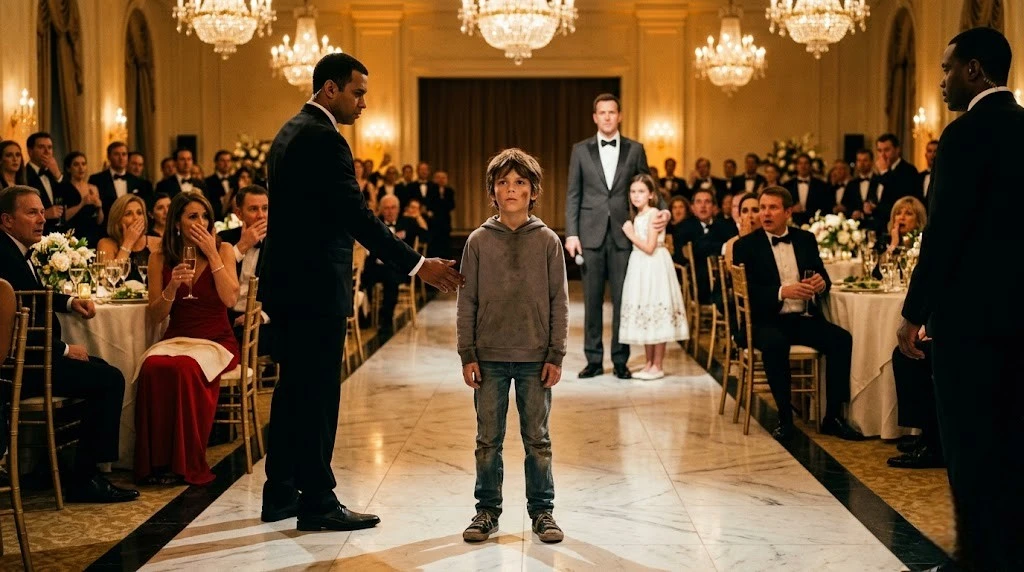
Heads turned like a single body. Standing near the service entrance was a skinny kid in a faded hoodie and scuffed sneakers. Maybe nine. Dirt on one cheek. Brown hair that hadn’t seen a comb in a while.
Two security guards were already moving.
“Sir, we are so sorry,” the nearest guard said into his earpiece. “He came through the kitchen, we’re removing him now—”
“I can make her talk,” the boy said again, louder.
One of Daniel’s business partners laughed. A short, ugly sound. “Is this a joke? Somebody find out who let this kid in.”
“Get him out,” another guest muttered. “This is embarrassing.”
Daniel’s face hardened. “Who authorized this?”
“Nobody, sir, he’s a trespasser—”
“I heard what you said,” the boy called out, holding his ground as the guard gripped his arm. “You said anyone. I’m anyone.”
“This isn’t a game, kid,” Daniel snapped. “Go home.”
“I don’t have one.”
That stopped the room.
The guard loosened his grip, unsure. Daniel’s chest rose and fell. He was about to speak again when he felt it — Emily’s small hand tightening around his fingers. He looked down.
She was staring at the boy. Really staring. The way she hadn’t looked at anyone in three years.
“Dad,” the head of security said quietly, “you want us to walk him out?”
Daniel didn’t answer for a long moment. Then: “Let him through.”
“Sir—”
“I said let him through.”
A murmur rolled across the ballroom. A woman in a red dress whispered, “Oh, for God’s sake, Daniel.”
The boy crossed the marble floor alone. Three hundred people watched him walk. He stopped about four feet from Emily and crouched down so their eyes were level. He didn’t smile. He didn’t put on a face. He just looked at her.
“What’s your name?” he asked softly.
Emily said nothing.
Daniel exhaled hard. “She doesn’t speak. That’s the whole point.”
“That’s okay,” the boy said, not taking his eyes off her. “You don’t have to.”
He reached into his pocket and pulled out a small metal toy car. The red paint was half gone. One wheel sat crooked.
“My mom gave me this,” he said. “Before she died. She told me if I ever got scared, I should hold it and remember I’m not by myself.”
Daniel’s breath caught.
“I didn’t talk for a long time after she was gone,” the boy said. “Almost a year. Not because I couldn’t. Because talking meant time was still moving. And if time was still moving, that meant she was really gone.”
The room was dead quiet now. The kind of quiet that settles when three hundred people all decide, at once, to stop pretending.
The boy placed the little car on the floor between himself and Emily.
“You can keep it tonight, if you want,” he said. “It helped me. Maybe it helps you.”
Emily looked at the car. Then at her father. Then back at the boy.
“Saying one word doesn’t mean you’re forgetting her,” the boy said. “It just means you’re ready to be brave about it.”
Daniel’s eyes filled. He didn’t bother hiding it.
Emily’s lips parted.
Nothing came out.
Daniel closed his eyes. He couldn’t watch another failure. He’d watched too many.
And then, very small, like a word learning how to be a word again:
“Daddy.”
Daniel’s eyes flew open.
“Daddy.”
Louder this time. Real.
A woman in the front row burst into tears. Someone dropped a champagne glass and it shattered, and nobody turned to look.
Daniel dropped to his knees. “Emily. Emily, sweetheart—”
She threw her arms around his neck. “Daddy,” she said again, and her whole body was shaking. “Daddy, Daddy.”
He held her so tightly his arms trembled. The orchestra conductor was crying. The head of security was crying. The business partner who had laughed was staring at the floor.
When Daniel finally looked up, the boy had already stepped back toward the edge of the crowd, as if he understood that the moment wasn’t his to stand inside.
“Wait,” Daniel said. “Please — wait.”
The boy stopped.
Daniel stood up, still holding Emily. “How did you do that?”
The boy shrugged one shoulder. “She just needed somebody who got it.”
“What’s your name, son?”
“Aaron.”
“Aaron.” Daniel said it slowly. “Where are your parents, Aaron?”
“My mom died two years ago. I live at the shelter on Pine Street. Most nights.”
Daniel’s face did something complicated. “Most nights?”
“Sometimes it’s full.”
From across the ballroom, a voice cut in. “Daniel, can we talk for a second?”
It was Marcus Vance. Chief Financial Officer. Daniel’s right hand for twelve years. He was walking over fast, with the tight smile of a man about to do damage control.
“Not now, Marcus.”
“Just a quick word.” Marcus lowered his voice. “Listen, what just happened was beautiful. Truly. But you announced a million-dollar offer in front of lawyers and reporters. If you actually hand that kind of money to a minor from a shelter, there are going to be questions. Custody questions. Guardianship questions. Liability questions.”
“He helped my daughter.”
“He got lucky, Daniel.”
The words landed wrong. Daniel turned to face him fully. “Excuse me?”
“I’m just saying. Kids say things. Your daughter was probably going to speak eventually anyway. This boy happens to be standing here when it happens and suddenly we owe him a million dollars? We should slow this down.”
“Slow it down.”
“Yes.”
“My daughter said my name, Marcus. For the first time in three years. And your instinct is to slow it down.”
“My instinct is to protect you. And the company. Which is what you pay me for.”
Emily’s arms tightened around her father’s neck. She was listening. Daniel could feel it.
“Marcus,” Daniel said, very evenly, “step away from me.”
“Daniel, come on—”
“Step. Away.”
“You’re emotional right now. Tomorrow morning you’re going to thank me.”
“Tomorrow morning I’m going to decide if you still have a job. Step away.”
Marcus stepped away.
Daniel turned back to Aaron. The boy was looking at the floor, his shoulders a little smaller than they had been a minute ago.
“Aaron,” Daniel said. “Look at me. Please.”
Aaron looked up.
“That man is wrong,” Daniel said. “Everything he just said is wrong. Do you understand me?”
Aaron nodded slowly.
“I made a promise in front of this room,” Daniel said, loud enough for the crowd to hear. “I said one million dollars to anyone who could make my daughter speak. You did that. That promise is yours.”
A few guests started clapping. Marcus was already halfway to the bar.
“But I’m not giving you a check,” Daniel said.
Aaron’s face fell for half a second before Daniel kept going.
“I’m going to set up a trust in your name. A real one, with a real lawyer, locked so nobody can touch it — not me, not my board, not anyone — until you’re old enough to use it the way you want to use it. College, a house, starting something of your own. Your choice.” Daniel crouched down. “But tonight, you’re not going back to that shelter. Not tonight, and not any night after this, unless that’s what you want.”
Aaron’s eyes went glassy. He didn’t say anything.
Emily reached out from her father’s arms and touched Aaron’s sleeve.
“Friend,” she said.
Three hundred people heard it.
It was the second word she had spoken in three years.
The press got hold of the story by sunrise. By noon, it was everywhere. By the end of the week, three different networks had sent reporters to the gates of the Hargrove estate.
“Dad, why are they outside our house?” Emily asked on the third morning, peeking through the blinds.
“Because they’re nosy,” Daniel said. “Come eat your pancakes.”
“Are they mad at us?”
“No, honey. They just want a story.”
“We already had the story.”
He laughed, which surprised him. He hadn’t really laughed in three years. “Yeah. We did.”
Aaron was staying in one of the guest rooms by then, at Daniel’s insistence and the social worker’s grudging approval. He walked into the kitchen in a hoodie two sizes too big — one of Daniel’s — and sat down quietly at the island.
“Morning, Aaron,” Daniel said.
“Morning.”
“Pancakes?”
“Yes, please.”
Emily slid the syrup across the counter to him without being asked. Aaron caught it one-handed.
“Thanks.”
“You’re welcome.”
That was the whole conversation. It was enough.
Marcus Vance gave a quiet interview to one of the networks. Off the record, supposedly. He called the whole thing “a PR stunt engineered by a desperate father.” He suggested the boy had been coached. He said Emily had been speaking for months at home and the family was milking a fake moment for attention. He even hinted that Aaron might have been promised money in advance.
It took exactly one day for the interview to stop being off the record.
Daniel read it in his kitchen with Emily next to him eating cereal. He put the phone down, picked up another phone, and made two calls.
The first was to his lawyer, Patricia.
“Pat. Pull every contract Marcus Vance has signed with this company in the last five years,” he said. “Every severance clause. Every non-disparagement agreement. Every NDA. I want to know the exact dollar amount he owes us if he violated any of them.”
“Daniel, are you sure? He’s been with you a long time.”
“He called a nine-year-old orphan a liar on national television, Pat.”
“I’ll have it on your desk by noon.”
“Thank you.”
“And Daniel?”
“Yeah?”
“For what it’s worth, I’m glad you’re doing this.”
The second call was to his head of HR.
“Diane. Marcus is out. Today. Walk him to his car personally. I don’t want him touching a single file on the way out.”
“Understood.”
“And disable his badge before he gets to the lobby.”
“Already on it.”
By Friday, Marcus Vance had been terminated for cause, stripped of his equity package under a morals clause nobody had ever actually enforced before, and sued for breach of his non-disparagement agreement to the tune of four point two million dollars. His name came off the building lobby on Monday.
A reporter caught Daniel coming out of a board meeting and stuck a microphone in his face.
“Mr. Hargrove, any comment on the Vance lawsuit?”
Daniel stopped. He gave exactly one sentence.
“He called a nine-year-old orphan a liar on national television. That was his resignation letter.”
He kept walking.
The clip ran for a week.
Two weeks after that, a woman showed up at the front gate of the estate claiming to be Aaron’s aunt. Her name was Sharon. She had paperwork. She had a story about a custody mix-up. She also had a new SUV she couldn’t obviously afford.
Daniel met her in the foyer with Patricia standing beside him.
“Ms. Doyle,” Patricia said pleasantly. “Thank you for coming.”
“I want my nephew,” Sharon said. “I want him out of this house and back with family.”
“I understand,” Daniel said. “Can I ask where you’ve been for the last two years?”
“That’s not relevant.”
“It feels relevant.”
“Look, I know who you are, Mr. Hargrove. I know what you’re worth. And I know a judge is going to look at a blood relative versus a stranger and see things my way.”
Patricia smiled. It was not a friendly smile.
“Ms. Doyle, I took the liberty of pulling the county records this morning. You relinquished visitation rights three years ago. There’s a letter on file with your signature. You also have two open warrants for passing bad checks in another state. Would you like to see the file?”
Sharon’s mouth opened. Nothing came out.
“We can do this two ways,” Daniel said, calmly. “Option one: you leave now, you don’t contact Aaron, and those warrants stay someone else’s problem. Option two: I make a phone call, and by tonight you’re answering questions you don’t want to answer.”
“You can’t threaten me.”
“I’m not. I’m offering.”
Sharon left.
The SUV pulled away fast enough to leave tire marks on the driveway.
Aaron had been listening from the top of the stairs the whole time. Daniel knew because he saw the hoodie move out of the corner of his eye. He didn’t say anything. He just waited until he heard the soft pad of sneakers going back down the hallway.
That night, Aaron knocked on the door of Daniel’s study.
“Come in.”
“Was that really my aunt?”
“Technically. Yes.”
“Did you pay her to leave?”
“No.”
“Why not? You pay for everything.”
Daniel set his pen down. “Because some things you don’t pay for, Aaron. Some things you just stand on.”
Aaron thought about that for a second. Then nodded.
“Okay,” he said.
And went to bed.
Six months later, Aaron had his own room in the east wing of the estate, a tutor three days a week, and a standing Wednesday dinner with Emily and Daniel where the rule was phones off and nobody had to talk unless they wanted to.
Emily talked plenty now. Some days too much, Daniel joked, and she’d roll her eyes the way eight-year-olds do.
“Dad, can Aaron come to my school play?”
“Of course he can.”
“He has to sit in the front row.”
“He can sit wherever he wants.”
“The front row, Dad.”
“The front row. Got it.”
The toy car sat on her nightstand. She and Aaron traded it back and forth like a secret. Sometimes it lived in his hoodie pocket. Sometimes it sat on her pillow. Neither of them ever talked about the rules of the trade, but they both knew them.
On the evening of Daniel’s forty-first birthday, he stood on the balcony with both kids. No ballroom this time. No orchestra. Just the three of them and the city lights.
Emily tugged his sleeve. “Dad.”
“Yeah, sweetheart.”
“Mom would like him. Right?”
Daniel looked at Aaron, who was pretending very hard to be interested in the skyline.
“She would’ve loved him,” Daniel said. “She would’ve hugged him so hard his feet came off the ground.”
Aaron’s mouth twitched into something that was almost a smile.
“Dad?” Aaron said.
It was the first time he’d called Daniel that.
Daniel kept his voice even. He had to. “Yeah, Aaron.”
“Thanks.”
“For what?”
“For the room. And the food. And… you know.”
“Yeah,” Daniel said. “I know.”
Emily looked up at both of them. “Is he my brother now?”
Daniel crouched down between them and put one arm around each.
“If that’s what you both want,” he said, “then yes. He is.”
“I want it,” Emily said immediately.
Aaron didn’t answer right away. He looked at the little red toy car in his hand. He looked at Emily. He looked at Daniel.
“Yeah,” he said. “Me too.”
“Okay,” Daniel said. “Then it’s done.”
“Just like that?”
“Paperwork tomorrow. But yeah. Just like that.”
Emily threw her arms around both of them.
“Come on,” Daniel said, his voice tight. “Dinner’s getting cold.”
They went inside together.
And somewhere across town, in a one-bedroom apartment he could barely afford anymore, Marcus Vance was opening a settlement letter from Patricia’s firm that started with the words “Final Notice.” His hands were shaking. He was going to lose the condo. He was going to lose the car. He was going to have to explain to his ex-wife why the alimony check was late again.
He had called a nine-year-old a liar on national television for the price of his ego.
It turned out to be the most expensive sentence he’d ever said.
Original fictional stories. AI-assisted creative content.