The Wrong Target
The desert gas station looked like it had been forgotten by the highway.
One pump island. A flickering OPEN sign. The kind of place where the wind pushed the trash around and nobody ever said anything about it.
General Elias Thorne pulled his motorcycle into the lot at half past noon and cut the engine. He sat for a moment in the heat, letting the tick of cooling metal fill the silence. He wasn’t in uniform. He never wore it anymore. Faded jeans. Worn leather jacket. Three days of road dust on his boots.
He had come to New Mexico to deliver a letter. A handwritten one. The kind nobody wrote anymore. The sergeant who’d saved his life at Fallujah had grown up here, and his family still lived twenty minutes up the road. Thorne figured it was the least he could do.
He climbed off the bike, stretched, and reached for the fuel pump handle.
That was the moment the patrol cruiser turned into the lot.
It didn’t park. It just drove straight across the gravel and stopped behind his motorcycle, blocking it in. No lights. No siren. Just a deliberate, heavy crunch of tires announcing ownership of the space.
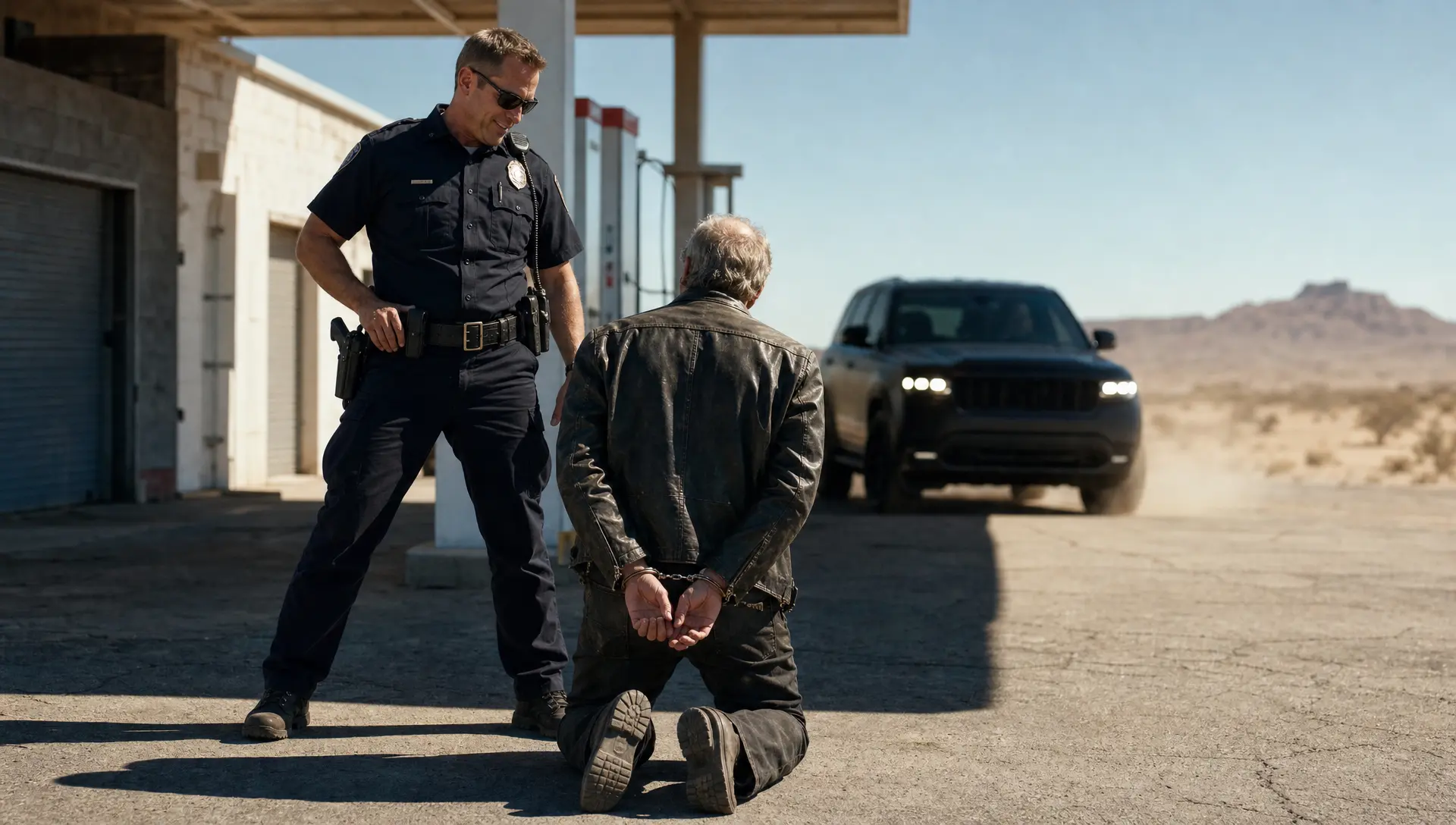
The officer stepped out slowly. Big guy. Sunglasses. Hand resting on his belt the way some men rest their hand on a weapon before they’ve decided to use it.
“You’re making noise,” the officer said. His name tag read MILLER. “This is a quiet community. We don’t appreciate city bikers rolling through and disturbing the peace.”
Thorne turned to face him. “I just cut the engine, Officer. I’m stopping for fuel.”
“I didn’t ask for your itinerary.”
“No,” Thorne agreed. “You didn’t.”
Miller took three steps forward, close enough that Thorne could smell the stale coffee on his breath. He looked the bike over the way a man looks at something he wants an excuse to take. “That exhaust looks modified. Could be a violation. I might need to impound this vehicle.”
“It’s street-legal. I have the registration.”
“Maybe I don’t feel like looking at it.”
The attendant at the pump—a kid, couldn’t have been more than twenty—had stopped moving. He was standing with the fuel nozzle in his hand like he’d been caught mid-breath, not sure whether to run or stay small.
Thorne kept his voice flat. “If there’s a violation, write the ticket. If there isn’t, I’ll be on my way in ten minutes.”
“You’ve got an attitude problem,” Miller said, leaning in. “I think you need a lesson in how we do things around here.”
He stepped forward and kicked the back of Thorne’s boot. Hard.
“Off the bike. Now.”
Thorne dismounted. Slowly. His hands visible. His face giving nothing away. He reached toward his inner jacket pocket for his wallet, the same wallet he’d reached for a thousand times in thirty-two years of service.
Miller grabbed his wrist.
“What are you going for?”
“My ID.”
Miller wrenched the wallet out of Thorne’s hand before he could open it. He looked at it—the scuffed leather, the worn edges—and snorted. He flicked his wrist and sent it skidding across the oil-stained concrete. It spun to a stop six feet away, and when it landed, the internal badge clip shifted, and a thin flash of silver-gold caught the noon sun.
Miller didn’t notice. He was already unclipping his handcuffs.
“You’re under arrest,” he announced, loud enough for the trucker on the far side of the pump island to hear. “Obstruction. Resisting an officer.”
“I haven’t resisted anything.”
“Keep talking.” Miller spun him and snapped the cuffs on. “On your knees.”
Thorne knelt on the hot asphalt. The grit pressed into his kneecaps. He didn’t make a sound.
Miller stood over him, one hand on his hip, taking his time with the radio. “Dispatch, I’ve got a hostile biker. Trespassing, disorderly conduct, resisting arrest. I’m bringing him in.”
The radio crackled. Copy that, Miller. Clear the lot.
Miller let out a short, satisfied breath. He looked at the kid behind the pump counter and gave a small nod, the way a man nods when he’s already written the end of his own story.
He was still smiling when the black SUV turned off the highway.
It didn’t slow at the entrance. It cut across the empty lane of the lot and braked hard, its front bumper stopping two feet from the side of the patrol car. No plates. Tinted windows. The kind of vehicle that didn’t need to announce itself.
The driver’s door opened. Then the passenger door. Then the rear door.
Three men. Dark suits. No visible weapons.
Miller’s hand went to his holster. “Back up! This is an active detainment! You need to leave this property right now!”
The man from the passenger seat didn’t stop walking. He was holding a tablet, screen facing down. He moved with a quiet, total authority that had nothing to do with volume.
“Officer Miller.” The man’s voice was flat and unhurried. “My name is Agent Halloway. Department of Justice. You are currently transmitting live to a secure federal server.”
Miller’s smirk fell off his face.
“This interaction has been flagged as part of an ongoing federal civil rights review,” Halloway continued. “Everything from the moment you entered this lot has been recorded, timestamped, and verified.”
“I don’t know what you think you’re doing,” Miller said, his voice climbing. “I’m a law enforcement officer in the middle of an arrest—”
“You’re in the middle of detaining General Elias Thorne,” Halloway said. “Retired. United States Marine Corps. Four stars. The wallet you threw in the dirt contains a military ID and a Congressional Medal of Honor citation.”
The silence that followed was absolute.
The trucker had stepped out of his cab. The attendant had come out from behind the counter. The two travelers who’d been parked near the air pump were now standing by their car, phones up. Everyone was perfectly still, the way people go still when they understand they are watching something that can’t be taken back.
Miller turned to look at the wallet on the ground. He looked at the silver-gold glint. And then he looked at Thorne, still kneeling on the asphalt, wrists cuffed behind his back. His face had gone the color of old chalk.
“I didn’t know,” Miller said. “He looked like a drifter. He had no—I didn’t know who he was.”
“That’s exactly the problem,” Halloway said. He walked past Miller, crouched down, and picked up the wallet. He opened it. He looked at it for three seconds, then showed it to the nearest bystander—the trucker, who looked at the badge, looked at Thorne, and looked away.
“Uncuff him,” Halloway said.
Miller didn’t move.
“Now, Officer Miller.”
Miller’s hands were shaking as he reached for the key. He fumbled it once. The cuff release echoed sharply in the quiet lot. Thorne stood slowly, rubbing his wrists. He turned to face Miller, and the look on his face was the most devastating thing in the scene—not anger. Not triumph. Just a long, tired, settled disappointment.
“You had the authority,” Thorne said quietly. “The badge, the uniform, the law behind you. You had every tool you needed to do your job right. And you used all of it to make yourself feel large.”
Miller’s mouth opened. Nothing came out.
A county cruiser rounded the far side of the station. The Sheriff stepped out, a heavy man with a permanently exhausted expression. He took one look at the federal vehicle, one look at Halloway, and one look at Thorne. Then he looked at Miller the way a man looks at a fire he knows he can’t put out.
“Sheriff!” Miller turned, desperate. “Sheriff, you know me. You told me to be tough on outsiders, you said—”
The Sheriff walked past him without stopping. He went directly to Halloway. He pulled his radio off his belt, clicked it off, and spoke in a voice just loud enough to carry.
“I don’t know this officer,” the Sheriff said. “Whatever he did out here, he did alone.”
“That’s being noted,” Halloway said.
The Sheriff nodded once, tightly, and stepped back.
Miller stood in the center of the lot with nowhere left to turn. The crowd was a ring around him. Every phone was recording. The federal tablet was still transmitting. His patrol car was boxed in. His badge was gleaming in the sun, and it had never looked less like protection.
Thorne walked to the SUV. He stopped at the door and turned back toward the attendant, the kid who had stood frozen at the pump through the whole thing.
“You didn’t do anything wrong,” Thorne said. “Don’t let this make you cynical about the uniform. There are good people wearing it. They just weren’t on duty today.”
He climbed in. The door closed.
As the SUV pulled away, Miller’s shoulder dropped. He looked at his handcuffs, hanging from his belt. He looked at the badge. He looked at the phones. He realized then that there was no move left—no version of this story where he came out ahead. The evidence was in the cloud, in the hands of strangers, and in a federal file that had been building for seventy-two hours before he ever stepped out of his cruiser.
He had picked the wrong man at the wrong gas station on the wrong day.
Three weeks later, Miller was placed on indefinite administrative leave pending a federal civil rights investigation. The Sheriff resigned six days after that, citing “personal reasons.” The county’s internal oversight board—the same board that had never once initiated a complaint review in four years—suddenly announced an independent audit of use-of-force incidents dating back thirty-six months.
The gas station attendant was interviewed by federal investigators. His account, combined with the phone footage from five different bystanders, was watertight.
Miller’s attorney tried to frame the incident as a misidentification. The federal prosecutor pointed out that the law protected everyone equally, not just generals—and that Miller had behaved the exact same way on seventeen prior stops documented over two years, all involving men who hadn’t had the same friends in high places.
That was the case that ended him.
Across the state, in a grey concrete municipal building that smelled of floor wax and stale ambition, a retired schoolteacher named Rose was about to walk into a room full of people who thought they had already won.
She wore her navy coat. Her grey hair was pulled back. In her coat pocket was a plastic evidence bag containing the shattered remains of a pair of reading glasses. In her other pocket was a flash drive the size of her thumb.
She had sent the audio file to the District Attorney’s server the morning it was recorded.
She had spent the two days since then building the zoning file—the Sunday filings, the absent secretary, the missing environmental impact study. She had not made a single phone call that could be traced back to her. She had let the facts speak at their own volume.
The Board President tapped his gavel and told her to sit down.
She put the evidence bag on the table.
“This is an exhibit,” she said.
Brad was standing against the wall with his arms crossed when she walked in, and he was still smirking thirty seconds later when he said, loud enough for the room to hear, that they were wasting time on a retired teacher’s drama.
Several board members looked at their agendas. They had all been her students once. They remembered the way she used to stand at the front of the classroom and wait—just wait, perfectly still—until the noise settled and everyone understood the silence meant she had something worth saying.
The room was already quieter than it had been a minute ago.
“I have a recording,” Rose said.
Brad’s smirk held. “Of what? Your grandkids?”
“Of a public incident,” Rose said. “In which the applicant’s son destroyed my property, stated that your permits were a foregone conclusion, and explained that this town was, in his words, a joke where everyone bows when they see the car.”
The silence that dropped over the room was the kind that has weight.
Brad’s father stood up. “Security—”
The security guard took one step forward, looked toward the back corner of the room, and stopped. The District Attorney was standing there in plain clothes, arms crossed. He gave the guard a single, small shake of his head.
The guard stepped back.
“You don’t need security,” Rose said pleasantly. “I’m not going anywhere.”
She turned to the AV technician—a young man who had been very carefully not looking at Brad for the last twenty minutes—and held up the drive.
“Please,” she said.
He plugged it in with the expression of a man who has been waiting for permission.
The speakers crackled. Then, unmistakably, the sound of a heavy shoe grinding glass into asphalt. And then Brad’s voice, bright and arrogant and completely unaware: Watch where you’re standing, grandma. You’re in the way.
The laugh that followed reverberated off the concrete walls.
Then: The guard knows who he’s dealing with. This town is a joke. Everyone just bows when they see the car.
The room didn’t react all at once. It went still first, the way a room goes still before thunder. And then, from the back—where the parents sat, and the business owners, and the teachers who had worked with Rose for thirty years—a long, collective exhale that had the quality of a verdict.
Everyone was looking at Brad.
Brad’s father turned toward his son with an expression of pure, contained fury. “You absolute idiot,” he said, barely loud enough for the front row.
Brad opened his mouth. Closed it. Looked around the room for someone to redirect the attention to, and found only faces looking back at him with cold, hard recognition.
“It’s not just the recording,” Rose said. Her voice had risen slightly now—not in anger, but in the particular register she used when she was addressing the whole room and wanted everyone to feel addressed. “It’s the zoning file.”
She opened the folder on the lectern.
“The permits you are voting on tonight were filed on a Sunday when the municipal offices were closed. They are missing the mandatory environmental impact study for the wetlands. And they carry the signature of a Board Secretary who was, according to her travel records, in Florida on the date listed on the document.”
She laid the papers on the table one by one.
“I spent my career teaching this town’s children what integrity looks like,” she said. “It appears some of the adults in this room have lost the thread.”
A woman near the back called out: “Did you forge those signatures?”
The Board President reached for his gavel. “We’ll take a recess—”
“There will be no recess.”
The District Attorney had walked forward from the back of the room. His voice was quiet, but it carried the way a quiet voice carries in a room where everyone has stopped breathing. “As of ten minutes ago, the state has been provided with documentation of every irregularity this woman has described. The FBI is currently at the construction site securing the records.”
Brad’s father sat down. Not in the slow, dignified way he had sat down at the beginning of the meeting. He sat down the way a man sits when his legs stop working.
Brad looked at the exit. He looked at the phones. He looked at the board members, who were now carefully not looking at anyone. He had spent twenty-three years in a world where the last name on the check opened every door, and in the span of four minutes he had watched that world close around him like a trap.
Rose didn’t watch him. She closed her folder, picked up the evidence bag with her glasses inside, and walked toward the exit with her head level and her stride unhurried. She passed within three feet of Brad on the way out. She didn’t look at him. She didn’t slow down.
Her footsteps on the hard floor were steady and even, the sound of someone who had decided something a long time ago and was simply continuing to walk in that direction.
Behind her, the gavel banged. It didn’t matter.
The permits were dead. The construction company’s financial records were in federal hands by morning. The Board President submitted his resignation before the week was out, citing health concerns that had not been apparent at any previous meeting.
Three weeks after the meeting, Rose was standing in the lobby of the high school when she saw him.
Brad was mopping the hallway floors.
He wore a standard-issue grey uniform. His hair was unstyled and damp. The expensive loafers were gone; he was wearing rubber-soled work shoes that squeaked on the polished linoleum. He was hunched over the mop handle with the particular posture of a man who is trying to take up as little space as possible.
Rose watched him for a moment.
She didn’t feel satisfaction. She didn’t feel the need to mark the moment for anyone else. She felt something simpler and quieter, the way you feel when a storm has finally passed and the air is clean.
She began to walk toward him.
He looked up when she was about ten feet away. He stopped. His grip tightened on the mop handle. His eyes moved to her hearing aid—the device he had mocked in the parking lot, the device that had recorded everything—and then he looked away, fast, and pressed himself against the wall to let her pass.
His head was bowed.
Rose didn’t stop. She didn’t speak. She didn’t need to. The silence between them said everything that years of testimony and federal fines could not: he understood now. Not because he was afraid of consequences—though he was—but because he was standing in a school hallway with a mop, and the woman he had dismissed as an obstacle was walking past him without breaking her stride, and the only thing he could do was get out of her way.
She walked to the main office, where the committee was waiting.
That evening, she found an envelope on her kitchen table.
It was from the parent company that had acquired the bankrupt construction firm. A formal apology. Procedural irregularities. Unfortunate incident. A donation to the school library fund in her name.
She read it once.
Then she folded it, placed it in the kitchen drawer, and walked to the living room.
On the side table was a new pair of reading glasses. Simple. Sturdy. Well-made.
She picked them up and held them to the window. The late afternoon light came through them clean and unbroken. She put them on.
The room sharpened. The oak tree outside the window came into focus—every leaf distinct, every edge clear. She looked at the newspaper on the table, and the words were sharp and immediate, the way the world looks when you’re no longer straining to see it.
She turned the page.
Outside, the neighborhood was quiet. The street belonged to everyone.
She didn’t need to squint. She didn’t need to search for the truth.
She just read.
THE END
Original fictional stories. AI-assisted creative content.