The ballroom was built to humble people quietly.
Gold climbed the walls. Chandeliers made everything look consecrated. Five hundred guests in their best armor — emeralds, tuxedos, the architecture of inherited ease — moved through the room like they owned the air inside it.
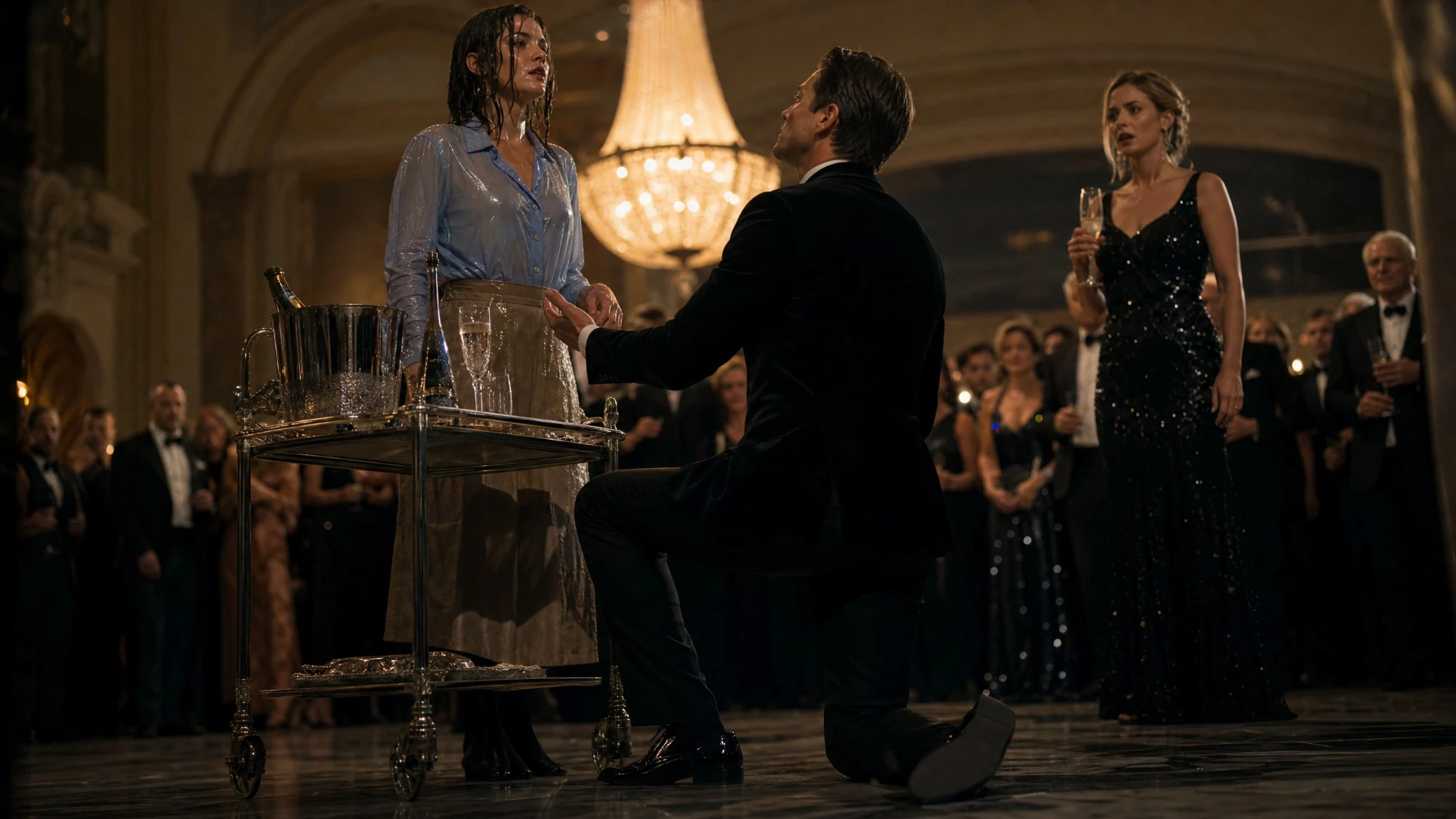
I moved through it too, but with a cart.
My hands trembled against the silver handle. I gripped harder so the coupes wouldn’t rattle. The tan apron, the light-blue blouse, the flat shoes — all of it designed to disappear me into the wallpaper. That was the point.
Celeste de Marais stepped close. Black sequins, diamonds, a face carved from years of confusing cruelty with authority.
“Faster,” she said. “Don’t keep the guests waiting.”
I lowered my head. She preferred that version of me.
Across the room, two women near the west wall laughed into their glasses. One said, not quietly enough, “She’s supposed to be the daughter-in-law?”
I held the tray steady.
My eyes burned anyway.
Three months. That was how long I had been carrying trays through rooms where women who once curtsied to my mother now discussed me like a rumor that hadn’t finished dying. I was twenty-six years old. I wore someone else’s shoes. And none of them knew what I knew.
My name was not Elena Vale.
It had never been.
My mother was Princess Helena, elder daughter of the old king. After the nursery fire that was said to have killed me as an infant, she was moved south, then further from sight, then finally into the kind of silence noble families call private care when they want to erase someone without admitting it. She kept me hidden. Not in a mountain monastery. In plain life. Convent school. A borrowed surname. Church accounts. A lawyer who died too conveniently.
She left me one thing before her mind went.
A signet ring wrapped in linen and one sentence beneath it:
They will only believe you once it costs them not to.
I carried that sentence into adulthood like a blade.
I met Adrian before he knew who I was. Archive library. Old paper, legal history, dust. He dismissed his security because he hated being watched while reading. He did not recognize me. Why would he? The court had spent nineteen years insisting the infant princess died in the fire. To him I was Elena Vale, a temporary restoration assistant with an inconvenient habit of correcting his assumptions.
He loved my mind first. That is what he told me on a rain-black terrace at midnight, the city below looking like a field of wet stars.
I did not tell him the truth immediately. My mother had taught me why: never hand your real name to a court that benefits from pretending you never existed.
When he proposed, he thought he was defying class. He was actually stepping into a dynastic murder his own family had never admitted.
We were married in a registrar’s chapel. Two witnesses. Father Lucien, who owed more to conscience than career, and Tomas Arendt, Adrian’s legal secretary. We signed. We exchanged rings. Adrian kissed my forehead before my mouth because he knew I was shaking. It was the most honest day of my life.
Three days later, the registry burned.
Not the whole building. Only the annex where supplemental ledgers were stored. Tomas vanished. Father Lucien was transferred north. The clerk who stamped our license denied ever seeing me. And Celeste — who had been circling the household like a patient vulture for months — smiled at me across the breakfast room and asked how I was enjoying the service corridors.
Within a week, no one addressed me as Mrs. Laurent.
Within a month, I was living in a servant’s room off the west laundry, carrying trays at dinners where people discussed Adrian’s future marriage prospects in front of me as though I were furniture.
Then the lodge fire.
Adrian disappeared into it. Some said Switzerland. Some said injury. Some said he had abandoned me rather than keep embarrassing the court with a wife no one could explain.
Celeste enjoyed every version.
She stepped closer now, her jeweled hand dropping onto my cart. Her perfume was heavy enough to give me headaches.
“You will keep your eyes down,” she murmured. “And if he appears tonight, you will remember what happened the last time you forgot your place.”
I did remember.
The east wing. The locked study. The torn letter. The registrar’s voice saying there had been no legal record of my marriage after all.
I remembered everything.
Which was why, when the orchestra faltered and the room shifted around me, I knew before I turned.
Someone important had entered.
The guests went silent in a wave.
Footsteps crossed the marble.
I looked up.
Prince Adrian walked straight toward my cart.
He wore black velvet and command like an accusation. Leaner than I remembered. A pale scar at his left temple I had never kissed. But his eyes found mine in the first second, and I understood two things at once.
He had not abandoned me.
He had learned my real name.
He stopped in front of the cart. Bowed his head.
“Your Highness.”
Celeste actually laughed — a short, startled sound, the kind that escapes before propriety can catch it.
Adrian raised his eyes to hers briefly.
Then said it again, louder, for the room.
“I said, Princess Elena.”
Gasps broke across the ballroom like glass under pressure.
Not from the servants. We were trained better. From the guests — judges, donors, old women in emeralds, younger men who had learned exactly how much surprise was socially acceptable and lost track of it all at once.
Celeste’s hand slipped from the cart.
“What did you say?” she whispered.
Adrian didn’t answer her. He turned to me first — deliberately, as a man turns toward the person he intends to restore publicly before destroying the person who buried her.
He held out a folder tied with black ribbon.
“Open it.”
My hands were shaking too badly to untie the knot cleanly. A page slid loose and caught the chandelier light.
Royal succession review. Emergency standing order. Genetic confirmation.
The orchestra had gone silent. Not one string moved. Even Armand Delacroix — our ancient ballroom pianist who had watched three generations of this family lie to itself in perfect tempo — sat frozen with both hands lifted above the keys.
Celeste found her voice.
“This is grotesque. She is a servant.”
“No,” Adrian said. “She was made one.”
That distinction shook the room harder than the title had.
Because it implied design. Plot. Hands.
I read faster.
Adrian had not been recovering abroad. He had spent the weeks after the lodge fire in the northern archives with a retired crown solicitor, a pathologist, and a bishop old enough to hate modern scandals less than old crimes. They reopened the nursery fire report. They found sealed testimony from a nurse who vanished two days after the blaze. They found payment records routed through Celeste’s late husband’s trust — signed, astonishingly, with Evelyn Laurent’s countersignature.
Evelyn.
My mother-in-law by public fiction. The king’s second wife by law. The woman who taught half the court how to smile while rearranging death into etiquette.
I looked up.
She had not moved from her chair across the room. But all color had left her face.
Adrian kept his voice level, steady, each word landing with the weight of a stone being set into mortar.
“The child declared dead was never identified. The nursery fire began in the records room below, not the sleeping chamber above. And the infant removed from the estate that night was placed under church protection under the name Elena Vale.”
The guests turned toward me as one organism.
I hated that part.
Not the attention. The pity beginning to bloom in certain faces now that the room had permission to see me as tragic instead of disposable. Pity is such a lazy cousin to justice.
Celeste stepped back.
Then again.
“What does any of this have to do with me?”
More than she knew. She had not designed the original crime. But she had been its willing caretaker, its daily administrator. She had learned early that humiliating me in public cost nothing as long as everyone still believed I had no blood claim, no marriage, no legal existence worth accounting for.
I pulled another page.
Marriage validation order.
Father Lucien had hidden a diocesan copy ledger before they transferred him north. Tomas Arendt — alive, in Belgium, under a protection agreement — had given sworn testimony. My marriage to Adrian had not simply vanished.
It had been erased.
And suddenly the season’s whispering — daughter-in-law, mistress, servant, impostor — collapsed into one ugly truth.
They hadn’t merely stolen my title.
They had been auditioning my replacement in front of me.
That was when Armand stood from the piano bench.
He was slow about it. Old. Leaning on his cane. But when his voice came, it was clear.
“She was not the only child taken.”
The ballroom changed shape.
You could feel it happen in the posture of the room, in the way all attention tore itself from me and swung toward Armand. Even Adrian looked startled. If he hadn’t known what was coming, then whatever Armand was about to say belonged to something older and deeper than anything the folder contained.
Armand came forward slowly.
Forty-two years at the winter court. He had accompanied my mother’s voice at private dinners. He had been in the palace that night because musicians used the side staircase after midnight.
“Your mother was not alone in the nursery,” he said to me.
The folder slipped in my hands.
A sharp ringing filled my ears.
“What?”
Armand’s eyes filled. “There was another crib. A boy. Newborn. Hidden from the official household. Very quiet. I thought it was some noble indiscretion being kept upstairs until arrangements could be made.”
Evelyn stood.
“No,” she said.
The first truly human sound she had made all evening. Not polished. Not moderated.
Pure refusal.
Armand ignored her.
“The fire records were altered twice. First to erase the movement of the infant princess. Then to erase the second child entirely.”
Adrian’s face went stone-still. He was already ahead of everyone else — already understanding what a hidden boy in the royal nursery, removed the same night as the missing princess, could only mean.
A son.
An heir.
Or a threat to one.
I looked at Evelyn.
All my life I had understood her cruelty toward me as succession strategy. Now I saw something worse: old terror. Old calculation. The memory of having nearly lost everything not to a baby girl but to a child whose existence would have detonated the line of inheritance entirely.
“My father had a son?” Adrian asked.
No one answered.
Then Evelyn looked — not at Adrian.
At Celeste.
The bride’s face emptied in stages. Confusion. Recognition. Then the sick arrival of understanding that she had not merely been raised inside a lie.
She had been built from one.
“My father…” she whispered.
The truth assembled itself from the pieces then, as truths tend to do when the architecture of a lie has finally been loaded with too much weight.
Celeste’s father had not been Evelyn’s husband.
He had been a shadow arrangement. A hidden lineage. Celeste was not Laurent blood at all — not legitimate, not rightful. She was an insurance policy. If I survived, I threatened succession. If the hidden boy survived, he destroyed it entirely. Evelyn had chosen the simpler theft.
Kill the son in the records.
Remove the daughter physically.
Raise her own imported child in the vacuum.
“Your mother paid to—” I began.
I couldn’t finish it.
Because the sentence was suddenly too large.
Your mother paid to erase me. Your mother paid to erase a son. Your mother paid to rebuild a dynasty on two graves and a staged dinner service.
Evelyn drew herself up one final time. I watched the old court woman return to her face like makeup applied over tears.
“I protected this family,” she said.
“No,” Adrian replied. “You replaced it.”
Security entered then — royal security, not ballroom staff, summoned by some aide clever enough to understand the scandal had crossed from etiquette into state territory. Evelyn saw them and understood, for the first time, that the room was no longer hers.
But before they reached her, she looked at me with a strange and weary hatred.
“You were never supposed to remember who you were.”
That may have been the truest thing she ever said to me.
What she did not understand was that I had not remembered.
I had rebuilt myself from scraps while she watched from high windows, convinced a servant’s apron could finish what fire began.
Adrian reached for my hand.
In front of everyone.
No more corridors. No more hiding. No more service carts.
But before I could take it, a young footman pushed through the edge of the crowd, carrying a sealed dispatch box, and called Adrian’s name.
It bore the winter crest.
The dead nursery’s crest.
Inside, as we learned in the next thirty seconds, was the proof that the hidden boy had not died either.
His name was Lucien.
Thirty years old. Placed under church protection in Austria under a noble household stipend, raised by men who understood secrecy, succession, and exactly how much the Laurent court would pay to keep all three confused. He was alive. He had sent the dispatch after hearing whispers that the palace had reopened the nursery fire inquiry under the cover of Adrian’s “recovery.”
Inside the box: baptismal copies, bloodline attestations, and one letter from the bishop who raised him.
I release this because the dead have waited long enough to stop being managed by women who called themselves necessary.
The ballroom stood still while Adrian read.
His hand tightened around the papers hard enough to bend them. I watched the line of his mouth change. Not because he feared losing his place — Adrian had always understood duty as burden before privilege. What moved through him was something closer to nausea. The kind that comes when your family history, your title, your mother’s smile, your childhood photographs, the entire shape of your future all reveal themselves to have been arranged around absence disguised as order.
Evelyn did not speak again.
Security escorted her with more courtesy than she deserved — palaces are built to protect spectacle even when the spectacle is a criminal matriarch in pearls.
Celeste stood alone beside the floral arch in a white gown that no longer meant anything at all. One of the women who had laughed behind her glass earlier now stared at the floor as though shame might be contagious through eye contact.
The orchestra did not resume.
Armand sat back at the piano and covered his face with one hand.
I finally took Adrian’s hand.
The room saw it.
That mattered. Public life had been used against me too long for me not to reclaim it publicly when the moment came.
He turned toward the guests, toward the trustees, toward the household officials already whispering behind the back row, and said in a voice that carried to every gold corner of the hall:
“This ceremony is over. Princess Elena Laurent is my lawful wife. All succession matters are frozen pending recognition of the surviving issue named in these records. Nothing leaves this room unrecorded.”
You could hear people stop breathing.
Not because of the marriage.
Because of the word surviving.
It changed everything. Not one stolen girl but two erased children. Not one ambitious widow but a dynastic coup managed over decades with church hands, legal ink, and the social elegance to make everyone call it stability.
Later, the papers would reduce it to manageable terms. Missing heiress found. Wedding halted. Royal inquiry opened. Former dowager detained. Headlines clean enough to eat dinner beside.
The truth was not clean.
The truth was service corridors and forged death. A mother turned ghost while still breathing. A hidden brother growing up under another language because one woman found history easier to kill than confront. Me, carrying champagne under chandeliers while the family that stole my life prepared to applaud itself for surviving its own damage.
When Adrian and I walked out of the ballroom, the guests parted again.
But this time they did not part for him.
They parted for us.
Outside, the night air smelled of wet stone and the roses from the cut arrangements beginning to die in the courtyard. Somewhere behind us, staff would already be stripping tables, boxing untouched cake, gathering glass. Institutions reset before anyone has finished bleeding.
I looked back once at the lit windows.
My wedding had been interrupted by a truth bigger than any vow.
The bride who was never meant to be there stood abandoned beneath the floral arch. The woman who stole two children’s lives was under guard. And somewhere in Austria, a man who did not yet know me had just become my brother through records that were meant to stay buried forever.
Adrian squeezed my hand.
“What now?” he asked.
I thought of my mother’s ring. Of Marisol’s last look. Of the service cart. Of Evelyn saying I was never supposed to remember.
Then I answered with the only truth left.
“Now,” I said, “they start saying our names correctly.”
Because that is how stolen people return.
Not all at once.
Not by miracle.
By record. By witness. By doors opening at the worst possible moment for the liars inside.
And once the room hears the truth aloud, the lie can never again pretend it is simply how the family has always been.
Original fictional stories. AI-assisted creative content.