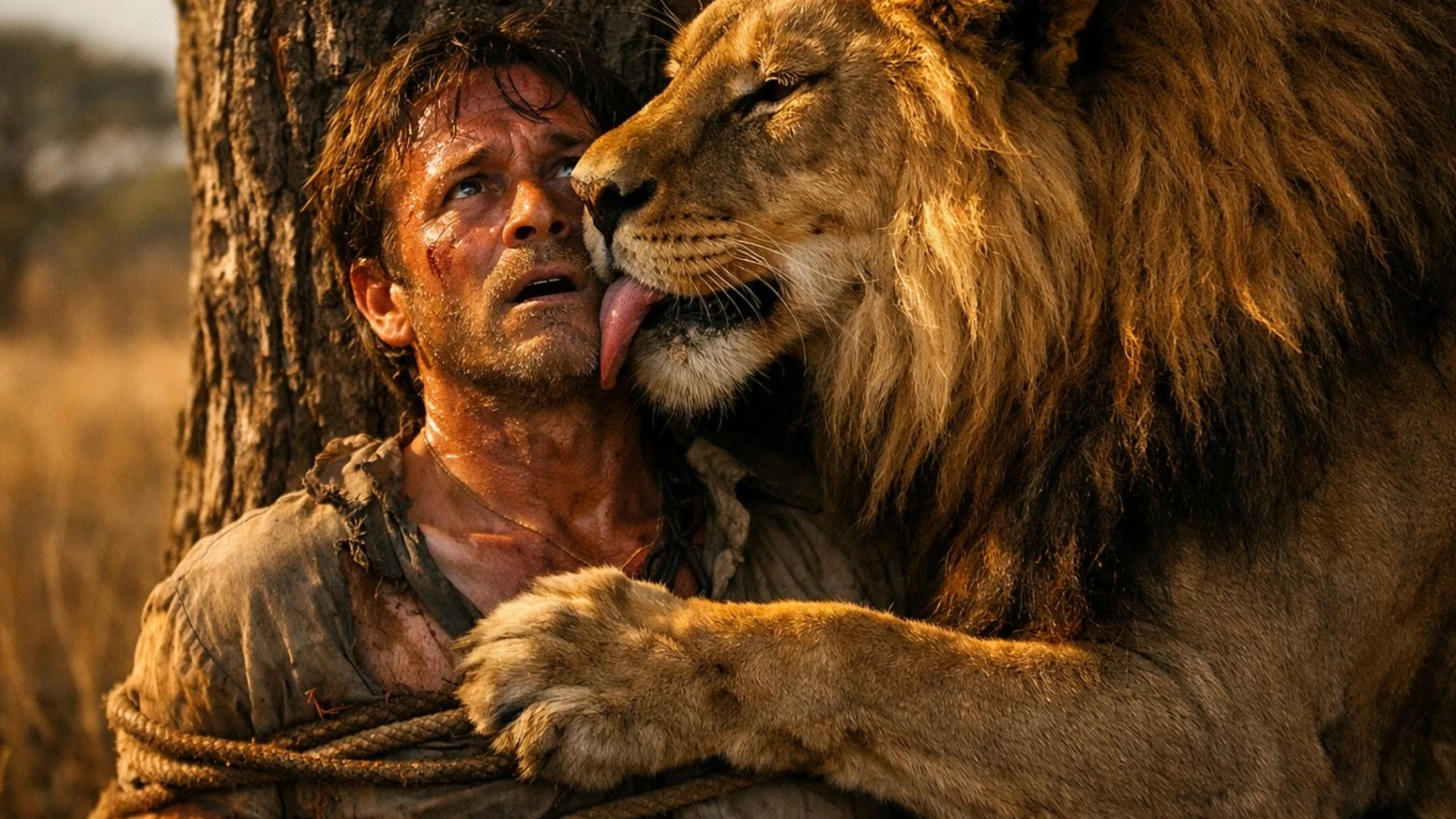
The rope had been on his wrists for six hours when Juan Valdés stopped counting.
He had tried everything. Twisting, pulling, working the fibers against the bark. All it did was open the cuts wider, and now the blood was drawing mosquitoes in thick, humming clouds he couldn’t wave away.
The afternoon sun came straight down through the canopy and found his face like it was looking for him specifically.
“You’ll last a night, maybe,” one of the hunters had said before they left. He said it pleasantly, like a weather forecast.
Juan’s cameras were gone. His pack was gone. His water was gone. He had been filming a wildlife survey thirty kilometers from the nearest settlement when three men with rifles stepped out of the brush and that was it. The whole thing took four minutes.
Now he was alone with the savanna, and the savanna had its own opinions about him.
Movement in the branches above his head made him go rigid.
A black mamba — gray-black, unhurried — was descending the trunk toward the level of his face. He knew what it was. He had filmed one last year. He knew what the venom did to a person’s nervous system in the final hour.
He stopped breathing.
The snake paused. Tongue flicking. Tasting the air that now included his terror. For thirty seconds neither of them moved, and then, with the indifference of something that had better things to do, the snake continued down the other side of the trunk and disappeared into the undergrowth.
Juan exhaled so hard he nearly passed out.
Dark came fast in the Kenyan savanna. Not gradually — just a dimmer switch thrown by an impatient hand. Sound changed with it. The birds went quiet and the things that operated in darkness began their shift.
Something heavy was moving through the brush toward him.
Juan saw the lion when it was eight meters away. Dark mane, massive shoulders, moving with the kind of patient confidence that doesn’t need to hurry because it already knows how the story ends. It stopped and looked at him.
He closed his eyes. This is how.
Nothing happened.
He opened his eyes.
The lion was still there. Closer now. Its head was tilted slightly to one side — not a threat posture, something else. Something that didn’t have a name in any field manual he’d ever read.
Then he saw the scar.
On the left side of the neck, a band of tissue where fur refused to grow properly — exactly where a narrow rock crevice had once trapped the animal’s head for two days until a wildlife filmmaker named Juan Valdés had widened the gap with a borrowed pry bar and pulled her free.
That had been eight months ago. Three hundred kilometers to the east.
“Hey,” Juan said. His voice came out cracked and strange. “I know you.”
The lion lowered its head toward his bound wrists. The enormous teeth caught the light for one impossible second, and then they closed on the rope.
The pain was white and total. Juan groaned through clenched teeth, trying not to scream as the lion gnawed and pulled. Each bite was a controlled demolition — methodical, patient, ignoring his sounds entirely. The fibers resisted for what felt like twenty minutes.
Then the rope snapped.
Juan collapsed face-first onto the dry ground. His legs were completely dead from the hips down. He rolled onto his back, gasping, and watched the spots in his vision slowly clear.
The lion stood over him, looking down at his face with those yellow eyes.
“Okay,” Juan said. “Okay. Give me a second.”
The lion made a sound — low, guttural — and took three steps toward the darkness of the trees. Then it stopped and looked back.
Follow me.
Juan got to his knees. Then one foot. The lion waited.
They moved together through the bush — the animal gliding, Juan stumbling over every root, catching himself on every branch. He fell twice. Both times the lion stopped and waited without comment.
They reached a stream. The moonlight showed dark water running too fast, and beneath the surface — motion that wasn’t current. Juan crouched at the bank.
Nile crocodiles. Three of them, motionless in the shallows — the stillness that isn’t rest but patience.
Three rotting logs crossed the water. The lion waded through the shallows at a narrow point and made it look effortless. On the far bank it turned and waited.
Juan put his foot on the first log. Wet moss, soft wood.
He made it to the second log when everything went wrong.
The wood snapped beneath his left foot. He lurched right, tried to jump to the next log, and his right leg went into the water to the knee.
Something clamped onto his calf with a force that compressed time. A crocodile — young, no longer than two meters, but that was more than enough. He screamed and yanked, but that just made it roll.
Something whipped through the air and struck the water hard beside his leg — the lion’s paw, flat and enormous, slapping the surface with a crack like a gunshot. The crocodile released. He didn’t wait to understand why.
He grabbed the vine with both hands and threw himself forward, yanking his leg free with a sound he didn’t want to hear.
He landed on the far bank and lay there, leg blazing, blood running freely from a dozen small wounds.
The lion stood beside him, sniffing the injury. Then, with absolute practicality, it ran its rough tongue across the cuts.
“Thank you,” Juan said. It sounded inadequate. It was inadequate.
He tore his pant leg and tied it tight above the wounds. Got up. Kept moving.
An hour later, voices.
He can’t have gone far. Male, close, carrying easily through the trees. Look at the blood trail.
Juan froze. The hunters. Still searching. Which meant they’d found no body at the tree and drawn the obvious conclusion.
The lion reacted before he could. It pressed its shoulder hard against his legs, driving him back against a wide palm. He flattened against the bark.
The voices grew closer. He could smell tobacco smoke now. A lighter clicking.
Fresh blood here on the bank. Look.
A pause. Boot steps in mud.
Probably a croc took something. Relax.
Juan didn’t breathe. His wound throbbed with every heartbeat, each pulse a small timer ticking down. The lion was beside him, pressed against the palm, so still it seemed carved.
Then the animal moved — three deliberate steps to the right, snapping dry branches underfoot with precise, careless noise.
There — did you hear that?
Boot steps hurrying away.
The lion was back beside him in seconds, appearing out of the dark like a thought. It bit his sleeve — not hard, just enough — and pulled.
Move.
They moved.
The waterfall announced itself as sound before it became visible — a low, constant roar that filled the jungle and masked everything else. When they reached it, Juan saw a curtain of white water falling ten meters into a dark pool. The lion didn’t slow. It walked straight through.
Juan followed.
The cold hit him like a fist. Then he was through, coughing, and standing inside a cave hidden behind the falls. The floor was dry except where the mist reached. Old bones crunched under his boot.
The hunters’ voices, even shouting, couldn’t reach them here.
Juan sat down against the cave wall. His hands were shaking. His leg was burning. His mouth tasted like blood.
The lion lay down across the cave entrance — not blocking it, just placed there between him and whatever the jungle might send next.
“You saved my life,” Juan said. “Twice.”
The lion’s eyes reflected the faint light from the waterfall’s edge. It blinked once, slowly.
Juan slept.
In the morning the lion was already moving. It led him deeper — not away from the river but toward it, along a route that skirted the area where the hunters’ voices had come from. By midday Juan’s infected leg had swollen to the point that his boot no longer fit properly. He limped. The lion shortened its pace.
They reached the river in the afternoon.
A boat was beached on the far side — or what had been a boat at some point. Old, wooden, half-rotted, listing to one side with visible holes in the hull.
“You’re joking,” Juan said.
The lion waded into the shallows and swam across without looking back.
Juan watched it climb out on the other side, shake the water from its coat, and sit down facing him with perfect patience.
He looked at the river. Then at the boat. Then at the lion.
“Fine.”
He swam across, which destroyed the makeshift bandage. He climbed out, leg bleeding freely again, and examined the boat. The holes were large. The wood was soft in places. But it was there, and the alternative was more jungle on an infected leg with hunters somewhere in the trees behind them.
He packed the holes with thick mud, pressed palm leaves over them in layers, and pushed the boat into shallow water. It floated. Water seeped through the cracks but slowly. Slowly enough.
The lion watched every step from the bank.
Juan loaded himself in, positioned the backpack against his chest, and found a flat piece of wood to use as a paddle. The current took him immediately, pulling the boat out and downstream with a force that surprised him.
He looked back.
The lion was sitting on the bank, watching him go. Yellow eyes catching the late sun filtering through the canopy.
Juan reached into the side pocket of the pack and found the last protein bar. He’d been saving it for a real emergency. He looked at it, looked at the lion.
He threw it toward the bank. The arc was poor; it landed in the mud near the animal’s paws.
The lion lowered its head and sniffed the bar. Then — with a care that looked almost ceremonial — picked it up and set it down as if placing a valuable object.
“Thank you,” Juan said. The words came out broken. Tears hit his face before he realized they were coming, mixing with river water and sweat and three days of everything. Not grief. Not even relief, exactly. Something he didn’t have a word for.
The lion raised its head and let out a sound — not the explosive threat-roar he’d heard it use against a four-meter python the night before. Something lower. Softer. A sound that moved through his chest wall from twenty meters away.
He kept paddling. The current increased. He kept looking back.
The last time he saw her, she was still on the bank — golden and still against the dry brush of the savanna — until the river’s curve took her away.
The water in the boat was at his knees when the lights appeared.
Yellow dots in the darkness. Then the shape of stilt houses above the river’s surface. Juan paddled until his arms stopped working, then paddled with what was left after that. A boat tied to a dock materialized out of the dark. He grabbed for it.
His legs gave out when he tried to stand.
Hands caught him before he went into the water. Voices erupted in Spanish around him, calling toward the houses. Juan felt himself lifted from the boat, which sank completely three seconds after he left it.
They carried him up to a wooden floor and lay him down. Faces gathered above him — men, women, faces made by years of equatorial sun. Eyes wide with the kind of shock that means we’ve seen bad but not this.
Someone brought water. He drank too fast and vomited. Someone else began working on his leg with damp cloths. The pain that produced made him make sounds he wasn’t proud of.
“What happened to you?” An older woman, cleaning the cut on his forehead with hands that were gentle and efficient.
He told them. His voice fractured in multiple places but he kept going. The hunters. The tree. The rope. The lion that freed him. The crocodile crossing, the cave behind the waterfall, the river, the rotting boat.
Heavy silence.
The villagers exchanged looks that Juan couldn’t read. Not disbelief — something more complicated.
An elder moved through the group. Skin like old bark, eyes that hadn’t stopped noticing things for a very long time. He crouched to Juan’s level.
“The lion,” the elder said. “Did it have a mark on its forehead? Here.” He touched a spot above his own eyebrow. “Like a crescent.”
Juan’s heart picked up speed for reasons it couldn’t fully explain.
“Yes,” he said.
The elder turned to the group and spoke quickly in a dialect Juan didn’t know. Reverent sounds moved through the room. Then the elder turned back.
“You were saved by the Guardian,” he said. “She is a legend older than anyone here. She only protects those with a pure heart. She chooses.” He let that land. “My grandfather saw her save a man from drowning sixty years ago. I thought it was a story.”
He looked at Juan’s face for a long moment.
“You were chosen by the soul of this land to live, my son.”
Juan felt the tears coming again. He didn’t stop them.
He understood now that rescuing the lion from the rock crevice eight months ago hadn’t been random. A debt had been created that day, without his knowledge, in a currency he hadn’t known existed. The jungle had its own accounting system, and it was more rigorous than any he’d encountered.
He had saved the Guardian. The Guardian had saved him. The books were balanced.
Recovery took twelve days in the village.
His leg was treated with local plants that burned like kerosene and worked better than anything he’d gotten from a pharmacy. He ate. He slept — long, dark, dreamless sleep, the sleep of someone who has used up every resource their body had and is waiting for the invoice to clear.
On the seventh day, he opened the backpack and checked the cameras.
The waterproof bag had held. The equipment was intact.
He sat there for a while, holding a camera that had survived everything he hadn’t managed to protect it from.
Inside: hundreds of photographs of the Kenyan savanna. And eight images of the Guardian — taken months ago, before any of this, on the day he’d found her trapped. The animal wedged in the rock crevice, exhaustion and wildness in those yellow eyes. The exact moment the head pulled free. And one final shot, taken as she disappeared into the brush: the lion looking back over her shoulder.
The look in that last photograph.
Juan had thought it was just an animal retreating.
He understood it differently now.
The exhibition opened eight months later in Nairobi. The Guardian: When Wildlife Repays.
The photographs did not go unnoticed. A filmmaker had saved a lion. The same lion, months later, had navigated him through sixty kilometers of hostile savanna and delivered him to a river village with his life.
The story was inconvenient for people who preferred clean boundaries between human and animal experience. Which meant it spread everywhere those people were.
Environmental organizations moved fast. A formal protection order came through Kenyan federal law within ten months. The territory where the Guardian ranged was declared a permanent reserve — no housing, no extraction, no hunting.
The hunters were identified from Juan’s account, arrested three weeks after the story broke, and charged under wildlife and kidnapping statutes. They were convicted. Both sentences were substantial.
Juan returned to the reserve two years after the incident, accompanied by a team of rangers and two biologists who had been trying to study the Guardian for years without success.
They spent five days in the bush and saw nothing.
On the sixth morning, Juan woke before sunrise and found fresh tracks around his tent. The print pattern was unmistakable — too large for any other feline in the region.
She had been there during the night. She had smelled him. She had chosen not to appear.
He stood at the tent entrance in the gray pre-dawn light, looking at the tracks in the mud, and understood: this was enough. This was more than enough.
The savanna had its Guardian.
And Juan had his photograph — the one he’d taken without understanding what it meant, of a lion looking back over her shoulder at a man who didn’t yet know she was going to save his life.
He kept it on his desk, not in the exhibition.
Some things are not for public consumption.
End.
Original fictional stories. AI-assisted creative content.