James Mitchell hadn’t cried in eight years.
Not at his divorce. Not when his son Thomas stopped returning calls. Not even on the night he sat alone in that empty apartment, every room still carrying the ghost of a life he used to have. He’d learned to exist without feeling much of anything. It was easier that way.
He was fifty-three. He restored old books for a living — cracked spines, faded ink, pages softened by a hundred years of hands. The work suited him. Quiet. Precise. Nothing could surprise you when your whole job was already about salvaging what time had almost destroyed.
He lived in a two-room apartment in the Manchester suburbs. No pictures on the walls. No plants on the windowsill. His daughter Sarah had sent him a cactus two Christmases ago. He’d killed it by March.
“You have to actually water it, Dad,” she’d told him over the phone.
“I know how plants work, Sarah.”
“Then why is it brown?”
He hadn’t had a good answer for that.
The truth was, James Mitchell had learned to let things die quietly rather than fight to keep them alive. It was less painful that way. That was the theory, anyway.
It was a Tuesday in late October when the call came in.
James was at his workbench — a 1920s botanical atlas spread under the lamp, its spine almost fully detached, thread fraying at the joints. He’d been working on it for three evenings. He was close to finishing. His phone buzzed against the table and slid two inches toward the atlas.
Unknown number. London area code.
He stared at it for four rings. Then a fifth. He almost let it go to voicemail. But something — some reflex he couldn’t name — made him pick up.
“Yeah.”
“Is this James Mitchell?” The voice was male. Calm. Neither young nor old. Like someone reading from a document they’d read a hundred times before.
“Depends who’s asking.”
“My name isn’t important right now,” the voice said. “But what I have to tell you is.”
James put down his tweezers. “I’m listening.”
“I need you to come to Manchester Piccadilly Station tomorrow. Platform five. Three o’clock in the afternoon.”
A pause.
“Why?” James said flatly.
“Because I have something that belongs to you.”
James turned that sentence over slowly. Something that belongs to you. He ran through possibilities — old books, maybe someone had found his work, a property dispute from the divorce he’d forgotten about. Nothing landed.
“What is it?”
“You’ll understand when you see it.”
“That’s not an answer.”
“It’s the only one I have right now.” A beat. “Please come, Mr. Mitchell. You won’t regret it.”
The line went dead.
James sat for a long time looking at his phone. The botanical atlas lay open under the lamp, its broken spine waiting for him. He set the phone face-down and picked up his tweezers. He tried to keep working. He couldn’t.
He didn’t sleep well.
He lay in the dark, listening to the rain against the glass, running the call through his mind over and over. Something that belongs to you. The voice had been so certain. Not threatening. Not nervous. Just — certain. Like the man already knew James would show up.
At 2 a.m. he got up and made tea he didn’t drink.
He thought about his kids. Sarah in London, Thomas in Edinburgh, both of them busy and full of their own lives. He thought about his ex-wife Carol. Then he stopped thinking about Carol, because that never helped anything.
He thought about Bailey.
He almost always thought about Bailey at 2 a.m.
Bailey had been a yellow Labrador. James had adopted him at thirty-five, from a shelter in Salford, on a Tuesday afternoon when he was supposed to be picking up supplies for a bookbinding job and instead found himself standing in front of a row of kennels, completely unable to leave. Bailey had been nine months old. Bony. Terrified. He’d pressed his nose against the chain-link and looked at James like he already knew him.
James had brought him home that same afternoon.
For nine years, Bailey had been the loudest, most constant presence in his life. He’d been there for both of his children’s births, had slept under the hospital waiting-room chair while James wore out the linoleum pacing. He’d been there for every version of James’s life — the good years, the slow unraveling of his marriage, the long silent dinners, the mornings when getting out of bed required more willpower than he could locate. Bailey had hauled him out of those mornings with a wet nose and an absolute refusal to be ignored.
When Bailey disappeared, something in James went quiet in a way it never fully recovered from.
It had happened eleven years ago. James had been transferred to Glasgow for a six-week contract — a university library’s rare manuscripts collection needed restoration. His neighbor, a retired teacher named Mrs. Hartley, had agreed to watch Bailey. She was kind and attentive. But she had also left the garden gate unlatched on a Tuesday evening, and by Wednesday morning, Bailey was gone.
James had driven back to Manchester the same day he found out. He’d spent three weeks searching. Posted notices on every lamp post in a four-mile radius. Called every shelter in Greater Manchester, in Cheshire, in Derbyshire. Drove the streets at dusk calling Bailey’s name until his voice gave out.
Nothing.
After six months, he’d had to accept it. He never fully did.
“He’s probably with a good family,” Carol had told him, gently, the last time he’d brought it up. “You have to let him go, James.”
He’d nodded. He hadn’t let him go.
That was the thing about Bailey. The grief had never really finished.
He arrived at the station forty minutes early.
He’d put on his old leather jacket — the one from his thirties, worn at the elbows, cracked along one shoulder seam. He didn’t know why. He just wanted something familiar against his skin.
Platform five was a through-platform, wide and echoing. James stood near the concrete pillar midway down and watched the arrivals board cycle through. Birmingham. Liverpool. Leeds. The air smelled of diesel and wet coats and the particular metallic coldness of train stations in autumn.
People flowed around him — suits with wheelie bags, a school group in bright orange vests, a couple arguing in low voices about something that had started in the car. James watched them without really seeing them.
At five minutes to three, a train from London Euston slid in on the adjacent platform. The doors opened. People poured out. James scanned faces out of habit, looking for the man from the phone call — someone who looked like they knew him, someone moving with purpose toward him.
No one.
Three o’clock came. A second train arrived on platform five itself, pulling in with the low metallic exhale of brakes. More doors, more coats, more suitcases. The platform thickened with people moving in every direction. James pushed back slightly toward the wall.
He started to feel it — the familiar tightening of having believed in something too much. The particular stupidity of hope.
And then the crowd thinned slightly, and he saw it.
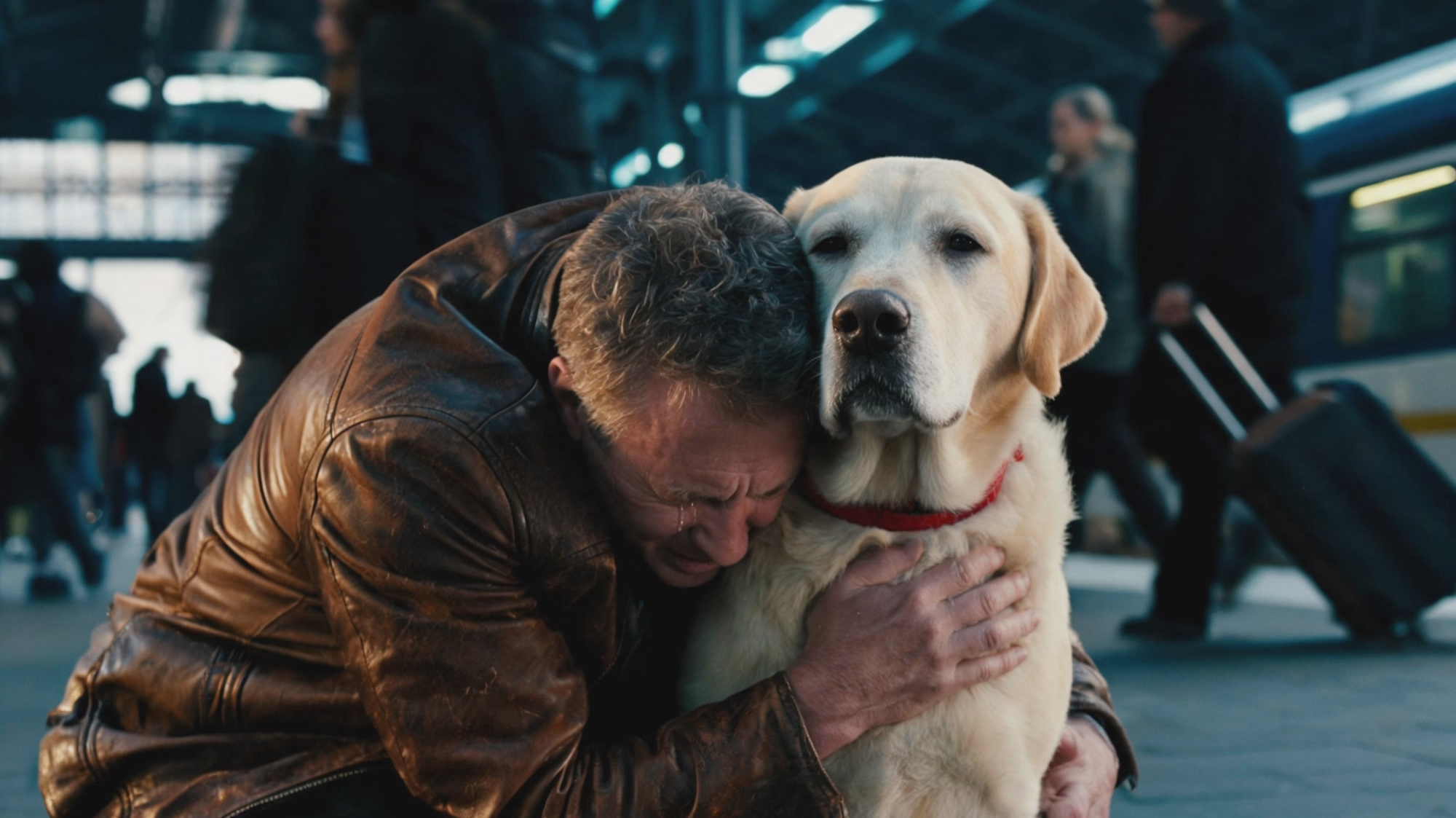
Sitting on the platform floor, perfectly still, directly in his path — a dog.
Old. Yellow-white, the muzzle gone completely pale. The face heavy and calm, the eyes deep and amber and entirely at rest. It sat the way old dogs sit when they’ve chosen a spot deliberately — not collapsed, not restless, but settled. Like it had been waiting there for a while and was prepared to wait considerably longer.
It wore a red collar.
James stopped walking.
His chest locked up. The sounds of the station went strange — muffled, distant, as though someone had pressed a hand against each of his ears. He felt his vision blur slightly at the edges. He blinked it clear.
He took a step forward. Then another. Then he stopped again, ten feet away.
The dog looked straight at him.
Not at the crowd. Not at the trains. At him.
James knew that look.
He’d spent eleven years trying to forget that look. The calm, absolute attention. The complete absence of anything but presence. The way Bailey had always looked at him when James came through the door — not excited, exactly, just… certain. Like arrival was never in question. Like James had only ever been temporarily away and was always going to come back.
“Bailey?” The word came out of him barely louder than a breath.
The dog didn’t move.
James walked forward. His knees were unsteady. He reached the dog and stopped, standing over him, looking down at the amber eyes looking up.
He lowered himself slowly to the ground. His knees hit the cold platform tile. He didn’t feel it.
He reached out. His hand shook so badly he had to stop and press it flat against his thigh for a moment, just to get it under control. Then he reached out again.
His fingers touched the fur.
Warm. Dense. Real.
He made a sound he didn’t recognize as his own voice.
He pressed his face into the dog’s neck and shook apart completely.
He hadn’t cried in eight years. He cried now. Not quietly — not the kind of crying you can keep contained. It came out of him in waves, ugly and broken, with no concern for the people around him, no protective performance of composure. The grief of eleven years and the relief of eleven years arrived at the same time and James just let them come. He held the dog and he wept and he didn’t care who saw.
The dog leaned slightly into him. Just slightly. Just enough.
After a long time, James sat back on his heels.
He wiped his face with the back of his hand. He looked at Bailey. Bailey looked at him.
“Where have you been?” James said. His voice was still broken.
The dog said nothing, obviously.
James almost laughed. He looked down at the red collar. There was something attached to it — a small metal cylinder, the kind you could unscrew, about the length of a finger. James’s hands were still shaking as he worked the cap off.
Inside was a rolled slip of paper. He unrolled it carefully. It was thin and yellowed, written in small, tidy, upright handwriting — a woman’s hand, he thought.
He read it.
Mr. Mitchell,
My name is Margaret Ellison. I am seventy-four years old and I am writing this from my home in Kensington, where I have lived alone for the past nine years.
Eleven years ago this autumn, a dog found his way into my garden in Didsbury. He was injured — a deep cut on his left back leg, badly infected — and utterly exhausted. I took him in. I had him treated by a vet. I gave him a name for a while, though I always had the sense that he already had one.
I searched for his owner. I placed notices. I contacted the local shelters. At the time, you had already left Manchester for a work contract and your neighbor was listed as the emergency contact. I was told the dog’s owner had been informed and had not come to collect him. I accepted this, though it troubled me.
He stayed.
He was the finest company I have ever had. I am not embarrassed to say that. He saw me through my husband’s death, my daughter’s wedding, two surgeries, one very bad winter, and a great deal of quiet that would have otherwise been unbearable.
I always knew, though. I always knew he wasn’t mine. There is a way certain dogs look at you that tells you plainly they are waiting for someone specific. He was always slightly turned toward the door. Always slightly elsewhere.
I am moving to a care facility next month. I am not able to take him. I have spent the past four months locating you — your neighbor Mrs. Hartley was eventually helpful, though it took time. I contacted my nephew, who made the call you received.
I do not know your circumstances. I do not know if you are in a position to take an old dog who sleeps most of the afternoon and requires expensive joint supplements and has absolutely no interest in fetch.
But I know he is yours. I think you should have each other for whatever time remains.
With respect and gratitude, Margaret Ellison
P.S. — His name is Bailey, isn’t it? He has always responded to that, though I called him something else entirely.
James read the letter twice. Then he folded it carefully and put it in his jacket pocket.
He looked at Bailey for a long moment.
“She called you something else?” he said.
Bailey blinked slowly.
“What did she call you?”
Nothing.
“Doesn’t matter,” James said. He put his hand on the dog’s head. “You’re Bailey.”
He called Sarah from the taxi.
She picked up on the second ring. “Dad? Everything okay?”
“Yeah.” His voice was still rough. “Listen. I need to tell you something.”
“You’re scaring me.”
“Don’t be scared. It’s — it’s good. I think.” He paused. “I found Bailey.”
Silence.
“Dad. Bailey’s been gone for—”
“Eleven years. I know. But someone had him. A woman in London. She took care of him.” He could feel himself losing the thread. “He’s old now. His muzzle’s gone white. But it’s him, Sarah. I know it’s him.”
A longer silence.
“Are you sure?” she finally said, quietly.
“I touched him and I knew.” He cleared his throat. “I know how that sounds.”
“It sounds like you,” she said. And then she made a sound that James realized, after a moment, was her crying. “Dad. Oh my God.”
“I know.”
“Are you okay?”
“I cried on a train platform in front of about four hundred strangers.”
She laughed through the crying. “Good. You needed that.”
“Yeah,” he said. “I think I did.”
He looked out the taxi window. Bailey was beside him on the back seat, pressed against his leg, already half asleep. James put his hand on the dog’s back and kept it there.
“I’m going to call Tom,” he said.
“He’ll want to come see him.”
“Maybe Christmas.”
“Yeah.” A beat. “Dad?”
“Yeah.”
“I’m really glad,” Sarah said. “I’m really, really glad.”
He didn’t trust himself to say much more. “Me too,” he said. “I’ll call you tonight.”
He hung up.
The taxi moved through Manchester. The afternoon light was low and golden, cutting long shadows across the wet streets. Bailey breathed slowly against James’s hand. James watched the city go by.
He thought about Margaret Ellison in her Kensington house, packing boxes, preparing to leave. He thought about the letter in his pocket. He would write to her. He would write her a proper letter — not an email, a letter, on good paper, with a real pen. He would tell her what the last eleven years had been like, and what this afternoon had been like, and how much she was owed.
He thought about the way Bailey had been sitting on that platform. Perfectly still. Entirely unafraid.
As if it had already known.
He got home at quarter past five.
He unlocked the apartment door and stood aside. Bailey walked in slowly, slightly stiff in the back legs, and made his way across the hallway into the living room. He sniffed the couch once. Turned around. Looked at James.
“It’s not much,” James said.
Bailey walked to the center of the rug and lay down.
James stood in the doorway of his own apartment and looked at it. The bare walls. The lamp on the workbench. The fading light through the window. He’d spent three years in these rooms with their absence, their echo, their carefully maintained emptiness.
He went to the kitchen and put the kettle on.
He opened the cabinet above the stove — the one he almost never used — and on the top shelf, pushed back, was a photograph. Him and Bailey on a beach in North Wales. James was thirty-eight in the picture. His hair was darker. He was laughing at something off-camera. Bailey was in the shallows, completely undignified, ears flat, running away from a wave.
He took the photograph down and looked at it for a moment.
Then he walked back into the living room.
“I put your picture away,” he said. “Years ago. Because it was too hard.”
Bailey opened one eye.
James set the photograph on the windowsill where the light could reach it. He stepped back and looked at it there. Then he looked at the dog on the rug.
“I should get you a bed,” he said. “And food. I don’t have dog food.”
He checked his watch. The pet shop on Wilmslow Road was open until seven. He grabbed his keys.
“Don’t destroy anything,” he said. “I’ll be twenty minutes.”
He paused at the door.
He looked back at Bailey, lying on the rug, already apparently asleep, entirely at home.
“I should’ve watered the cactus,” James said.
Bailey did not respond to this, which was fair.
James smiled — the first full, uncomplicated smile he’d produced in as long as he could remember — and stepped out into the evening.
He walked fast, the cold air sharp against his face.
He had a list in his head already — dog food, a bed, joint supplements, a new lead. Something for the gate in the building’s small courtyard, because he was absolutely going to secure that latch. He would call Margaret Ellison’s nephew and get her address. He would write that letter this week.
He thought about the coming months. The long walks Bailey would slow him down for. The appointments at the vet. The sleeping warmth on the end of the bed at night. The presence.
He hadn’t had presence in years.
The pet shop was bright and warm. James walked straight to the food aisle and stood there for a full minute reading labels before a young woman in a red apron appeared at his elbow.
“Can I help?”
“Yeah.” He held up a bag. “What’s good for an older dog? Joints. He’s about — twelve, thirteen, maybe. Large breed.”
“This one’s popular.” She reached past him and pulled down a bag. “And for joint support, we have these.” She handed him a bottle of supplements. “How old is he exactly?”
“I’m not sure. He was mine years ago and I just got him back.”
She blinked. “You just got him back?”
“Long story,” James said. Then, because he was apparently incapable of keeping himself together today: “He disappeared eleven years ago and someone took care of him and found me.”
The woman stared at him.
“That’s — ” she seemed to search for the word. “That’s an incredible story.”
“Yeah,” James said. “It is.”
He paid for the food, the supplements, a fleece-lined dog bed, a new lead, and a stuffed duck that he couldn’t quite explain, except that Bailey had always liked soft toys and old habits died harder than he’d thought.
He walked home under a sky that had gone dark and full of city light.
The stuffed duck was under his arm. He felt slightly ridiculous. He didn’t care.
He let himself back into the apartment. Bailey lifted his head from the rug and watched him come in.
“Right,” James said. He set everything down. He took the stuffed duck out of the bag and held it up. “I know. I know. You’re a dignified old dog and this is embarrassing.”
He set the duck down in front of Bailey.
Bailey looked at it for a long moment. Then he picked it up in his mouth and set it between his paws.
James sat down on the floor next to him.
They stayed like that for a while. The apartment was quiet in the way it had always been quiet, except that it wasn’t the same silence. It was the silence of a room with something alive in it. Something warm. Something that breathed.
James reached over and scratched behind Bailey’s ear.
Bailey leaned into it.
“You know what the worst part was?” James said quietly. “Not knowing. Just — not knowing.”
He paused.
“But you knew, didn’t you. You always knew you’d come back.”
He looked at the photograph on the windowsill. The laughing version of himself on that Welsh beach, thirty-eight and unbroken.
He was fifty-three now. Cracked in a few places. But still here. Still holding on.
He looked at Bailey.
“Let’s not do that again,” he said. “The losing-each-other thing.”
Bailey looked up at him with that amber, untroubled gaze.
And James understood, with the clarity that only comes when you’ve stopped trying to argue with something true, that whatever time they had left — whether it was months or a few good years — it was enough. It was more than enough.
He got up and made tea. He fed Bailey his dinner. He called his son Thomas, who said nothing for a full ten seconds and then said, “I’m coming up this weekend,” and James said fine, good, bring Sarah if she can make it.
He sat at his workbench afterward and picked up his tweezers and went back to the botanical atlas. He worked carefully, steadily, the lamp warm over his hands. Bailey lay at his feet, breathing slow.
At eleven o’clock, James turned off the lamp, locked up, and went to bed.
Bailey climbed up and settled at the foot of the mattress.
James lay in the dark, listening.
Not to the rain this time. Not to the silence.
To the sound of the dog breathing. Slow and even. The most ordinary sound in the world.
He closed his eyes.
He slept.
Original fictional stories. AI-assisted creative content.