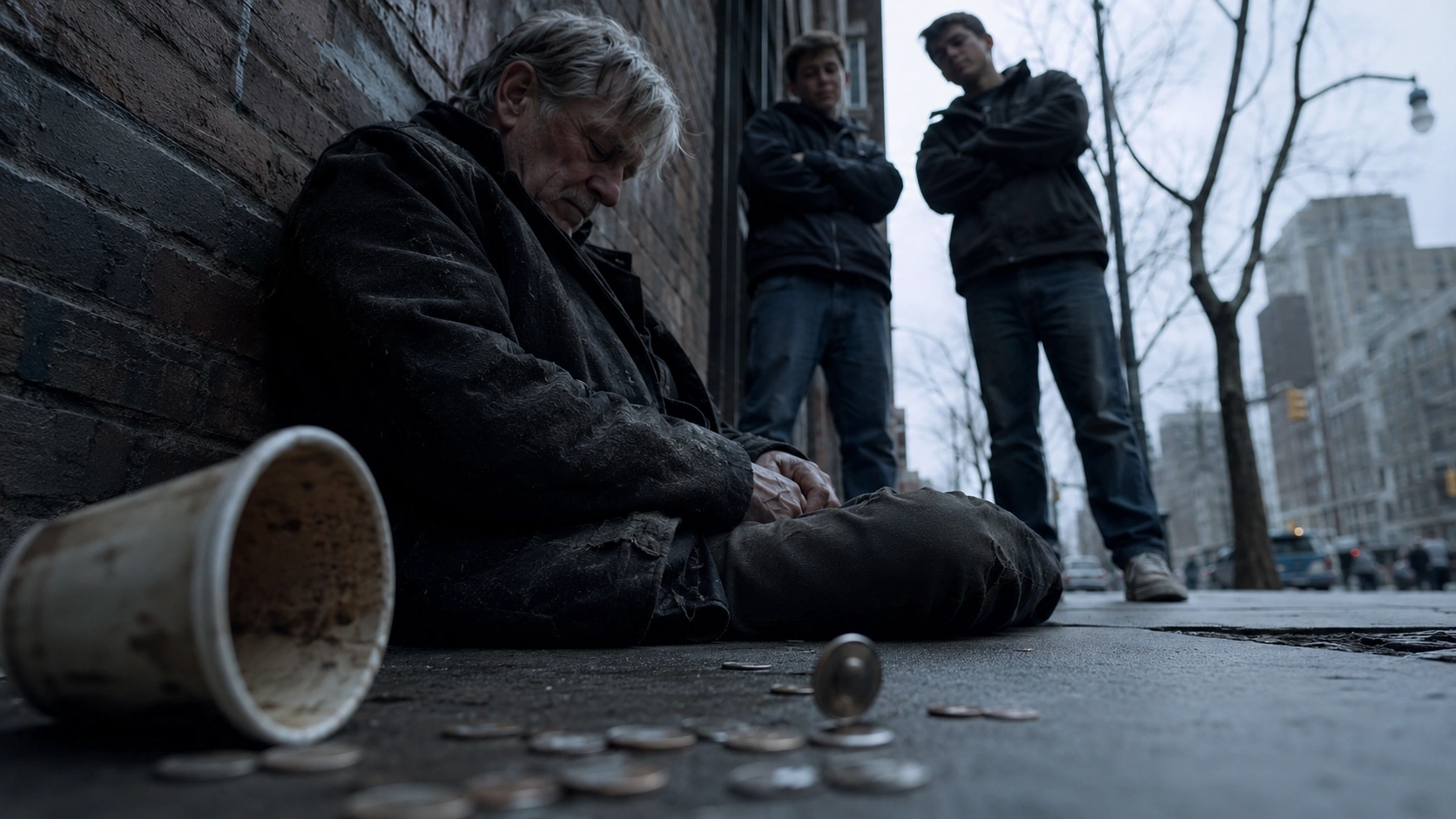
The coin cup shattered against the pavement before the laughter even registered.
“Yo, kick it harder!”
Edward Whitmore did not move. He sat against the cold brick wall with his hands loose in his lap, watching coins roll toward the gutter one by one. The morning crowd parted around the teenagers without slowing. A businessman in a navy coat glanced down, checked his watch, and kept walking.
The city always kept moving.
One of the boys crouched directly in front of him and dangled a twenty-dollar bill close to his face.
“You hungry, old man?” he mocked. “Go chase it.”
The laughter crashed around him again.
Edward’s eyes stayed on the pavement. He had learned a long time ago that humiliation passed faster when ignored. That was the only thing these streets had taught him that was actually useful.
A sneaker slammed down on a quarter near the curb just as his fingers reached for it.
“You deaf too?”
Edward finally looked up.
For a brief second — just one — something sharp moved behind his eyes. Not anger. Not fear. Just the particular kind of exhaustion that had been building inside him for three years.
Then it disappeared.
He pulled his hand back.
“Say something sad for the camera,” one of the boys said, pointing a phone directly into his face.
Edward looked away.
That somehow made them laugh even harder.
Then — a small voice cut through everything.
“Stop it.”
The teenagers turned.
A girl stood at the edge of the sidewalk. Eight years old, maybe. An oversized faded hoodie. Worn-out shoes. One sleeve hanging loose near a tiny hand that was holding half a piece of bread wrapped carefully in crumpled paper.
She was breathing hard from running.
The boys looked at her for half a second before one of them grinned.
“Oh great. Another homeless rat.”
She ignored him completely.
She walked straight toward Edward without hesitation, knelt beside him on the cold pavement, and held the bread toward him with both hands.
“Grandpa,” she said softly. “You can eat mine.”
The word hit him somewhere he hadn’t felt anything in years.
Grandpa.
She wasn’t his granddaughter. She didn’t know him. She just — used the word the way children used it when they wanted to protect someone old and alone.
Edward stared at the bread.
His eyes became watery almost instantly.
“I already ate,” the girl said quietly.
She was lying. He could see it clearly. The pale cheeks. The way she glanced once at the bread before offering it.
She was hungry herself.
She was giving him the only food she had.
“Bro, zoom in on his face,” one of the boys said. “He’s literally about to cry.”
Edward lowered his head slightly.
His rough fingers tightened gently around the bread.
Then the street changed.
Three black luxury SUVs screamed around the corner and stopped hard at the curb with a sound that cut through the entire block. Doors swung open almost simultaneously. Men in black suits moved fast across the sidewalk, scanning the crowd with tense, urgent expressions.
One of them spotted Edward instantly.
“Sir!”
The teenager filming dropped his phone.
A younger man in a charcoal suit pushed carefully through the crowd and stopped directly in front of Edward. His eyes were red. He looked like someone who hadn’t slept properly in days.
“Mr. Whitmore,” he said, his voice barely above a whisper. “We’ve been searching for you everywhere.”
The sidewalk went completely silent.
The teenager who had been laughing ten seconds ago stood completely still.
One bodyguard draped an expensive cashmere coat over Edward’s shoulders. Another opened the SUV door.
Whispers spread through the crowd like electricity.
“Whitmore? The Whitmore Group?”
“The billionaire—”
“I thought he disappeared—”
The phone lay cracked on the pavement where it had fallen.
One of the boys opened his mouth.
“W-Wait,” he stammered. “We didn’t know who you were.”
Edward stopped walking.
He turned slowly.
The teenager looked seconds away from being sick.
Edward studied him quietly for a long moment.
Then, in a voice so calm it was worse than shouting —
“If I wasn’t him…”
The boy swallowed.
“…would this have been okay?”
Nobody answered.
Because there was no answer.
Edward turned away again.
That silence stayed with them longer than anything else that morning.
But he wasn’t thinking about the teenagers anymore.
His attention was already on the girl.
She stood frozen near the brick wall, clutching the straps of her torn bag with both hands, staring at the SUVs and the suited men like none of it was real.
Edward walked toward her.
“What’s your name?”
“Lily.”
“Do you have parents, Lily?”
Her shoulders went rigid instantly. Fear crossed her small face so fast that most people would have missed it.
“My mom’s sleeping.”
She pointed weakly toward a narrow alley farther down the block.
Something about the way she said it made the air feel wrong.
“Take me there,” Edward said.
The alley swallowed the light.
Sunlight barely reached past the entrance. The warmth of the avenue vanished. Garbage bags lined the walls, and damp newspaper drifted along the ground in the cold wind.
Near the back corner, behind stacked cardboard boxes, someone lay under a thin gray blanket.
“Mom!” Lily ran forward.
The woman didn’t move.
Lily shook her shoulder gently.
“Mom, please—”
Nothing.
Edward moved faster than anyone expected for a man in his condition. He dropped to one knee and touched the woman’s forehead.
Burning.
“She has a fever.” He looked up sharply. “Medical team. Now.”
The assistant was already speaking into his earpiece.
Lily’s hands were shaking.
“She said she was just tired,” the girl whispered.
The woman stirred weakly. Her eyes opened halfway — then widened in terror at the sight of men in suits surrounding her.
She tried to sit up immediately.
“I’m sorry,” she rasped. “We weren’t bothering anyone. We’ll leave right now—”
“Easy,” Edward said.
The woman found Lily standing beside him and fear flooded her face.
“Lily,” she whispered sharply. “Come here.”
“She gave me her food,” Edward said quietly.
The woman went still.
For a long moment she just stared at him. Then her eyes drifted toward the SUVs visible at the alley entrance. Recognition moved slowly across her exhausted face.
And then — horror.
“Oh no.”
The assistant frowned slightly.
“You know who he is?”
She looked down immediately.
“I used to work for Whitmore Group,” she said weakly. “Accounting division.”
The assistant’s expression changed instantly.
“What was your name?”
She hesitated for a long time.
“…Rachel Bennett.”
The assistant went pale.
Edward noticed immediately.
“What is it?”
Rachel closed her eyes.
“Please don’t.”
The alley felt smaller suddenly. Edward looked between them. Something was buried here. Something unresolved and old and ugly.
The assistant spoke carefully.
“Rachel Bennett disappeared the same week you vanished, sir.”
Rachel laughed once — a short, hollow sound with no humor in it.
“You really didn’t know,” she said.
“Know what?”
The assistant exhaled slowly.
“After your wife passed away, several board members started moving company funds through shell corporations. Millions over three years. Rachel found the transfers.” He paused. “She tried to report them.”
Silence.
Edward turned back to the woman on the ground.
Rachel’s voice came out barely above a whisper.
“They framed me before I could expose them. Told the public I was the one who stole.”
“And you ran,” Edward said.
“They said if I kept talking, they’d take Lily away from me.” Her voice cracked. “I had nothing to prove I wasn’t guilty. Nothing. They had lawyers. I had a seven-year-old.”
Edward felt something cold settle in his chest.
He remembered those months after losing Claire. The grief that had made everything feel like it was happening at the bottom of a lake. Board meetings he barely attended. Documents he signed without reading. The executives who had surrounded him with concern and patience while he drowned.
He had trusted them completely.
Because trusting them was easier than being present.
And because of that — this woman and her daughter had been living in alleys for three years.
“They told the public she stole company money,” the assistant said quietly. “She’s been running ever since.”
Rachel looked ashamed now.
“I never touched a dollar that wasn’t mine.”
“I know,” Edward said.
Rachel stared at him.
“How?”
“Because no one who actually stole anything,” he said, “gives their daughter’s last piece of bread to a stranger.”
Rachel’s face collapsed.
She turned away quickly, pressing the back of her hand against her mouth.
Lily moved closer to her mother and held her arm tightly.
Then the assistant removed his glasses.
His hands were trembling slightly.
“Sir… there’s something else.”
The alley went very quiet.
“The board doesn’t know I found you.”
The bodyguards looked confused immediately.
Edward stared at him.
“Explain.”
The assistant swallowed hard.
“I never told them I located you. I lied.” His voice was unsteady. “They weren’t searching for you to bring you back.”
Lily instinctively pressed closer to her mother.
“The federal investigation into the company,” the assistant continued, “quietly reopened last week. And the board has already prepared documents transferring responsibility for the fraud onto you — using your three-year disappearance as cover.” He paused. “If you stay hidden, they’ll bury the evidence and you’ll take the blame for everything.”
The alley became completely still.
Far outside, a siren echoed faintly through the city.
Edward lowered his eyes to Lily.
She stood gripping her mother’s sleeve, watching him with an expression of careful, frightened hope. The same expression she’d had when she offered him the bread. Uncertain whether kindness was real or whether it always came with a price attached.
The assistant’s voice broke slightly.
“I was the intern who copied Rachel’s files before security confiscated everything. I kept the evidence. For eight years I kept it.” He looked ashamed. “I stayed silent because I was terrified. But I built a case.”
Rachel stared at him in disbelief.
“You were there?”
“First floor. End of the corridor.” His voice cracked. “I’m sorry it took this long.”
Nobody spoke for a moment.
Then Edward looked at him directly.
“What’s your name?”
“Daniel.”
“Daniel.” Edward’s voice changed — not louder, not harder, but something clarified inside it. The same shift that had frightened board rooms for thirty years. “If we do this, we finish it completely.”
Daniel’s eyes reddened.
“Yes, sir.”
Rachel looked terrified.
“They’ll come after all of us.”
Edward turned toward her.
For the first time in the conversation, the exhausted homeless man in the alley was entirely gone. What stood in his place was the man who had built a company from scratch and lost his way grieving — not a fool, and not a coward.
“They already did,” he said.
The medical team arrived in eleven minutes.
Rachel was treated for pneumonia on the way to the hospital. Lily sat beside her in the SUV and didn’t let go of her hand once during the entire ride.
Edward sat across from them and said nothing.
He watched the city pass through the tinted window and felt — not the relief he had expected — but something sharper. Responsibility. The specific, unwanted weight of it. He had hidden from the world because losing Claire had felt unsurvivable. And while he hid, real people had been crushed by men who wore his company’s name.
He couldn’t undo those three years.
But he could finish this.
Daniel walked into the federal field office on a Tuesday morning with a hard drive, four encrypted folders, and eight years of documented evidence.
He brought a lawyer.
He also brought Edward Whitmore.
The lead investigator stared at both of them for a long, silent moment.
“We’ve been waiting,” she said finally.
“I know,” Edward said. “I’m sorry it took this long.”
The warrants were signed within seventy-two hours.
All four board members were arrested before the week ended. The CFO was taken from a breakfast meeting still holding his coffee cup. The General Counsel walked out of his own building in handcuffs in front of every employee he had ever threatened. The other two were picked up at the airport attempting to board a flight.
Not one of them made it out of the country.
The charges were extensive: securities fraud, obstruction of justice, falsification of corporate records, and witness intimidation — the last count specifically tied to what they had done to Rachel Bennett.
Her name was formally cleared eleven days after Daniel’s testimony.
The judge’s language in the ruling was unusually direct. He called what had been done to her “a deliberate and calculated destruction of an innocent person’s life for financial protection.”
Rachel read the ruling three times sitting in a hospital bed.
She didn’t say anything for a long time.
Then she looked at Lily beside her.
“It’s real,” Lily told her quietly.
Rachel laughed — actually laughed — for the first time in years.
The company restructuring took months.
Edward rebuilt the board. He hired people he chose himself, slowly, carefully. He read every document before signing it. He came in early and stayed late and remembered why he had built the company in the first place — not for the money, but because he had genuinely believed in what it could do.
Rachel was offered her position back.
She declined.
“I don’t want to go back to what it was,” she said plainly when Edward asked her.
“Fair,” he said.
She became the company’s independent compliance officer instead — a new role, with full authority and direct access to the board. She reported to no one inside the company except the federal oversight committee.
She was very good at it.
Months later, on a cold Saturday morning, Lily stood at the window of their apartment looking down at the street below.
It was the same kind of morning. Golden light on the skyscraper windows. Steam rising from the subway vents. People moving fast along the sidewalks with coffee cups and briefcases.
Her mother came up beside her.
“You’re staring again,” Rachel said.
“I know.”
Rachel looked down at the street.
For a moment, neither of them said anything.
“Do you think he’s okay?” Lily asked.
Rachel smiled.
“Go ask him yourself.”
Edward was sitting at the kitchen table when Lily appeared in the doorway.
He had a mug of coffee in both hands and was looking at a photograph on the table. Lily had seen it before. A woman with dark hair laughing beside a fountain in the summer. She had kind eyes.
Lily sat across from him.
She didn’t say anything right away.
Edward looked up.
“You’re going to grow up to be impossible, aren’t you?” he said.
Lily thought about it seriously.
“Probably,” she said.
Edward laughed.
It was a real laugh — the kind that surprised him, that came from somewhere he hadn’t accessed in years. It sounded strange. It sounded good.
He looked at the photograph again.
Then carefully — very carefully — he set it down and slid it a few inches toward Lily.
“Her name was Claire,” he said.
Lily looked at the photograph for a long time.
“She looks like she was funny,” she finally said.
“She was.” Edward’s voice was quiet. “She was the funniest person I ever knew.”
A silence settled between them that wasn’t uncomfortable.
Outside the window, the city moved the way it always did — indifferent, rushing, enormous.
But inside that kitchen, on a cold morning in November, something had changed that the city would never notice and didn’t need to.
An old man and a small girl sat at a table with a photograph between them.
And for the first time in three years — Edward Whitmore felt like someone’s family.
The four board members were convicted on all counts.
The CFO received twelve years.
The others received sentences between seven and ten.
None of them ever returned to the financial industry.
The teenager who had filmed everything that morning on the sidewalk — the one whose phone had cracked when it hit the pavement — eventually saw the video surface. Not the mocking version he’d intended to post.
The full version. Thirty-seven minutes. Including everything that came after.
It was shared eleven million times in four days.
His name was attached to it permanently.
He transferred schools in January.
His friends did too.
On the last day of November, Lily left a half piece of bread on Edward’s desk beside his morning coffee.
She had wrapped it carefully in paper.
She didn’t explain it.
She didn’t need to.
Edward sat down, picked it up, and held it for a moment the way he had that first morning on the cold sidewalk — like something precious that he was still learning to deserve.
Then he unwrapped it.
And ate.
Original fictional stories. AI-assisted creative content.