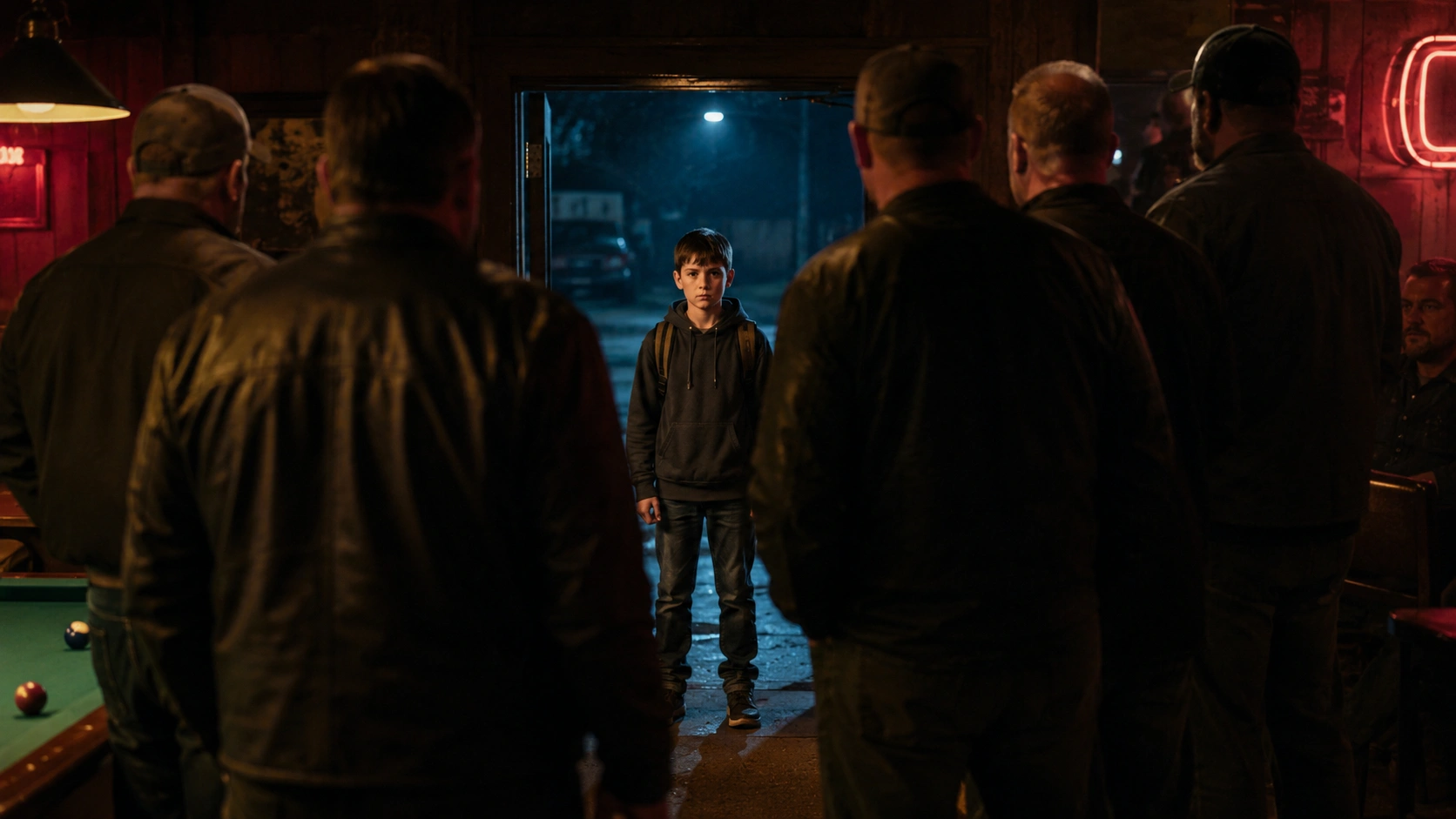
The door hadn’t fully closed behind the boy when Mace felt it — that electric wrongness that made the hair on his arms stand up. Twenty years in the life. He knew that feeling. It meant something lethal was close.
The kid was maybe ten. Dark-circled eyes. Dried blood on his collar. His sneakers were torn at the toe, like he’d been running on pavement for miles. He stood at the threshold of the Black Toll and scanned every face with the focused calm of someone trained to look for threats, not comfort.
Nobody moved.
“You lost, son?” Mace said.
The boy’s eyes landed on him. “I’m looking for Mace Dorin.”
“You found him.”
“My father told me to find you.”
Mace set his glass down. “Who’s your father?”
The silence after that name was worse than a gunshot.
“John Wick.”
Every man at the bar heard it. Mace watched the word land on them one by one — Reeves at the pool table going still mid-stroke, Cole dropping his phone, Hatchett turning from the jukebox with his jaw open.
“John Wick?” Mace repeated. The words came out broken.
The boy nodded once, tears spilling now.
Mace looked around the room. Every man looked back the same way — stunned, unsettled, suddenly afraid of what might be coming through those doors behind him.
“That’s impossible,” Mace muttered.
The boy’s breath hitched.
Then he reached into his pocket with trembling fingers and pulled out a blood-stained gold coin. He held it out. The crest caught the light from the overhead lamp.
The room changed instantly.
Mace snatched it — gentle but fast — staring at it like it might burn through his hand. He turned it over. Pressed his thumb against the edge, feeling the weight, the cut of the stamp.
It was real. No joke. No trick. No child could fake that.
His jaw tightened as he looked back at the boy. “What happened to him?”
The boy’s face collapsed.
“They hurt him,” he whispered. “He told me to run.”
That hit every man in the bar at once.
Big Danny stood so fast his chair slammed backward. The others were already moving — hands going to weapons, eyes cutting to the doorway, bodies turning from shock into war.
“How many?” Cole said, moving to the window.
“I don’t know,” the boy said. “Four. Maybe more. They had a van.”
“Color?”
“Black. No plates.”
Mace crouched down in front of the boy, putting himself at eye level. “What’s your name?”
“Jonah.”
“Okay, Jonah. Listen to me.” He kept his voice low. “Did he say anything else? Before he told you to run?”
Jonah wiped his face with his sleeve. “He said you’d know what to do. He said say the name and show the coin and you’d know.”
Mace felt something old and cold settle into his chest. He hadn’t spoken to John in three years. Not since the night the man had walked away from all of it — from the Table, from the contracts, from every living soul who shared their alphabet. He’d bought his peace with a deed no one talked about in daylight.
And now his kid was standing in the Black Toll with blood on his collar and a gold coin in his hand.
“Lock the doors,” Mace said.
Men exploded into motion. Bolts slammed. Chairs scraped. Guns appeared from places tourists wouldn’t know to look.
“Cole — back exit, two men, now.”
Cole grabbed Reeves by the collar and moved.
“Danny, get the lights down. Leave the neon.”
“Already on it.”
Mace stood. He turned back to Jonah. The boy was tracking everything — every man, every movement. Not panicking. Cataloguing.
His father’s kid, Mace thought.
“You hungry?”
Jonah blinked. “What?”
“Food. You hungry?”
“I—” He stopped. “Yes.”
“Sit.” Mace pointed to the stool at the far end of the bar, tucked against the wall. Position of cover. No sightlines from the windows. “Stay low. Don’t move until I say.”
Jonah moved to the stool without argument.
Mace turned to Hatchett. “Get him something.”
Then he pulled out his phone and called the only number that mattered.
It rang twice.
“We have a problem,” Mace said.
The voice on the other end said, “How bad?”
“The Wick kid is in my bar. Father’s in the wind, probably hurt. Black van, four plus, no plates, last seen — ” he looked at Jonah. “Where’d you leave him?”
“The parking garage,” Jonah said. “On Fifth. Level two.”
Mace repeated it.
A pause. Then: “Fifteen minutes.”
“We may not have fifteen.”
“Ten. Keep the coin on you.”
The line went dead.
Hatchett slid a plate down the bar — cold sandwich, bag of chips. Jonah took it without looking at him, eyes already back on the door.
Smart kid.
Mace walked to the front window and looked through the gap in the blackout curtain. The street was quiet. Wednesday night, industrial block, no pedestrian traffic. One streetlamp out — the one closest to the entrance. That wasn’t an accident.
“They cut the lamp,” he said.
“Yeah,” Danny said from his right. “I clocked it.”
“Back?”
“Clear so far. But there’s a car parked tight on the service lane. Engine’s warm.”
They were already in position. They’d been watching the bar before Jonah even walked through the door.
Before the last lock dropped, a shadow moved across the bright doorway outside.
Jonah saw it first. His whole body went rigid on the stool.
Then he said the line that made even Mace — who had outlived eleven men who’d tried to put him in the ground — go still.
“They’re not here for me.”
Mace turned sharply. “Say that again.”
Jonah’s lips trembled. “I heard them talking. In the garage. Before I ran.” He swallowed. “They said they didn’t care about the kid. They said they needed to close every door first. Every name he’d ever trusted.” He looked at Mace. “You’re on a list.”
Danny said, very quietly, “How many names on the list?”
“I don’t know. They said seven.”
Seven.
Mace thought of six other faces.
“Phone,” he said.
Danny handed his over without question. Mace dialed fast. First number — two rings, pickup.
“Get out of your house. Right now. Don’t take the car.” He hung up. Dialed again. “Are you alone? — Leave. Go to the contingency point. Yes, now. — I’ll explain when you get there.” Hung up. Dialed again, again, again, moving down a list burned so deep in his memory he’d have remembered it under anesthesia.
Third call didn’t pick up.
He tried again.
Nothing.
He looked at Danny. Danny looked back.
“Marcus,” Mace said.
“I know.”
They’d been too slow on Marcus.
“How many outside now?” Cole called from the back.
“At least three on the street. One in the service lane. Probably two on the roof across.”
Six accounted for. More unknown.
Mace walked back to the bar. Jonah was watching him over the untouched sandwich.
“What happened in the garage?” Mace said. “Start from the beginning. Don’t skip anything.”
Jonah set the chips down. He took one breath, the way a kid does when he’s trying not to cry and trying not to show it.
“Dad picked me up from school. Normal. We were driving home and he said, ‘Don’t look back.’ I knew what that meant.”
“What did it mean?”
“It meant we were being followed.”
Mace nodded slowly. “Go on.”
“He drove for a while. Then he pulled into the garage. He said it was a parking problem, trying to lose them in the levels. But when we got to level two there were already two men waiting.” Jonah’s jaw tightened. “They weren’t there to talk.”
“What happened to them?”
The boy met Mace’s eyes. “Dad happened to them.”
Nobody laughed. Nobody moved.
“Then a second group came in from the ramp. More than the first. Dad put me behind a concrete pillar. He said — ” Jonah stopped. He pressed his lips together. “He said he was going to make some noise and I was going to run when the doors opened. He said follow the map in my head. He taught me the route a long time ago.”
“He planned this,” Mace said.
“Yes.”
“He knew this was coming.”
“I think — ” Jonah paused, choosing words carefully. “I think he knew it might.”
The boy was ten years old, and he was speaking like a man who understood contingency planning. John had done that. John had built that into the child deliberately, the same way Mace had been built at that age by men in the same life. He felt a hot, quiet rage about that — and then set it aside, because it wasn’t the time.
“He gave you the coin before he sent you.”
“He always carried two.” Jonah looked at his hands. “He said one was his. One was mine. For emergencies.”
“You’ve had it this whole time?”
“Since I was seven.”
Three years. John had been preparing this handoff for three years. Trusting a child with an asset that carried the weight of a Continental marker, a proof of identity, a key to a world the boy wasn’t supposed to know existed.
Except he did know.
He’d been raised inside it, just far enough back from the edge to see the shape of it without falling in.
From outside came three short, sharp knocks on the front door.
Pattern knock. Their own.
“That’s early,” Danny said.
Mace looked at his watch. Eight minutes. “Open it.”
Reeves pulled the bolt.
A woman stepped in. Forty, trim, leather jacket, eyes that processed the room in under a second. Sofia. She’d driven from the other side of the city in eight minutes, which meant she’d been already moving before Mace called her.
She looked past him, past Danny, past all of it, and found Jonah at the bar.
She crossed the room without speaking and crouched in front of him.
“Hi,” she said.
Jonah looked at her. “Hi.”
“Your dad talks about you.” She said it quietly. “He’s very proud of you.”
Jonah’s composure cracked for just a moment — one breath, one blink — and then he locked it back down. Sofia saw it. She didn’t press it.
She stood. Turned to Mace. “What do we have?”
“Seven targets. Mine’s confirmed, Marcus is dark. Still trying to reach the others.”
“I reached two on the way in. They’re mobile.” She pulled out her phone. “Third contact just confirmed — they got to Delilah. She’s hurt, not gone. Paramedic is with her.”
“The list has two more.”
“Ruiz and Park. Ruiz isn’t answering. Park confirmed safe.”
“So Ruiz.”
“Maybe.”
The front window shuddered. Not broken — pressure. Someone testing it.
“We’re not waiting,” Mace said. He turned to the room. “This is what we’re going to do.”
What followed happened in four minutes.
It had been planned, in the abstract, for years — the way all contingency plans are planned. Maps in the head, alternate routes, exit protocols. Mace had never wanted to use it. He’d assumed he never would.
He was glad, now, that he’d kept it current.
The back exit led to a service tunnel that connected to the parking structure two blocks east. Cole and Reeves took Jonah between them, the boy moving fast and quiet without being told to. Sofia covered the rear. Danny and Hatchett stayed behind — noise and presence, buying ninety seconds, because ninety seconds was all that was needed.
They didn’t need to fight everyone outside. They just needed to not be inside.
The men in the service lane heard the back door.
By then, Mace was three blocks away and Jonah was in the back of a car Mace didn’t legally own, heading north.
The garage on Fifth. Level two.
They found John Wick behind a concrete pillar, exactly where Jonah said he’d be.
He was upright. That was the first thing. Not on the ground, not incapacitated — upright, back to the wall, with the deliberate stillness of a man controlling blood loss through sheer discipline.
He had his hand pressed flat against his left side. His face was pale in the bad fluorescent light. His eyes tracked the doorway before any of them could speak.
Then they landed on Mace.
“Took you long enough,” John said.
“Your kid walks fast,” Mace said.
John’s face moved — not quite a smile. Not quite relief. Something between them.
“He make it?”
“He’s in a car. He’s fine. He ate half a sandwich and memorized the exits of my bar.”
John exhaled. One long, slow breath. “Good.”
Sofia was already kneeling beside him, hands moving to the wound. “How long?”
“Forty minutes.”
“Through and through?”
“Yes.”
“You’re lucky.”
“I’ve been told.”
Mace crouched beside him. “The list. Seven names.”
“I know about the list.”
“Marcus.”
John’s jaw tightened. “I know.”
“He didn’t pick up.”
“I know.” A pause. “I’m sorry about Marcus.”
“Who put it together? Who authorized this?”
John looked at him. In the bad light, his eyes were very still. “Someone who thought seven names would be enough to close all my doors. Make me walk in with nothing.”
“Walk in where?”
“There’s a meeting tomorrow. At the Continental. Formal. The High Table has a grievance.” He shifted his weight slightly and controlled the wince. “Someone on the inside decided to skip the meeting and solve the problem another way. Take out everyone I might call, then call me in and tell me my son is collateral if I don’t cooperate.”
“Cooperate with what?”
“They want a name. Someone I’m protecting.”
“Are you?”
John looked at him without answering.
“John.”
“Yes,” John said. “I’m protecting someone.”
“Who?”
“Someone who doesn’t deserve what they’d do to her.”
Mace sat with that. Around them Sofia worked, quiet and efficient. The garage was silent except for the distant sound of the city above.
“So what do you want to do?” Mace said.
“I want to go to that meeting.”
“You’re in no shape —”
“I’ll be in shape.” John’s voice was flat and final. “I want to go to the meeting and I want Jonah safe and I want the man who put Marcus on that list to understand that closing doors doesn’t end the problem. It makes it worse.”
“That’s going to start a war.”
“No.” John met his eyes. “It’s going to end one. There’s a difference.”
The meeting was at noon the following day, in the upper conference room of the Continental — neutral ground by rule, witnessed by the concierge, recorded per High Table protocol.
John walked in at 11:58, dressed cleanly, moving without visible pain. Sofia had worked through the night. He sat at the table and waited.
The man across from him was named Crane. Forty-five, silver-haired, double-breasted suit. A regional seat at the High Table, three years appointed. He had ordered seven names with the confidence of a man who had never operated in the field himself.
He did not expect John Wick to be sitting across from him.
He covered it well. His expression barely changed.
“Mr. Wick,” Crane said. “I’m surprised you made it.”
“I’m difficult to inconvenience,” John said.
“We’re here about a formal grievance. The matter of —”
“We’re here,” John said, “because you put my son in danger.”
The room went quiet. The concierge, standing at the far wall, did not move.
“I don’t know what you’re referring to,” Crane said.
“Yes you do.” John placed a folder on the table and slid it across. Crane didn’t touch it. “Seven names. The order was placed through a cutout, but the authorization traces back to a code that belongs to your office. That’s in the folder. Along with the testimony of a man you hired who found it in his interest to be cooperative when asked politely.”
Crane’s expression didn’t move. But something behind his eyes shifted.
“That folder,” John said, “has three copies. One is with the Continental. One is in transit to a Table arbiter right now. And one is somewhere you won’t find it, held by someone I trust.”
Crane looked at the folder. Then at John. “What do you want?”
“Jonah is off the board. Permanently. No contracts, no collateral, no leverage. He gets his life.” John’s voice was absolutely level. “If anyone in your organization looks at him twice, the folder becomes a formal filing. And I will not wait for the Table to process it.”
“And in exchange?”
“The name you want. I’ll give you the name.”
A pause. Crane weighed it.
“The name,” he said slowly, “and the folder disappears?”
“The folder disappears. The copies don’t. They stay where they are, inactive, as insurance.” John looked at him. “You’ll never know where they are. But they’ll know where you are. That’s how this works.”
Crane was quiet for a long moment.
“The name,” he said.
John told him.
He found Jonah that evening in the safe house outside the city — a borrowed place, plain and clean, with good sightlines and two exits. Jonah was sitting at the kitchen table doing something on paper. Drawing, or writing, Mace couldn’t tell.
John came through the door, and Jonah looked up.
He didn’t say anything. He got up and crossed the room and put his arms around his father and held on.
John stood very still for a moment. Then he put one hand on the back of his son’s head.
“I’m okay,” he said.
“I know,” Jonah said, his voice muffled. “I wasn’t worried.”
“You absolutely were.”
A pause. Then Jonah said, “A little.”
John looked across the room at Mace, who was leaning against the doorframe with his arms crossed.
“Thank you,” John said.
Mace shrugged. “He brought the coin.”
“He knew to.”
“Yeah.” Mace looked at the boy, still holding on. “You did a good job with him.”
John didn’t answer that. He didn’t have to.
Jonah finally stepped back, scrubbing his face with his arm. He looked at his father with the same clear, measuring eyes he’d had in the bar — the eyes of a kid who’d been afraid and kept moving anyway.
“Are we safe now?” Jonah said.
John considered it. The honest answer was complicated. The world they lived in did not produce permanent safety. It produced periods of equilibrium, enforced by leverage and consequence and the cold logic of mutual deterrence.
But Crane had taken the deal. The name was given. The copies existed. The boy was off the board.
“Yes,” John said. “We’re safe.”
Jonah nodded. He believed it — not because he was naive, but because he’d watched his father walk into a room where men with power wanted something, and walk out having turned it.
He’d seen the door close on a threat.
He understood, in the way children raised close to consequence understand things, that safe was something you earned and maintained and sometimes bled for.
His father had done all three.
He went back to the table and picked up his pencil.
John sat down across from him.
Outside, the evening came in gray and quiet. Mace left them to it.
Original fictional stories. AI-assisted creative content.