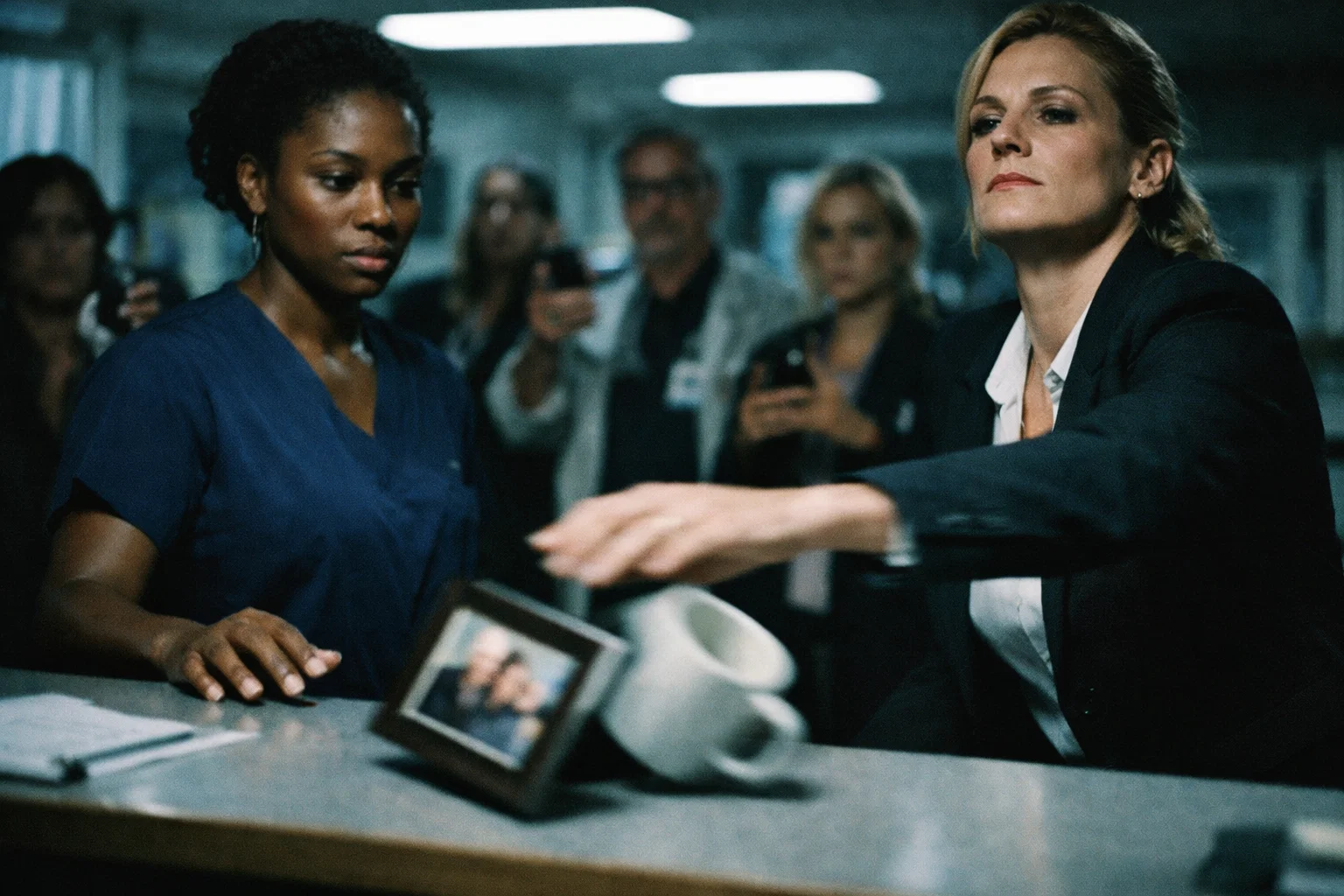
The graduation photo hit the floor first.
Karen Matthews didn’t even look down. She swept her arm clean across the nurses’ station desk like she was brushing crumbs off a tablecloth, and everything Amara Johnson had brought to work—a ceramic coffee mug, a prescription glasses case, a framed photo of a young woman in cap and gown—went crashing to the linoleum.
“Pack your ghetto belongings and get out,” Karen said. “You’re fired, girl.”
Twelve staff members turned. Three patient families looked up from the waiting area. A charge nurse named Maria Gonzalez quietly opened Instagram Live on her phone and held it at her side.
Amara knelt. She picked up her daughter’s graduation photo carefully, brushing glass fragments from the frame with her thumb. Her navy scrubs were wrinkled from a sixteen-hour shift. Natural hair pulled back simply. Hands steady.
She stood slowly. She did not cry. She did not plead.
“Karen,” she said, opening a small leather notebook with gold initials—AJ—”can you state your full name and title for the record?”
Karen laughed. “Are you threatening me? I’m Karen Matthews, nursing supervisor, level four. Fifteen years here.” She crossed her arms. “You have six months.”
“What specific policy violations are you citing?”
“Policy?” Karen’s voice pitched louder—deliberate, performative. She wanted the room to hear. “Girl, this isn’t about policy. This is about fit. Cultural fit. You people always make everything about rules and lawyers.”
Maria’s phone showed 47 viewers. Then 89. Then 156.
Jasmine, a Black nursing student by the supply closet, went completely still. Her fists slowly closed at her sides.
“And don’t think about applying anywhere else in this city,” Karen continued. “I have connections. Your career in prestigious healthcare is over.”
Dr. Sarah Kim, an attending physician, stepped forward cautiously. “Karen—maybe we should handle this privately?”
“No need.” Karen didn’t even look at her. “This is a teaching moment. Standards matter here.”
Amara continued writing in her notebook, pen moving in steady, methodical strokes.
“Have you consulted the board of directors about this decision?”
Karen laughed—sharp, dismissive. “Board of directors? Honey, they don’t care about your little feelings. I am the authority here. I decide who stays and who goes.”
The hospital’s main phone began ringing. Maria’s stream hit 312.
Janet Webb, assistant administrator, hurried toward the unit. “What’s happening here?”
“Handling a personnel issue,” Karen said smoothly.
Janet frowned. No termination memo had come through her office.
“Six minutes,” Karen announced, checking her Apple Watch.
Luis Martinez, one of the responding security guards, approached slowly. Something about the woman in scrubs nagged at him—a face he’d seen somewhere important, somewhere that mattered—but he couldn’t place it.
“Ma’am,” he said quietly. “I’m sorry, but we need you to collect your things.”
His partner Mike looked equally uncomfortable. Neither had details. Only orders.
Amara walked to her locker. She entered the combination with steady fingers. Inside: a Harvard Medical School diploma in a protective sleeve. A stack of business cards. Legal documents in a manila folder.
She placed the diploma in her bag alongside a pair of first-class airline ticket stubs visible at the top of her purse.
“Four minutes,” Karen called out, savoring the room. “Let this be a lesson. This is what happens when affirmative action places people where they don’t belong.”
Maria’s screen showed 1,247 viewers. The hashtag #CatherinesRacism was trending locally.
Jasmine finally spoke, voice trembling. “This isn’t right.”
Karen whirled. “Excuse me?”
“She’s one of the best nurses on this floor. Everyone knows that.”
“Everyone doesn’t make hiring decisions,” Karen retorted. “And neither do students. Remember that when you apply for jobs.”
Two minutes left. Amara closed her locker. She turned to face the room—staff, patients, families, security. Phones everywhere. Troubled expressions.
“Time’s almost up,” Karen said. “Security. Escort her out.”
The room waited for tears. For begging. For the breakdown.
Instead, Amara smiled slightly.
She walked toward the main corridor—not the exit.
“Where are you going?” Karen demanded. “The exit is the other direction.”
Amara didn’t answer.
She approached the locked administrative display case near the corridor wall—the one marked Hospital Administration—and she reached into her keychain. Among the ordinary keys was one small, distinctive one that caught the fluorescent light just so.
It slid into the lock. The case opened with a soft click.
Maria’s stream hit 1,847. Comments moved too fast to read.
Luis stopped walking. That nagging recognition sharpened into something real—a face in a newspaper clipping he’d kept folded in his wallet for months.
Amara opened the administrative directory inside the case. She removed a professional headshot—boardroom quality, not hospital ID—and placed it in the Board of Directors section. Then she reached into her notebook and produced a small placard.
She set it below the photo: Dr. Amara Johnson, MD, MBA — Chairman of the Board and Primary Shareholder.
The hallway went completely silent.
Karen’s face drained white.
“That… that can’t be real.”
Amara pulled her real business cards from the notebook—elegant, heavy stock—and placed one in the information slot.
Johnson Medical Holdings. Healthcare Investment and Reform. 67% ownership, St. Catherine’s Healthcare System.
Dr. Patterson’s chart clattered to the floor. Janet Webb’s phone slipped from her fingers. Luis turned to Mike and whispered:
“Oh my God. That’s Dr. Johnson. My daughter has her picture in her room. She donated to our school district.”
The stream exploded past 3,000. She owns the hospital. Plot twist. Karen is done.
Karen stood frozen. Her mouth opened.
“That’s… that’s not possible. You’re just a nurse. You can’t be—I mean—”
“Actually, Karen.” Amara turned, expression unhurried. “I’m a Harvard-trained physician and the majority owner of this hospital. I’ve been working here as a nurse to understand our workplace culture firsthand.”
Karen stumbled backward. Her designer heel caught the linoleum.
Stream count: 5,000. She OWNS it. Karen’s finished.
Dr. Patterson moved forward carefully. “Dr. Johnson? The Dr. Johnson—the Medicare reform papers?”
“That’s correct.”
Janet Webb’s voice came out thin. “But your employee file says—”
“Exactly what I wanted it to say.” Amara pulled out her full ID. “Johnson Medical Holdings acquired this facility eighteen months ago. I’ve been conducting what you might call field research.”
Luis snapped his fingers. “That’s where I know you. You spoke at my daughter’s graduation. You donated two million dollars to our school district.” He pulled a folded newspaper clipping from his wallet—Amara in an elegant blazer, shaking hands with the mayor.
Karen’s breathing went shallow. “This is impossible. You wore scrubs. You worked nights. You cleaned bedpans.”
“I did,” Amara said. “How else would I learn what really happens here?”
The stream hit 8,000. Local news vans were in the parking lot. Channel 7’s cameras were setting up at the entrance.
Dr. Kim stepped forward quietly. “Dr. Johnson—your work on healthcare equity is required reading in our residency. I’m sorry I didn’t speak up sooner.”
Amara gave a small nod. Then she turned back to Karen.
“Standards,” Amara said calmly. “Let’s review them. I graduated summa cum laude from Harvard Medical School. Completed residency at Johns Hopkins. Published twenty-three peer-reviewed papers on healthcare reform. Led quality initiatives in four states.” Each credential landed like a weight. “What standards, exactly, did I fail to meet?”
Karen had no answer.
“And Karen—just so the board understands the full picture.” Amara opened her leather notebook to a tabbed section. “Section 4.2 of our employee handbook—which I authored—prohibits discriminatory language in the workplace. Section 7.1 requires documentation before any disciplinary action. Section 12.3 mandates HR consultation before any termination.” She looked up. “You violated all three. In front of witnesses. On a live stream now approaching fifteen thousand viewers.”
Karen made one last desperate attempt. “Dr. Johnson, please. I have a mortgage. Kids in college. I was just trying to maintain standards.”
“I know,” Amara said quietly. “That’s what makes this worth fixing.”
She dialed her phone. “Patricia, it’s Dr. Johnson. Prepare emergency board meeting materials for five o’clock. Full attendance required. Yes—the incident I flagged. It’s happening now.”
Karen’s knees nearly buckled. Stream count: 15,000.
CEO Richard Brennan burst through the main doors in golf clothes, face flushed. His eyes swept the crowd, the cameras, the news vans, the trending hashtag on a nearby staffer’s phone—and landed on Amara.
“Dr. Johnson.” His voice held equal parts respect and controlled panic. “I came as soon as I heard.”
“Richard.” Cool acknowledgment. “Perfect timing. You’ll want to be present for the board discussion.”
Brennan glanced at Karen. Then at the phones. Then at the reporters outside.
“Perhaps we should move this to a private conference room,” he suggested weakly.
“Why?” Amara’s question was soft. “Karen felt comfortable conducting her business publicly. I see no reason to change that now.”
The crowd murmured. Justice delivered in daylight.
The next fifty minutes passed in slow-motion disaster for Karen Matthews. News crews interviewed staff in the parking lot. Maria’s stream was picked up by two major news outlets. The hashtag #JusticeAtStCatherines was trending nationally.
Karen sat on a hallway bench, designer blazer wrinkled, makeup smudged, phone pressed to her ear cycling through attorneys, former colleagues, anyone who might help. No one could.
At 4:55 p.m., Amara walked to Conference Room A.
Board members were assembled—four in person, three on video conference. Dr. Patricia Williams, chief of internal medicine, spoke first.
“Dr. Johnson. We reviewed the incident documentation you sent. We’re ready to proceed.”
Amara took her seat at the head of the table—a chair Karen now realized had always belonged to her—and opened her folder.
She clicked a remote. The wall screen displayed a PowerPoint presentation clearly prepared weeks in advance.
“Before we address today’s incident,” she began, “I want to review why we implemented our undercover assessment program in the first place.”
Slide one: patient satisfaction scores, broken down by race. An eighteen-point gap between white patients and Black patients.
“Thirty-four percent of our minority nursing staff resign within their first year,” she continued. “Exit interviews consistently cite cultural hostility and blocked advancement.”
Board member Dr. Marcus Thompson, joining from Seattle, leaned forward. “Dr. Johnson—are you suggesting systematic discrimination?”
“I’m not suggesting it, Marcus. I’m documenting it.” She advanced to the next slide. “Today’s incident was not aberrant. It was a symptom. In eight months undercover, I personally documented fourteen incidents. I filed three formal complaints. None were investigated.” She looked at Janet Webb’s empty chair. “Because they came from a nurse.”
Attorney Sarah Carter unmuted from Chicago. “What are you proposing?”
“Immediate termination of Karen Matthews for violation of sections 4.2, 7.1, and 12.3, and for documented racial discrimination. A mandatory diversity and equity audit of all supervisory staff. A new anonymous reporting system. And a diversity equity officer reporting directly to me.”
The vote was unanimous.
At 5:47 p.m., Karen Matthews was escorted from the building by the same security guards she’d sent after Amara. Luis held the door. He didn’t say anything. He didn’t have to.
Amara stood in the corridor as Karen passed. She spoke once.
“Karen.” She waited until Karen met her eyes. “I’m not doing this to destroy you. I’m doing it because the next nurse who walks through that door deserves better. I hope you eventually understand the difference.”
Karen said nothing. She walked out.
Three months later, St. Catherine’s Hospital looked different—not cosmetically, but structurally.
The Equity Watch app—an anonymous bias reporting system developed by Amara’s team—had processed over 1,400 reports in its first ninety days. Fourteen supervisors had completed mandatory retraining. Two had resigned rather than comply.
Patient satisfaction scores climbed from 67% to 88%. Staff retention among minority nurses improved by 29%.
Maria Gonzalez had been promoted to unit manager. Her live stream, viewed over two million times, had been cited in three healthcare trade publications as a turning point in hospital accountability journalism. She laughed when she heard that.
“I was just holding my phone,” she told her team. “Amara did the rest.”
Jasmine received a letter six weeks after the incident. Full scholarship to nurse practitioner school. Signed by the Johnson Medical Holdings Educational Foundation.
She called the number on the letterhead, not expecting anyone to answer. Amara picked up on the second ring.
“You spoke up,” Amara said. “That mattered. Don’t let anyone tell you otherwise.”
Luis Martinez’s daughter received a similar letter the same week—full funding for medical school, first-year costs covered in advance. Luis told anyone who would listen. He started keeping two newspaper clippings in his wallet.
Dr. Patterson, who had stayed silent in the corridor, approached Amara six weeks into the reforms after a staff meeting.
“Dr. Johnson.” He stopped her in the hallway. “I was raised to think staying quiet was professional neutrality. I’ve been rethinking that.”
“And?”
“Last week I witnessed a colleague making dismissive comments about a resident’s competence. I intervened immediately and filed a report through Equity Watch.” He paused. “I wanted you to know.”
“How did it feel?”
“Terrifying. Then right.”
Amara nodded. “That’s usually how it goes.”
Karen Matthews completed her mandatory diversity training and accepted a position at a community clinic three counties away—different role, lower salary, smaller stage.
In a follow-up interview published in a regional healthcare journal, she said: “I lost my career. But I found out who I actually was. That’s not a comfortable thing to learn. Dr. Johnson gave me a chance to do something with it instead of just being defined by it.”
Amara read the quote once. She didn’t comment publicly.
Six months after the board meeting, she stood before a packed auditorium at the National Healthcare Leadership Conference. The video of the nurses’ station confrontation had been viewed forty-seven million times. The hashtag had spawned a movement. Three major hospital networks had contacted her team requesting equity framework consultations.
“That morning in the ICU,” she told the audience, “I had a choice. Personal revenge—easy, immediate, satisfying. Or systemic change—harder, slower, and the only thing that actually helps the next person who walks through those doors.”
She let that settle.
“I chose systems over satisfaction. Justice over vengeance. Long-term transformation over short-term vindication. And I’ll tell you something no one expected: it worked better. It worked faster. And it cost Karen Matthews exactly as much as it should have—no more, no less.”
The standing ovation lasted nearly four minutes.
But the moment Amara remembered longest came from a Monday morning three weeks after the incident, before any of the conferences, before the metrics and the press coverage and the national attention.
She was walking the floor at 6 a.m. in plain clothes when she passed a supply closet and heard a voice—low, careful, certain.
She stopped.
A senior nurse was standing with a newly hired Black nursing assistant, pointing out a chart discrepancy another supervisor had made. “You document it,” the senior nurse was saying. “You use Equity Watch. You don’t have to fix it alone. The system exists. Use it.”
Amara stood there for a moment, unnoticed.
Then she kept walking.
That was the whole point.
“Real power isn’t revenge. It’s changing systems so the next person doesn’t face what you did.” — Dr. Amara Johnson
Original fictional stories. AI-assisted creative content.