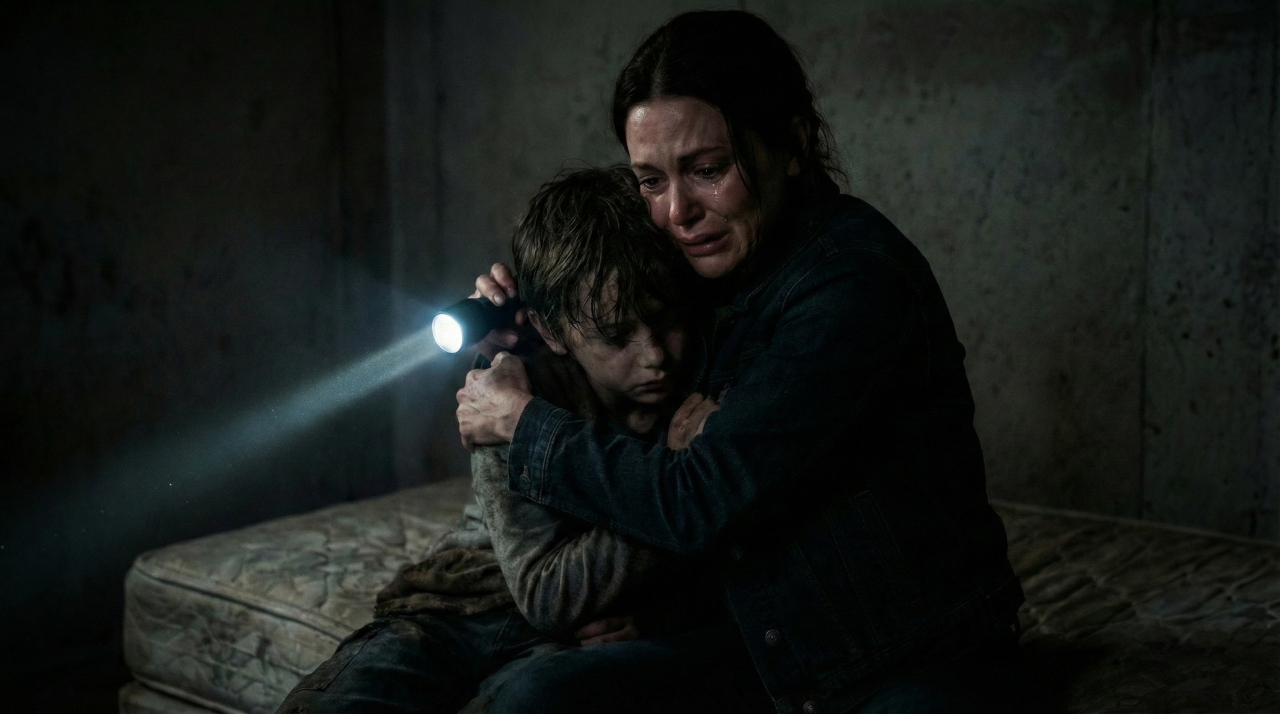
Daniel didn’t call ahead.
That was the plan. Show up at the door, see her face, make fifteen years disappear in a single moment. He had the photograph in his jacket pocket — Emma at nine, screwdriver in her fist, grinning like she’d just solved the world.
The estate was perfect. Gates, fountain, white columns, trimmed hedges.
He used his key.
The foyer was silent. Not peaceful — pressurized. The kind of silence that lives in houses where people learn not to breathe too loud.
Then he heard scrubbing.
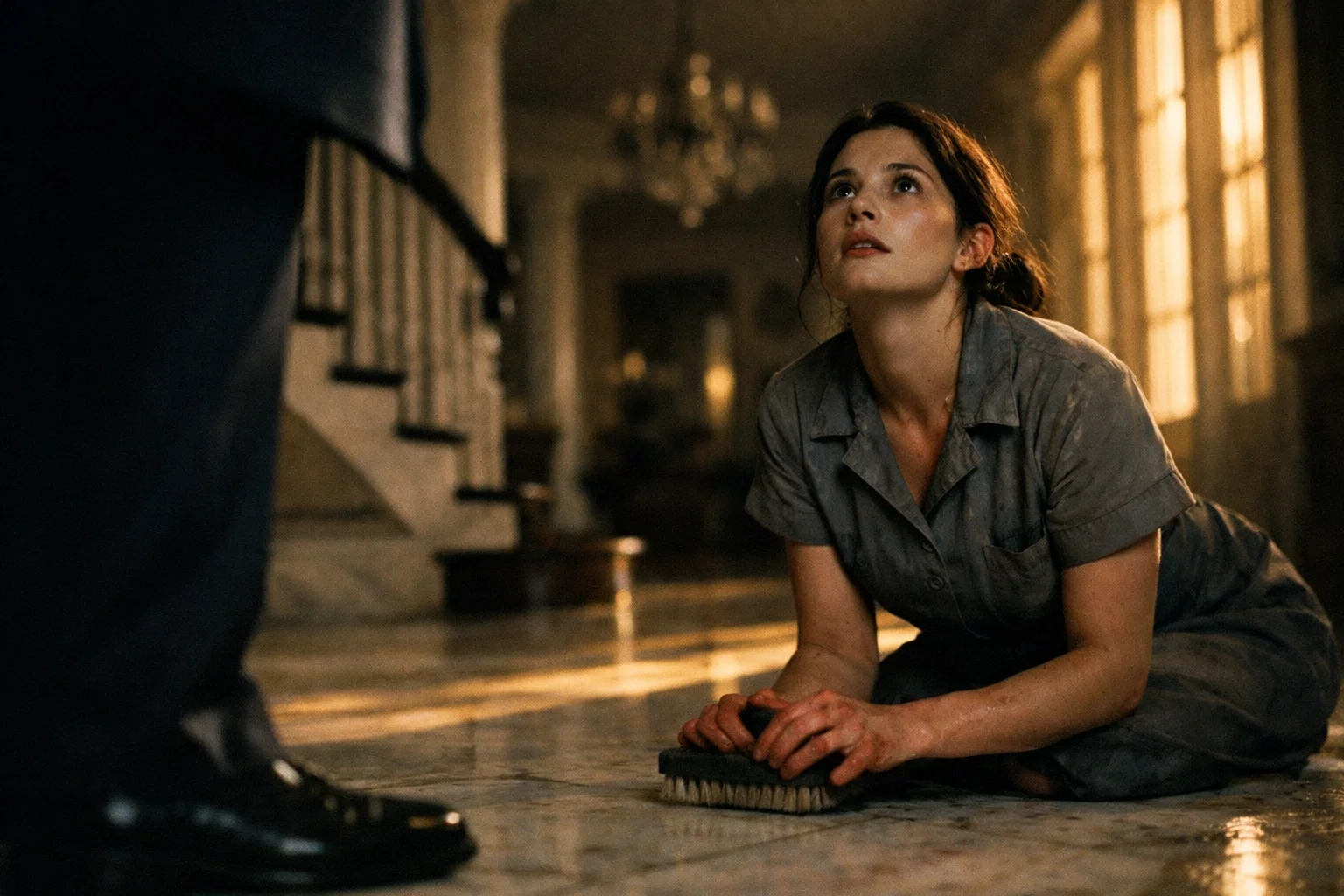
A young woman in a faded gray uniform knelt at the base of the staircase, working a brush against marble with her whole body. Sleeves rolled up. Hands raw. A strand of dark hair stuck to her cheek.
She looked up.
The bucket nearly went over.
“Dad?”
He couldn’t speak for a full second. “Emma.”
She was twenty-four now. Her eyes were the same — bright, sharp, the exact eyes he’d kissed goodbye outside the departure gate — but something behind them had gone very quiet, like a room where the furniture had been removed.
He stepped forward.
Rachel appeared.
She came out of the living room with a glass of red wine, cream silk loungewear, hair arranged like she’d been expecting a photographer. Her smile arrived half a beat late.
“You’re back early,” she said, with a practiced little laugh.
She moved between him and Emma.
That was the moment. That small, automatic placement of her body. That was when Daniel understood everything without knowing anything yet.
He looked past her at his daughter, still kneeling on the floor.
He saw the bruise-shadows on her forearms. He saw the flinch when Rachel shifted her weight. He saw a young woman who had learned to make herself small inside her own home.
He took out his phone.
“Daniel, don’t be dramatic—”
He dialed his attorney. “Start the investigation. Now.”
Rachel’s wine glass stopped halfway to her mouth.
“Investigation.” Her voice flattened. “What on earth are you—”
“Be quiet.”
He had never said that to her in his life. The words came out so cleanly they surprised even him.
Rachel went still.
He crossed to Emma and crouched to her level. Her knuckles were white around the wet rag.
“You don’t have to scrub another floor,” he said. His voice shook slightly. “You don’t have to do anything except tell me the truth.”
Emma’s eyes filled. She looked at Rachel once — a reflex, quick and terrified — then back at him.
“She did this to me,” Emma said quietly. “All of it.”
Rachel set her glass down on the side table with a sharp click.
“I gave her structure,” she snapped. “You have no idea what I dealt with. The moods, the defiance, the obsessive tinkering. Someone had to teach that girl what the real world looks like.”
“This house is hers,” Daniel said.
Rachel smiled. It was not a warm smile. “Not anymore.”
He stood slowly.
She crossed her arms. “When you left, you signed a temporary guardianship. Smart man, terrible father. When Emma was seventeen and going through one of her episodes — yes, episodes, Daniel, ask her — I petitioned for extended financial oversight. She signed documents. There were evaluations. Witnesses. Amendments. Transfers.” She tilted her head. “Your lawyers overseas barely blinked because the trust kept paying and all communications came through authorized channels.”
Emma’s face had gone white.
“What documents?” Daniel asked.
Emma’s voice was barely above a whisper. “She told me they were school forms. Then medical paperwork. She said if I refused to sign, they’d say I was unstable and take me away.”
“Legally,” Rachel continued, as if discussing weather, “she transferred operational control. I established management rights under a family protection clause.” She smiled. “You built an empire, Daniel. You just forgot to watch who was minding the house.”
Sirens drifted in from somewhere down the road.
Rachel heard them. Her eyes sharpened.
“Go ahead,” she said. “Call the police. Everything here is documented, filed, and airtight.” She stepped closer. “But while we’re all being honest — ask her about the fire.”
Emma made a strangled sound. “Don’t.”
“What fire?” Daniel said.
Rachel’s smile stretched.
“Tell him,” she said softly. “Tell Daddy what you did when you were fourteen.”
Emma’s whole body was shaking now. But she didn’t look at Rachel. She looked at her father.
“I was in the workshop,” she said. “Mom’s old workshop, off the east wing. I was building a motor from scrap parts. Rachel told me not to touch anything in there, but the backup generator had been broken for months and I thought if I fixed it—” She stopped. Steadied herself. “I crossed the wiring. There was a spark. A curtain caught. It wasn’t big — I put it out — but Rachel said if anyone found out, they’d say I was dangerous. That they’d take the house. Take me.”
“That’s when the instability started,” Rachel said pleasantly.
“No,” Emma said, and her voice came out louder than she intended. “That’s when you locked the workshop.”
Daniel looked at his sister.
Emma pressed on, trembling but standing now. “Mom left me her tools. Her whole kit from college — circuit boards, measuring instruments, engineering notebooks. Rachel burned some of them after the fire.” Her voice cracked. “Then she said I had to earn back the right to touch anything mechanical. She pulled me out of my classes. She told every tutor I hired that I was disruptive. She told me you were ashamed of me and that’s why you never called.”
The question came out of him like a wound. “Why?”
Rachel looked at him for a long moment.
When she spoke, everything else fell away.
“Because I was the one who stayed.”
She didn’t shout. She didn’t need to.
“I stayed while you built your empire. I listened to your daughter ask about you at every birthday, every Christmas, every recital you missed. I watched wire transfers arrive with more zeros than feeling. I lived inside the shadow of a child everyone adored and a dead woman no one ever stopped mourning.” Her voice went flat and final. “You put the life I should have had in my hands and called it a favor. So yes. I took what I could.”
The front door rattled. Police. Attorneys.
No one moved.
Then Rachel said, almost lazily, “Of course, before they come in — perhaps Emma should tell you what was in her mother’s notebooks.”
Emma looked up sharply.
“What notebooks?” Daniel said.
Rachel’s eyes glittered. “Claire wasn’t just an engineer before she got sick. She was brilliant. Logistics-routing compression. Inventory prediction models. Shipping optimization systems years ahead of anything on the market.” She let that settle. “Sound familiar? It should. That work is the foundation of every major breakthrough Whitmore Global made in the last decade.”
The room tilted.
Daniel’s wife, Claire, had been an engineer. He had always said she inspired him. He had never imagined—
Emma’s voice was barely audible. “I found her notebooks when I was thirteen. I could understand parts of them. I started sending ideas to your private email — the one you always used with me. Rachel told me you never answered because you didn’t care about me anymore.” She swallowed hard. “But I kept sending anyway. It made me feel close to Mom. I improved the models. I was alone and I needed something to—”
She stopped.
“One day Rachel printed some of the files. After that, she stopped letting me use the computer by myself.”
Daniel stared at his sister.
Rachel smiled faintly, without shame.
The door opened. Officers entered. Attorneys behind them. Footsteps on marble.
But Daniel only heard Emma’s last sentence.
“I thought you got rich because of Mom’s ideas,” she whispered. “But it was both of us, Dad. I kept building on her work for years, sending it into the dark, thinking you’d never even read it.” Tears ran freely down her face. “You didn’t build the empire for me. Mom and I built it for you.”
The truth arrived harder than any blow.
All of it — the routing innovations, the efficiency breakthroughs, the “anonymous consulting materials” his executives had praised as miraculous — had not been miracles. They had been Claire’s unfinished genius and Emma’s stolen mind, harvested and fed to him through the hands of the woman who had spent fifteen years turning his daughter into a servant inside her own home.
Rachel hadn’t merely taken the house.
She had taken Emma’s life and sold her intelligence back to her father, one wire transfer at a time.
The officers moved in. Rachel’s composure finally cracked — she screamed, pulled back, cursed them all as they guided her toward the door, still insisting it was documented, still insisting she was owed.
No one listened.
Daniel looked at Emma.
She stood in the center of the foyer — the marble floor, the curved staircase, the chandelier casting cold light across her raw hands — and for the first time since he’d walked through the door, she wasn’t flinching.
He crossed to her and held out his hand.
She looked at it for a moment.
Then she took it.
Three months later, Rachel was charged with elder financial abuse statutes extended to dependent adults, fraud, forgery, and coerced document signing. She was convicted on all counts. The financial oversight transfer was nullified. The house reverted fully to Emma.
Daniel dissolved the holding structure Rachel had built and restructured the company’s intellectual property records to formally credit Claire Whitmore’s foundational designs and Emma’s derivative engineering work. Emma was named Chief Innovation Officer of Whitmore Global at twenty-four.
She rebuilt her mother’s workshop, cabinet by cabinet.
On the day it was finished, she called her father.
“Come see it,” she said.
He was on the next flight.
Original fictional stories. AI-assisted creative content.