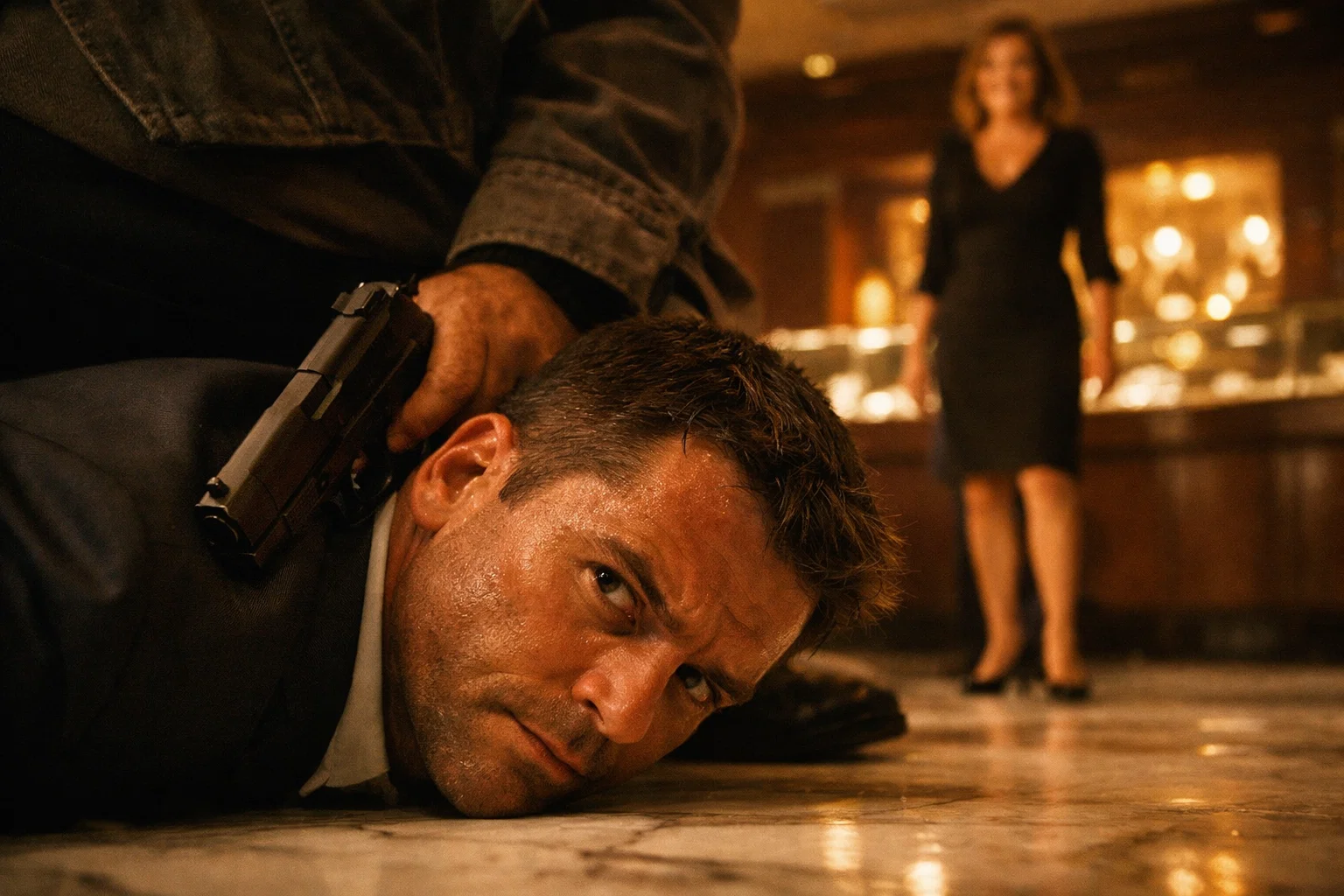
The cold marble floor pressed against my cheek like a slab of ice.
I could feel his knee — heavy, deliberate — pinning me down. The barrel of his gun grazed the back of my neck so lightly it almost felt polite. Like a greeting. Like he was checking to see if I was still breathing.
I was.
I was thinking about Mariana.
Out of the corner of my eye, I saw her heels. Black. Expensive. The ones I’d watched her pick out last Christmas when I handed her a bonus check she cried over.
She wasn’t moving.
She wasn’t shaking.
Her posture was the posture of someone watching a plan come together exactly the way they’d drawn it up.
When I risked tilting my head half an inch, I caught her face.
That smile.
Not fear. Not guilt. A slow, curled sneer — the face of someone who had been waiting a long time to see this.
“Please,” she said to the gunman, her voice perfectly soft. “Don’t hurt him. He’s just a customer.”
She was already in character.
I’d hired Mariana five years ago on a Thursday afternoon.
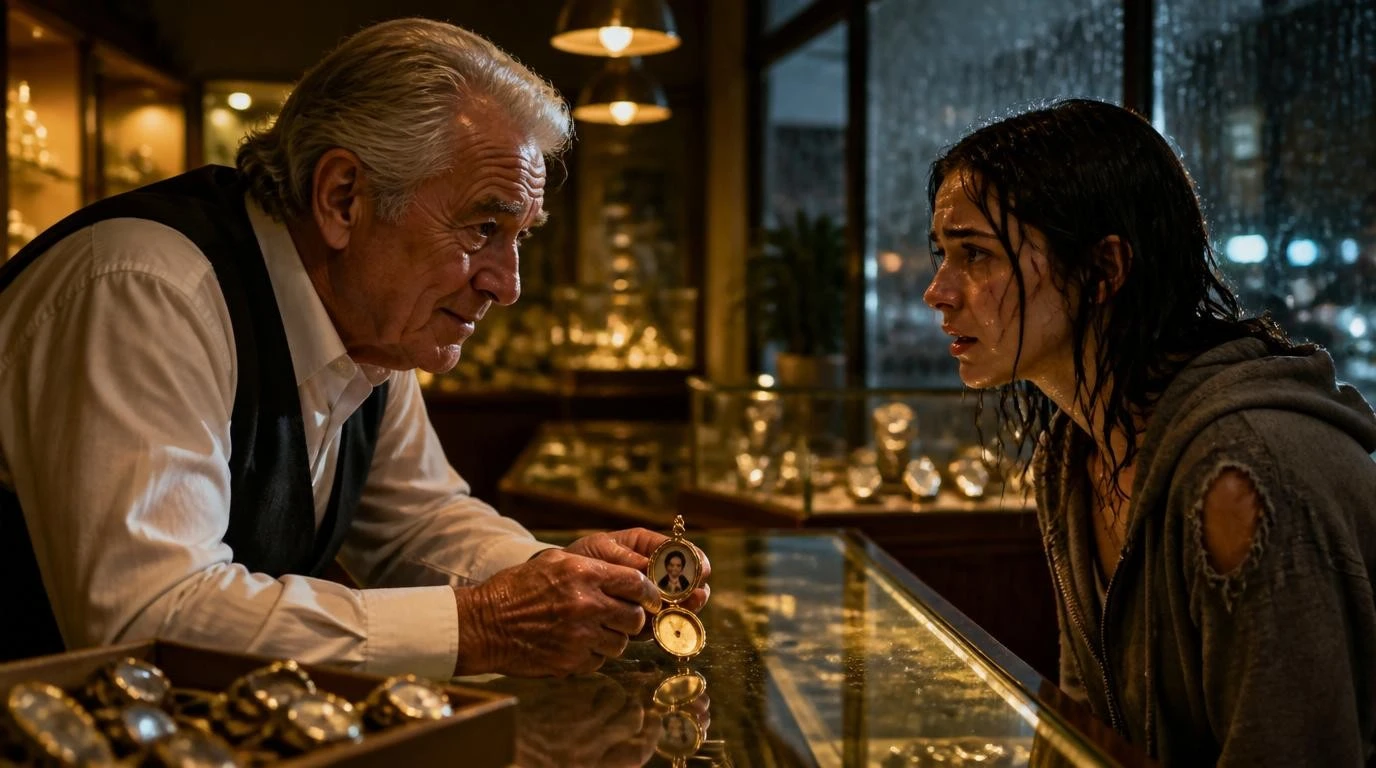
She’d shown up at my office in a coat that was too thin for November, holding a folder of references in hands that wouldn’t stop trembling. She told me she was three months behind on rent. She told me her mother had a heart condition and the medication cost more than she made in a week.
I hired her on the spot. I lent her the money. I never asked for it back.
For three years, she was the best employee I’d ever had. She knew every piece in the store by name. She remembered clients’ anniversaries, their kids’ birthdays, what metal their wives preferred.
Then the inventory started lying.
It was small at first. A gold chain. A mid-range engagement set. A pair of earrings that should have been in the case but weren’t.
“System glitch,” Mariana said. “I’ll look into it.”
“Vendor error,” she said the next month.
“I think the cleaning crew might have moved things,” she said the month after that.
Each explanation was just plausible enough. Just enough to make me feel like I was the one being paranoid.
But I kept a second ledger. A private one. And by month four, I knew the number. I just didn’t know the face.
So I built a stage.
I hired a makeup artist — the kind who works film sets, the kind who can give you a different nose and a beard that doesn’t budge even when someone kicks you in the ribs.
I bought a cheap suit. I found an old briefcase and had it retrofitted by a private security consultant. I created a character: an eccentric out-of-town buyer, cash-heavy, not too bright, the kind of mark that makes a thief’s mouth water.
Then I called ahead and told Mariana I was heading to a buyer’s conference for three days.
“Hold down the fort,” I told her.
“Always do, boss,” she said.
I walked into my own store forty minutes later.
The prosthetic changed my face entirely. The tinted glasses and the cap finished the job. I put on the accent — a loose, unhurried drawl — and I dropped the briefcase on the counter like it weighed everything.
“I’m looking for something in the two-million range,” I said. “A statement piece. Cash transaction.”
Mariana’s eyes went to the briefcase immediately.
Then she excused herself to “check the back inventory.”
She was on the phone within ninety seconds. I know, because I watched her on the hidden feed from my phone, which I held beneath the counter as if checking messages.
She didn’t call the police.
She called a number that wasn’t in any employee directory.
They came in twelve minutes later.
Two men. One large — the kind of large that fills a doorway — with a gun that he didn’t bother to hide once the door closed behind them. One smaller, watching the exit.
The big one moved fast.
“On the floor. Face down. Don’t look up.”
I went down. I let him put his knee on my back. I let him press the barrel to my neck.
And I stayed calm, because the briefcase was already open on the counter — he’d grabbed it from me on the way down — and in exactly three minutes, something was going to happen that these two men were not ready for.
The smell hit first.
An industrial skunk-grade chemical compound, pressurized, mixed with the kind of indelible red ink that banks use in their dye packs. It detonated from the center of the briefcase with a sound like a firecracker.
I heard the big man shout. I heard something wet and heavy hit the floor.
Then I heard the voice.
Mariana’s voice — coming from a small speaker bolted inside the briefcase lid, looping clean and clear in the empty store:
“I’m going to send them to the slaughterhouse. When the idiots come in, I’ll call the police myself and have them caught with the briefcase. That way I’ll be completely clean.”
Her voice. Her words. A recording I had edited with clinical precision from security footage taken three weeks earlier — a conversation about a different situation entirely, cut and restructured until every word landed exactly where I needed it.
The men ran.
Red-stained, gagging, with Mariana’s voice following them out the door and into the alley.
Mariana’s performance began the moment the motorcycles pulled away.
She dropped to her knees. She hyperventilated. She made the sound of a woman who had just survived the worst moment of her life — raw, gasping, her shoulders shaking with it.
“Oh God,” she choked out. “Oh God, they could have killed us—”
She had her phone out. Trembling hands. Dialing 911 with the practiced urgency of someone who had rehearsed this scene in her head.
“Yes, please hurry. They robbed a customer, they took millions—”
I stayed on the floor.
I breathed.
My ribs ached. The marble was still cold. The smell of her perfume — the same one she’d worn for five years, the expensive kind I knew she bought with money that wasn’t hers — hung in the air over everything.
I stood up slowly.
I dusted off the suit.
I reached up and pulled the fake beard off in one clean motion. I took the glasses off. The cap. I set them on the counter next to the velvet display case that held the real two-million-dollar piece — the one the thieves had completely ignored in their scramble for the briefcase.
Mariana’s back was still to me.
“—send someone right away, please, I’m still shaking—”
“Hang up the phone, Mariana.”
She went still.
The kind of still that isn’t a decision. The kind your body makes before your brain can catch up.
She turned around slowly.
Her phone fell.
I watched the color leave her face — not gradually, but all at once, like a drain opening.
Her eyes locked onto mine and her mouth opened but nothing came out.
“Boss?” she finally whispered.
Her knees buckled. She caught herself on the counter.
“I called the police forty minutes ago,” I said. “Before I walked through the door. They’ve been waiting for my signal.”
She tried to speak. Words started and stopped, started and stopped. She reached for something — an excuse, a prayer, a version of events that could still save her.
“I can explain — I didn’t — it wasn’t supposed to—”
“I know what it was supposed to be,” I said. “I designed it.”
The sirens arrived four minutes later.
I heard them pull up outside before I saw the lights — two patrol cars and a third vehicle, unmarked, belonging to the inspector I’d briefed two weeks ago.
They came in with their hands ready and their eyes moving.
Mariana didn’t run.
She stood in the center of the store with her arms wrapped around herself, makeup tracked down her face, shaking in a way that was finally, genuinely real.
An officer moved toward her with the cuffs already out.
“Mariana Voss?”
“Yes,” she said. Barely audible.
Three blocks away, the situation in the alley had not gone well for the two men.
When the briefcase opened — when the ink exploded and the smell hit — they had panicked. Red-soaked, blinded for thirty seconds, retching on the asphalt, they’d heard Mariana’s looping voice telling them that she had set them up from the beginning.
By the time the police turned into the alley, both men were on their knees.
Not running. Not fighting.
Shouting.
Shouting Mariana’s name, shouting that she was the one who had planned all of it, that she’d fed them every detail of every job, that she’d handed them a list of which stores were understaffed and when — not just mine, but six other businesses across the city spanning eighteen months.
They offered to testify. They were practically begging to testify.
They wanted to watch her go down.
I watched them put the cuffs on her from the doorway of my store.
She looked back at me once, just before they walked her to the car. Her eyes were still searching — still looking for the version of me that used to hand her bonus checks and ask about her mother.
That version of me had died four months ago, standing in a back room with a ledger that didn’t add up.
“I trusted you,” I said.
That was all.
She got in the car.
The glass replacement cost eleven thousand dollars.
The cleaning crew worked through the night on the marble. One of the display cases was cracked from where the big man had grabbed the counter on his way down, and a velvet display pad was ruined by a bootprint.
By morning, the store looked like itself again.
Six months later, sentencing was handed down.
The two men received seven years each for armed robbery, aggravated assault, and a string of related charges the DA’s office had been building for a year.
Mariana received eleven.
The judge cited the sustained breach of trust. The deliberate, calculated nature of the betrayal. The fact that she had not only stolen from an employer who had helped her at her lowest point, but had arranged for that same employer to be held at gunpoint — and had stood in the same room and watched it happen, smiling.
Her accomplices’ testimonies had been extensive.
And damning.
And delivered with a fury that only comes from people who believe, in their bones, that they were the ones who got betrayed.
I sat in the courtroom for the verdict.
I didn’t feel satisfaction exactly. Not the clean, bright kind.
What I felt was more like the end of a long headache. The kind you’ve had so long you forgot what it felt like not to have it. And then one morning it’s gone, and the absence itself is the thing you notice.
I thought about the woman who’d walked into my office in November, shaking, holding her references with both hands.
I thought about what I’d seen in her then — determination, gratitude, someone who knew what it meant to be helped when you needed it.
I hadn’t been wrong about what I saw.
I’d just been wrong about how long it would last.
My new head of staff is a twenty-four-year-old named Derek who triple-checks the inventory every Friday afternoon and leaves me a typed summary on my desk before he goes home.
He asked me once, a few months in, why I kept such a detailed separate ledger in addition to the store system.
I thought about it for a moment.
“Because the system can be wrong,” I said. “And it’s better to know early.”
He nodded like that made sense to him.
It does.
There’s a two-million-dollar piece still sitting in its velvet case in the center of the main display.
The thieves never touched it.
In all the chaos — the gun, the floor, the briefcase, the escape — they never once looked at it.
They were so focused on what they thought they were getting that they walked right past the thing that was actually worth something.
I’ve thought about that a lot.
Original fictional stories. AI-assisted creative content.