Victoria Lawson didn’t walk into a room. She arrived. And when she arrived, every head turned, every whisper died, and every camera found her face like sunlight finds a mirror.
Tonight was no different.
The Grand Hall was packed. Five hundred seats at five hundred dollars each. Two million viewers streaming live from their couches. “Voices for Hope” — a charity gala for children with heart conditions. Victoria’s name was on every banner. Her face was on every screen. Her voice was the reason people opened their wallets.
She stood backstage, adjusting her earpiece, scrolling through her phone. Her manager, Doug Fenton, hovered behind her like a nervous shadow.
“We’re at 1.9 million concurrent,” he said. “Biggest stream yet.”
“Good.” She didn’t look up.
“The duet with Marcus Cole is at nine-thirty. Don’t forget the key change in the bridge—”
“Doug.” She lowered her phone. “I wrote that bridge. Don’t tell me how to sing it.”
He raised both hands. “Just making sure.”
She smiled, the kind of smile that meant the conversation was over. Doug disappeared.
Out in the hall, a janitor named Jack Davis pushed a mop across the marble floor behind the stage curtain. Thirty-two years old. Divorced. One daughter — Lily, age six, currently asleep at his mother’s apartment across town. He wore an oversized uniform with “GH Facilities” stitched on the chest. Yellow rubber gloves. A rag draped over one shoulder.
He wasn’t supposed to be here tonight. His regular shift was mornings. But Eddie, the night guy, had called in sick, and Jack needed the overtime.
“Forty-two bucks an hour for holiday rate,” his supervisor had said. “You in?”
“I’m in.”
So here he was, mopping floors while crystal champagne glasses clinked twenty feet away. He didn’t mind the work. He minded the invisibility — the way people looked through him like he was a smudge on glass.
But Jack had a secret. Not the dramatic kind. The quiet kind. The kind that lived in the back of his throat every time music played.
He’d been a singer once.
Not famous. Not rich. But real. He’d studied vocal performance at the University of Michigan on a full scholarship. Baritone with a freakish upper range — his professor once said his passaggio was the cleanest she’d heard in twenty years. He’d sung in recitals, competitions, even a few small clubs in Detroit.
Then life happened. His father got sick. The bills piled up. He dropped out at twenty-three to work full-time. By twenty-five, his father was gone and so was the music. He picked up maintenance work, then custodial. The singing stayed inside him like a locked room he never opened.
Until four hours ago.
He’d been cleaning near the stage while the band rehearsed. Victoria was running through “Higher Ground” — her signature hit, the song that had made her a household name. The one with the legendary C6 in the final chorus. Music critics called it “the note that sold ten million records.”
Jack stopped wiping the railing and listened.
The lower register was flawless. Victoria’s tone was rich, controlled, professional. But as the melody climbed, something changed. She tensed. Her shoulders lifted. Her neck stiffened.
And when she reached for the C6 — her voice cracked. Not dramatically. Subtly. A half-step flat, covered quickly with a cough.
Jack’s eyes narrowed.
She tried again. Same result. This time, she waved the band off.
“We’ll just use the track for that part,” she told the sound engineer.
“Same as the last twelve shows?” the engineer asked.
Victoria shot him a look that could’ve cut steel. “Did I stutter?”
The engineer went quiet. Jack went back to mopping. But the information sat in his brain like a splinter.
She was lip-syncing the high note. Had been for a while.
Now, four hours later, the gala was in full swing. Jack was backstage, finishing up the green room when he heard Victoria’s heels clicking toward the stage. He kept his head down and pushed his cart into the wings.
That was his mistake — being visible at the wrong moment.
Victoria was mid-stride, radiating confidence, when she spotted him. He was standing near the curtain edge, mop in one hand, bucket in the other, headphones around his neck playing something soft.
She paused. Looked him up and down. A slow scan, like she was reading the menu at a restaurant she’d never eat at.
“What are you listening to?” she asked.
Jack pulled the headphones off. “Excuse me?”
“The music. On your little headphones. What is it?”
“Oh. Uh — Puccini. ‘Nessun Dorma.'”
Something flickered in her eyes. Amusement. Maybe contempt. Hard to tell with Victoria. She turned to her assistant, Rachel, and whispered something. Rachel’s eyes widened, then she grinned.
Victoria walked onstage. The crowd erupted.
“Good evening, everyone!” Her voice filled the hall like honey poured into crystal. “Welcome to Voices for Hope. Tonight, we raise our voices — and our wallets — for the children who need us most.”
Applause. Standing ovation. The cameras loved her. The donors loved her. The world loved her.
She performed two songs. Both were stunning. The crowd ate it up.
Then, between sets, she paused. Tilted her head. Let the silence build.
“You know what I love about music?” she said into the microphone. “It doesn’t care who you are. It doesn’t care what you wear, where you come from, or what you do for a living.” She paused. “So let’s test that.”
A murmur rippled through the audience.
“I noticed someone backstage tonight. A janitor. A man who cleans these floors so we can stand on them and feel special.” She let the words land. “And I heard — through the grapevine — that he thinks he can sing.”
Jack’s stomach dropped.
“Hey, you. The janitor in the back. Come out here.”
Five hundred heads turned. The cameras swiveled. Two million viewers leaned in.
Jack stood frozen in the wing, mop still in hand. His heart hammered against his ribs.
“Don’t be shy,” Victoria called, her smile wide and warm for the cameras. “Come on, sweetheart. This is your moment.”
A stagehand nudged him. “She means you, bro.”
Jack set the mop down. His legs moved before his brain caught up. He stepped into the light, and it hit him like a wall — blinding, hot, suffocating.
The audience stared. Some smiled politely. Some exchanged uncomfortable glances. A few phones came up.
Victoria glided toward him, microphone in hand. “What’s your name?”
“Jack. Jack Davis.”
“Jack.” She said it like she was tasting something bland. “Jack, I hear you listen to opera while you mop. That’s adorable.”
A ripple of laughter from the crowd. Not mean, exactly. But not kind, either.
“Tell me, Jack — can you sing?”
He swallowed. “I used to.”
“Used to. Love that. Well, tonight you get a chance to prove it.” She turned to the audience. “Shall we let Jack sing?”
The crowd cheered. Not for him. For the spectacle.
Victoria snapped her fingers toward the band leader. “Play ‘Higher Ground.'”
The murmur became a gasp. “Higher Ground.” Her song. The impossible song. The one with the C6 that no one could hit.
The band leader hesitated, looking at Victoria for confirmation. She nodded once, eyes glittering.
“Give him a mic,” she said to Rachel.
Rachel handed Jack a wireless microphone. His hands shook as he took it.
Victoria leaned close. She reached down and clicked off her own mic with a practiced flick. But Jack’s mic was still live. Hot. Broadcasting to the hall and two million screens.
“Fail in silence, kid,” she whispered.
The words echoed through every speaker, every phone, every television.
The room went dead quiet. Five hundred people stopped breathing. Two million jaws dropped.
Victoria’s face froze. For one flicker of a second — half a heartbeat — something cracked behind her eyes. She hadn’t known his mic was on. But she recovered fast, plastering the smile back on.
“Just a little joke,” she said into her now-reactivated mic. “A little backstage humor. Right, Jack?”
Jack didn’t answer. He stared at her. And in that stare was something she didn’t expect: stillness.
Not anger. Not fear. Stillness.
The band started playing. The opening chords of “Higher Ground” filled the hall — slow, building, like a storm approaching from a distance.
Victoria stepped back, arms crossed, smirk in place. She was waiting for the trainwreck. She was counting on it. The janitor would choke, the audience would laugh gently, she’d rescue the moment with a flawless performance of her own, and the donations would roll in. That was the script.
Jack closed his eyes.
He thought about Lily. About the way she sang in the bathtub — off-key, joyful, fearless. About the way she’d say, “Daddy, why don’t you sing anymore?” And he’d always answer, “Maybe tomorrow, baby.”
Tomorrow never came. Until now.
He opened his mouth.
The first note came out rough. Scratchy. Like a door that hadn’t been opened in years. A few people winced. Victoria’s smirk deepened.
But then something shifted.
Jack found the groove. The second line came smoother. The third, cleaner. By the end of the first verse, his voice had settled into something rich and resonant — a baritone that filled the hall from floor to ceiling without effort, like water finding its level.
The audience stirred. Phones lowered. Eyebrows rose.
Victoria uncrossed her arms.
The chorus hit. Jack’s voice climbed. The melody of “Higher Ground” rose through the middle register, then higher, then higher still. His tone didn’t thin. It didn’t strain. It opened up, fuller and brighter with every step.
A woman in the third row put her hand over her mouth.
Doug Fenton, watching from backstage, dropped his clipboard.
The bridge came. The part where the song pulls back before the final push. Jack softened, letting the band carry the weight, his voice dropping to a near-whisper that somehow reached every corner of the room.
“When you’ve been down so low, the ground becomes your ceiling…”
He sang the lyric like he meant every word. Because he did.
Then the final chorus. The build. The climb.
This was the moment. The C6. The note that had defined Victoria’s career. The note she’d been faking for twelve shows straight.
The band surged. The drums rolled. The hall held its breath.
Jack looked up at the lights. He thought about his father, who used to say, “If God gave you a voice, son, don’t let the world make you a mute.”
He opened his mouth and let go.
The C6 came out like a beam of light — pure, clean, effortless. It hung in the air, sustaining, growing, vibrating through the walls and the seats and the bones of every person in the room.
Five seconds. Ten seconds. Fifteen. He held it like it cost him nothing.
Then he let it go.
Silence.
One second. Two seconds.
Then the Grand Hall exploded.
Five hundred people surged to their feet. The ovation was deafening — not polite applause, not charity-gala clapping, but a roar. Primal. Real. The kind of sound that happens when something genuine cuts through a room full of performance.
Victoria stood frozen at the edge of the stage, her face cycling through expressions too fast to catch — shock, rage, disbelief, and something worse: recognition. She knew. She knew everyone in the room had just heard the difference. The real thing next to the imitation.
Jack lowered the mic. His hands were still shaking. His eyes were wet.
The cameras were on him. All of them.
In the control room, the stream’s chat exploded. Comments flying faster than the moderators could read. “WHO IS THIS GUY?” “THE JANITOR JUST DESTROYED VICTORIA LAWSON.” “Play that whisper back. PLAY IT BACK.”
Because they’d heard it. All two million of them. “Fail in silence, kid.” It was already being clipped, screen-recorded, and uploaded to every platform on earth.
Victoria stepped forward, microphone in hand, ready to take back control. She was a professional. She’d handled worse. She’d spin this.
“Well!” she said brightly. “I think we found a hidden gem tonight! Let’s give it up for Jack!”
She clapped. The audience clapped. But the energy was different now. They weren’t clapping for her generosity. They were clapping despite it.
Victoria turned to the band. “Let me show you how a professional does it. Full band — ‘Higher Ground’ — from the top.”
The band played. Victoria sang. She was good. She was very good. The lower register was perfect, the phrasing immaculate, the stage presence undeniable.
Then the C6 came.
Her throat tightened. Her chin lifted. Her shoulders crept upward.
And the note came out… from the speakers. Perfectly. On pitch. Pristine.
But Victoria’s mouth was a fraction of a beat behind the sound. A fraction most people wouldn’t notice. But tonight, after hearing Jack do it live — raw, real, resonant — the fraction was a canyon.
A woman in the front row frowned. A man near the aisle tilted his head. In the balcony, someone pulled out their phone and started recording her mouth versus the audio.
Victoria saw it. She saw the phones, the squinting eyes, the tilted heads. And for the first time in her career, she felt the room turn.
She finished the song. The applause was polite. Respectful. But thin. Like applause at a funeral.
Backstage, Doug was already on the phone.
“Kill the stream,” he said. “No — I said kill it. Now.”
But it was too late. The internet had already decided.
Within thirty minutes, “Victoria Lawson lip-sync” was trending on four platforms. Within an hour, a sound engineer from her 2019 tour posted a thread: “I’ve been waiting three years to talk about this.” Within two hours, a vocal coach on YouTube had done a side-by-side analysis: Jack’s live C6 versus Victoria’s studio-assisted version.
By midnight, “Jack the Janitor” was the number one search in the United States.
Jack didn’t know any of this. After his performance, he’d gone backstage, put on his gloves, and picked up his mop. A few stagehands patted him on the back. One of them said, “Dude, that was insane.” He nodded, said thanks, and kept cleaning.
Rachel found him in the green room twenty minutes later.
“Victoria wants to see you.”
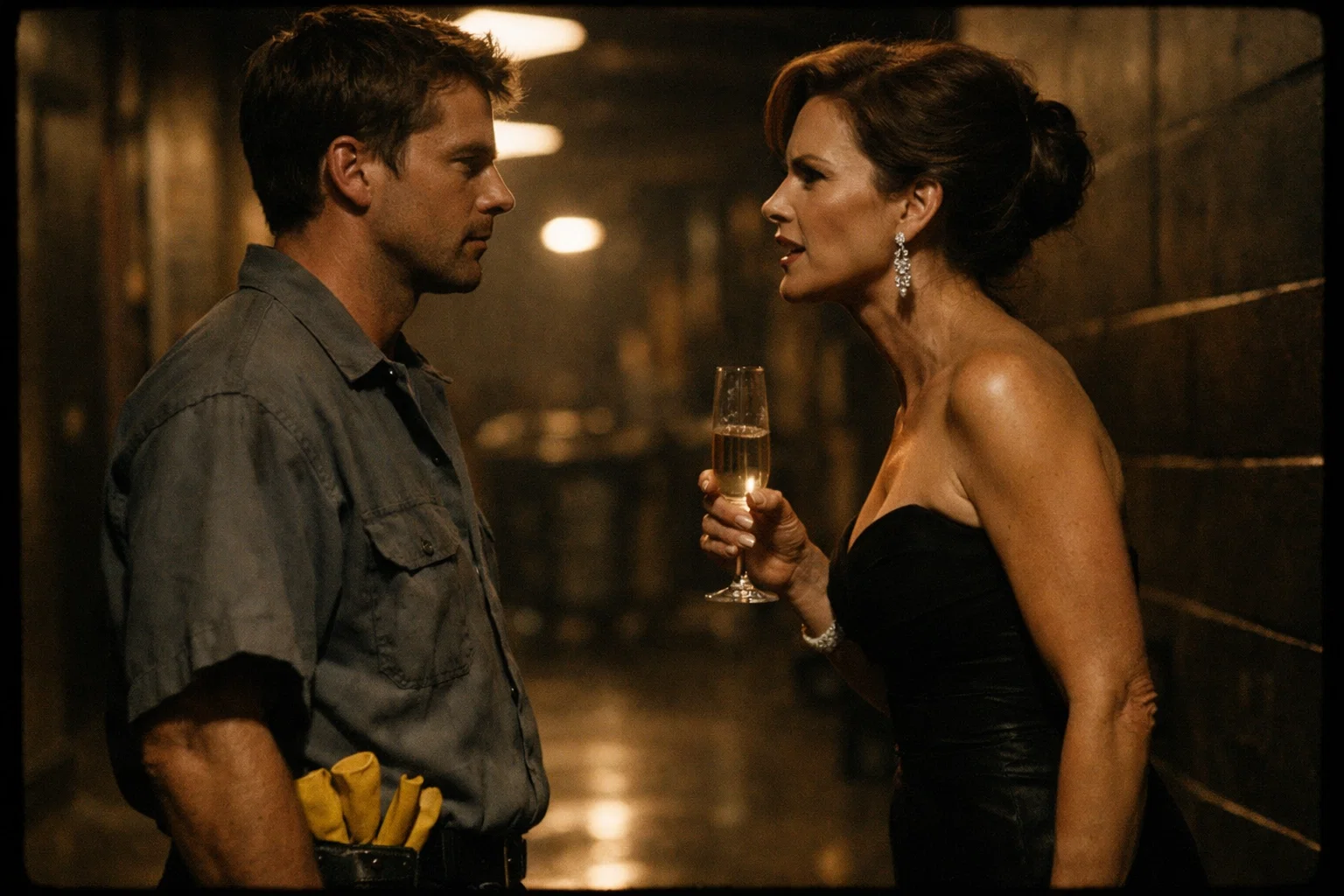
He followed her to a private lounge behind the stage. Victoria was sitting in a leather chair, legs crossed, a glass of champagne in her hand. She wasn’t smiling.
“Close the door,” she said.
Rachel closed the door and left.
Victoria stared at Jack for a long time.
“You think you’re clever?” she finally said.
“No, ma’am.”
“You think embarrassing me on live television is going to get you somewhere?”
“I didn’t embarrass you. You brought me onstage.”
Her jaw tightened. “You were supposed to be the joke. That’s how this works. I bring up the little guy, he fumbles, I save the night, everybody feels good about giving money.”
“That’s a pretty ugly script,” Jack said.
“It works. It raised two million dollars last year.”
“Tonight wasn’t about raising money for you. It was about proving you’re still on top.”
She stood up. The champagne sloshed in her glass. “You don’t know anything about me.”
“I know you can’t hit the C6 anymore.”
The room went cold.
Victoria’s face drained of color. She set the glass down very slowly, as if it might shatter if she moved too fast.
“Excuse me?”
“I was cleaning near the stage during rehearsal. I heard you try it three times. You cracked every time. Then you told the sound engineer to play the track — same as the last twelve shows.”
Victoria’s lip twitched. “You’re lying.”
“I’m not. And now two million people know the difference, because they heard the real thing right before the fake one.”
She stepped toward him. Her eyes were burning. “Do you have any idea what I can do to you? One phone call and you never work in this city again. Not as a janitor. Not as anything.”
Jack looked at her steadily. “Go ahead.”
“I’ll bury you.”
“You already tried. Onstage. In front of the whole country. And it didn’t work.”
Victoria opened her mouth. Closed it. Opened it again.
Nothing came out.
Jack reached for the door handle.
“For what it’s worth,” he said, “your lower register is beautiful. Always has been. You don’t need the C6 to be great. You just need to stop pretending.”
He walked out.
Victoria stood alone in the room. The champagne went flat. The silence was louder than any applause she’d ever earned.
The next morning, Jack woke up to forty-seven missed calls.
His mother was the first one he answered.
“Jackson Robert Davis, why is your face on the television?”
“Long story, Mom.”
“They’re calling you Jack the Janitor. Channel 4, Channel 7, CNN — you’re everywhere.”
He sat up in bed. Lily was already awake, eating cereal on the couch.
“Daddy, you’re on the iPad,” she said, holding it up.
He looked. It was a clip of him hitting the C6, slowed down and replayed from six different angles. Eighteen million views. And climbing.
His phone buzzed. Unknown number. He answered.
“Mr. Davis? This is Sharon Kessler from Atlantic Records. Do you have a moment?”
He blinked. “I’m eating cereal with my daughter.”
“I understand. Can we schedule a call for later today? We’d like to discuss a recording contract.”
He looked at Lily. She was watching him with wide eyes, milk dripping from her spoon.
“Daddy, are you gonna sing on the radio?”
He smiled. “Maybe, baby.”
“You said maybe means yes when you smile.”
He laughed. “Yeah. I guess it does.”
He put the phone back to his ear. “Ms. Kessler? I’ll call you at noon.”
Two weeks later, Victoria Lawson held a press conference. Not by choice. Her PR team had spent fourteen days in crisis mode, and the internet was not letting go.
“I want to address the rumors,” she said, standing behind a podium, cameras flashing. “Yes, I’ve had some vocal difficulties over the past year. I’ve been dealing with a condition called vocal cord nodules, which has affected my upper range.”
Reporters fired questions.
“Have you been lip-syncing at live performances?”
“Were fans deceived?”
“What about the refund petition?”
Doug stood in the back, rubbing his temples.
Victoria held up a hand. “I made mistakes. I should have been honest with my audience from the start. I was afraid — afraid of losing what I’d built. That’s not an excuse. It’s the truth.”
A reporter in the front row asked, “What about Jack Davis? What do you say to him?”
Victoria paused. Something moved behind her eyes — not the old arrogance, but something heavier.
“Mr. Davis is a remarkable talent. What I did to him onstage was wrong. I tried to use him as a prop, and he turned out to be the realest person in the building.” She cleared her throat. “I’ve reached out to him privately to apologize. Whether he accepts is up to him.”
She stepped down from the podium. The cameras kept flashing.
Jack watched the press conference from his mother’s living room. Lily was at school. His mom sat next to him, arms crossed.
“You believe her?” she asked.
“I believe she’s scared,” Jack said. “That’s not the same thing.”
“She called you a prop on national television.”
“She called me a prop. Then I sang. And the whole country heard the difference between real and fake.” He turned off the TV. “That’s enough.”
His phone buzzed. A text from Sharon Kessler: Studio session booked for Thursday. Sending car at 9 AM. Welcome to Atlantic, Jack.
He read it twice. Then he called Lily’s school and asked to speak with her teacher.
“Hi, this is Jack Davis, Lily’s dad. I just wanted to let you know — she might be a little excited today. Her dad got a record deal, and she thinks that means I’m going to be on the radio.”
The teacher laughed. “She already told the entire class at morning circle.”
He hung up, sat back on the couch, and exhaled.
Three months later, Jack released his debut single. It wasn’t “Higher Ground.” It was an original — a quiet, powerful ballad called “Tomorrow Came.” He wrote it about Lily, about his father, about every morning he woke up and chose to keep going even when the music had gone silent.
It debuted at number four on the Billboard Hot 100.
Victoria’s tour, meanwhile, was quietly canceled. Ticket sales had dropped sixty percent after the gala. Her label didn’t renew her contract. She checked into a vocal rehabilitation clinic in Nashville and disappeared from public life.
Six months after the gala, a package arrived at Jack’s new apartment — a modest two-bedroom he’d rented with his first advance check. Inside was a handwritten note on plain white paper. No letterhead. No logo.
Jack — You were right. I didn’t need the C6. I needed to stop pretending. I’m working on it. — V
He read it once. Folded it. Put it in his desk drawer.
That night, he tucked Lily into bed. She was holding a small plastic microphone she’d gotten from a birthday party.
“Sing me the song, Daddy.”
“Which one?”
“The one about tomorrow.”
He sat on the edge of her bed, cleared his throat, and sang. Softly. Just for her. No lights, no cameras, no audience of millions. Just a father and his daughter in a quiet room, and a voice that had finally come home.
Lily’s eyes closed before the second verse.
Jack pulled the blanket up to her chin, kissed her forehead, and whispered, “Tomorrow’s here, baby.”
He turned off the light and closed the door.
Original fictional stories. AI-assisted creative content.