JFK Terminal 4 moved fast. Gavin Mercer moved faster — and louder.
He was a senior managing director at a Manhattan private equity firm, the kind of man who wore tailored coats like armor and regarded inconvenience as a personal insult delivered by the universe. He was forty-four, trim, with the practiced authority of someone who had spent twenty years being told he was right. His shoes were polished. His tone was not.
By the time he crossed the terminal threshold that afternoon, he’d already left a trail.
A check-in clerk had flinched when he dropped his passport on her counter without greeting. A glass lounge door had bounced hard off its stopper when he shoved it open. An elderly man pulling a carry-on had stumbled sideways trying to get out of Gavin’s path, and Gavin hadn’t looked back. Each moment small on its own. Together, they formed a pattern every airport employee recognized: the man who believed money was a substitute for manners.
He entered the premium lounge and went straight to the desk.
“Confirm seat 1A,” he said, setting his passport down with a slap. “International departure. Now.”
The lounge supervisor, Elaine Porter, had been doing this job for eleven years. She had a voice trained for de-escalation and eyes that catalogued behavior within seconds. She looked at Gavin Mercer once and knew exactly what she was dealing with.
“Good afternoon, sir,” she said. “I do need to let you know — seat 1A is already assigned. The cabin is very close to full, but I’m happy to check on other first-class availability—”
“I don’t take other options.”
“Sir—”
“I take 1A.”
Elaine kept her expression neutral. “The seat is occupied, sir.”
His gaze followed hers without thinking. By the window, on the far side of the lounge, a man sat alone. He was Black, in his early fifties, broad through the shoulders, wearing a dark blazer over a light shirt with the collar open. A boarding pass rested on the table beside an untouched coffee. He was reading from a tablet, scrolling slowly, completely absorbed — the picture of someone who had reached the lounge early, settled in, and had no intention of being disturbed by anything.
He looked composed. Self-contained. Utterly unaware that he was being watched.
That alone made something tighten in Gavin’s chest.
He crossed the lounge without invitation.
“You’re in my seat.”
The man looked up once. His eyes were calm, direct. “No. I’m in mine.”
“I always fly 1A.”
“Sounds like a personal tradition,” the man said, and returned to his tablet without another glance. “Not my problem.”
Travelers nearby had started looking up. Elaine was already moving. Gavin didn’t give her time.
His voice climbed. He said the airline needed to fix this problem immediately. He said he had paid a price that entitled him to a specific experience and a specific seat. He looked at the man seated before him — at his composure, his stillness, the small way he continued scrolling as if this conversation were background noise — and something ugly broke through. The insult he delivered was not subtle. It was blunt-force and deliberate, loaded with implication that had nothing to do with a seat assignment and everything to do with who he believed should be sitting there.
The man set his tablet down.
He folded his hands on the table. Looked at Gavin with the measured patience of someone who had heard this kind of thing before and was no longer interested in pretending it was surprising.
“You should step back,” he said.
Gavin leaned closer. “Who exactly do you think you are?”
The man held his gaze without blinking. “My name is Colonel Adrian Cole.”
Gavin gave a short laugh. “Colonel. Right.”
Security was called. Gavin talked through the entire escort — threats of lawsuits, promises of ruined careers, commentary about the airline’s failure to serve its most valuable clients. His voice carried all the way to the lounge exit. The door closed behind him.
Staff exhaled.
Elaine caught the eye of a colleague across the desk and gave a small shake of her head.
They thought it was over.
They were wrong.
At the gate, Gavin stopped cold.
Colonel Adrian Cole was already seated. Row 1A. Jacket folded over the armrest. Tablet open. Coffee in hand. He looked like a man who had been waiting ten minutes for a pleasant flight and expected nothing less.
The sight of it hit Gavin like a door swung back in his face.
His jaw tightened. He stepped through the aircraft door. The first-class cabin was filling — eight rows, quiet conversations, the early-boarding hum of business travelers settling in. And Gavin walked down the aisle, past row 2, past row 3, until he was standing in the open space with a direct line of sight to 1A.
He raised his voice for the entire cabin to hear.
“Get him off this plane.”
The cabin went silent.
No one moved.
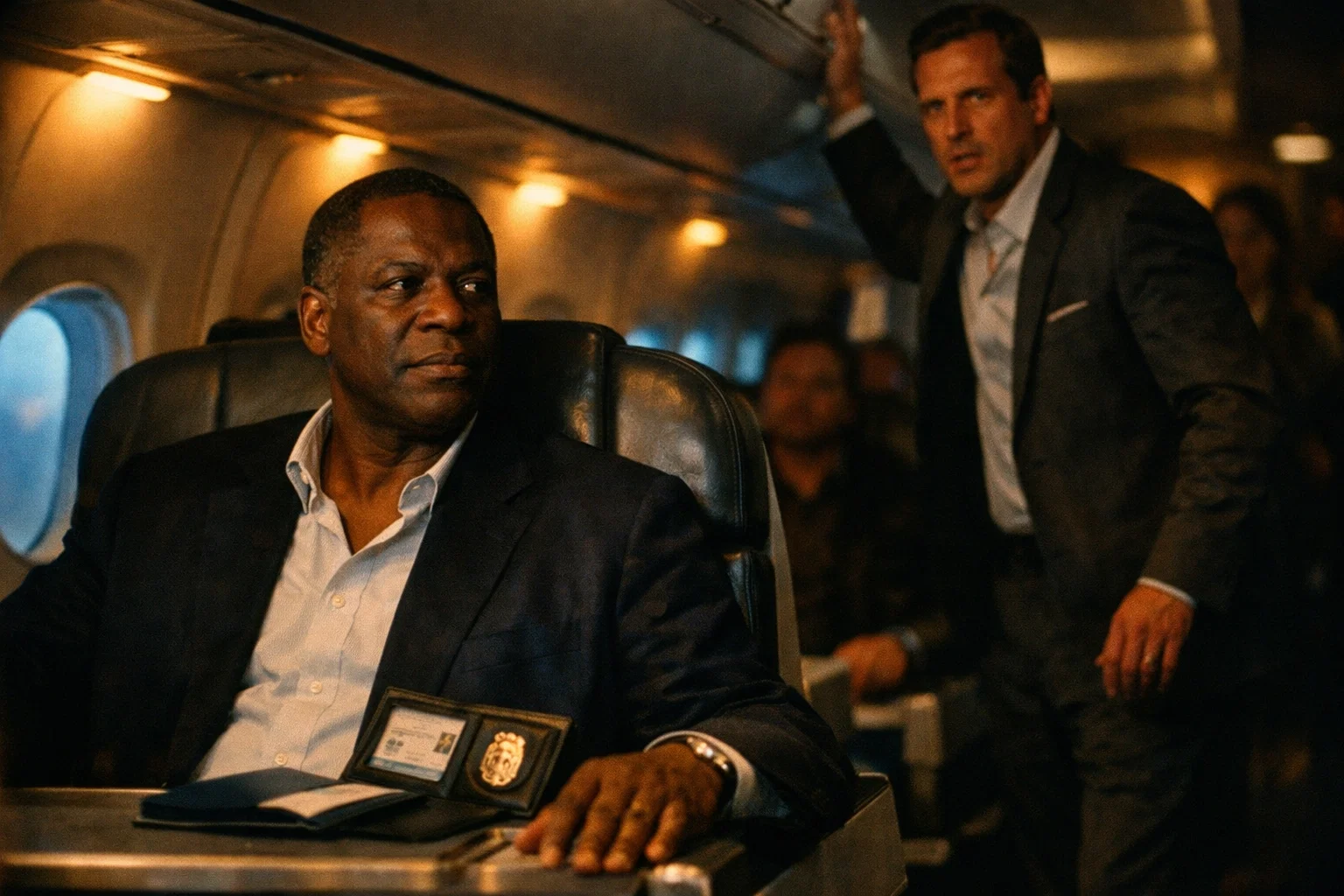
Then Adrian Cole reached into his jacket and opened a slim credential wallet. He held it in one hand, unhurried, and turned it toward lead flight attendant Marissa Dunn, who had been approaching with the carefully managed calm she used for every boarding disruption she had ever managed in twelve years on international routes.
She looked at the credential.
Her posture changed completely.
Shoulders squared. Expression sharpened. She stepped past Gavin as if he had ceased to be the relevant party in the room. She reached for the interphone, lifted it, and spoke.
“Captain to the front cabin. Now.”
Gavin’s smirk slipped.
He looked at the other passengers. A younger couple in row 2 exchanged glances. A businessman in row 3 slowly folded his newspaper. Two flight attendants near the galley had frozen mid-motion, watching without the polite pretense of looking elsewhere.
Something had shifted. Everyone felt it.
“This is a safety issue,” Gavin said, louder than he needed to. “That man harassed me in the lounge. He’s been targeting me since—”
Nobody responded.
Adrian sat still. Hands rested on his armrests. He was looking forward, not at Gavin, not at the crew. He looked like a man waiting for the aircraft to push back — patient in the way that isn’t passivity, but practiced control.
Captain Robert Hensley came through the cockpit door within thirty seconds.
Marissa handed him the credential wallet without explanation. He opened it, read the contents once, then again, then closed it carefully. When he looked at Adrian Cole, it wasn’t the courtesy he extended to premium passengers or the mild patience he offered difficult ones. It was the calibrated respect of a professional recognizing someone with institutional authority he had not expected to find in seat 1A.
He stepped to Adrian and spoke quietly enough that only the first two rows could hear.
“Sir. Would you prefer we deplane him now?”
That was the moment Gavin understood he was no longer in control of what happened next.
He tried to laugh. “This is insane. I’m the one being threatened. This whole thing is a setup—”
Adrian spoke.
He didn’t raise his voice. He didn’t look at Gavin when he said it. He spoke to the captain, clearly, the way someone gives a formal statement.
“Captain, before any action, I’d suggest you ask your crew what occurred in the lounge, what happened at the gate, and why this passenger filed a verbal safety complaint against me immediately after failing three separate attempts to have me removed from my assigned seat.”
The words were unhurried, factual, and hit the room harder than anything Gavin had shouted all afternoon.
Hensley turned to Marissa. “Did he make a threat?”
Marissa’s voice was steady. “No, Captain. Mr. Mercer is the one escalating. Same as in the lounge and at the gate.”
Gavin turned left, turned right. He looked at the passengers in the nearest rows. No support. No sympathy. A few faces had gone openly blank — the expression of people watching something unfold that they want no part of but cannot stop watching.
Hensley handed the credential back to Adrian and turned to face Gavin directly.
“Sir. You need to step out of the aisle immediately.”
Gavin drew himself up. “Do you have any idea who I am?”
Adrian spoke before the captain could answer.
“That’s been your problem since this morning,” he said. “You believe that question matters more than your behavior.”
The silence that followed was long enough to be uncomfortable for everyone in the cabin except the man who had caused it.
Captain Hensley addressed the first-class cabin in measured, precise terms.
Colonel Adrian Cole was a retired Air Force officer, currently serving as Director of FAA Airline Compliance and Operational Conduct Review. He was traveling on a mixed personal-official itinerary. He was not there to issue orders to crew or override operational command. But any documented incident involving safety violations, discriminatory conduct, boarding interference, false threat reporting, or crew compliance failures on a flight where he was present fell within the review scope of his office.
Every incident.
Every document.
Every witness account.
Gavin’s face had gone from red to pale.
He had not merely insulted a passenger. He had targeted, harassed, threatened, and falsely accused a senior federal aviation compliance official — in front of a full crew, a cabin of witnesses, terminal staff, and multiple active security cameras — after already creating documented disturbances inside a controlled international terminal.
Adrian looked at him with the same expression he had worn since the lounge.
“I told you to breathe,” he said. “You mistook restraint for weakness.”
Captain Hensley made his decision.
Gavin Mercer would be denied transport. The grounds: passenger disruption, repeated interference with boarding operations, submission of a false onboard safety claim, and refusal to comply with crew instruction across multiple points of contact.
Marissa signaled the gate.
What followed was noise.
Gavin went loud in the way people do when they know the argument is lost — not to change anything, but because silence would require acknowledging what had just happened. He cited his elite status. He cited his spending with the airline. He threatened personal lawsuits, regulatory complaints, executive-level escalation. He accused Adrian of engineering the entire situation from the lounge — a coordinated setup, a racial grievance manufactured to cost him his flight. He demanded names. Badge numbers. Direct lines to the airline’s vice presidents.
Each demand made the next one sound more desperate.
By the time two Port Authority officers stepped onto the aircraft, the first-class cabin had gone completely silent. Every passenger was listening. No one was pretending otherwise.
One officer looked at Hensley. “Captain — denying transport?”
“Yes,” Hensley said. “For cause.”
“Sir.” The officer addressed Gavin. “Collect your belongings and come with us.”
Gavin didn’t move.
Marissa said — clearly, evenly, loud enough for the front four rows to hear without effort — “His checked baggage will need to be pulled before departure.”
The meaning landed immediately. Pulling checked luggage from an international departure took time, disrupted the gate queue, delayed departure, and was documented in every airline operations log it touched. Everyone in first class knew what it meant. Several had stopped pretending to look at their phones.
The two officers waited.
Gavin finally reached for his bag.
As he was walked back down the aisle and through the aircraft door, he turned one last time. He looked at Adrian Cole, the way a man looks at someone when he wants to carry the moment out with him — to keep it as something personal and unfinished, something that might yet be reversed.
Adrian had already reopened his tablet.
He was reading.
That calm — the absolute absence of triumph, satisfaction, or reaction — frightened Gavin in a way that the whole scene had not. Because it made clear that whatever had just happened was not personal to Adrian Cole. It was not a victory. It was not a confrontation worth his attention.
It was paperwork.
Before the aircraft doors closed, the documentation had already begun to form.
Crew incident reports logged at multiple timestamps. Terminal witness accounts from the lounge, the gate corridor, and the concourse. Security footage from six cameras across two terminal zones. A federal compliance observer’s written incident account. Gate logs with biometric boarding records. A maintenance supervisor’s notation about the lounge door frame.
Gavin Mercer still thought he was having a bad travel day.
He did not yet understand that what was accumulating — quietly, systematically, in the language of official records — would follow him past the terminal, past the city, past the month.
In a private interview room near Gate 42, Port Authority officers explained that formal statements were required. Property damage in the lounge. Physical contact with another traveler near the main concourse. Verbal threats directed at airline employees at two separate points of contact. A potential false safety report filed under onboard incident protocol.
For the first time all afternoon, Gavin stopped talking.
Not because he accepted any of it. But because the situation had grown past the point where volume was a strategy. There were timestamps. There were camera angles he hadn’t thought about. There were witnesses who had no connection to each other and no reason to coordinate. And above all of it, there was Colonel Adrian Cole — calm, present, and precisely aware of which details carried institutional weight.
He gave his statement. He said what he needed to say. He thought about calling his lawyer and decided he should wait until he saw the full scope.
He was right to wait. He had not seen the full scope yet.
Over the following forty-eight hours, the consequences expanded with the efficiency of systems that have been designed specifically for situations like this one.
The airline’s internal security division reviewed lounge surveillance from four angles. They pulled the gate audio. They cross-referenced crew reports from three separate staff members who had interacted with Gavin before the aircraft incident. Elaine Porter’s formal statement documented the lounge threats in detail. A maintenance supervisor confirmed the cracked door stopper. A business traveler who had been physically displaced near the main concourse provided a written account. Marissa Dunn’s incident report ran eleven pages and was irrefutable on every material point. Captain Hensley’s denial-of-transport certification sealed the operational record.
Then the FAA inquiry opened.
Adrian Cole didn’t call anyone. He didn’t brief anyone informally. He didn’t reach out to media contacts or industry peers. He forwarded the incident package to the proper review channels, the way he would any other documented case involving crew safety, boarding interference, discriminatory conduct, and false threat reporting in a federally regulated environment.
Gavin’s behavior had touched jurisdictions Adrian’s office covered directly. The review moved quickly.
Meanwhile, a video went viral.
A passenger in first class — row 3, window seat — had been recording with his phone from the moment Gavin stepped into the aisle. The footage showed thirty seconds of Gavin pointing at Adrian, red-faced, voice raised, shouting across the first-class cabin: “Get him off this plane.” The identification took less than four hours. Gavin’s firm profile appeared in the first comment thread by midnight. By 6 a.m., Mercer Hale Capital’s main phone lines were ringing with calls from institutional clients, board contacts, and three financial journalists who had already filed information requests.
The firm placed Gavin on administrative leave before noon.
The board convened an emergency session that evening.
Gavin hired counsel by the end of the first day. He had a strategy within twenty-four hours.
He framed the incident as a misunderstanding that had been exploited. He claimed he had genuinely felt unsafe. He argued that his status had been used against him — that the situation had been engineered by a federal official who, for personal or professional reasons, had wanted to create a record. He was prepared to allege that what had happened to him was itself a form of targeted misconduct.
His counsel reviewed the full evidentiary package that evening and called him back at nine o’clock.
The call was short.
Staff testimony from six independent sources. Surveillance footage from a total of nine camera angles across the terminal and gate area. Written accounts from passengers who had no connection to the airline or to Adrian Cole. A detailed timeline beginning at check-in, not at the aircraft door. The false safety claim logged by crew protocol with Gavin’s own words captured on the cabin interphone system. A federal compliance officer’s account that was, by any legal standard, a primary witness document.
There was no narrative that survived contact with that record.
His victim framing collapsed before it reached a draft press statement.
Within a week, Mercer Hale Capital released a statement announcing Gavin Mercer’s resignation. The language was careful: conduct inconsistent with firm values, effective immediately. Privately, the decision had been faster and far less deliberate. Three major institutional clients had reached the firm’s managing partners directly by the third day. Their message was consistent: they wanted distance, and they wanted it before the end of the week. No one managing seven-figure assets wanted those assets associated with a man who had become a documented case study in entitlement, racial aggression, and federal misconduct — verified, time-stamped, and publicly visible to anyone with a phone.
Gavin Mercer was out of the firm he had helped build.
He was out of the industry he had spent twenty years in.
He was, as of that week, professionally radioactive.
Adrian Cole returned to work on Monday without comment.
He gave his regulatory statement. Confirmed the material facts for the FAA review. Responded to two formal inquiries from airline legal and one from airport authority. Declined every media request — there were fourteen in the first week — with the same two-line reply his assistant sent on his behalf.
He had no interest in being the story.
But the story reached the industry regardless.
Six weeks later, at a closed FAA-airline industry roundtable on passenger conduct and frontline staff protection, a senior executive from a major domestic carrier referenced the Terminal 4 incident during the opening session — not by name, but clearly. The phrase used was “the JFK documentation case.” Crew training coordinators at two airlines added a reconstructed scenario to de-escalation curriculum within the month. A terminal operations supervisor in Atlanta cited it by reference in a published safety brief.
None of it happened because Adrian had asked for it. All of it happened because Gavin Mercer had given the industry a clean, documented example of something it already understood and rarely got to examine this clearly: the passenger who believes his status is a shield, who mistakes other people’s professionalism for surrender, who pushes past every off-ramp offered to him — and discovers, at the end of that sequence, that the records have been running the whole time.
Months later, Gavin Mercer had disappeared from public finance circles. His name appeared in whispered contexts — airport lounges where colleagues exchanged cautionary anecdotes, boardroom conversations where his firm’s handling of the situation was referenced as a compliance benchmark. He was not destroyed in any dramatic, cinematic sense. He was simply gone, which in his world was the same thing.
Adrian Cole still flew often. He boarded early when he could, took his seat without drama, opened his tablet, and read until the aircraft pushed back. He didn’t tell the story at dinners. He didn’t reference it in interviews he didn’t give. He moved through airports the way he always had — quietly, correctly, with the practiced ease of a man who understood that authority doesn’t announce itself, and composure is not the same as weakness.
Those who knew the full sequence remembered one thing above all others.
The calmest person in the room is often the one who decides how it ends.
Original fictional stories. AI-assisted creative content.