Jonathan Reeves hadn’t cried in eleven years.
Not at board meetings where he closed billion-dollar deals. Not at the ribbon-cutting of his Manhattan headquarters. Not even at the funeral of his own father, where he’d stood at the graveside in silence and simply squeezed his son’s shoulder.
He thought he’d trained himself out of it.
He was wrong.
The restaurant was called Altura. Forty-second floor, floor-to-ceiling windows, Central Park spread below like a dark green quilt stitched with autumn gold. The kind of place where the sommelier knew your name before you sat down.
Jonathan had reserved the corner table. Quiet. Away from the center of the room.
Noah’s wheelchair fit beside it perfectly—he’d called ahead to check.
“Is the band playing tonight?” Noah had asked three times during the cab ride up.
“They always play on Fridays,” Jonathan told him.
“What if they don’t?”
“They will.”
“But what if—”
“Noah.”
A pause. Then: “Okay.”
They were seated by seven-fifteen. Noah wore his navy blazer—the one with the small anchor on the lapel that he’d picked out himself at a thrift store and refused to let anyone touch. His dark hair was pushed back neatly. He looked, Jonathan thought, like a small person trying very hard to seem casual about being somewhere exciting.
It worked, mostly.
“I like the candles,” Noah said, scanning the room.
“Good.”
“They’re not real wax. They’re LED.”
“I know.”
“Still looks nice though.”
Jonathan smiled. “Yeah. It does.”
Their waitress arrived two minutes later.
She was young—mid-twenties, dark ponytail, dark eyes that moved quickly and assessed everything without making it obvious. Her name tag read: MAYA.
“Good evening, gentlemen.” Her voice was easy, unhurried. She looked at Noah first, not Jonathan. “Are you the one who requested the corner table, or is that him?”
Noah blinked. “Him. But I told him which side I wanted to face.”
“Smart. The park view is better from this angle anyway.” She set down the menus. “Do you like jazz?”
Noah sat up slightly. “Yeah. A lot.”
“Good news. They’re doing Louis Armstrong tonight. Second set starts in about twenty minutes.” She glanced at Jonathan. “Can I start you both with something while you look?”
“Water, please. Still.” Jonathan folded his hands on the table. “Noah?”
“Do you have Shirley Temples?”
Maya didn’t blink. “We do not have a Shirley Temple on the menu.” She leaned slightly forward. “But I know how to make one.”
Noah grinned for the first time all evening.
She was good at her job. Jonathan noticed these things—he’d spent thirty years studying how people operated under pressure. Maya moved efficiently. She remembered orders without writing them down. She refilled Noah’s glass before he thought to ask. And she talked to his son the way people almost never did: like a person.
Not a kid. Not a wheelchair. A person.
Over the appetizers, Noah mentioned that he could recognize most Armstrong songs by the first four notes. Maya stopped beside the table and raised an eyebrow.
“Prove it.”
“You have to hum something.”
She hummed four notes. Low, a little off-key.
Noah tilted his head. Thought for exactly two seconds. “‘La Vie en Rose.'”
“That’s not Armstrong.”
“I know, but it’s what you hummed.”
Maya laughed—a real one, surprised out of her. “Okay. Fair.”
Jonathan watched this exchange and said nothing.
The main course came and went. The band settled in across the room, adjusted their mics, exchanged a few quiet words with each other.
The first notes of “What a Wonderful World” drifted out across the restaurant.
Noah’s hands went still on the table for exactly one second. Then his right index finger started tapping. His left followed. His eyes found the saxophone player and didn’t leave.
Jonathan set down his fork.
He’d seen this before—dozens of times at home, Noah swaying in his chair while music played from the kitchen speaker, conducting an invisible orchestra with a pencil. Always alone. Always in their apartment where no one was watching.
Never here.
He watched his son’s face and felt the familiar ache settle in behind his sternum like a stone.
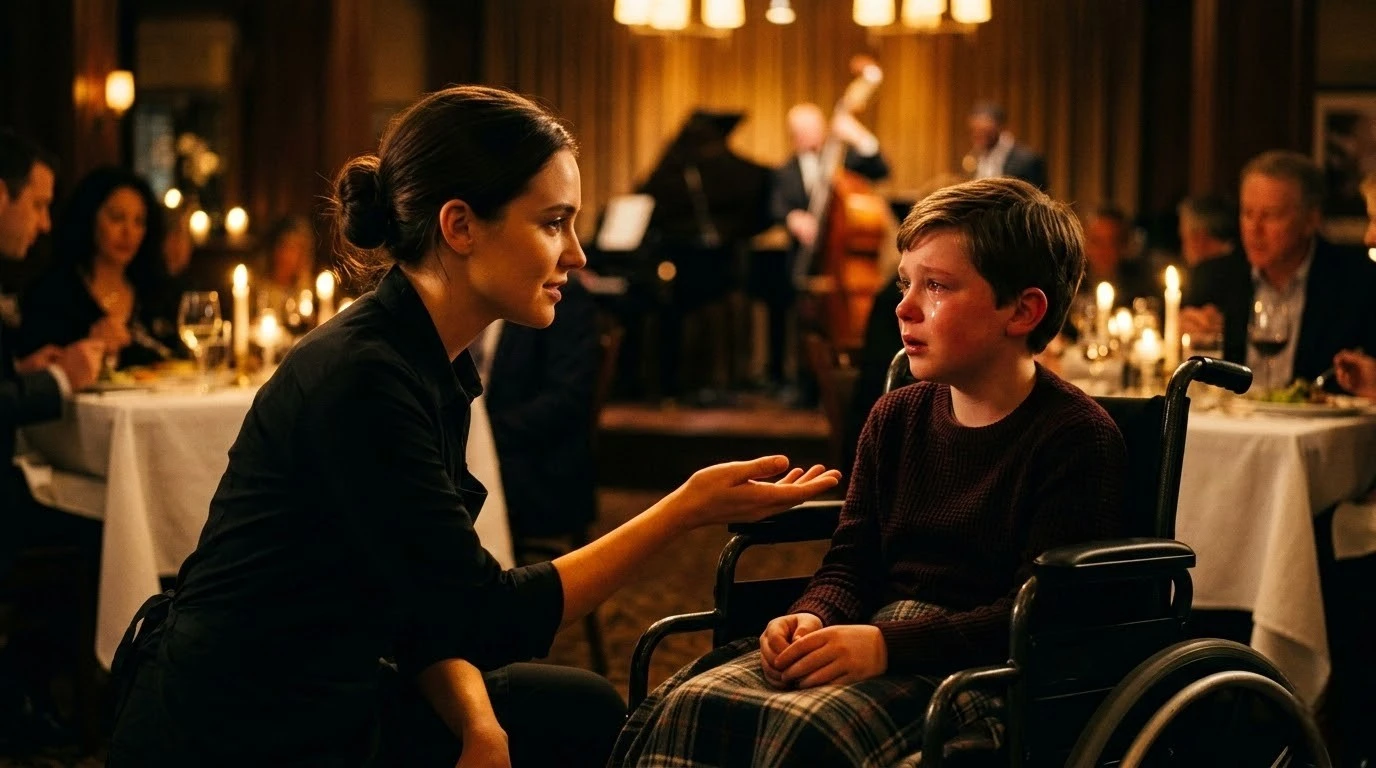
Maya appeared beside the table.
She wasn’t carrying anything. She’d come back specifically.
“Mr. Reeves.” She looked at Noah. “Noah.”
Noah glanced up.
“This song always makes me want to dance,” she said. Her voice was quieter now. Sincere. “Would you want to lead me? From your chair. I’ll follow every move you call.”
The table went silent.
Jonathan looked at her. She wasn’t performing. She wasn’t doing a kindness routine. She was just—asking.
Noah’s cheeks went pink. He looked at his father, then back at Maya.
“Really?”
“Really.”
“I’ve never… I mean—”
“Neither have I, technically.” She crouched beside the chair, placed one hand over his, rested her other hand lightly on the armrest. “But you know this song. I can tell. So you lead. I follow. That’s the whole deal.”
Noah swallowed once.
Then he straightened his spine.
“Okay,” he said. “Left.”
She stepped left.
“Now right. Slow.”
She moved right, slow.
“Spin—half spin—stop.”
She turned, paused mid-turn, held it, let the beat catch up. Her free hand lifted slightly, graceful and unhurried.
“Now back, three steps.”
She stepped back. One. Two. Three.
Around them, the restaurant was still eating, still talking. Then it wasn’t.
One table noticed. Then another. Conversations dropped off in rings, like ripples from a stone. Forks went down. A woman near the window pressed two fingers to her mouth.
Noah didn’t notice any of it.
He was conducting.
“Turn again—full this time. Then come back to me.”
Maya spun fully, her hair catching the candlelight, and stepped back toward the chair with a laugh that came out soft and real.
“You’re good at this,” she told him.
“I’ve been practicing in my head for a long time.”
“It shows.”
Jonathan couldn’t breathe.
He sat completely still, hands flat on the table, and watched his son lead a woman across a restaurant floor with the kind of certainty he hadn’t seen on that face in years.
Not careful confidence—the practiced kind kids learn when adults keep praising them for enduring hard things. Real confidence. The kind that comes from being in charge of something and knowing it.
The stone behind Jonathan’s sternum shifted.
Then it cracked.
He didn’t wipe his eyes. He didn’t have time. They were already wet.
The song ended.
The room applauded—not the polite kind, the quiet scattered clapping of an audience uncertain of the occasion. Real applause. Sustained. A man two tables over stood up. His wife pulled him back down, then stood up herself.
Maya hugged Noah gently.
“You’re a fantastic dancer,” she said. “Thank you for leading me.”
Noah pressed his face briefly against her shoulder.
When he pulled back, his eyes were bright.
“Can we do another one?”
Maya laughed. “I’ve got three more tables waiting.”
“After?”
She pointed at him. “After.”
Jonathan stood as she straightened.
His voice, when it came, was not steady. He didn’t try to make it steady.
“Maya.” He stopped. Tried again. “What you just did—” He shook his head. “I don’t have the right sentence for it.”
She looked at him with the same directness she’d had all evening. “He’s an amazing kid. I just asked him to dance.”
“No.” Jonathan pressed his hand flat to his chest. “You let him lead. That’s different.”
Maya was quiet for a moment. Then she nodded, once, like she understood the distinction completely—and turned back to her other tables.
Jonathan sat down.
Noah was still watching the empty dance floor, his fingers drumming the last few beats of the song against the armrest.
“Dad.”
“Yeah.”
“I want to come back here.”
Jonathan looked at his son. At the anchor blazer. At the straight spine. At the boy who had walked into this restaurant tonight already half-beaten by a world that kept pitying him.
“We’ll come back,” he said.
He didn’t ask the maître d’ about her.
He didn’t have to. He had the reservation under his name, the credit card receipt, the time stamp. In the world Jonathan Reeves moved through, finding a person’s story when you wanted to help them wasn’t difficult.
It took a week.
Maya Thompson. Twenty-four. Single mother—daughter named Clara, age three. Enrolled part-time in the nursing program at Hunter College. Two years left. Working three shifts a week at Altura to cover tuition gaps after her scholarship ran short.
Her financial aid appeal had been denied in September.
She hadn’t told her mother. She’d picked up extra shifts instead.
Three weeks later, Jonathan and Noah arrived at Altura on a Tuesday evening. Off-schedule. No reservation.
Maya was at the host stand when they came through the door. Her expression shifted through surprise, then professionalism, then something warmer.
“You came back.”
“Told you,” Noah said.
She smiled. “I didn’t doubt it.” She looked at Jonathan. “Table for two?”
“In a minute.” He held out an envelope. “This is for you.”
She didn’t take it immediately. “What is it?”
“Open it.”
She opened it at the end of the bar, during her break, with Noah pretending to study the dessert menu nearby.
Inside: a letter on Reeves Foundation letterhead. Full settlement of her remaining nursing tuition—paid directly to Hunter College’s bursar. A 529 education fund established in Clara’s name, funded at fifty thousand dollars. And a formal offer: Program Director, Disability Inclusion Initiative, Reeves Family Foundation. Part-time, remote-eligible, starting when she graduated.
She read it twice.
Then she put it down on the bar and stared at it.
“This is too much,” she said when Jonathan approached.
“It isn’t.”
“Mr. Reeves—”
“Jonathan.”
She looked up. Her eyes were wet but she was holding it together—barely. “I just asked him to dance.”
“You let him be the one in charge.” Jonathan’s voice was quiet and certain. “You have no idea how rarely anyone does that. How much it cost him every time someone didn’t.” He paused. “You gave my son something I couldn’t buy for him. I’d like to help give you something back.”
Maya looked down at the letter again.
Then she looked at Noah, still studying the dessert menu with theatrical focus.
“Noah,” she called.
He looked up immediately. Guilty.
“Did you know about this?”
He tried to hold the innocent face for approximately one second. “Maybe.”
“Was this your idea?”
A pause. “…Partially.”
Maya laughed—the surprised kind again. She pressed both hands to her face. When she lowered them, she was still half-laughing, half-crying, and not apologizing for either.
“Okay,” she said finally. “Okay. Thank you.”
She finished her nursing degree in two years.
She started at the Reeves Foundation the following September. Within eighteen months, she had launched a sensory-accessible play program in four New York pediatric wards and trained sixty-three nurses in adaptive communication with nonverbal patients.
She sent Jonathan a photo of the first ward opening. He printed it and put it on his desk, next to Noah’s school picture and a ticket stub from a Friday night at Altura.
Clara started kindergarten that fall. The college fund sat untouched and growing.
Three years after the dance, Maya got married.
She called Jonathan the week before to ask a question.
“Noah’s twelve now,” she said. “I want him to walk me down the aisle. I know he can’t technically walk—I just mean—”
“He’ll lead you,” Jonathan said. “He’s good at that.”
At the ceremony, Noah sat at the front of the aisle in his chair, the anchor blazer pressed and perfect.
When the doors opened and Maya appeared, he straightened his spine exactly the way he had that Friday night at Altura.
“Ready?” she asked, taking his hand.
“Left,” he said. “Slow.”
She laughed. She moved left, slow.
They went down the aisle together—her walking, him guiding—while the string quartet played “What a Wonderful World” and every single person in the room understood exactly what it meant.
Jonathan sat in the front row and did not try to hold it together.
He didn’t need to anymore.
He would say, years later, in interviews and keynotes and quiet dinners with old friends, that he had made hundreds of investments in his life. Infrastructure. Software. Human capital. Emerging markets.
Only one of them had ever given him something that couldn’t be measured.
It had started, he always said, when a waitress asked his son a question—and then actually let him answer it.
End.
Original fictional stories. AI-assisted creative content.