The flags snapped in the cold morning air outside the Federal Hall of Military Honors. Black sedans pulled up to the curb. Officers in full dress uniform moved in pairs toward the entrance, ribbons gleaming under the gray sky.
Colonel Frank Delaney, 79, made his way up the stone steps alone.
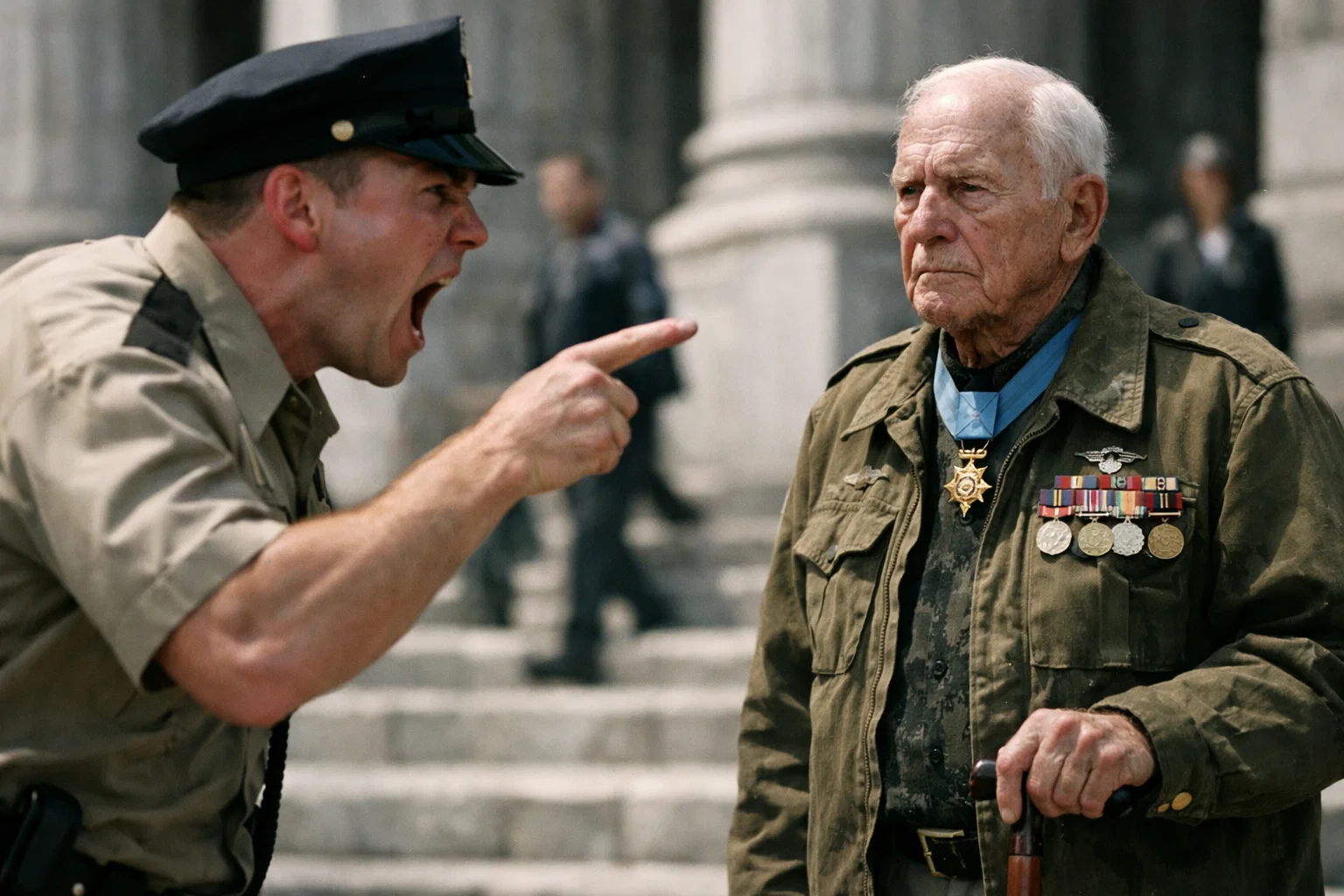
He wore the same Army jacket he’d owned for forty years. Worn at the elbows. Pressed flat along the collar. The medals on his chest — eleven of them — caught the light with every slow step he took.
He gripped his cane and kept moving.
“Sir.” A voice cut across the plaza. “Stop right there.”
Frank paused. A young security officer — early twenties, pressed khakis, an earpiece — moved to block the doors.
“This event is invitation only,” the guard said.
“I know,” Frank replied. “I’m here for the ceremony.”
The guard’s eyes dropped to Frank’s jacket, then came back up. His expression didn’t change.
“You need to check in at the registration table. That’s around the side.”
“I’ve been to this building fourteen times,” Frank said. “I’ve never checked in around the side.”
“Policy changed last year.” The guard took a half-step forward. “I’ll need you to move away from the entrance.”
A few feet behind Frank, two Army captains had slowed their pace. They said nothing. They watched.
Frank looked at the doors — the same doors he’d walked through the year they gave him the Medal of Honor, the year he shook the hand of a sitting president, the year he buried three of his closest friends in a ceremony that lasted four hours and left him standing alone in the rain.
“I belong inside that building,” Frank said.
“Sir.” The guard’s voice tightened. “This ceremony is for decorated military personnel and their families. I’m going to need to see—”
“Look at my chest,” Frank said quietly.
The guard glanced at the medals. Then back at Frank’s face.
“I understand you served,” the guard said. “But without your badge or—”
“Not at my chest.” Frank tapped the center medal with one finger. “At that one. Right there.”
The guard looked. It was a sky-blue ribbon. A gold star. An eagle with wings spread.
The guard’s jaw went still.
Frank watched the recognition move across the young man’s face the way it always did — slowly, then all at once, like a door opening in a dark room.
“That’s the…” The guard stopped himself.
“Congressional Medal of Honor,” Frank said. “They gave it to me inside that building. November 1971. I was twenty-six years old. Half the men in that room aren’t old enough to know what it cost.”
Behind Frank, a female captain with three combat tours stepped forward.
“Officer,” she said. “Do you know who this man is?”
The guard swallowed. “I’m starting to.”
“Colonel Francis Delaney. Third Infantry Division. Two Purple Hearts. Distinguished Service Cross. And the Medal of Honor.” She paused. “He is the keynote speaker.”
The guard’s face went from pale to a deep, burning red.
“Sir,” he said. Barely above a whisper. “I—”
“You were doing your job,” Frank said.
The guard blinked.
“A man in an old jacket walks up without a badge — you stopped him. That’s correct.” Frank met the young man’s eyes. “But the job doesn’t end at ‘stop.’ The job ends when you know the truth.”
“I should have called someone immediately,” Davis said. “I’m sorry, Colonel.”
“What’s your name?”
“Davis, sir. Officer Ryan Davis.”
“Have you ever served, Davis?”
“No, sir. I was going to enlist. Some medical issues.” He stopped. “No, sir.”
“Then here’s what you need to understand.” Frank’s voice stayed even. “Every single person walking through those doors today spent years doing things that should have killed them. A lot of their friends didn’t make it. And none of them are going to tell you that. They’ll walk in, sit down, and be quiet.” He tapped the medal. “That’s what this looks like on the outside.”
Davis nodded. His shoulders had dropped. His whole face had changed.
“I do now, sir.”
Davis moved quickly and pulled the door open himself. Both hands. Spine locked.
Frank paused in the frame.
“Thank you, son.”
“Yes, sir.”
As the female captain passed Davis, she stopped for just a second.
“What you did in the ten seconds after you realized your mistake?” she said quietly. “That’s what character looks like. Don’t forget it.”
Davis didn’t move from the door for a long time after they’d all gone in.
The ceremony lasted three hours. Colonel Delaney spoke for twenty-two minutes. No notes.
He talked about the men he’d lost. About asking someone to do an impossible thing and having them say yes. About the young soldiers who came home and the ones who didn’t.
At the end, he paused.
“Respect doesn’t start inside a ceremony,” he said. “It starts at the door. Every single door. And it belongs to everyone who earned it — whether they’re wearing a name badge or not.”
The room rose to its feet.
Frank came through the doors last.
Davis snapped to attention without thinking.
Frank looked at him. Then he reached into his breast pocket and pulled out a folded photograph. Black and white. A young soldier, mid-twenties, jungle fatigues, squinting in the sun, surrounded by men whose faces were tight with exhaustion and something that wasn’t quite a smile.
He held it out.
Davis took it carefully.
“That’s my unit,” Frank said. “1968. Before the operation that got me that medal. Three of those men are still alive. The rest — I’ve been carrying them a long time.”
Davis looked at the photograph. His jaw was tight.
“I’m not giving you that to make you feel bad,” Frank said. “I’m giving it to you so you know the weight of what you’re guarding. Every time you open that door.” He tapped the photo once. “Keep it.”
“I will, sir. Every day.”
Frank gave a single nod, took his cane, and walked down the steps.
Davis watched him go. Then he tucked the photograph carefully into his inside pocket, right over his chest.
And turned back to face the door.
Original fictional stories. AI-assisted creative content.