Tyler Marsh walked through Westfield High like the hallways belonged to him.
At seventeen, he had the confidence of someone who had never once faced a consequence. Designer hoodie. Expensive sneakers. A large coffee cup in his hand every afternoon — the kind with the paper sleeve and the plastic lid — because he could, and because nobody told him not to.
He wasn’t a bully in any dramatic sense. He was quieter than that. More comfortable. The kind of person who doesn’t register other people as real.
Mr. Earl Dawson had worked the side corridor of Westfield High for twenty-three years. Same brown uniform. Same cart with the wobbly left wheel. He arrived before the first bell and left after the last one. He knew every scuff mark on every locker. He knew the floor.
Nobody knew him.
That Wednesday, the hallway was nearly empty — end of day, most kids already gone. Tyler walked alone, coffee in hand, earbuds in, the corridor all his. Earl was mopping near the lockers, working a fresh section of floor, the wet shine of it catching the fluorescent light.
Tyler didn’t slow down. Didn’t look over. He just tilted his wrist as he passed — smooth, casual, deliberate — and let the coffee pour straight out through the lid. A wide dark stream hit the linoleum and spread immediately, brown and steaming, right across the section Earl had just finished.
Tyler kept walking.
Earl stopped.
He looked at the puddle. He looked at Tyler’s back. He set the mop handle against the wall — slowly, carefully, the way a person does when they are controlling something large — and moved.
Tyler didn’t hear him coming.
Earl’s hand closed around his wrist from behind, hard and certain, and yanked him to a stop.
Tyler spun. “What the—”
The coffee cup lurched in his grip. His face went through three things at once — shock, then confusion, then something that looked very much like fear. The kind that comes when you realize the world just pushed back.
Earl was right in front of him. Eyes level. Voice low and absolute.
“You’re going to respect someone else’s work.”
“Let go of me.” Tyler’s voice came out smaller than he intended. He pulled at his wrist. Earl didn’t move.
“I’ve been cleaning this hallway every day for twenty-three years,” Earl said. “And you just poured your coffee on a floor I finished ten minutes ago.”
“It was an accident—”
“It wasn’t.”
Tyler’s mouth closed.
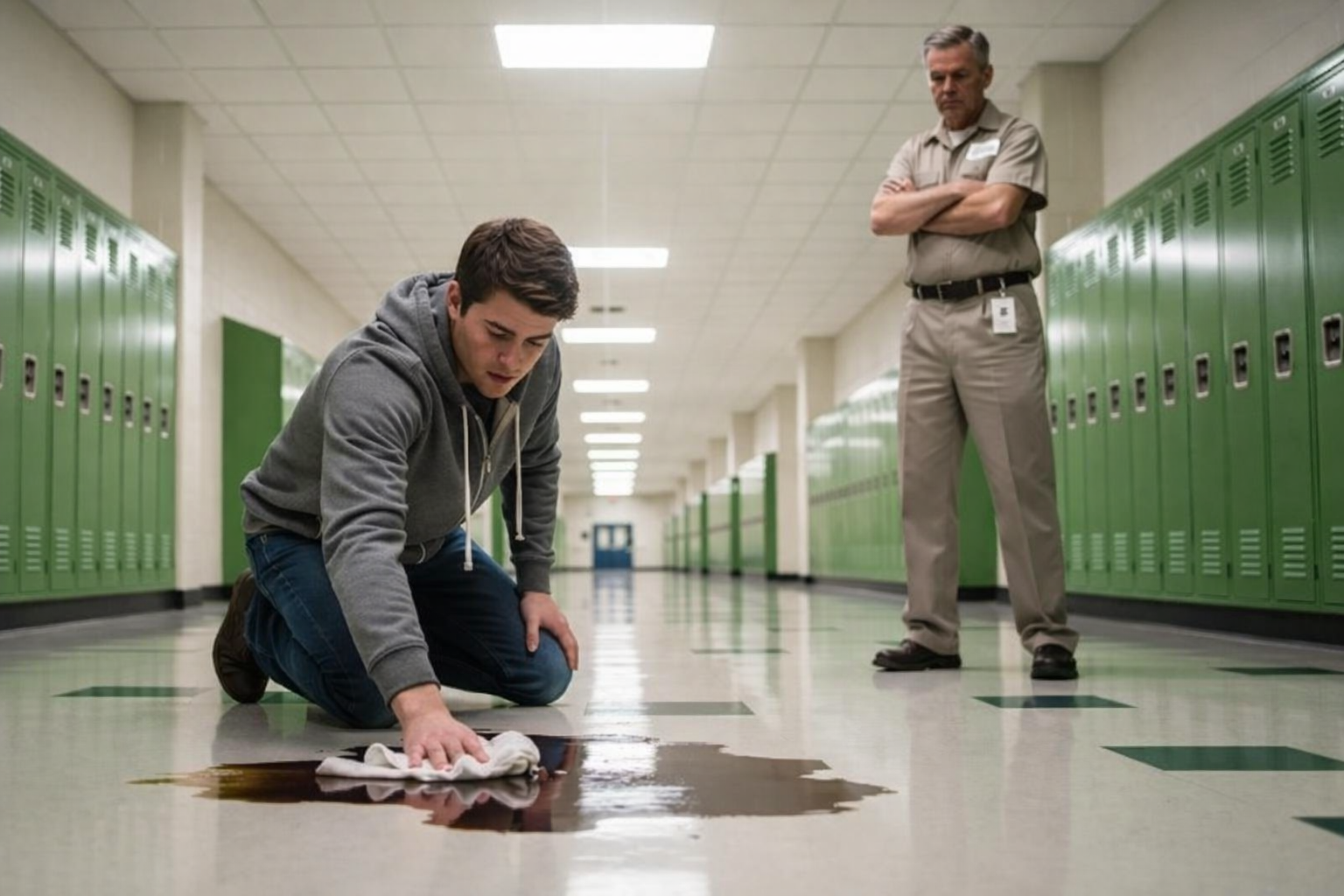
Earl walked him back — wrist still in hand — to the puddle. He reached into his cart, pulled out a clean white rag, and pressed it into Tyler’s free hand.
“Get on your knees. Clean it up.”
Tyler stared at the rag. He looked at the mess on the floor. He looked at Earl.
“You can’t make me do this.”
“I’m not making you do anything.” Earl crossed his arms and stepped back. “But that floor doesn’t clean itself. And you made that mess. So one of us is going to clean it, and it isn’t going to be me. Not this time.”
Silence stretched between them.
Somewhere down the hallway a locker shut. Footsteps. A couple of students appeared at the far end, slowed down, stopped. One phone rose.
Tyler looked at the rag in his hand.
He looked at the coffee spreading slowly across the linoleum.
He looked at Earl — who was just standing there, arms crossed, not angry anymore. Just waiting. Like he had all the time in the world and had been waiting, specifically, for this moment, for a very long time.
Tyler crouched down.
He pressed the rag to the floor.
He scrubbed.
Nobody said a word. The students at the end of the hallway didn’t move. Earl didn’t move. The only sound was the wet drag of the rag across the linoleum.
It took three minutes. Tyler stood, floor clean, rag dark with coffee.
He held it out. Earl pointed at the cart.
Tyler walked to the cart and dropped the rag in the bin.
He stood there for a moment, not sure what to do with his hands.
“That’s it?” he said.
Earl picked up his mop. “That’s it.”
Tyler didn’t move. “You could’ve just — called a teacher or something.”
“I could’ve.” Earl ran the mop over the area once, evening it out. “But that wouldn’t have taught you anything.”
Tyler was quiet.
“I don’t even know your name,” he said finally.
Earl looked at him. “Earl.”
“I’m Tyler.”
“I know.”
Tyler shifted his weight. “I’m sorry, Earl. I don’t know why I did that.”
Earl studied him for a long moment. Then he nodded, once. Not a forgiveness. An acknowledgment.
“Go home,” he said. “Come back tomorrow and walk through here like you’ve got somewhere to be. That’s all I’m asking.”
Tyler left.
The students at the end of the hallway dispersed. Phones went down. The corridor went quiet again.
Earl mopped the section one more time, slow and even, the way he always did.
The next morning, Tyler walked through the side corridor before first bell. He slowed as he passed the lockers. The floor was clean. Gleaming under the fluorescents, the same as always. Earl was already working further down the hall, back turned, moving through his routine.
Tyler kept walking.
But he looked at the floor the whole way through.
By the end of the semester, Tyler had quietly joined the student facilities committee after seeing a flyer in the main office. He didn’t talk about why.
At the year-end assembly, when the principal called Earl Dawson to the stage for the first time in twenty-three years — staff appreciation, long overdue — Tyler started the applause before anyone else.
Earl stood at the podium in his brown uniform, award in hand, and looked out at the auditorium full of students finally looking back at him.
He didn’t make a speech.
He just nodded, once, the same way he’d nodded at Tyler in the hallway.
An acknowledgment.
It was more than enough.
Original fictional stories. AI-assisted creative content.