Elena Brooks had been working the same corner for eleven years.
Corner of Maple and 4th, right where the bus stop met the old pharmacy that closed down in 2016. She sold rice plates, beans, sometimes chicken if she could afford the thighs from the discount rack at FoodMart.
Her cart had no name. Just a piece of cardboard taped to the side that read: HOT FOOD $4.
She woke up every morning at 3:45 AM. By 5, she was prepping. By 6:30, the cart was rolling. By 2 PM, she was done — unless it rained, then she was done whenever her body told her to stop.
There was no retirement plan. No savings account. No husband anymore. Just Elena, her cart, and the quiet math of survival.
But this story doesn’t start with her.
It starts with three kids under a bridge.
Twenty-two years ago, Elena was thirty-one and barely making rent. She worked two jobs — a diner in the mornings, a laundromat in the evenings — and walked the same route home every night through Granger Park.
One night in October, she heard crying.
Not loud. Not dramatic. The kind of crying that’s been going on so long it doesn’t have energy left.
She stopped. Looked under the bridge.
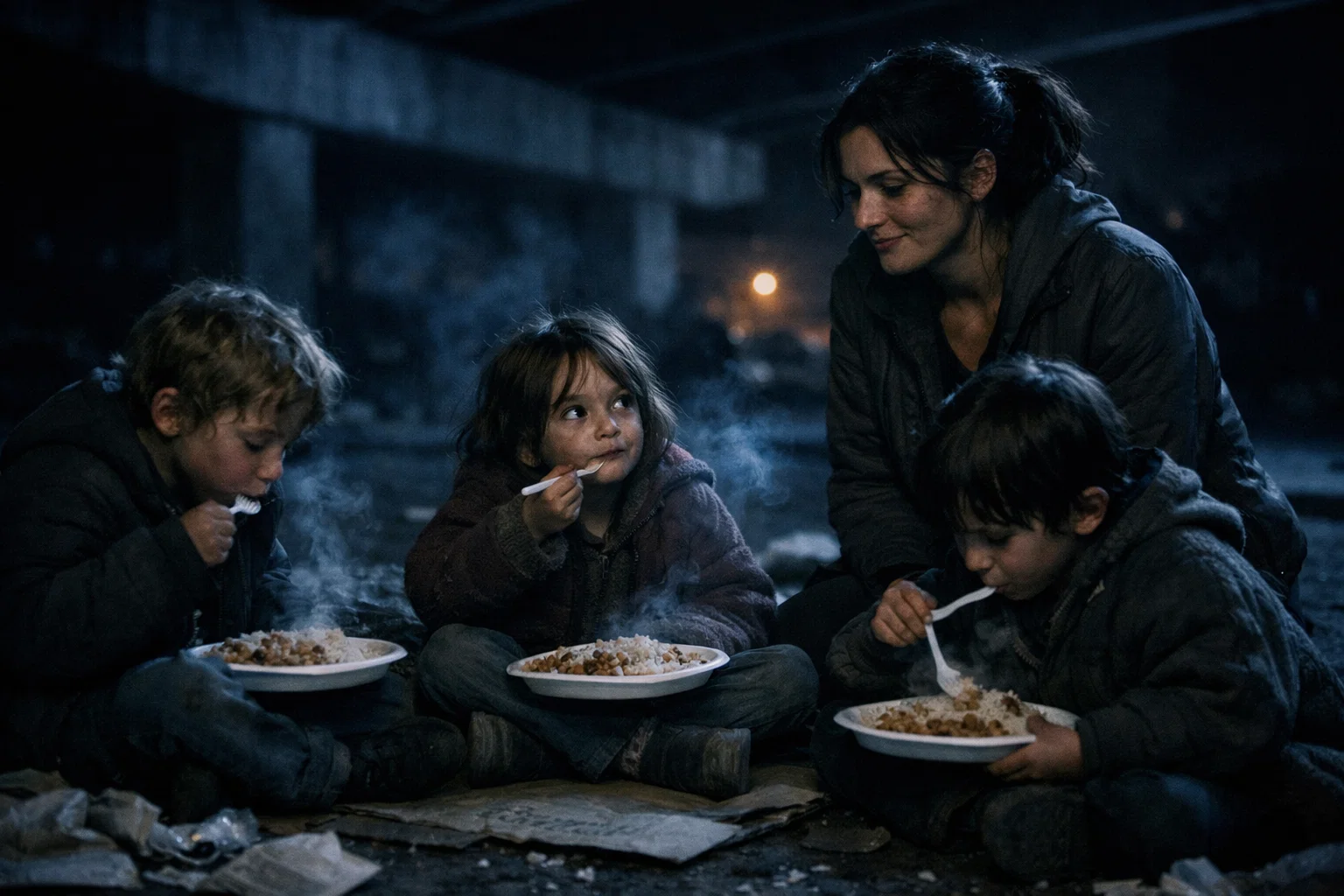
Three children sat on flattened cardboard. Two boys and a girl. Triplets, she’d later learn. Couldn’t have been more than six or seven. Dirty faces. No jackets. Sharing a single bag of stale chips between them.
Elena stood there for a long time.
Then she walked away.
But she came back twenty minutes later with three plates of food from the diner — leftovers the manager was going to throw out.
“Here,” she said, kneeling down. “Eat.”
The girl looked at her like she was a trick. “We don’t got money.”
“I didn’t ask for money.”
The boys grabbed the plates. The girl hesitated.
“Go on,” Elena said. “Eat first. The world can wait.”
The girl took the plate. And for the first time that night, the crying stopped.
Elena came back the next night. And the next. And the next.
She brought whatever she could — rice from the diner, bread from the day-old shelf, soup she made herself on Sundays. Some nights she skipped her own dinner to make sure they had enough.
She never asked where their parents were. She figured if they had parents worth mentioning, they wouldn’t be under a bridge.
One night, the girl — Maya — looked up at her and asked, “Are you our mom now?”
Elena’s chest cracked open.
“No, baby,” she said softly. “But I’m here.”
The boys were Darius and Marcus. Quiet. Watchful. Darius always said “thank you” twice. Marcus never said it at all, but he’d hold the plate like it was something sacred.
For three months, Elena fed them. She bought them jackets from Goodwill when November hit. She brought them blankets. She asked around about shelters, about social workers, about anyone who could help.
Then one night, she came to the bridge — and they were gone.
No note. No trace. Just the flattened cardboard and a few crumpled napkins.
She stood there for ten minutes, holding three plates of food, and cried.
She never saw them again.
Twenty-two years passed.
Elena lost her diner job. Lost the laundromat job. Got sick. Got better. Got a cart. Built something small and fragile out of nothing but stubbornness and rice.
She never talked about the kids under the bridge. Not to anyone. It lived in her chest like a locked room she didn’t have the key to anymore.
Some mornings, when the cold hit a certain way and the street was quiet, she’d think about Maya’s face. About Darius saying “thank you” twice. About Marcus holding the plate.
And she’d whisper to herself: “I hope they made it.”
Then she’d light the burner and get to work.
It was a Tuesday.
11:47 AM. Lunch rush hadn’t started yet. Elena was stirring a pot of rice and beans when she heard it.
Not loud. But wrong. Too smooth. Too clean for this street.
A low, velvet engine purr. Then another. Then a third.
She looked up.
Three Rolls-Royces turned the corner — one white, one black, one white — and rolled to a stop directly in front of her cart.
People on the sidewalk stopped. A man on a bike almost fell over. A woman pulled her kid closer like something dangerous was happening.
Elena’s ladle froze mid-air. Steam curled around her face.
“What in the world…” she muttered.
The engines died. One by one.
The doors opened.
Three people stepped out. Two men. One woman. Late twenties. Dressed like they owned the block. Maybe they did. Perfect shoes. Straight posture. Eyes locked forward.
They didn’t look at the street. They didn’t look at the crowd.
They looked at her.
Elena’s stomach dropped. Her first thought was trouble. City inspection. Health code. Some rich developer trying to push her off the corner. She’d seen it before.
She gripped the ladle tighter. “Can I help you?”
They didn’t answer. They just stood there, three across, like a wall of something she couldn’t name.
The man on the left — tall, dark suit, clean shave — tried to smile, but his lips trembled.
The man in the middle — broader, brown suit, hands clasped in front of him — swallowed hard and blinked fast.
The woman — fitted coat, hair pulled back, heels that clicked on the pavement — pressed a hand to her chest like she was keeping something from falling out.
Elena set the ladle down. “I said, can I help you?”
The woman stepped forward. One step. Two. Her eyes were locked on Elena’s face — searching, scanning, breaking apart.
Then she spoke. And her voice was small. Smaller than her clothes. Smaller than the car behind her.
“You fed us.”
Elena blinked. “Excuse me?”
The man in the blue suit stepped closer. His jaw was tight. His eyes were wet.
“We were the kids,” he said. “Under the bridge.”
The world tilted.
Elena grabbed the edge of the cart. Her knees buckled but didn’t break. Not yet.
“No,” she whispered. “No, that’s not—”
“Darius,” the man on the left said, pointing to himself. Then to the man in the middle. “Marcus.” Then to the woman. “Maya.”
Elena’s hand went to her mouth.
Maya’s face crumpled. Twenty-two years of composure collapsed in two seconds. “You told us to eat first,” she said, her voice cracking. “You said the world could wait.”
“Oh my God,” Elena breathed. “Oh my God.”
Marcus — the one who never said thank you — stepped forward. His voice was low, rough, barely held together. “I never said it back then. I need to say it now.” He paused. “Thank you.”
Elena broke.
Not quietly. Not gracefully. She broke the way people break when something they buried twenty-two years ago comes back to the surface and demands to be felt.
She sobbed. Her whole body shook. She pressed both hands to her face and cried like the world had just opened up and shown her something she’d given up believing in.
Maya reached her first. Wrapped her arms around her. Held her tight.
“Easy,” Maya whispered. “We’ve got you.”
Darius joined. Then Marcus. Three grown adults, standing in the middle of a sidewalk, holding a woman next to a food cart, crying like children.
The crowd didn’t move. Someone lowered their phone. Someone else wiped their eyes.
When Elena finally pulled back, her face was a mess. She laughed through the tears. “Look at me. I’m a disaster.”
“You’re beautiful,” Maya said.
“How did you find me?” Elena asked, wiping her eyes with the back of her hand.
Darius reached into his coat. “We’ve been looking for seven years. Hired investigators. Searched databases. You moved twelve times.”
“Fourteen,” Elena corrected. Then she laughed again, the kind of laugh that has no joy in it, just exhaustion.
Marcus said, “We tracked the cart. Someone posted a photo online — ‘Best $4 rice plate in the city.’ We saw the corner. Recognized the neighborhood.”
“A four-dollar plate,” Elena murmured. “That’s what brought you back?”
“No,” Maya said firmly. “You brought us back.”
Darius pulled out a thick sealed envelope and placed it gently on the cart. Steam from the pot curled around it.
Elena stared at it. “What is that?”
“Open it.”
Her hands were shaking. She picked it up. Unsealed it slowly.
A photograph slid out first.
Old. Faded. Creased at the corners.
Three small children sitting on the ground, holding plates of food. And behind them — her. Younger. Thinner. Tired. But smiling.
“Where did you get this?” she whispered.
“A man at the shelter took it,” Darius said. “The night before they moved us. We kept it. All these years.”
Elena pressed the photo to her chest.
Then she looked at what was underneath.
A document. Thick. Official. A property title.
Her name was on it.
Her fingers went numb. “What is this?”
Marcus looked at her. “It’s yours.”
“I don’t understand.”
Maya stepped closer. “It’s a restaurant, Elena. Twelve blocks from here. Three thousand square feet. Kitchen’s already built out. Fully paid. Fully yours. No rent. No mortgage. No debt.”
Elena shook her head. “No. No, I can’t—”
“Yes, you can,” Darius said.
“You don’t understand,” Elena said, her voice breaking again. “I’m nobody. I sell rice out of a cart. I don’t run restaurants. I can barely keep the health inspector off my back.”
Marcus stepped forward. “You fed three kids who had nothing. You came back every night. You didn’t call the cops. You didn’t call social services and walk away. You showed up. With food. Every single night.”
“For three months,” Maya added.
“That’s not nobody,” Marcus said. “That’s everything.”
Elena looked at the document again. Her name, printed in clean black letters. A real address. A real place.
“There’s more,” Darius said.
She looked up. “More?”
He pulled out a second envelope. Inside was a check. She unfolded it.
Her knees gave out for real this time.
Maya caught her. Marcus grabbed her other arm. They lowered her gently to sit on the curb.
“Fifty thousand dollars?” Elena’s voice was barely audible.
“Operating capital,” Darius said. “For the first year. Supplies, staff, whatever you need.”
“We handle the lease on the building,” Marcus added. “You handle the food. That’s all you’ve ever needed to do.”
Elena stared at the check. Then at the photo. Then at the three of them.
“How?” she asked. “How did you— what happened to you?”
They looked at each other.
Maya spoke first. “After the bridge, we got picked up by child services. Separated for a while. Then a foster family took all three of us. Good people. Not perfect, but good.”
“I went into finance,” Darius said. “Scholarships. Internships. Worked my way through.”
“Tech,” Marcus said. “Started a logistics company. Sold it last year.”
“I’m a real estate attorney,” Maya said. “That’s how I found the building.”
Elena shook her head slowly. “You were so small. You were so scared.”
“We were hungry,” Marcus said. “And you fed us. That was the first time anyone treated us like we mattered.”
“You know what I remember most?” Darius said. His voice dropped. “You didn’t just hand us the food. You sat down. On the ground. In the dirt. You sat with us and watched us eat. Like you were making sure we were okay.”
Elena covered her face again.
“Nobody had ever done that,” he said.
The crowd had grown. Thirty, forty people now. Some had been recording. Some were just standing there, looking at something they didn’t fully understand but could feel.
An older man in a bus driver’s uniform was crying openly. A teenage girl held her phone at her side, not recording, just watching.
Elena looked up at the three of them. “I need you to know something.”
They waited.
“After you disappeared,” she said, “I went back to that bridge every night for two weeks. I brought food. I waited. I thought maybe you’d come back.”
Maya’s face twisted.
“You didn’t,” Elena continued. “And I told myself you were okay. I told myself someone found you and took care of you. But I didn’t know. For twenty-two years, I didn’t know.”
She took a breath.
“And every single day, I wondered if I should have done more.”
Marcus knelt down in front of her. He took her hands.
“You did enough,” he said. “You did more than enough.”
Three weeks later, the cart was gone.
In its place — twelve blocks east, on the corner of Grand and Wilson — stood a small restaurant with a wide front window and a hand-painted sign above the door:
EAT FIRST.
The menu was simple. Rice. Beans. Chicken. Soup. Bread. Nothing fancy. Everything good.
There was no minimum purchase. A small sign near the register read: If you’re hungry and you can’t pay, sit down. You eat first. The world can wait.
Elena ran the kitchen herself. She hired two assistants — both from the neighborhood, both single mothers, both people she’d fed from the cart over the years.
On opening day, the line went around the block.
Maya handled the books. Darius covered any gaps in funding. Marcus showed up every Saturday to bus tables, still not saying much, still holding plates like they were sacred.
A local news crew came by the second week. The story went viral. Donations poured in. Elena used every dollar to expand the free meal program.
By the end of the first month, “Eat First” had served over four thousand meals. Eleven hundred of them were free.
On a quiet Thursday evening, after the last customer left, Elena sat alone at a table by the window. The chairs were up. The kitchen was clean. The lights were low.
She held the old photograph in her hands.
Three kids. Three plates. One woman.
The door opened. Maya walked in, car keys in hand.
“You’re still here?” Maya said.
“Just sitting,” Elena said.
Maya pulled up a chair. They sat in silence for a while.
“I keep thinking I’m going to wake up,” Elena said.
“You’re not dreaming.”
“I know.” Elena paused. “I just never thought it would come back.”
“What?”
“Any of it.” She looked at the photo. “I gave away food I couldn’t afford. I sat in the dirt under a bridge. I cried when you were gone. And I told myself it didn’t matter. That I was just a woman with leftovers.”
Maya put her hand over Elena’s.
“You were never just a woman with leftovers.”
Elena smiled. A real one. Full. Unguarded.
“I know that now.”
Outside, three cars sat parked along the curb — one white, one black, one white — their engines off, their headlights dark. Just there. Just present. Like a promise that had finally been kept.
And inside, a woman who had once given everything she had to three strangers sat in a restaurant with her name nowhere on the wall — just a simple truth above the door:
Eat First.
Because kindness doesn’t disappear.
It doesn’t forget.
And when it finally comes back, it doesn’t knock.
It sits down, takes your hands, and says: You did enough.
Original fictional stories. AI-assisted creative content.