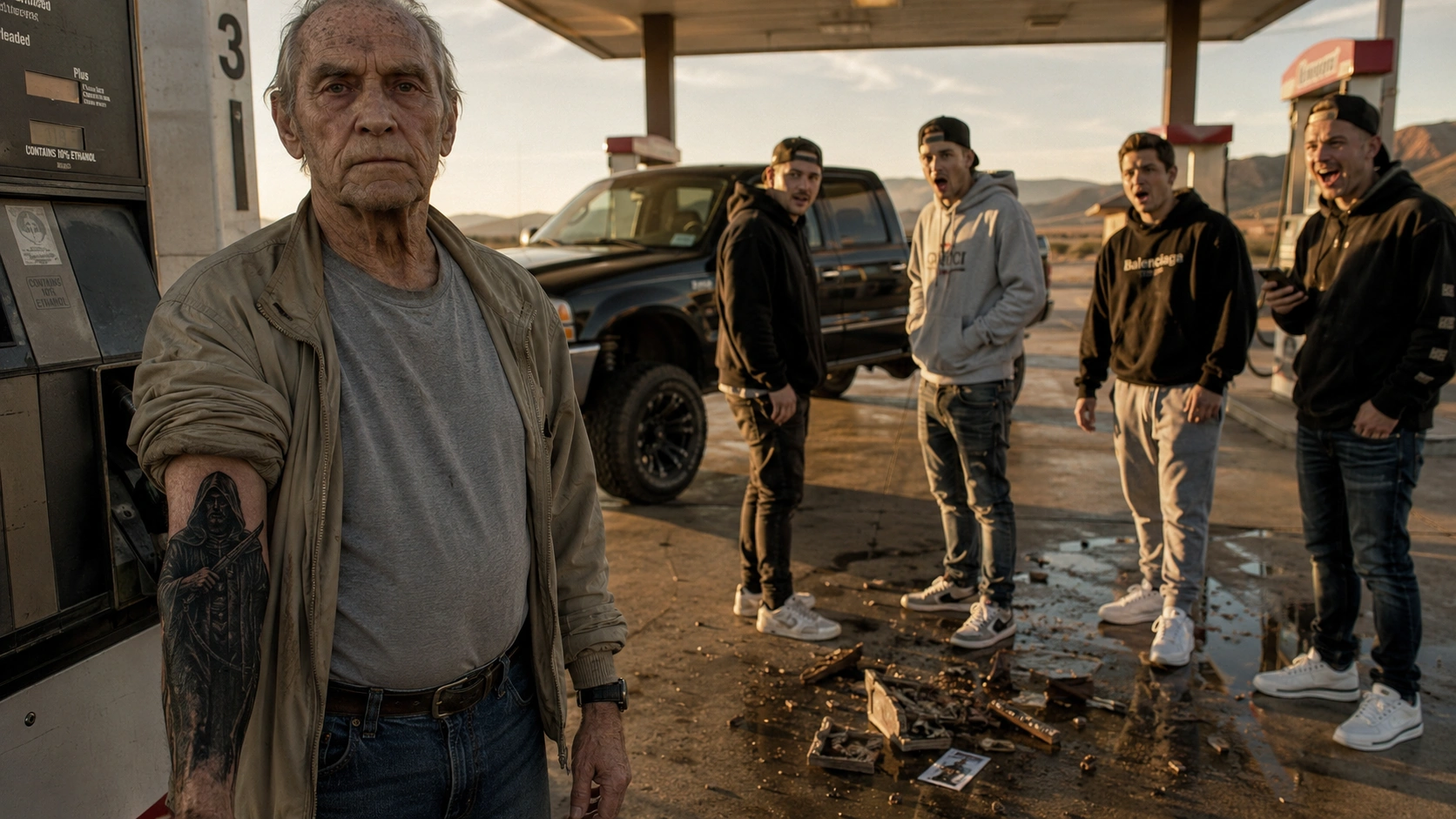
Victor Reyes stood at pump three, one hand on the nozzle, the other resting on a small wooden box he’d set on the concrete island beside him. The box was beautiful. Hand-carved. Vines and flowers wound around the lid in tight, patient lines that only a person with real love in their fingers could have made.
He was seventy-nine. He didn’t look like much. Cheap beige windbreaker. Worn slacks. Orthopedic shoes. The kind of man you look past without meaning to.
He was almost done pumping when the boys pulled in.
Four of them, packed into a jacked-up black pickup with the bass thudding hard enough to shake the windows of the store. The truck skidded to a stop across two parking spaces. The doors popped open one at a time and they spilled out — early twenties, maybe younger, dressed in matching arrogance. Backwards caps. Designer hoodies. Chains. One of them had a phone already up, filming for the group chat before his feet hit the ground.
The leader was tall and lean. Maybe twenty-two. Sharp jaw, bleached hair, a smirk that had probably never been wiped off him by anyone who mattered. He hopped down from the driver’s seat, cracked his neck, and scanned the lot the way a boy scans for something to enjoy.
His eyes found Victor. Then they found the box.
“Yo, grandpa.” His voice carried across the whole lot. “You planning to move that junker or are you just gonna stand there breathing our air?”
Victor twisted the gas cap back on. Slow. Careful. “Just finishing up. Won’t be a minute.”
“Didn’t ask how long it’d take.” The kid walked closer, his three friends drifting in behind him. The one with the phone circled wide to get a better angle. “Asked if you were gonna move.”
Victor looked up. His voice stayed quiet. “I’ll be out of your way. Promise.”
The kid glanced down at the box. Something mean flickered across his face.
“What’s in there, gramps? Your teeth?” He smirked at his boys. “Or you hauling around your dead wife’s ashes?”
Victor’s fingers tightened on the lid. “It’s something my daughter made for me. Please. I’ll be gone in thirty seconds.”
“Your daughter.” The kid laughed once. Short and ugly. “That’s cute. Bro, get this on camera.”
The one with the phone stepped in tighter. “Rolling, rolling. Go.”
The kid lifted his sneaker.
The sound when it came down was like a small gunshot. Wood cracked and flew. The carved lid split inward and sideways across the asphalt. The box collapsed under the heavy sole. Something small and rectangular shot free and landed face-up in a shallow puddle of oily water three feet away.
The boys erupted.
“OH MY GOD, bro, you smoked it!”
“That’s going up TONIGHT.”
“Look at his face, look at his face —”
The leader planted his sneaker on the biggest remaining piece and ground it once, slow, for the camera. Then he grabbed the front of Victor’s windbreaker in one fist and yanked him forward. The cheap fabric pulled tight across Victor’s chest.
“Get on your knees and pick it up. Every piece. Don’t leave your trash on our pavement.”
Victor didn’t fight the grip. He looked down at the ruined wood. At the photograph lying in the dirty water. His daughter on her wedding day. The mud was already soaking into the paper.
“Please,” he said. His voice cracked on it. “She carved that box for me. It’s all I have left of her.”
The kid shoved him back a step. “Then she should’ve carved it out of steel. On your knees, old man. Now. Camera’s watching.”
The laughter got louder. One of the boys kicked a splinter toward Victor’s feet. The one with the phone crouched low to catch the shot from below.
Victor looked around once. The young mother who’d been parked at the next island was already gone. The trucker in the rig cab was staring straight ahead, pretending not to see. The clerk inside the store was watching through the glass but hadn’t moved toward the door.
Victor lowered himself to the ground.
His knees hit the asphalt hard. Pain shot up both legs. He knew that pain. He’d learned to ignore pain a long time ago, in places and circumstances he had worked very hard to leave behind him. He shuffled forward on his knees toward the puddle. The fabric of his slacks soaked through immediately. The water was cold and slicked with old oil.
He reached in with both hands. Picked up the broken pieces of wood first. Set them carefully to one side as if they might still be reassembled later. Then he reached for the photograph.
The mud had streaked across his daughter’s face. He tried to wipe it away with his thumb. The motion only smeared it deeper.
His hands were shaking.
“Look at him shake,” the leader said, loud, for the camera. “You gonna cry too? Go ahead. We got time. This is going viral, bro.”
One of the younger boys did a high-pitched imitation of Victor’s trembling. The group laughed louder.
Victor didn’t answer. He gathered another piece of wood. His breath came in short pulls. Inside his chest the old heat tried to rise — the same thing that had lived in him during the years he didn’t talk about. He’d buried it carefully over twenty-three years. He pushed it back down now. His fingers kept moving. Picking up the pieces. Trembling.
Then the trembling stopped.
It didn’t slow down. It didn’t fade. It simply stopped, all at once, like a machine that had been switched off. His hands went still in the oily water. The shaking in his shoulders ended. His breathing leveled out and became very quiet.
He lifted his head.
The fear was gone from his face. The sorrow was gone. The careful, apologetic politeness he’d carried for twenty-three years of quiet civilian life — gone. What remained was empty. His eyes were flat and still, the way the surface of deep water goes still right before something rises.
The kid closest to him took a half-step back without meaning to.
Victor gathered the last splinter. He rose.
Not the way an old man rises, gripping something for support, wobbling, catching his breath. He stood in one smooth motion, knees and back straightening together, until he was upright. No stumble. No pause. The wet patches on his slacks dripped steadily onto the asphalt, but nothing else about him moved.
The laughing had gone thin. The leader was still smirking, but his eyes weren’t in it anymore. The one with the phone kept filming, uncertain now, the camera drifting.
Victor looked at the leader. He didn’t speak. He reached, slow and deliberate, for the zipper of his windbreaker.
The metal tab made a small, clear sound as he drew it down. The fabric parted. He shrugged the jacket off his shoulders in one even motion and let it fall.
The arms beneath it were not what anyone expected.
They were thick with muscle that hadn’t softened, corded under skin that told its history in scar tissue. Pale lines crossed both forearms — some thin and straight from blades, others puckered and round from things that had hit him and hadn’t quite finished the job. A long, faded ridge ran along the left bicep where something had torn deep and been stitched badly by someone without much time or light.
The right forearm carried the mark.
A solid, pitch-black tattoo starting just above the wrist, winding upward in dense, deliberate patterns until it disappeared under the sleeve of his gray T-shirt. The ink was old but the black was still absolute, the kind of black that seemed to absorb light rather than reflect it. No color. No shading. Just the unmistakable silhouette of a hooded figure holding a blade across its chest, the lines sharp and final.
Anyone who had spent time in certain circles knew exactly what that mark meant.
It wasn’t prison ink. It wasn’t gang flash. It was the mark of a man who had done very specific work for very specific people — the kind of work done quietly, at close range, without witnesses, and then walked away from as if nothing had happened at all.
The one with the phone saw it first through his screen. The camera zoomed in on its own, his thumb moving before his brain caught up.
“Uh — bro.” His voice cracked. “Bro, look at his arm.”
The leader turned. His face went pale so fast it looked like something had pulled a plug. His mouth opened. His mouth closed. He took one involuntary step backward and the heel of his sneaker caught on a crack in the asphalt. His eyes locked on the tattoo and stayed there.
“What the hell is that,” he whispered.
His friend, the shortest one, still riding the high of the moment, laughed nervously. “It’s just a tat, dude, chill —”
“Shut up,” the leader snapped. His voice had lost everything that had been in it two minutes ago. No swagger. No easy arrogance. Just something thin and afraid. “That ink is real. That’s — that’s not something you get. That’s something you earn. We just put our hands on the wrong man.”
“Bro, what are you talking about, he’s just some —”
“I SAID SHUT UP.”
The words went through the group like cold water. The one with the phone slowly lowered it. The camera kept rolling, forgotten, pointed at the asphalt now. The shortest one’s smile flickered and died. The fourth boy — quiet the whole time, standing a step behind the others — had already begun edging backward toward the truck without realizing he’d done it.
Victor hadn’t moved. He stood with his arms at his sides, letting them see what was on his arms. He didn’t flex. He didn’t posture. He breathed slowly and waited.
The leader tried to find his voice. It came out thinner than he wanted. “Listen. We didn’t know. Okay? We didn’t know who you were. It was a joke. The box — we can pay for it. Whatever it costs. My dad’s got money, he’ll cover it, whatever you want —”
Victor took one step forward.
Then another.
He moved until he was standing directly between the boys and the black pickup. To leave, they’d have to go around him.
Neither option looked clean.
The lot felt smaller. The pumps and concrete islands seemed to press in from both sides. The highway traffic sounded very far away. The clerk inside the store was on the phone now, watching through the glass, not coming out.
Victor’s voice, when it came, was quiet. No anger in it. No threat. Just a statement delivered the way a man states the weather.
“My daughter carved that box.”
The words landed heavier than a shout.
The leader swallowed. His throat moved visibly. He backed up another step and bumped into the side of his truck. The mirror rattled once, small and lonely.
“Please,” he said. The word came out of him like it surprised him. “Please, man, we’re just — we’re just messing around. We didn’t mean anything.”
Victor waited. He didn’t press. He didn’t threaten. He simply occupied the space he had claimed and let the silence do what silence does to boys who’ve just understood they’ve made an error they can’t take back.
The shortest one broke first.
Fear does that — it twists in some boys until it comes out the other end as something loud and stupid. He yanked something from his hoodie pocket — a folding knife, cheap, the kind you buy at a gas station like this one. The blade snapped open with a small, shaky click.
“He’s an old man!” His voice cracked hard on the words. He lunged, knife angled low, aiming for Victor’s side.
Victor didn’t retreat.
He stepped into the attack.
His left hand caught the boy’s wrist with a grip that didn’t grab so much as receive — redirecting the momentum instead of stopping it. At the same time his right forearm drove upward in a short, brutal arc. Bone met bone with a distinct, wet crack. The knife clattered to the asphalt. The boy’s scream ripped out of him as his wrist folded at an angle wrists aren’t designed to reach.
Victor released him without ceremony. The boy dropped to his knees, clutching the ruined arm, sobbing openly, all the bravado gone in a single heartbeat.
The whole exchange had taken less than two seconds.
The other two on their feet froze. The one with the phone had it dangling at his side now, forgotten. The quiet one was already backing toward the truck with both hands rising slowly, palms out.
“Please,” the quiet one whispered. “Please, please, please —”
The leader made his choice.
He turned and ran for the driver’s door of the pickup. His sneakers slapped the concrete hard as he grabbed for the handle.
Victor moved.
He covered the distance between them with startling speed — not a sprint, but a series of efficient strides that closed the gap before the leader could get the door open. As the boy yanked at the handle, Victor’s foot lashed out in a low, precise arc. The orthopedic shoe connected with the side of the leader’s right knee at the exact point where the joint was most vulnerable — not a wild kick, but a focused impact that hyper-extended the knee backward with a sickening pop.
The leader screamed.
He collapsed against the side of the truck and slid down, the damaged leg folding beneath him at an angle that made him vomit once onto the concrete.
The lot fell silent except for the wet, ragged breathing of two boys on the ground and the shortest one still sobbing over his ruined wrist.
Victor stood over the leader. He had not pursued the other two. He hadn’t needed to. The quiet one now stood at the far edge of the lot with both hands raised and empty, backing slowly, tears running silently down his face. The one with the phone had dropped it and was standing frozen where he’d been, staring at nothing.
The leader tried to push himself up on his left arm. His right leg wouldn’t obey. Pain had reorganized his face into something raw and very young. He looked up at Victor standing above him and found no triumph there, no rage. Only the same flat, empty calm that had appeared the moment the windbreaker hit the ground.
“You broke my knee,” the leader said. He had to stop and breathe. “We didn’t know. We didn’t know who you were, please, I’m sorry, I’m so sorry —”
Victor didn’t answer.
“I got money. My dad has money. I can pay for the box. I can get you whatever you want.” The leader’s voice was picking up speed now, the words spilling out. “Just please — please, we’re just kids, we’re just —”
Victor turned away from him.
He walked back to the concrete island near pump three. He lowered himself to one knee beside the puddle — the same motion he’d made when the boys had laughed at him — and reached into the shallow, oily water. He lifted the photograph free with both hands. Mud clung to the paper in thick streaks across his daughter’s face.
He reached into his pocket. Found a clean cotton handkerchief and began to wipe the photograph with slow, deliberate strokes. The mud came away in smears. His daughter’s smile emerged piece by piece beneath the careful pressure of his thumb.
“Hey.” The leader’s voice was high and ragged. “Hey, please, I’m talking to you. Please. We can make this right.”
Victor kept wiping. The handkerchief moved across the photograph in steady, unhurried passes. He worked the edges first, then the center. When the worst of the mud was gone, he held it up to the afternoon light and looked at it. A small crease ran through one corner. The colors had blurred slightly at the edges from the water soaking in, but her face was clear again.
He nodded once, almost to himself.
He slipped the photograph into the inside pocket of his faded gray T-shirt, directly over his chest. The fabric settled around it.
He left the broken pieces of the wooden box exactly where they were on the concrete. The largest splinter still showed part of the carved vine his daughter had spent weeks etching with a small chisel she’d bought with her own money. He did not gather the pieces. He did not glance back at them. They remained where they’d fallen — stark, pale shards on dirty asphalt.
The leader had managed to drag himself a few feet toward the curb. His damaged leg left a small smear on the concrete. “You can’t just walk away. I need a hospital. You broke it. You broke my knee. Please —”
Victor rose. He straightened his shoulders — the same smooth motion he’d used when he stood up from the asphalt earlier. He looked once at the boys still on the pavement. None of them met his eyes.
The one with the shattered wrist sat rocking slowly, making small sounds. The leader lay against the side of his truck, breathing in shallow pulls. The quiet one was still standing at the edge of the lot with both hands raised. The one with the dropped phone hadn’t moved at all.
Sirens rose in the distance. Still several miles out, but carrying clearly across the flat land.
Victor walked toward the highway shoulder. His steps were even. He passed the pickup without touching it. The camera on the dropped phone was still recording, pointed at the asphalt, catching nothing but the sound of his footsteps as they crossed the frame.
At the shoulder he paused. The wind came across the open land and pulled at his T-shirt. He adjusted the fabric once over the pocket where the photograph was. Then he stepped onto the gravel margin and began walking north.
Cars and trucks passed him without slowing. None of the drivers knew what had happened at the gas station behind him. None of them would remember the old man in faded clothes walking alone with one hand resting flat over his heart.
Back at the pumps, the sirens grew.
The leader had stopped begging. He lay on his side, one arm over his face, breathing in short, shallow pulls. The quiet one sat down on the curb and stared at nothing. The clerk finally came to the doorway of the store — but stayed in the threshold, phone still at his ear, not quite willing to step fully into the lot.
When the first patrol car turned in with its lights going, Victor was already far enough down the shoulder that only someone specifically looking would have noticed the solitary figure.
He didn’t look back.
The officers who stepped out of their cruisers found four young men who couldn’t, or wouldn’t, give a clear account of anything.
The leader told them they’d been jumped by multiple attackers. The others stayed silent or offered fragments that contradicted each other. None of them mentioned the old man by name or description. None of them mentioned the tattoo. When the officers asked about the shattered wooden box near pump three, the scattered pieces of carved wood still lying where they’d fallen, the boys had no answer that made any sense at all.
“Whose is this?” one officer asked, crouching near the debris.
Silence.
“Someone want to explain this?”
More silence.
The leader stared at the ceiling of sky above him and said nothing. His knee was broken. His friends were broken. And the man who had done it was already around the first gentle curve in the highway, walking north at an unhurried pace, fading into the long, flat landscape until even the faint glint of afternoon light on his shirt became indistinguishable from everything else.
The photograph rested against his chest with every step. Small and steady and returned to him.
The road ahead was empty and open.
He kept walking.
Three weeks later, a man identifying himself only as an attorney walked into the county sheriff’s office and placed a manila envelope on the front desk.
Inside it: surveillance footage from a gas station camera that had been functioning just fine, despite what the clerk had told the officers. The footage showed, in clear daylight, four young men surrounding a senior citizen, destroying his property, physically forcing him to the ground, filming him for entertainment, and initiating a violent assault that the senior citizen then defended himself against with proportionate and legally justifiable force.
The attorney also included a certified letter from a physician documenting Victor Reyes’s existing injuries — two hairline fractures in his knees consistent with being forced to kneel on hard pavement — sustained before he ever defended himself.
He also included, notably, a copy of the video the boys had filmed themselves. Retrieved from a cloud backup on the dropped phone. Time-stamped. Undeniable.
The four boys were charged. The leader, Tyler Whitmore, faced felony assault, property destruction, elder abuse, and criminal recording charges. His attorney — hired by his father — argued self-defense on the knee injury. The judge reviewed the footage for approximately forty-five seconds before denying that motion.
Whitmore was sentenced to three years. He served two and a half.
The others drew shorter terms and lengthy community service.
None of them ever spoke the name of the man who’d walked away.
Victor Reyes received a letter at a P.O. box he’d maintained for eleven years under a different name. Inside was a single line from the attorney: Case closed. You’re clear.
He folded the letter and set it on the kitchen table of the small house he rented on a gravel road outside of a town with a single stoplight. He went to the shelf above the window where a new wooden box sat — the replacement his granddaughter had carved for him over the winter, working from photographs of the original, her hands careful and slow, the same patience in her fingers that her mother had carried.
He opened the lid. The photograph was inside, slightly creased at one corner, the colors blurred at the edges. His daughter on her wedding day, smiling at something the camera couldn’t see.
He closed the lid. He sat down. He rested his hand flat on top of the box.
Outside, the afternoon light came through the window at a low angle and lay across the floor in a long gold stripe, warm and still and quiet.
Victor Reyes sat with his hand on his daughter’s work and let the quiet be enough.
Original fictional stories. AI-assisted creative content.