Evelyn Ross pressed her navy dress the morning she drove to Coronado.
She’d worn it to Michael’s memorial. The hem had been repaired twice. She almost bought something new, then counted the bills in her purse and closed it.
Andrew would have laughed at her for that.
“Mom, nobody looks at shoes during a military ceremony,” he’d told her once.
She had polished the old pair until her wrists hurt anyway.
The invitation arrived six days earlier through certified mail. Formal, brief, almost painfully restrained. It requested her presence at a ceremony honoring personnel from a recently completed overseas operation and directed her to a seat beside the guest of honor.
No explanation beneath that.
Evelyn didn’t need one.
For eleven months, the Navy had told her Andrew remained missing. They used careful language during every call. Recovery operations continuing. Information limited. The command would contact her upon any confirmed development.
She’d learned to hear what lived inside that kind of language.
She had heard it twice before. Once for Daniel. Once for Michael.
Three boys had crowded her kitchen every Saturday morning. Three boys had argued over cereal, baseball gloves, and the front seat of her sedan. Three boys had eventually chosen the same dangerous path.
She never called them heroes inside her house.
There, they were Daniel, Michael, and Andrew.
They forgot birthdays, left wet towels on bathroom floors, and ate food straight from cooling pans.
Their uniforms belonged to the country. Their unfinished chores belonged to her.
A civilian coordinator named Rachel Bennett met her at the entrance.
Rachel recognized the name immediately. Her face softened, then tightened back into professional restraint.
“Mrs. Ross, your table is prepared.”
Evelyn noticed the woman glance toward the sealed envelope.
“Has anyone told you what today involves?”
“They told me where to sit.”
Rachel hesitated. “Yes, ma’am.”
“That is usually how the Navy handles difficult news.”
Rachel’s eyes dropped. “I can escort you personally.”
The corridors were crowded. Families searching for assigned tables, photographers testing equipment near the stage, sailors moving in every direction. Rachel guided Evelyn toward a table near the front.
A place card read EVELYN ROSS.
The card beside it read GUEST OF HONOR.
Evelyn studied both cards for a long moment.
“Will he come through those doors?”
Rachel didn’t pretend confusion. “Yes, ma’am.”
“Is my son with him?”
The coordinator’s breath caught. “I am not authorized to answer that.”
Evelyn nodded once. “Then you answered enough.”
Rachel was called away before the ceremony began.
Minutes later, Lieutenant Mason Cole entered from the side corridor.
He wore his dress uniform with sharp creases and the restless energy of a man managing appearances. He checked table cards, corrected a sailor’s posture, moved floral arrangements by inches. He had a list of authorized guests printed inside his folder and a certainty about what belonged where.
Evelyn’s name had been added to an addendum sent that morning while Mason was inspecting the hall.
He never opened the attachment.
When he spotted an elderly woman in an inexpensive dress seated beside the guest-of-honor card, irritation replaced curiosity.
He walked over without checking with the coordinator. Without examining the sealed envelope beside her plate. He saw only a potential embarrassment before senior leadership arrived.
“You need to move, ma’am.”
He planted himself beside her before she could unfold her napkin. His shadow crossed the table. His polished shoe struck the chair leg with a sharp knock.
Evelyn looked up slowly, one hand resting over the cream invitation beside her plate.
Mason reached down without asking and pulled the card from beneath her fingers.
“You’re sitting where honored families are supposed to sit.”
The thick paper bent in his grip. Evelyn rose slightly—more from surprise than fear—and held out her open palm.
“That invitation has my name on it.”
He ignored her hand and examined the faded navy dress, the worn black shoes with the fresh polish that couldn’t hide years of creases.
“This section is not for people looking for a free meal.”
A young petty officer at the next table stared at his plate. A sailor nearby shifted but said nothing.
Evelyn pointed to the lower corner of the card. “Read the line under the crest.”
Mason glanced down for less than a second. Then he laughed—loudly enough that several guests turned.
“Anyone with a printer can make something like this.”
He gripped both ends and tore the invitation straight through the center.
The rip sounded louder than the silverware. Louder than the music. Louder than Evelyn’s quiet breath.
One half landed beside her plate. The other floated beneath the empty chair next to her.
Mason picked up the water glass from that place setting and poured it across the cushion. Cold water spread over the seat, dripped onto the floor, darkened the edge of Evelyn’s skirt.
“Leave before the honored guest walks in and sees this mess.”
Evelyn watched the water gather beneath the chair. She didn’t look at him when she bent and recovered the fallen half of the invitation.
“The honored guest will not take that seat without me.”
Several heads lifted at once. Mason’s smile tightened. He stepped closer and caught Evelyn above the elbow—his grip pulling her halfway upright, her chair scraping an ugly sound across the polished floor.
She didn’t cry out.
She looked past him toward the closed double doors.
A drum sounded in the corridor.
The deep beat traveled through the room and settled inside every rib.
Mason’s fingers remained around her arm.
“Last chance, ma’am.”
Another drumbeat.
Then the doors opened with enough force to strike the wall stops.
Every uniformed guest rose almost together.
Boots entered in measured rhythm as a rear admiral crossed the threshold beside an entire returning SEAL team.
Mason’s grip loosened. He expected the admiral to walk toward the stage.
The admiral never looked at the podium.
He walked past the commanding officers, past the decorated guests, and stopped in front of Evelyn Ross.
Then he lowered himself onto one knee.
The room went so quiet that water dripping from the soaked chair sounded like a clock.
“Mrs. Ross. We brought your son home.”
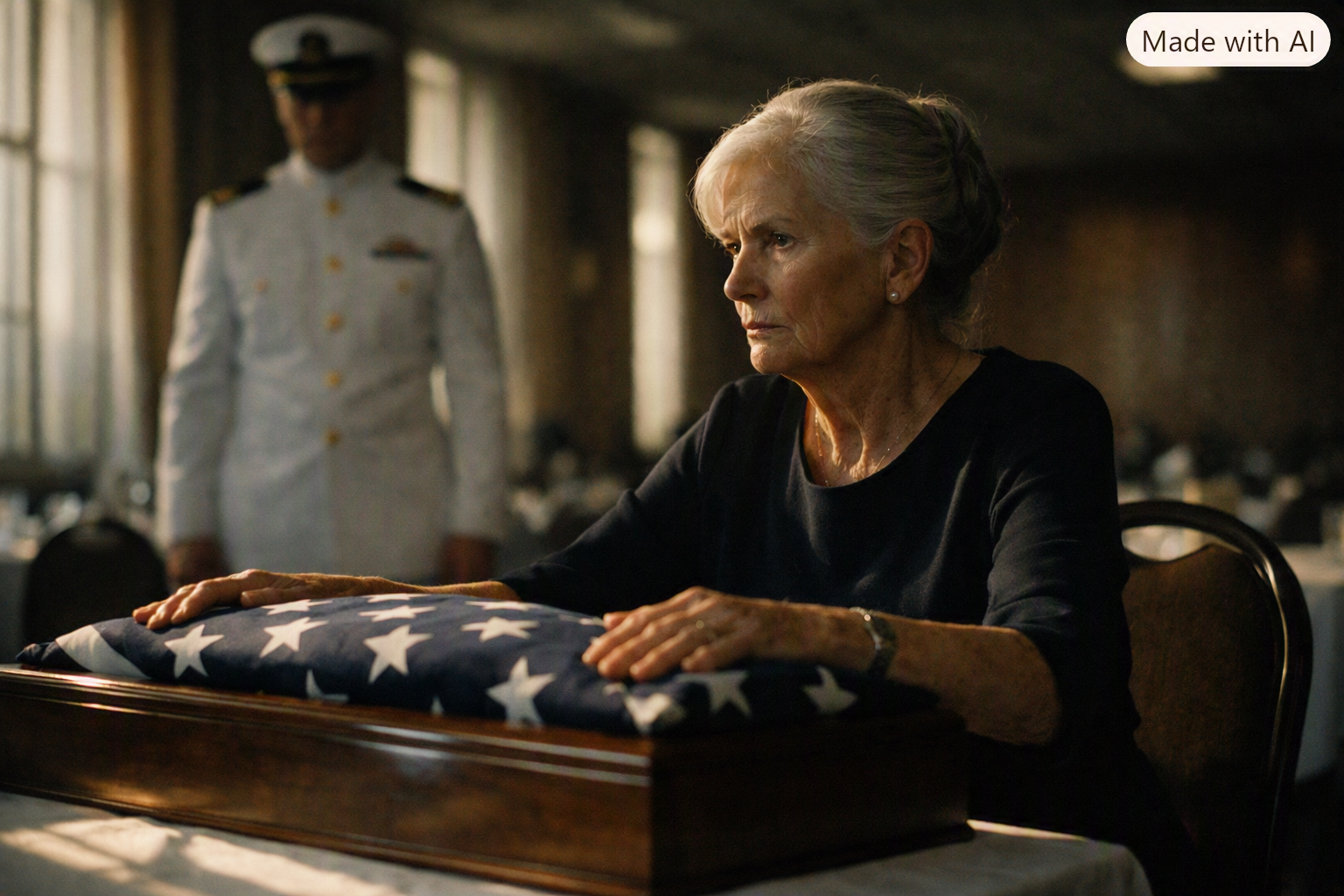
Two sailors stepped forward carrying a walnut memorial case beneath a precisely folded American flag. They placed it on the table with both hands and remained at attention.
Mason’s grip disappeared from Evelyn’s arm.
Rear Admiral Thomas Mercer rose and turned toward him.
“This woman gave three sons to this command.”
Evelyn bent carefully and picked up both pieces of her invitation. Her fingers trembled. Her voice did not.
“I did not come here for anyone’s pity.”
She looked at the flag, then placed the torn pieces beside it.
“I came to take the last soldier in my family home.”
No one moved.
The place card had read EVELYN ROSS the entire time.
The evidence had been there before Mason touched her.
Mercer’s jaw hardened as he studied the lieutenant.
“Admiral, I believed she was unauthorized,” Mason said.
Mercer pointed toward the torn invitation. “She told you otherwise.”
“The credential did not match my original list.”
“You destroyed the credential before verifying it.”
Mason opened his mouth. Then stopped. Every explanation now sounded like another accusation against himself.
Command Master Chief Luis Ramirez stepped beside him. “Lieutenant, stand away from Mrs. Ross.”
Mason moved backward. His heel struck the puddle beneath the chair and water climbed the edge of his polished shoe.
Nobody laughed.
That silence cut deeper than ridicule.
Mercer faced Evelyn. “We can move you somewhere private.”
“No.”
“My son’s team entered this room publicly.” She was gentle but immediate. “I will receive him publicly.”
“Yes, ma’am.”
Sailors adjusted the walnut case until it rested squarely before her. The folded flag covered its upper surface. A brass plate carried Andrew Ross’s name.
Evelyn didn’t touch the plate at first.
Andrew had hated polished furniture. He left rings from coffee cups on every surface he used.
She almost smiled at the thought. Then she saw a shallow scratch near the brass plate.
Her hand moved toward it.
“Was this with him?”
Mercer understood the question beneath the question. “The case contains recovered personal effects and remains confirmed through identification procedures.”
Evelyn closed her eyes.
“Was he alone?”
“No, ma’am.”
“Did his people come back?”
Mercer glanced toward the operators behind him. “All seven came back because of him.”
Evelyn opened her eyes and looked past the admiral.
The returning team stood in two rows. Their faces were controlled but exhausted. One man’s arm rested in a sling. Another had healing cuts along his temple. A broad-shouldered chief near the center looked directly at her—and his composure broke first. He lowered his chin and pressed his lips together.
Evelyn recognized him from Andrew’s photographs.
“Chief Nolan?”
The man stepped forward. “Yes, ma’am.”
“Andrew said you snored like a damaged lawn mower.”
A strained laugh escaped someone in the back row.
Chief Aaron Nolan’s eyes filled. “He said worse things about me, ma’am.”
“That sounds like him.”
The small laugh changed the room. It didn’t remove grief. It allowed everyone to breathe inside it.
Mercer gestured toward the soaked chair. “Bring another seat.”
Evelyn raised one hand. “Leave it.”
Mason looked at her, startled.
She continued without facing him. “I want the chair exactly where he left it.”
Ramirez studied her. “Mrs. Ross, may I ask why?”
“Because every person here should remember what certainty looks like before the facts arrive.”
Mason’s face tightened.
Mercer said nothing for several seconds. Then he nodded to the staff. “The chair stays.”
Mercer addressed Evelyn from the podium—quietly, without ceremony scripts.
He told the room about the mountain compound, the collapsed extraction route, the enemy fire that damaged the lead vehicle. He told them about Andrew taking a defensive position while wounded teammates crossed exposed ground, keeping the route open until the last operator reached cover.
He told them about the radio transmission that ended with Andrew asking about his mother’s leaking kitchen faucet.
A ripple of broken laughter moved through the team.
Evelyn covered her mouth. “That fool,” she whispered.
Chief Nolan heard her. “He made me promise to fix it.”
“You never did.”
“No, ma’am.”
“Then his final order remains outstanding.”
Nolan nodded, tears running freely. “I will fix it tomorrow.”
“You will eat first.”
“Yes, ma’am.”
“Andrew would never forgive me for starving his team.”
The men looked at one another. Their discipline couldn’t hold against the memory. One sailor wiped his face with the side of his hand. Another stared at the floor.
Mercer stepped away from the podium. “Mrs. Ross, your son was nominated for the Medal of Honor.”
The room inhaled.
Evelyn looked at him steadily. “You invited me for a medal?”
“We invited you because Andrew came home.”
“That is the only reason that matters today.”
“Yes, ma’am.”
“The medal may wait.”
Mercer considered the prepared ceremony behind him. Then he closed the presentation folder. “The medal will wait.”
No one objected.
Evelyn’s authority didn’t come from rank. It came from knowing exactly which symbols mattered and which could stay unopened.
Meanwhile, Captain Rebecca Sloan questioned Mason in the executive officer’s office.
Twenty-six years of service. She didn’t raise her voice. That made each question precise.
“Did Mrs. Ross show you an invitation?”
“Yes, ma’am.”
“Did you inspect the full credential?”
“No, ma’am.”
“Did she resist your instructions?”
Mason hesitated. “She stated that the guest of honor would not sit without her.”
“That was not my question.”
“No, ma’am.”
“Did she threaten anyone?”
“No, ma’am.”
“Did she behave disruptively before you approached?”
“No, ma’am.”
Sloan set down her pen. “Then describe the security necessity behind grabbing a seventy-three-year-old woman.”
Mason looked at the blank wall. “There was none, ma’am.”
“Why did you do it?”
“I believed immediate removal would prevent embarrassment.”
“For whom?”
He couldn’t answer.
Sloan waited.
“For the command,” he finally said.
“No.” Calm. Flat. “You were protecting your image of the command.”
Mason’s shoulders dropped a fraction. “Yes, ma’am.”
“You saw inexpensive clothing and decided she lacked standing.”
Silence.
“Answer.”
“Yes, ma’am.”
“You heard her explanation and decided her voice lacked credibility.”
“Yes, ma’am.”
“You destroyed official correspondence because verifying it might delay your control of the situation.”
Mason closed his eyes briefly. “Yes, ma’am.”
Through the office monitor, Mercer’s voice carried from the dining hall. The phrase “remained behind voluntarily.” Then “secured the evacuation route.” Each sentence stripped another defense.
Sloan muted the monitor.
“You will not use that man’s actions to punish yourself dramatically.”
Mason looked at her.
“Self-hatred can become another form of selfishness.” She folded her hands. “You will face facts, consequences, and the person you harmed.”
“Yes, ma’am.”
“You are temporarily reassigned pending investigation. Written account before eighteen hundred. And you will not contact Mrs. Ross until she chooses.”
“Yes, ma’am.”
Evelyn left the base after sunset.
Chief Nolan rode with Andrew’s case in the Navy vehicle behind her. The escort moved through Coronado traffic beneath orange streetlights.
At a stoplight, Evelyn looked in the mirror. The escort waited behind her.
For one impossible second, she imagined Andrew driving it. He would have honked. He would have called her phone and complained about her speed.
The light changed.
She drove on.
Her house stood on a quiet street lined with low fences and jacaranda trees. The porch light had been burning since morning. A neighbor named Carol watched from across the street—and stepped outside when the vehicles arrived.
Then Carol saw the flag and covered her mouth.
Evelyn walked to her first.
“Carol, this is my son’s team.”
Carol embraced her without speaking. The hug lasted several seconds.
“Andrew?”
Evelyn nodded. “He is home.”
The words nearly failed on the final syllable.
Nolan and another sailor carried the case inside. Evelyn directed them toward the living room.
Three framed graduation photographs stood on the mantel.
Daniel smiled with reckless confidence. Michael looked serious even at eighteen. Andrew appeared unable to keep his tie straight.
Nolan stopped when he saw them together.
“I have never seen all three pictures.”
“They hated formal photographs.”
“They look alike.”
“They argued about that.”
The men placed Andrew’s case beneath the mantel. For the first time in years, all three sons occupied the same room.
Two appeared in frames. One rested beneath a flag.
Evelyn stood until her knees weakened. Nolan moved quickly, but she lifted a hand.
“I can sit by myself.”
He let her.
“Chief. The kitchen faucet is still leaking.”
Nolan glanced toward the hallway. “I will fix it now.”
“You have one arm.”
“I can supervise.”
“Admirals supervise.”
“Then I will demonstrate leadership.”
A laugh escaped Evelyn before she could stop it. The sound turned into a sob.
Nolan knelt beside her. He didn’t touch her until she reached for his hand.
Then both held on.
“I should have brought him back sooner,” he whispered.
“You brought him back when you could.”
“He saved me.”
“I know.”
“I do not know what to do with that.”
Evelyn tightened her grip. “You live well enough that his choice remains worthy.”
Nolan lowered his head. “That sounds impossible.”
“It is.”
He looked up. “Then how?”
“One decent day at a time.” She glanced toward Andrew’s photograph. “He never mastered more than that.”
The team stayed for dinner.
Carol arrived with a casserole. A neighbor brought rolls. Someone drove to a twenty-four-hour diner for coffee and pie.
The men crowded Evelyn’s kitchen exactly as her sons once had. They opened wrong cabinets, misplaced serving spoons, argued about plates.
Evelyn corrected them sharply. The ordinary chaos steadied her.
A young operator named Ben Foster fixed the faucet. Nolan issued instructions from a chair with his healing arm.
“You need a new washer,” Ben said.
“I needed one eleven months ago,” Evelyn replied.
“Andrew did mention that.”
“He mentioned many things instead of fixing them.”
Ben tightened the fitting. Water ran without dripping.
The entire kitchen applauded.
Evelyn shook her head. “You people survive impossible missions and celebrate plumbing.”
Nolan raised his coffee mug. “Outstanding orders completed.”
They ate after nine. Nobody offered a formal toast. Nobody mentioned medals.
They told stories until midnight. Andrew had once hidden Nolan’s boots in a freezer. He had mailed a teammate’s mother flowers under the teammate’s name. He had lost a bet and sung country music during a training run.
The house was full again. Not the same full. A different kind—part memory, part presence, part grief wearing civilian clothes.
Evelyn sat at the center of it, tired and awake at once.
For the first time since the certified letter arrived, she was not alone with what she already knew.
Over the next six weeks, the Navy completed its investigation and formally disciplined Mason Cole.
His promotion review was delayed. Every ceremonial assignment was stripped. Captain Sloan required him to document each decision in his own words, without qualifications.
Mason wrote Evelyn a private letter—not to the admiral’s satisfaction, not to Sloan’s requirements. To Evelyn.
He admitted judging her clothing. Ignoring her words. Destroying evidence. Using force to protect his pride.
He asked for no forgiveness.
He stated plainly that her identity did not make his behavior wrong. He would have been equally wrong if she had been confused, or hungry, or simply sitting at the wrong table.
That line, Evelyn read twice.
She called Admiral Mercer the following afternoon and agreed to meet Mason at her home.
Saturday arrived with marine clouds over San Diego.
Mason parked outside her house ten minutes early. He waited in the car until noon exactly.
He wore plain working khaki. No medals on his chest. He carried no flowers.
Evelyn noticed that immediately and appreciated it.
Nolan opened the door. His arm had healed enough to leave the sling behind.
The two men looked at each other. Neither offered comfort.
Nolan led Mason into the living room. Mason stopped when he saw the three photographs above the memorial case.
Evelyn sat in an armchair by the window.
“Sit down, Lieutenant.”
Mason took the edge of the sofa. His eyes moved toward Andrew’s case, then away.
“Thank you for allowing me here.”
“I read your letter.”
“Yes, ma’am.”
“You wrote that my identity did not make your behavior wrong.”
“Yes.”
“Why include that?”
He kept his hands open on his knees. “Because I first understood my mistake only after learning who you were.” A pause. “That was another mistake.”
Evelyn waited.
“I would have been equally wrong if you had been hungry, confused, or sitting at the wrong table.” He looked at the floor. “I used respect as a reward for status.”
Evelyn’s gaze sharpened. “That is the first useful thing you have said.”
Mason accepted it. “Yes, ma’am.”
“Are you sorry because your promotion was delayed?”
“No.”
“Would you answer differently if it had not been?”
“I hope not.”
“Hope is not an answer.”
He took a breath. “I do not know who I would be without consequences.”
Evelyn leaned back. “That is honest.”
Mason looked toward the torn invitation, now framed beneath glass on a side table.
“You kept it.”
“I keep evidence.”
“Of me?”
“Of certainty.”
He nodded slowly.
“What do you want from me?” he asked.
Evelyn glanced toward Nolan. The chief stayed silent.
“I want you to tell me about your mother.”
Mason blinked. “My mother?”
“Yes.”
“She lives in Ohio.”
“Do you call her?”
“Not often enough.”
“Why?”
He looked down. “My father makes every conversation difficult.”
“Is your mother your father?”
“No.”
“Then stop punishing her for his voice.”
The question reached somewhere no investigation had touched. Mason’s face changed.
“My sons called me from impossible places,” Evelyn said. “You have ordinary roads and working telephones.”
“Yes, ma’am.”
“Call her before you leave.”
He nodded. “I will.”
“No.”
She pointed toward the kitchen. “You will call now.”
Nolan almost smiled.
Mason removed his phone. His hand trembled more than Evelyn’s had during the ceremony. He selected a contact.
A woman answered on the fourth ring.
“Mason?”
His expression broke at the single word. “Hi, Mom.”
Evelyn looked away, offering privacy without pretending not to hear.
The conversation lasted twelve minutes. Mason apologized for being absent. His mother cried. He promised to visit Ohio before winter.
When the call ended, he sat quietly.
Evelyn handed him a box of tissues. “Authority does not help with mothers.”
“No, ma’am.”
“Good.”
Mason wiped his eyes. “I do not expect forgiveness.”
“You should not.”
He nodded. “Do you believe people can change?”
Evelyn considered him for several seconds.
“I raised three teenage boys.”
Nolan laughed first.
Mason managed a small smile. “That sounds like a yes.”
“It sounds like evidence.”
Evelyn stood and walked toward Andrew’s case. She lifted the torn invitation from its frame—the two halves aligned but not taped.
She placed them in Mason’s hands.
His smile disappeared. “I cannot take this.”
“You are not taking it.”
She handed him a small roll of archival tape. “You are repairing it.”
Mason looked at the delicate paper. “I may damage it.”
“You already did.”
Nolan folded his arms. “Follow instructions, Lieutenant.”
Mason moved to the dining table. He aligned the torn edges carefully. The task required patience, light pressure, and acceptance that the seam would remain visible.
Evelyn watched his hands.
“Do not hide the tear.”
“I was going to tape the back.”
“Good.”
“The front will still show.”
“That is the point.”
He secured the first section. Then the second. When he finished, he returned the invitation.
A pale line crossed Evelyn’s printed name.
She examined it. “Better.”
“Not perfect.”
“No honest repair is.”
Mason looked toward Andrew’s photograph.
“I am sorry your son came home that way.”
Evelyn’s face tightened. “Thank you.”
It was the first expression of condolence she had accepted from him.
He didn’t add anything.
That restraint mattered.
On the second anniversary of Andrew’s return, the base held a private remembrance.
Evelyn arrived early. The dining hall had been renovated, but the same tables remained.
A new lieutenant checked her invitation at the entrance. He read the entire card, confirmed her identification, welcomed her by name.
Mason stood farther inside, now serving as a training officer. His promotion had been approved after sustained performance and formal review. He wore the new rank without display.
When he saw Evelyn, he approached but stopped several feet away.
“Mrs. Ross.”
“Lieutenant Commander Cole.”
“May I escort you to your seat?”
“You may.”
He walked beside her—not ahead.
At the front table, two chairs waited. Neither was labeled guest of honor.
One place card read EVELYN ROSS.
The other read ANDREW ROSS AND TEAM.
Evelyn touched the second card. “Whose idea was this?”
“Chief Nolan’s.”
“Then the spelling is probably wrong.”
Mason smiled. “We checked it four times.”
“Growth.”
“Yes, ma’am.”
A glass of water stood beside the empty chair.
Evelyn looked at Mason.
He understood. “Would you like it removed?”
“No.”
She sat. “Leave everything where it belongs.”
The team entered together a few minutes later. Nolan walked first, carrying Andrew’s field notebook and three photographs instead of a memorial case.
The men took seats around Evelyn.
Mason remained standing at the edge.
Nolan pointed toward the final chair. “Sit down, Commander.”
Mason hesitated. “That place is for the team.”
Nolan looked at Evelyn.
She gave a small nod. “You heard the chief.”
Mason sat.
For the first time, he joined the table he once believed he was protecting.
No admiral announced the moment. No camera recorded it.
Outside, San Diego Bay shone beneath a clear afternoon sky.
Inside, Evelyn opened Andrew’s notebook to a page filled with grocery lists, radio frequencies, and a reminder about her faucet.
Everyone laughed quietly.
The laughter faded into comfortable silence.
Evelyn placed the repaired invitation beside the notebook. The seam remained visible. So did Andrew’s handwriting.
She rested one hand over each.
Around her sat men who had survived, one man who had changed, and memories that still carried weight.
The empty chair remained empty. Nobody pretended otherwise.
Evelyn looked toward it, then toward the people who had come home.
For that afternoon, loss and return occupied the same table. Neither erased the other.
The room stayed quiet as sunlight moved across the repaired paper.
Evelyn finally said, “All right, boys. Let’s eat.”
Original fictional stories. AI-assisted creative content.