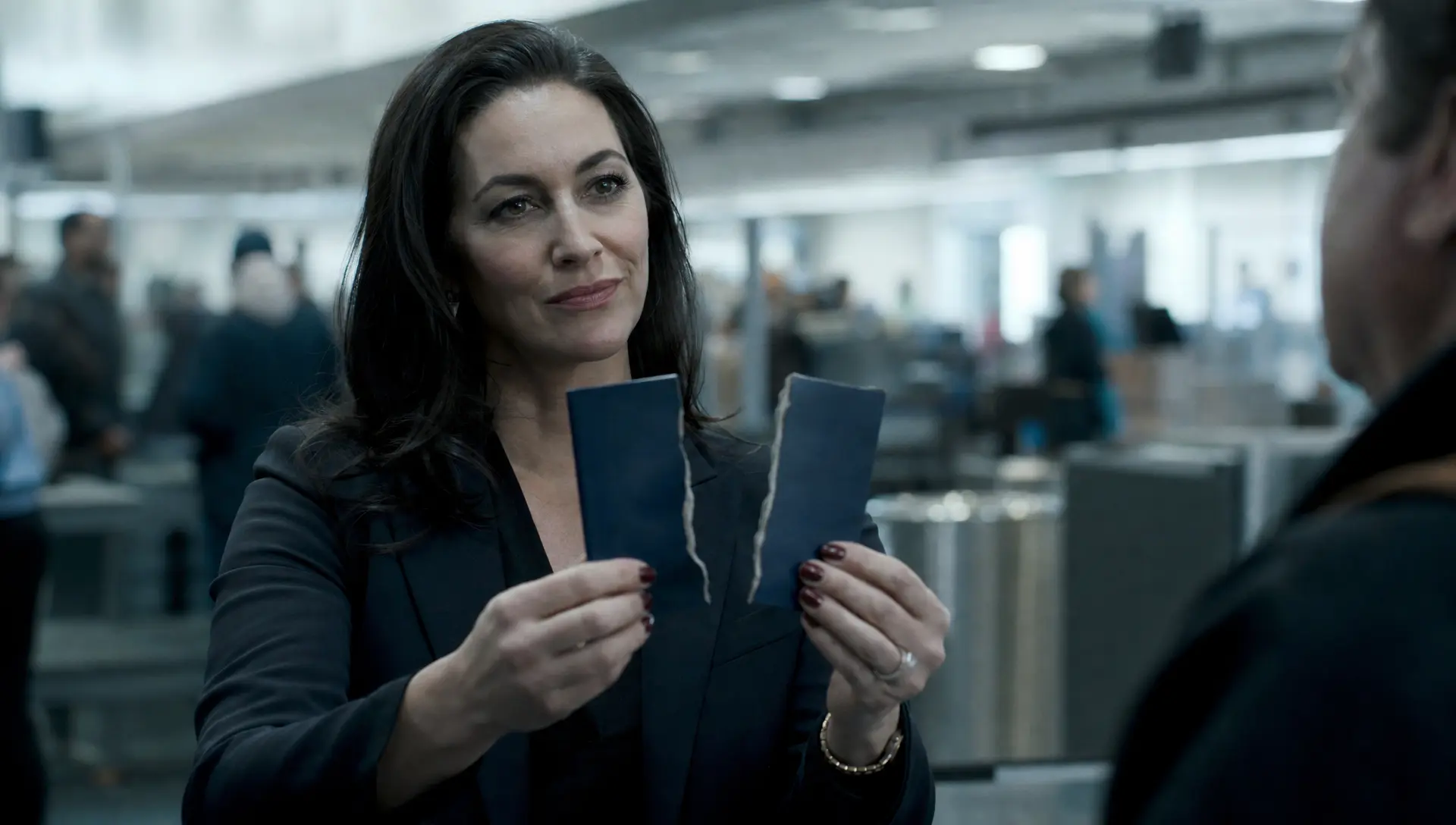
The sound was small and final—one clean tear, then another.
Vanessa held both halves of my passport between polished fingers, then let them fall into the gray airport trash can like she was dropping a paper towel. “You’re not going to Hawaii, Maggie,” she said, that pleasant voice she uses when she wants to leave no marks. “You’re staying home to watch my cats.”
Behind me, a little boy stopped crinkling his snack bag. A man in a navy jacket slowly lowered his phone.
My daughter Emily stood three feet away and studied the floor. She has my eyes and Paul’s soft mouth. Today she had no courage.
“Come on, Maggie.” Derek checked his watch and gave me the kind of pat reserved for stray dogs. “It’s probably for the best. You’d slow us down anyway.”
I looked at the trash can. I looked at the brown leather planner on my shoulder.
Thirty years in corporate finance taught me one thing: people show you exactly who they are when they believe you have no leverage.
“Next party,” the gate agent called.
Vanessa stepped forward like she owned the morning. Derek followed. Emily finally whispered, “Mom.” Not I’m sorry. Not stop her. Just Mom, like the word might clean up the mess she’d made by standing completely still.
I did not raise my voice.
I walked past my family to the customer service desk.
The agent’s name tag said Rita. The first thing she did was look at me—not at Vanessa. That small courtesy nearly broke something loose in my chest.
“I’d like to check in for Honolulu with my driver’s license,” I said. “And I’d like to report that woman for destroying my passport.”
Vanessa’s certainty cracked first, then her color. “That—you need a passport for Hawaii.”
Rita’s eyebrows lifted slightly. “Hawaii is a U.S. state, ma’am. A driver’s license is sufficient for domestic travel.”
Derek gave a hollow laugh. “Okay. Fine. Then let’s not make this a whole police thing.”
“I want the destruction documented,” I said. I didn’t look at him.
The officer who arrived was younger than Emily, with a patient face and a notebook. Notebooks have a way of reminding people how fragile charm really is. He asked who had torn the passport.
Before I could answer, the man in the navy jacket stepped forward. “I saw it. She ripped it twice and dropped it in the trash.”
The mother behind him added, “I recorded part of it.”
For years, Vanessa had built her entire method on private cruelty. She had never once considered witnesses.
Emily pressed her fingers against her lips. “Mom, please don’t do this.”
I finally looked at her. “You watched her do it.”
“I froze.”
“Yes,” I said. “You did.”
That was the exact moment I stopped confusing love with exemption from consequences.
Rita quietly arranged a seat change so I wouldn’t have to fly beside any of them. I used accumulated points to upgrade myself to first class—points I had been saving for a someday that Paul never lived to see.
As I walked down the jet bridge, I could hear Vanessa demanding to know whether the airline could legally “separate families like this.”
The irony was so complete it almost made me laugh.
Honolulu opened around me in warm air and plumeria.
The first day, I slept. The second, I ate breakfast alone overlooking the water and discovered that loneliness feels entirely different when no one is using you. On the third day, I turned on my phone.
Forty-seven messages.
Most were from Emily. A few from Derek. Vanessa had sent exactly two.
The first: You embarrassed me in public.
The second: Princess hasn’t eaten since yesterday. Call me.
I stared at that second message for a long time.
Then, for the first time in nine years, I didn’t solve the problem.
I opened my brown leather planner instead.
The Travel tab had never been the only reason I carried it.
Behind it were copies of every loan, transfer, and account authorization I had made since Paul died. Derek’s business loan had not been a gift. Neither had the emergency mortgage payment, the car note, the private-school tuition deposit, or the credit card balance I’d quietly cleared after Emily called me sobbing one winter. I had kept records because finance people keep records, even when mothers tell themselves the money doesn’t matter.
The total came to $186,400.
I called my attorney, June Park, from the hotel balcony. She listened without interrupting while I described the passport, the cats, Sophie’s flinch, and Emily’s silence.
“Do you want repayment?” June asked.
“I want boundaries with teeth.”
June understood immediately.
By noon, three things had happened. My automatic transfers to Emily’s household stopped. Derek received formal notice that his outstanding business loan would be called per the signed agreement he had once laughed off, saying no mother would actually enforce it. And I removed Emily as successor trustee from the small family trust Paul and I had built for the grandchildren.
I did not cut Lucas and Sophie off. I did the opposite—I moved their educational funds into protected accounts no parent could raid.
Then I went swimming.
The ocean held me without asking anything in return.
When I came back to my room, Emily had left a voicemail. Her voice was raw and young-sounding, the way it used to be before Derek.
“Mom, Derek says the bank account is short and Vanessa says this is all because of me. Please call me. I know I should have stopped her.”
I listened to it twice.
Then a message arrived from an unfamiliar number. It was Sophie.
Grandma, can I talk to you alone?
I called back immediately.
Her voice was barely above a breath. “Is Vanessa going to be mad at me?”
“Why would she be mad, sweetheart?”
A pause.
“Because I told Dad she grabs me too hard sometimes.”
Every nerve in my body went quiet and sharp at the same time.
Sophie began to cry softly. “She says I’m dramatic. She locks my phone in her room when I tell.”
The memory of Vanessa’s fingers closing around Sophie’s shoulder at O’Hare rearranged itself into something new. Not a rude gesture. Evidence.
“Where is your father right now?”
“Downstairs. They’re fighting.”
“Where is Lucas?”
“With me.”
“Lock the bedroom door,” I said, keeping my voice even. “I’m going to call your father right now.”
Derek answered on the sixth ring, already angry before he knew why. “Maggie, if this is about the loan—”
“It’s about Sophie.”
Silence.
I told him exactly what she’d said.
He defended Vanessa automatically at first—reflexes, not conviction. Then I described the flinch at the airport, the shoulder grip, the confiscated phone. Then I asked him one question.
“When your daughter is afraid, do you want to be Emily at O’Hare?”
That landed.
Twenty minutes later, Derek texted: Kids are with me. Vanessa left.
I sat on the edge of the hotel bed and shook.
For the first time since Paul died, the family’s crisis was resolving without my money, my labor, or my surrender. All I had supplied was the truth.
The rest of the trip changed after that.
I took a boat tour. I bought a ridiculous wide-brimmed sun hat. I ate pineapple so sweet it hurt my teeth. Each evening I checked in with Sophie and Lucas, but I didn’t let Derek or Emily turn those calls into negotiations.
On my last night, June called again.
“There’s something else,” she said. “When Vanessa filed a counter-complaint accusing you of making a false report, it triggered a routine records check.”
“Of course she did.”
“She had no idea your passport number was already flagged in an active federal identity-theft case.”
I sat up straight. “What?”
June exhaled carefully. “Someone tried to use your passport information six months ago to open an offshore payment account.”
The room seemed to tilt.
“Who?”
“No final determination yet. But the application used an email address tied to Derek’s company.”
I closed my eyes.
Derek’s bridge loans. His unexplained urgency. Vanessa’s insistence that I stay home. The passport destroyed before I could reach the international check-in lounge.
Suddenly the humiliation at O’Hare looked less impulsive.
When I landed in Chicago a week later, Emily was waiting near baggage claim. Alone. No Derek. No Vanessa. Her face looked older—the kind of older that comes from a week of looking at yourself clearly.
“Mom,” she said. “I need to tell you something before you hate me.”
“I don’t hate you.”
That made her cry harder.
She told me Vanessa had found a scan of my passport in an old travel folder months earlier. Derek had used it as identity support for a financing application after his business credit collapsed. Emily had known he was desperate. She claimed she hadn’t known my documents were involved.
“And the scene at the airport?” I asked.
Emily wiped her face. “Vanessa panicked when you said you were going through the international lounge. She thought the system might flag the passport number. The cats were an excuse.”
I held her gaze until she looked away.
The torn passport had never been about keeping me home.
It had been about destroying evidence they were afraid I might present—without knowing I already had it.
Derek was indicted three months later on financial fraud charges.
Vanessa cooperated with investigators after they recovered messages in which she had written that the old lady’s passport problem needed to disappear. Her cooperation earned her a reduced charge. It did not erase what she had done.
Emily separated from Derek and began the long, humbling work of rebuilding trust with her children. I did not rescue her from that work. I helped her find a good therapist. I answered the phone. I did not write the checks.
The following spring, I returned to O’Hare with Sophie and Lucas.
We were flying to Hawaii. Together.
At the security line, Sophie squeezed my hand. “Grandma,” she said quietly, “do you have your passport?”
I smiled and held up a brand-new blue booklet.
“Yes.”
Then I showed her what mattered more: a slim folder with their travel consents, protected account documents, and emergency contacts.
“Always keep your own papers,” I told her. “And never let anyone convince you that love requires you to hand over your proof.”
As we walked toward the gate, my phone buzzed.
Emily: Have a beautiful trip. I’m proud of you for going.
I didn’t know yet whether full forgiveness would come.
But I knew something better.
I was finally going somewhere because I wanted to go—and nobody in my family had the power to tear that choice in half.
Original fictional stories. AI-assisted creative content.