My robot hit the gym floor and shattered in front of eight hundred students.
The sound was louder than I expected.
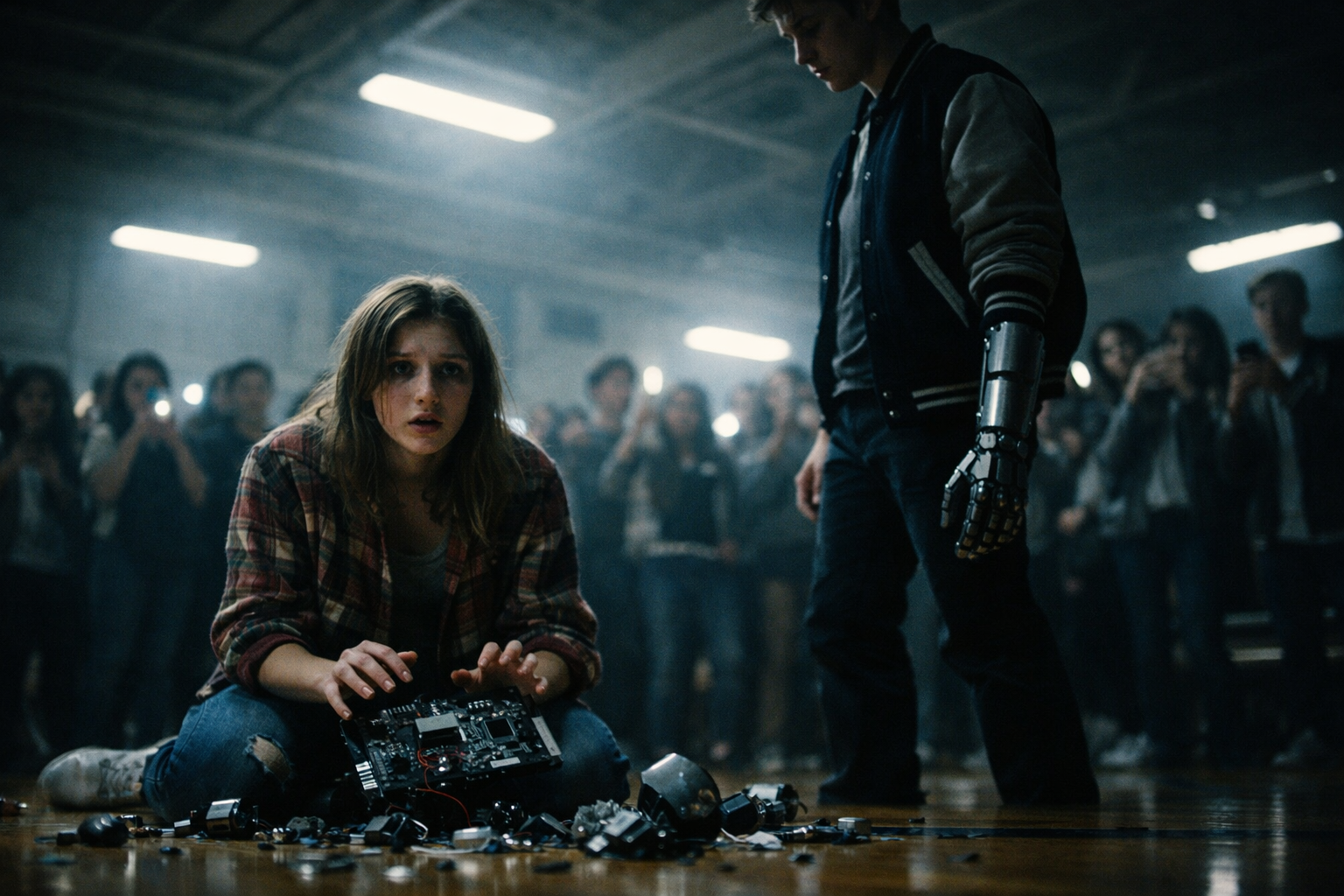
Metal cracked. Plastic panels snapped. One wheel rolled beneath the judges’ table.
The small blue light I had spent three months programming flickered twice, then went dark.
For a few seconds, nobody moved. Then someone laughed.
That was all it took. The laughter spread through the bleachers. Phones rose into the air.
I stood beside the display table, unable to breathe.
My name is Nora Ellis. Senior at Westfield Academy for Science and Engineering. I built that robot — Sparrow — to identify gas leaks and carry emergency supplies into places too dangerous for rescue workers.
I hadn’t always wanted to build things. That started three years ago, when a gas leak two blocks from our house forced an evacuation in the middle of the night. My father, a volunteer firefighter, went in before the utility crew arrived because a neighbor’s dog was still inside. He came out fine. But I remembered standing on the sidewalk in my pajamas, watching him disappear into a house that could have exploded, and thinking someone should have built something that didn’t need a person to take that risk.
So I taught myself circuitry from library books that summer. Then sensor arrays. Then code, one broken program at a time, in a garage that still smelled like sawdust from my dad’s old workbench. By junior year I was staying after school in the robotics lab most nights, the only girl in a room usually dominated by boys who assumed the equipment belonged to them first and me second.
Grant Mercer never had to prove he belonged anywhere.
He’d been science club president since sophomore year, unopposed, because nobody wanted to run against the son of Mercer Technologies’ founder. He was smart — genuinely smart, not just well-funded — but he’d never once had to sit with an idea that didn’t work. His father hired tutors for anything that didn’t come naturally, and any project that stalled got quietly redirected with company resources until it succeeded. I used to watch him breeze through the lab, other students orbiting him like he was already something important, and wonder what that kind of certainty felt like.
We’d been polite to each other for two years. Not friends. Just two people who nodded in hallways and occasionally partnered on lab assignments neither of us wanted to fail. I didn’t know, until the night everything fell apart, how much pressure had been sitting underneath that easy confidence of his.
Dr. Wallace Crane had run the robotics program for twelve years, and most students respected him. He’d built the program from nothing — one classroom, a handful of donated parts — into a lab with a state grant and a wall of competition trophies. What I didn’t know then was how much of that funding now depended on staying close to families like the Mercers, and how far a person can bend when an entire program’s future rests on one sponsor’s approval.
I didn’t think about any of that the morning of the competition. I only thought about Sparrow, charged and ready, sitting in its case in the back seat of my mom’s car, three months of my life folded into a machine the size of a toolbox.
I had no idea it would end up in pieces on a gym floor by that afternoon.
The gym had been transformed for the regional showcase — bleachers pulled out on both sides, a row of display tables draped in the school’s navy and gold colors, judges from three local universities seated behind a folding table near center court. Westfield’s science department treated this event like a mid-season championship game. Half the school showed up, some for the robots, most for the excuse to skip last period.
Now Sparrow lay in pieces at my feet, and none of that history mattered anymore.
Grant Mercer lowered the steel demonstration arm he’d used to knock it off the table. Science club president. Top of the class. Son of the man who owned Mercer Technologies.
“Stop pretending that thing belongs to you,” he said.
The gym went silent.
“What?”
“You stole my design.”
Gasps rippled through the crowd.
Behind him, Dr. Wallace Crane — faculty advisor for twelve years — looked disappointed. Not surprised. That scared me more than the accusation.
“We discovered serious evidence this morning,” Crane said to the judges.
“What evidence?”
Grant opened his laptop. The screen above the stage lit up with a folder labeled SPARROW — ORIGINAL FILES, timestamped six months earlier. Circuit diagrams. Code. All under Grant’s name.
“I filed these with the school in March,” Grant said. “Nora had access to the shared robotics lab computer. She copied my work.”
Whispers turned into open murmurs.
“That’s not possible,” I said. “I built Sparrow from scratch. I have three months of dated build logs—”
“On your personal laptop,” Crane cut in. “Which conveniently can’t be verified by the school network.”
My hands were shaking. “Conveniently? I never used the shared computer for this project. Ask anyone in the lab.”
Nobody spoke. The lab kids stared at their shoes.
“The judges will need time to review this,” Crane announced. “Until then, Miss Ellis is suspended from the competition.”
I looked at the wreckage of Sparrow scattered on the floor and felt something break that had nothing to do with metal.
That night I sat in the empty robotics lab with the door locked. I pulled every file, every timestamp, every version history I had. My hard drive logged every single edit — down to the minute — because I’d set it up that way after a professor warned me plagiarism accusations happen more than people think.
I had proof. What I didn’t have was anyone who’d believe a senior against the school’s golden boy and a faculty advisor with twelve years of credibility.
Then I remembered something. The shared lab computer had a security camera above the door — installed two years ago after a theft. If Grant claimed I’d used that computer, there’d be footage proving I never did.
I emailed the IT department at 11 p.m. asking for the footage from the past six months. I didn’t expect an answer until Monday.
I got one in forty minutes.
“Ms. Ellis — before I pull that footage, I should mention something. Mr. Mercer requested the same date range be deleted from our backup server two days ago. I flagged it but didn’t act on it yet. Do you want me to preserve it?”
I read the message twice.
Grant had tried to erase the exact footage that could clear me.
“Yes,” I typed. “Preserve everything. And please loop in the principal.”
The footage came through the next morning. Six months of timestamped video. Grant appeared exactly four times — each time working alone, late at night, on a project that had nothing to do with Sparrow. I appeared over sixty times, always at my own laptop, in the corner desk, building my robot piece by piece on camera without ever touching the shared machine.
I brought the footage to Principal Reyes myself, along with the IT email showing Grant’s deletion request.
Reyes watched in silence, jaw tightening with every clip.
“Where is Dr. Crane?” she finally asked her assistant.
“In his office.”
“Bring him. And Mr. Mercer. Now.”
Twenty minutes later, we sat across from each other in Reyes’s office. Grant’s confidence had thinned into something brittle.
“Explain the deletion request,” Reyes said, sliding the IT email across the desk.
Grant glanced at it and said nothing.
“I’ll explain it,” I said. “He panicked when I asked IT for the footage. Because that footage proves I never touched the shared computer — and it proves he’s the one who filed false timestamped documents to make it look like his idea predated mine.”
“That’s a lie,” Grant said, but his voice cracked on the last word.
Reyes turned to Crane. “Did you know about the deletion request?”
Crane’s silence answered for him.
“I asked him to handle it quietly,” Crane finally admitted. “I didn’t think it would come to this.”
“You mean you didn’t think you’d get caught,” Reyes said.
She turned to Grant. “Why would a student with your resources need to steal a design?”
Grant’s jaw tightened. “Because my father’s company is sponsoring the National Young Innovators finals this year. If I don’t place top three from this school, he pulls the sponsorship and the funding for next year’s robotics program disappears. He told me that himself.”
“So you decided to destroy someone else’s robot instead of building a better one,” Reyes said.
Grant didn’t answer.
Reyes stood. “Effective immediately, Mr. Mercer is disqualified from this competition and placed on academic probation pending a full disciplinary review. Dr. Crane, you’ll be meeting with the school board this week to discuss your role in suppressing evidence.”
Crane’s face went pale. “Twelve years—”
“Twelve years doesn’t cover falsifying an investigation,” Reyes said.
She turned to me. “Miss Ellis, I’m reinstating you immediately. And I’ve already called the competition committee. They’re aware of the situation.”
I exhaled for what felt like the first time in two days. “What about Sparrow? It’s in pieces.”
“You have three days until nationals submission,” Reyes said. “Can you rebuild it?”
I thought about the spare parts in my garage. The backup 3D-printed frame I’d made in case something went wrong. The nights I’d already spent memorizing every wire.
“Yes,” I said. “I can rebuild it.”
I didn’t sleep much over the next three nights. My hands ached from soldering. My mom brought coffee to the garage at 2 a.m. without saying anything, just setting the mug down and squeezing my shoulder before going back inside.
By the third night, Sparrow rolled across the garage floor, blue light steady, sensors calibrated, exactly as it had been before Grant’s steel arm crushed it.
The night before nationals, I got a text from a number I didn’t recognize.
“This is Marcus, I work in the robotics lab. I should’ve spoken up when Crane suspended you. I saw you build that robot with my own eyes. I’m sorry I stayed quiet. I already told Reyes everything.”
I stared at the message for a long time before typing back: “Thank you for telling the truth. That’s what mattered.”
At nationals, I stood in front of a different panel of judges, in a different city, with Sparrow steady on the table beside me. I explained the sensor array, the emergency payload system, the mapping software I’d written from nothing.
One judge asked, “What made you build this?”
I thought about my father, who used to say even the smallest thing could survive a storm.
“I wanted to build something that goes into the places people are too afraid to go,” I said. “Something that survives when everything around it is falling apart.”
Sparrow won second place nationally. Not first — a team from Ohio built something extraordinary — but second, out of three hundred entries, after being smashed on a gym floor five days earlier.
Back at Westfield, the story had already spread. Grant’s disqualification was public. Mercer Technologies quietly withdrew its name from the school’s sponsorship list — not because Reyes forced them out, but because Grant’s father, once he learned the full story, refused to let his company be associated with what his son had done.
Dr. Crane resigned before the board meeting could vote on his termination.
Grant transferred schools the following semester. I heard he still builds things — quietly now, without an audience, without a father standing behind every decision demanding results.
I don’t know if that’s punishment or the beginning of something better for him. I stopped needing to know.
What I do know is this: Sparrow still sits on a shelf in my room, blue light blinking, wheels a little scratched from the fall, a small dent in its side panel that I never bothered to fix.
I kept the dent on purpose.
It reminds me that something can be broken in front of everyone who’s laughing and still get back up rebuilt, stronger, and undeniably yours.
Original fictional stories. AI-assisted creative content.