The garage smelled like hot rubber and money.
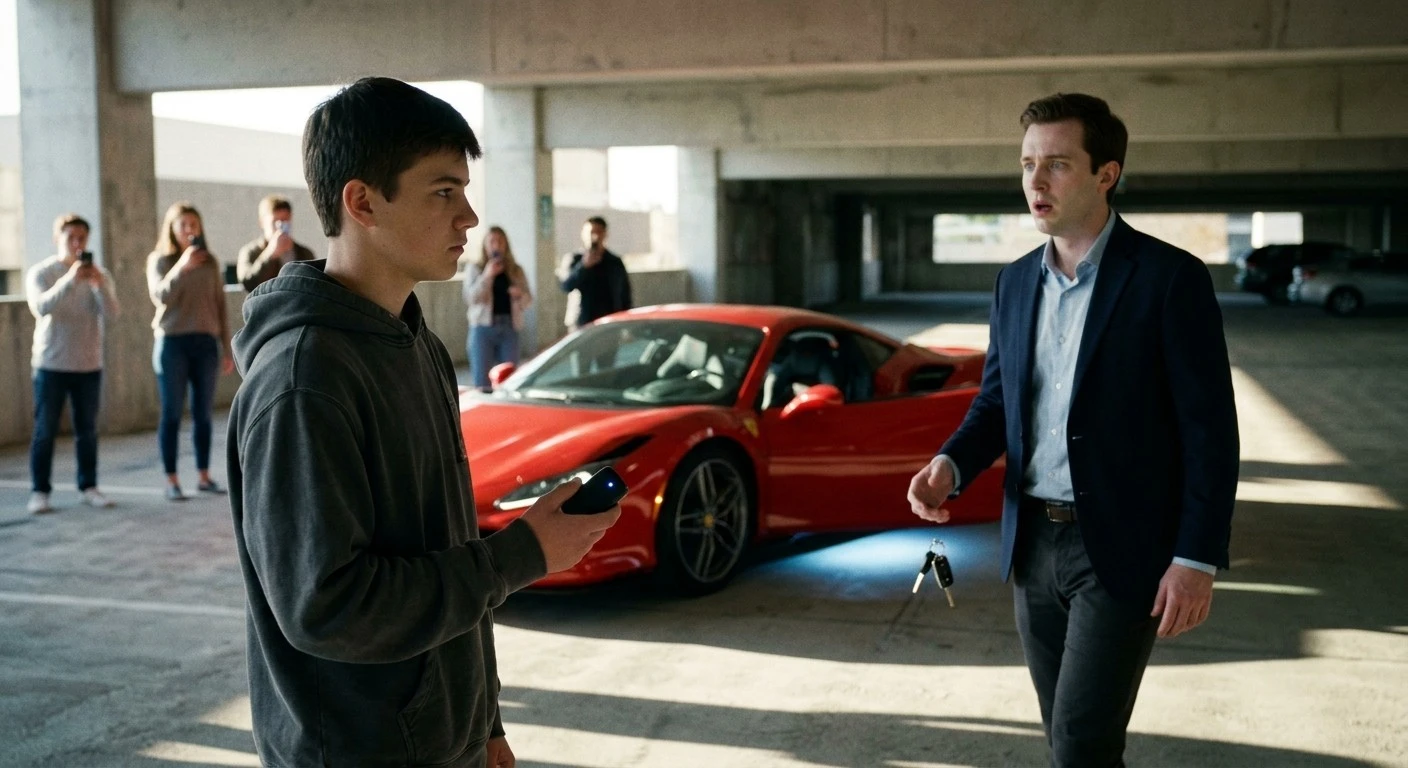
Julian Ashworth leaned against the Ferrari like it was an extension of his own spine. Red paint. Center spot. Two empty stalls on either side, because the building manager knew better than to park anything near it.
Leo Vane stood six feet away in a hoodie that had survived three winters.
“Don’t even breathe on it, kid,” Julian said, spinning his keys on one finger. “The paint job costs more than your dad made in his whole life.”
“You’re very sure it’s yours,” Leo said.
“It’s my father’s. Which makes it mine by extension. That’s how families like mine work.” Julian smiled the way rich men smile at doormen. “How does your family work? Foreclosure notices?”
Leo didn’t answer that. He’d learned a long time ago that the people who ask questions like that don’t want real answers.
“I’ll make you a bet,” Leo said instead. “If I can unlock that car right now, without your keys, you get on your knees and apologize. To me. And to every person in this garage you’ve ever talked down to.”
Julian laughed, and it echoed off the concrete pillars like a gunshot in a church.
“And if you can’t?”
“Then I’ll carry your bags to the elevator for a month. Your choice.”
Julian looked at the security guard by the exit, looked at the two valets pretending not to listen, looked at the boy in the ten-dollar hoodie standing in front of a car worth more than a house.
“Deal,” Julian said, and threw his keys at Leo’s feet like he was tossing scraps to a dog.
Leo didn’t pick them up.
He reached into his pocket and pulled out a small black device, matte and cold, with a single blue light pulsing on its face.
“What is that,” Julian said. It wasn’t a question anymore. His voice had changed.
Leo pressed his thumb to the surface. The car’s interior lights bloomed a deep, authoritative blue. The engine woke up on its own, a low predatory hum vibrating through the concrete floor.
A synthesized voice filled the garage, calm and clear.
“Access granted. Welcome back, Owner: Leonardo Vane.”
Nobody laughed. Nobody breathed.
Julian’s face went the color of old paper.
“That’s — that’s not possible,” he said. “This is my father’s car. It’s registered to Ashworth Capital. The company holds the title—”
“The company held the title,” Leo said. “Past tense.”
“What does that mean?”
“It means you should read the mail your father doesn’t let you see.”
Julian’s hands were shaking now, and he hated himself for it, because Ashworths didn’t shake. Ashworths made other people shake.
“You’re lying,” he said. “This is some kind of prank. Did my father’s assistant give you access to a spare key? Is this a sick joke from one of his rivals?”
“No joke,” Leo said. “No rival. Just paperwork.”
“What paperwork.”
“The kind that says who actually owns Ashworth Capital’s fleet, its downtown properties, and forty-one percent of its outstanding debt.” Leo said it the way other people read a grocery list. “I bought it eight months ago. Quietly. Through six shell companies, because I didn’t want anyone panicking before I was ready.”
“Ready for what.”
“For this conversation.”
Julian’s jaw worked, searching for the sentence that would put the world back in order. It didn’t come.
“You’re a kid,” he finally said. “You’re seventeen. You don’t buy debt. You don’t own companies. Look at you — you look homeless.”
“I look like someone people don’t watch,” Leo said. “That’s useful.”
The security guard by the exit had stopped pretending. He was filming now, phone held low against his hip, the way people film things they know they’ll want to show someone later.
“Turn that off,” Julian snapped at him.
The guard didn’t.
Julian’s phone buzzed. He looked down, and for one second, hope flickered across his face — a lifeline, an explanation, someone telling him this was a mistake.
It was his father. Calling.
He answered on speaker without thinking, hands trembling too hard to hold it to his ear properly.
“Dad. Dad, there’s a kid down here in the garage, he’s got some kind of device, the car just—”
“Julian.” His father’s voice came through tight and strange, stripped of its usual boardroom polish. “Julian, listen to me very carefully. Do not say anything else in that garage. Do you understand me? Not one more word.”
“What is happening?”
“I’ll explain when I get there. Do not touch the car. Do not touch the boy. Just — wait.”
The line went dead.
Julian stared at the phone like it had bitten him.
“He sounded scared,” Julian said, mostly to himself. “My father doesn’t sound scared.”
“He will,” Leo said. “He’s had eight months to prepare for this and he still wasn’t ready. That’s the thing about houses built on other people’s ruins. They feel solid right up until they don’t.”
Marcus Ashworth arrived eleven minutes later in a car that wasn’t the Ferrari, moving faster than a man in a three-thousand-dollar suit should move.
He stopped ten feet from Leo and went very, very still.
“Leonardo,” he said. Not “kid.” Not “boy.” A name, spoken like it had weight.
“Marcus,” Leo said back, no honorific at all.
“You’ve made your point,” Marcus said, low, urgent, like a man trying to negotiate a hostage situation. “Whatever this is — whatever grievance — we can handle it privately. In my office. With lawyers. Not like this. Not in front of my son.”
“Your son is exactly who needs to hear it,” Leo said. “He’s been living off a fortune that isn’t real for his whole life. Somebody should tell him before the rest of the world does.”
“Dad, what is he talking about,” Julian said, and his voice cracked on the word Dad in a way it hadn’t since he was nine years old.
Marcus didn’t answer his son. He was looking at Leo the way a drowning man looks at the shoreline.
“Please,” Marcus said. “Not here.”
“Ten years ago,” Leo said, “you sat across from my father at a table very much like the ones in your boardroom. He’d built a logistics company from nothing. Forty employees. A warehouse he owned outright. You offered to invest. You offered to save him during a bad quarter.”
“Leo, don’t,” Marcus said.
“You restructured the loan three times,” Leo continued, and his voice never rose, which somehow made it worse. “Each time, the terms got a little more impossible. Each time, you smiled and called it a partnership. And when the balloon payment came due on a date you’d quietly moved up without telling him, you took the whole company for eleven cents on the dollar.”
“That was a legal transaction,” Marcus said. “Every signature was his own.”
“He didn’t understand what he was signing,” Leo said. “You made sure of that. You picked him because he trusted you. You picked him because he wasn’t the kind of man who’d think to hire his own lawyer to check yours.”
Julian looked between them, his whole understanding of his own life rearranging in real time.
“Dad. Is that true?”
Marcus didn’t answer. That was answer enough.
“He had a heart attack four months after you took everything,” Leo said. “Did you know that? Did anyone from Ashworth Capital send flowers? A card? Anything?”
Marcus’s face had gone the color of the concrete around them.
“I didn’t know,” he said quietly.
“You didn’t ask,” Leo said. “That’s different. I was thirteen. I watched him lose a company he’d built with his hands and then lose the will to fight for what was left of it. I spent four years learning everything I could about how money actually moves. Not the version they teach in school. The real version. The version where paperwork is a weapon if you know how to hold it.”
“So this is revenge,” Julian said, like saying the word out loud might make it smaller.
“No,” Leo said. “Revenge would be burning it down. I bought it instead. Piece by piece. Quietly. Your father’s company has been leveraged past its actual value for three years, propped up by loans nobody scrutinized because nobody expected the eighteen-year-old kid buying up distressed debt in shell companies to be the son of a man your father destroyed.”
He looked at Marcus.
“I own forty-one percent of Ashworth Capital’s debt,” Leo said. “As of nine a.m. this morning, I own sixty-two.”
The number landed in the garage like a dropped weight.
“That’s not possible,” Marcus said, but his voice had lost its certainty completely. “The board would have flagged a shift like that.”
“The board flagged it an hour ago,” Leo said. “Check your email.”
Marcus’s hand went to his pocket like it belonged to someone else. He pulled out his phone. His thumb moved. His face changed.
“You forced an emergency vote,” he said, reading. “You—”
“I called for a shareholder meeting,” Leo said. “This afternoon. Three o’clock. I already have the votes. I just wanted your son to hear the reason before the headlines did.”
“Why,” Julian said. It came out smaller than he meant it to. “Why do it this way. Why the car. Why the bet. Why not just — take it, if you already had the votes.”
For the first time, something in Leo’s face softened, just slightly, like a crack of light through a closed door.
“Because you needed to feel it,” Leo said. “Not read about it in a press release. Feel the second where the ground stops being solid. That’s what your father did to mine, standing in a boardroom while my dad signed his life away smiling, because he trusted the man across the table.”
“I never even met your father,” Julian said.
“No,” Leo said. “You just inherited the money he took. That’s how it works. You don’t have to do the harm yourself to live inside its results.”
Marcus stepped forward, and for a moment something like the old confidence flickered back into his shoulders.
“You’re a child playing a very dangerous game,” he said. “You think a shareholder vote erases twenty years of infrastructure? Relationships? Lawyers who will bury a seventeen-year-old in litigation before the ink dries on your paperwork?”
“Try it,” Leo said. “I’ve had eight months and forensic accountants going through every restructured loan Ashworth Capital has signed in a decade. Yours isn’t the only family my father’s company destroyed, Marcus. It’s just the first one I could prove in a courtroom with documentation clean enough to survive your lawyers.”
He held up the black device again, tapped it once.
“There are fourteen other companies with paperwork just like his,” Leo said. “Fourteen other founders who signed something they didn’t understand because they trusted the smile across the table. I have all fourteen files. I have the emails where you moved payment deadlines without formal notice. I have the recorded call where your CFO admits the interest calculations were, quote, ‘designed to be confusing.'”
Marcus said nothing. There was nothing to say that wouldn’t make it worse.
Marcus’s phone rang again. This time he didn’t answer on speaker.
“Get legal down here,” he said into it, voice low and clipped. “Now. Garage level. Bring Halloran.”
Four minutes later, a woman in a charcoal suit strode out of the elevator with a tablet already in her hand, two junior associates trailing behind her like nervous shadows.
“Mr. Ashworth,” she said, “I need everyone to stop talking immediately.”
“Too late for that, Halloran,” Marcus said.
She turned to Leo, sizing him up the way lawyers size up problems — looking for the seam, the weak point, the place where a claim could be made to unravel.
“Whatever documents you believe you have,” she said, “acquiring debt through shell entities without proper disclosure could constitute securities fraud on your end. I’d be very careful about what you say next, on the record, in front of witnesses.”
“I disclosed everything through the proper regulatory filings six weeks ago,” Leo said, unbothered. “Form 13D. Public record. Your compliance team should have flagged it. I’m guessing they didn’t, because nobody at Ashworth Capital expected to be watched by someone they’d already written off.”
Halloran’s expression flickered, just slightly, the first crack in her composure.
“That’s not possible,” she said. “We monitor every filing that touches our shareholder structure.”
“Check again,” Leo said. “Look for Vane Meridian Holdings. Then look for the four entities beneath it. I made it easy to find, once you knew to look. I wanted this done in daylight. Not in some backroom settlement nobody outside this garage would ever hear about.”
Halloran’s thumb moved fast across her tablet. Marcus watched her face instead of the screen, and whatever he saw there made his shoulders drop half an inch.
“He’s right,” she said quietly. “It’s filed. It’s clean.”
“Find something,” Marcus snapped. “There has to be a hole somewhere.”
“There isn’t one I can see yet,” Halloran said. “Not standing in a parking garage with four minutes of prep time.”
“Take all the time you need,” Leo said. “I’m not going anywhere. I own the building your office sits in.”
By the time the elevator doors opened behind them, word had already reached the lobby. Employees who normally wouldn’t dream of loitering near the executive garage were finding excuses to walk past. Phones were already up, already filming, already texting each other links to nothing yet, just rumor moving faster than fact.
“Get inside,” Marcus told Julian. “Now.”
“No,” Julian said.
It was the first time in the conversation his voice hadn’t cracked.
“You lied to me,” Julian said, looking at his father like he’d never seen him before. “My whole life you told me we built this. You told me Grandpa built the first branch with a folding table and a phone line, and we grew it through hard work and good instincts. You never said anything about — this.”
“Julian—”
“Did you take his company?” Julian said. “Just answer me. Yes or no.”
Marcus’s silence lasted three full seconds. In front of a crowd now forming at the garage entrance, three seconds felt like an hour.
“The terms were legal,” Marcus finally said.
“That’s not a no,” Julian said.
Leo watched the exchange without pleasure. He’d imagined this moment for four years, and none of the versions in his head had included the small, sick feeling of watching a boy his own age realize his whole family story was a lie built on someone else’s ruin. There was no joy in it. Just the cold relief of finally being believed.
“There’s a bet still open,” Leo said quietly.
Julian turned to him. His face had lost the arrogance completely now, scraped down to something raw and young.
“You want me to kneel,” Julian said. “In front of all these people. Is that really what this is about? Humiliation?”
“No,” Leo said. “The bet was never really about the knee. It was about whether you’d honor a deal once it stopped favoring you. That’s the whole difference between your family and mine. My father honored every clause he signed, even the ones that ruined him. Your father broke his word the second it was profitable to.”
Julian looked at the crowd. Looked at his father, who wouldn’t meet his eyes. Looked at the Ferrari, which had never really been his to begin with.
Then he knelt down on the hot concrete, in the middle of the garage, in front of the security guard, the valets, and the growing crowd with their phones raised.
“I’m sorry,” Julian said, and his voice carried farther than he expected, bouncing off the pillars the way his father’s laugh once had. “For everything I said to you today. And to anyone else I’ve talked down to in this building, because I thought money meant I’d earned the right to.”
Nobody laughed at him. It wasn’t that kind of moment anymore.
His mother arrived twenty minutes later, heels clicking fast across the concrete, phone still pressed to her ear from the call that had pulled her out of a lunch meeting.
“Marcus, what is happening, the assistant said something about a shareholder emergency—” She stopped when she saw her son still on his knees, the crowd still watching, her husband’s lawyer standing frozen with a tablet in her hand.
“Get up, Julian,” she said. “Get up right now, you don’t kneel for anyone.”
“He does today,” Leo said.
Diane Ashworth turned on him with the particular fury of a mother who has just watched her family come apart in a public parking garage.
“And who exactly are you?”
“Leonardo Vane,” he said. “My father used to run a logistics company. Forty employees. Ask your husband what happened to it.”
“I don’t know what fantasy you’ve constructed—”
“Diane,” Marcus said quietly. “Stop.”
She looked at him. Really looked at him, in a way that suggested she’d spent a decade choosing not to look too closely at how the money moved through their lives.
“Marcus,” she said, and her voice had changed too, the anger draining into something more like dread. “Tell me he’s lying.”
Marcus didn’t answer. He’d stopped being able to answer that question an hour ago.
“Oh my god,” Diane said, and put a hand over her mouth, and for the first time since arriving, she looked less like a woman defending her family and more like a woman realizing she’d been living inside someone else’s crime scene the entire time. “The Danvers settlement. The Whitfield account. I asked you about those years ago and you told me it was routine restructuring.”
“It was,” Marcus said.
“It wasn’t,” Leo said. “I have the Whitfield file too. That’s founder number six on my list.”
Diane sat down on the low concrete curb beside the empty parking space, the same one Julian had been staring at, and put her face in her hands, and didn’t say anything else for a long time.
The shareholder meeting happened at three o’clock exactly, in a conference room two floors above the garage, and by three-forty it was over. Sixty-two percent doesn’t need a long meeting.
Marcus Ashworth was removed as CEO of the company that bore his name. The board — Leo’s board now, in every way that mattered — appointed an interim chief financial officer with instructions to begin restitution proceedings for the fourteen founders whose loans had been restructured under terms a forensic audit was already calling, in writing, “predatory and possibly fraudulent.”
Leo’s father was the first name on that list.
By five o’clock, financial news sites were running headlines with words like “reversal” and “reckoning” and “teen investor.” None of them had the full story yet. That would come later, in depositions and filings and the kind of detailed reporting that takes weeks, not hours.
The next morning, a woman named Priya Danvers stood in front of a bank of cameras outside the new company’s headquarters, her hands steady on a podium she’d been offered and almost hadn’t believed was real.
“Nine years ago, Ashworth Capital restructured my family’s shipping business into bankruptcy,” she said. “I lost my warehouse. I lost forty jobs I’d promised to protect. I lost eleven months to a depression I never talked about publicly, because I thought it was my failure, not theirs.” She paused, steadying her voice. “This morning, I received a settlement and a formal admission of wrongdoing. I want every founder watching this to know — it wasn’t your failure either. Check your old contracts. Ask someone to actually read them.”
A reporter shouted a question about Leo. Priya answered without hesitation.
“He found thirteen of us before any of us found each other,” she said. “That’s not luck. That’s someone who spent years reading contracts nobody else bothered to reread.”
Inside the building, Leo watched the broadcast on a monitor in what used to be Marcus’s office, his father seated beside him in a chair that had been reupholstered but never fully replaced.
“You didn’t have to include the others,” his father said. “You could have just fixed what happened to us.”
“No,” Leo said. “I couldn’t have. Not really. Fixing ours and leaving the rest would’ve just meant I learned the lesson and kept it for myself. That’s not fixing anything. That’s just switching which family gets to be comfortable.”
His father was quiet for a moment, watching Priya answer another question, watching thirteen years of quiet damage finally get a name in public.
“Your mother would have been proud of this,” he said finally. “She always said you noticed things other people didn’t want to see.”
“I had a good reason to start noticing,” Leo said.
Julian didn’t go home that night. He sat in the parking garage long after the crowd dispersed, on the concrete beside the empty space where the Ferrari used to sit, because Leo had driven it away hours ago and hadn’t looked back once.
His phone buzzed. A text, from a number he didn’t recognize.
The company’s under new management. Most of the executive team is being reviewed. You’re not on any of the lists, if that’s what you’re worried about. You didn’t do this. Your father did. You get to decide who you become next. — L.V.
Julian read it four times.
Then he typed back three words, and for once in his life, meant every one of them.
Show me how.
Three months in, Marcus Ashworth sat in a courtroom that felt nothing like a boardroom, in a suit his lawyer had told him to choose specifically because it looked less expensive than the ones he actually owned.
The prosecutor read the counts one at a time. Wire fraud. Securities fraud. Fourteen counts of predatory lending disguised as restructuring, each one tied to a name — Vane, Danvers, Whitfield, and eleven others the public hadn’t heard yet but soon would.
“Mr. Ashworth,” the judge said, “how do you plead?”
Marcus’s lawyer had prepared him for this moment for weeks. Deny everything. Let the process take years. Let appeals grind the truth into something too exhausted to matter by the time anyone actually read the verdict.
He looked over his shoulder instead, at the gallery, where Julian sat in the third row — not because he’d been subpoenaed, but because he’d asked to be there, every single day since the trial began.
“Guilty,” Marcus said.
The courtroom didn’t erupt. It just went very quiet, the particular quiet of a room absorbing a sentence that had taken a decade to become true.
Halloran, still his lawyer out of contractual obligation more than loyalty at that point, turned to him in disbelief. “Marcus, we had grounds for a plea to a lesser—”
“I know,” Marcus said. “I don’t want it anymore.”
Afterward, in the hallway outside the courtroom, Julian caught up to his father before the marshals did.
“Why?” Julian asked. “You could have fought it for years. Dragged it out. You always said a good lawyer buys time, and time is worth more than money.”
“I’ve spent your whole life teaching you that,” Marcus said. “Watching you kneel on that concrete taught me something faster than any lawyer ever could. I didn’t want you learning the rest of it from a man who kept lying in a courtroom while his own son watched.”
It wasn’t an apology, not exactly. But it was the first true thing Julian remembered his father saying without a deal attached to it.
Six months later, Leo stood in a boardroom that had once belonged to Marcus Ashworth, now repainted, renamed, restructured from the ground up. Fourteen founders had received settlement checks with more zeroes than any of them expected, funded by the sale of assets that had never rightfully belonged to Ashworth Capital in the first place.
Leo’s father sat at the head of the new company’s advisory board, his hands steady on the table for the first time in years, his name back on the door of a business he’d built twice — once with nothing, and once with the truth.
Julian worked two floors down, in compliance, the department nobody’s rich kid ever volunteers for, reviewing loan contracts line by line to make sure nothing like what happened to Leo’s father could ever happen again on paper he’d signed off on.
He’d sold his own car — a gift from his father, bought with money that was never really clean — and taken the bus to work every day since. Nobody made him do it. He just couldn’t sit in leather anymore without thinking about whose name should have been on the title.
Marcus Ashworth faced three separate civil suits and one criminal referral for fraud. He would spend the next several years in courtrooms instead of boardrooms, answering for the fourteen names on Leo’s list one at a time.
The Ferrari sat in Leo’s garage now, untouched, keys in a drawer.
He never drove it. He kept it as a reminder of exactly how much a signature can cost the person who trusts the hand offering the pen — and exactly how long it can take to make that signature mean something again.
On the one-year anniversary of the garage confrontation, Julian found Leo in the same underground level, standing near the same empty parking space, though neither of them mentioned that out loud.
“I read all fourteen files,” Julian said. “Every founder. Every restructured loan. I made compliance sign off on new templates so nothing like it can happen again without three separate people flagging the terms.”
“I know,” Leo said. “I get a copy of every filing that leaves this building. Old habit.”
“Do you think he’s actually sorry?” Julian asked. “My father. Or just caught.”
“Does it matter which, if the fourteen families got their money back and the next fourteen won’t lose theirs?” Leo said. “I stopped needing him to feel the right thing a long time ago. I just needed the paperwork to stop happening.”
Julian nodded slowly, looking at the space where a red Ferrari once sat like a manifesto of ego, now just an empty rectangle painted on concrete like any other.
“For what it’s worth,” Julian said, “I’m glad you didn’t take the easy version. Burning it down would’ve been faster.”
“Faster isn’t the same as finished,” Leo said. “I wanted this actually finished. Not smoldering. Finished.”
He turned and walked toward the elevator, the same way he had the day everything changed, except this time nobody threw keys at his feet, and nobody needed to.
THE END
Original fictional stories. AI-assisted creative content.