The Fairview Fresh Market sat on the corner of Clement and 9th, a mid-size grocery in a quiet part of the city that had never given anyone trouble. The parking lot was half full on a Tuesday afternoon — retirees, young mothers, the occasional delivery truck idling near the side entrance. Nothing happened here. That was the point of a place like this.
James Calloway walked out through the automatic doors at 2:17 p.m.
Seventy-four years old. Six feet even, though the years and the hip had taken maybe half an inch. He wore a plain gray jacket, dark slacks, and a pair of shoes that had been resoled twice and still held their shape. In his left hand he carried a single paper bag — milk, soup, bread. In his right, a wooden cane, straight-grained oak, worn smooth at the handle from years of use.
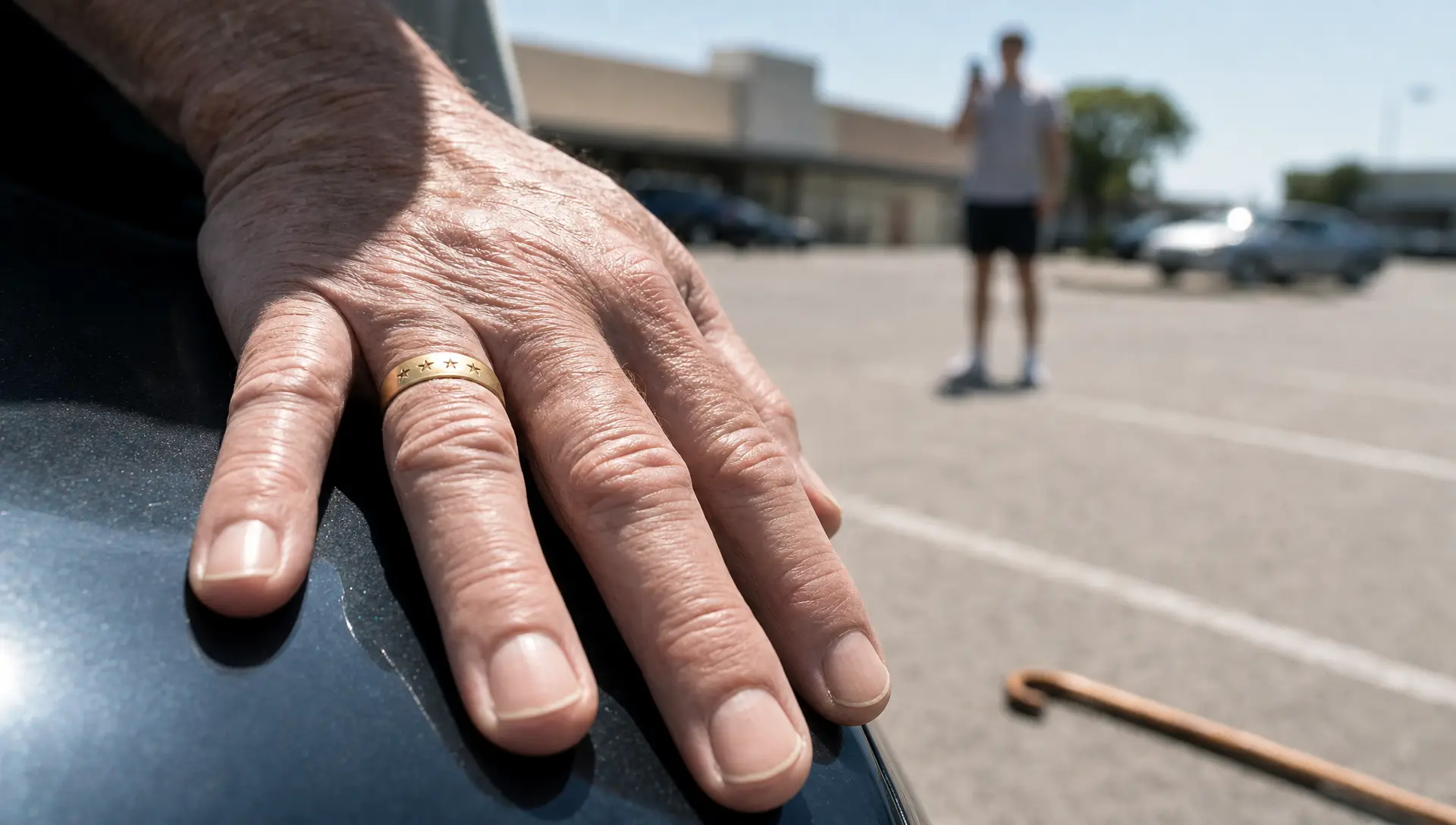
On the fourth finger of his left hand was a gold ring. Heavy, simple, with four small stars engraved into the band. He had worn it so long he no longer noticed the weight.
He had taken maybe ten steps into the lot when he heard them.
Three of them at first, leaning against a lifted pickup near the far row. Then it became clear there was only one who mattered — the one who peeled off from the group and started walking toward James with the loose, purposeless stride of someone who had decided something was going to happen before he’d even finished his energy drink.
Ryan Mast. Twenty-two years old. The kind of young man who had never been told no in any language he could hear. He’d grown up with enough money to avoid consequences and enough free time to fill the gap with the particular brand of cruelty that comes from being bored and untested. He was filming already — phone up, grinning at the lens, narrating something for whoever was watching.
“Check this out,” he said to the camera. “Free parking lot entertainment.”
James saw him coming. He adjusted his grip on the cane and kept walking. He had walked through things that would not fit in any sentence he had ever been willing to say at dinner tables. A twenty-two-year-old with a phone did not change his pace.
Mast cut sideways and stepped directly into his path.
James stopped.
“You need something?” James said. His voice was even. Not warm. Not hostile. The voice of a man who had long ago stopped wasting either.
“Nah,” Mast said, still filming. “Just looking at you, old timer.” He tilted the phone, getting the cane in frame. “What happened, you break a hip?”
“I’d like to get to my car,” James said.
“Yeah, in a second.” Mast circled slightly, the way young men do when they want a crowd even if there isn’t one yet. “You a veteran or something? You got that whole…” he waved a hand at James’s posture, his jacket, the straight line of his back, “…thing going on.”
“Move,” James said.
Mast’s grin widened. He looked at the camera, then back at James.
Then he kicked the cane.
Not a tap. Not a nudge. A sharp, deliberate sideways kick, boot connecting clean with the shaft, sending it cracking hard across the asphalt. The sound was louder than Mast expected — a hard crack that bounced off the surrounding cars and stopped two women near the entrance dead in their tracks.
James’s right side dropped. His weight shifted wrong. For one half-second the body did what bodies do when the ground changes unexpectedly — it fell toward the gap. But his left hand shot out and found the hood of the nearest parked car, a dark blue sedan, and caught there. Palm flat. Fingers spread. He held.
He did not go down.
He stood there for one full breath, hand on the car, cane on the asphalt six feet away, paper bag still in his left arm, milk intact.
Mast was already laughing for the camera. “Oh man — oh, did you see that—”
James turned his head.
He looked at Mast the way a man looks at something he has already completely understood and found, in the end, not particularly interesting. The eyes were dark and steady and they did not blink, and what was in them was not anger — anger was too fast and too loud for what was in James Calloway’s eyes. What was in them was older than that. Slower. The accumulated weight of thirty-one years of knowing what real danger looked like and what it cost and who paid.
He said, low and unhurried, with the full weight of a man who had never once needed to raise his voice:
“You picked the wrong man.”
Mast’s laugh hitched. Just for a second. The phone dipped half an inch.
Then he caught himself and laughed louder, covering it. “Oh yeah? That supposed to scare me, old man?”
James did not answer. He looked at the camera once — directly into the lens, steady and without performance — and then he pushed off the car hood, walked six paces, and picked up his cane.
He continued to his car.
Mast filmed his back the whole way, narrating. But the laugh had changed shape. There was something underneath it now that hadn’t been there before, and if you watched the footage later — and a lot of people were going to watch the footage later — you could hear exactly where it changed.
Sandra Okafor had been loading groceries into her trunk when it happened. Thirty-eight years old, still in her scrubs from the morning shift, two bags of groceries and a phone she’d pulled out to text her sister. She had pressed record the moment the kid started circling. She had a father who had served. She knew what she was looking at.
She had the whole thing. Approach, kick, the sound of the cane on the asphalt, the old man’s hand catching the car hood, the four words, the ring.
She watched it back once. Then she pulled up the number for the local veterans’ affairs office, which she had saved three years ago for reasons she’d never expected to be this specific, and sent them the clip with a single line of text:
Don’t know who he is but someone should.
She also posted it.
By the time James Calloway got home and put the milk in the refrigerator, the clip had been viewed sixty thousand times. By the time he sat down at the kitchen table, it was two hundred thousand. By the time he took the ring off and set it on the wood in front of him — the way he did every evening, the same ritual, the same pause — three local news stations had the clip, a veterans’ organization in the city had already identified him by the ring, and Ryan Mast’s mother had called him four times without getting an answer.
James’s phone rang at 4:40 p.m. A number he recognized.
Colonel Patricia Webb. Army, retired. She ran the regional veterans’ liaison office out of a suite on the fourteenth floor of a building downtown and had the particular gift of making phone calls that felt like operational briefings.
“James.”
“Patricia.”
“I’ve seen the footage.” A pause. “Are you hurt?”
“My pride took the worst of it. My palm’s scraped. My knee will complain tomorrow.”
“I need you to understand something.” Her voice was precise and unhurried. “What I’m about to do is not about you. It is not about that young man. It is about the six other veterans I know personally who have been treated like furniture in public spaces in the last eighteen months and had no one film it. You are going to be the case that makes the next six harder to ignore. Do I have your permission to move on this?”
James looked at the ring on the table. The four stars caught the light from the window the way they always did at this hour — the same angle, the same quiet gold.
“Do what needs doing,” he said.
“Good. Stay home tonight. You’ll hear from me by morning.”
She hung up.
Patricia Webb made nine phone calls in the next two hours. She spoke to the director of the city’s veterans’ services board, two city council members who owed her professional debts of varying sizes, a journalist at the Tribune who had been waiting for a story with documentation this clean, the regional director of an advocacy organization with a legal team, and — last, and most carefully — Ryan Mast’s father, Gerald Mast, who ran a mid-size commercial real estate firm and whose number she had obtained in under twenty minutes.
That conversation lasted four minutes.
Gerald Mast did not speak for the first ninety seconds of it.
When he did speak, he said: “What does he want?”
“He hasn’t asked for anything,” Patricia said. “That’s what should worry you most.”
Ryan Mast had spent the afternoon at his friend Derek’s apartment, watching the view count climb with the particular excitement of someone who had never understood the difference between attention and consequence. He had posted the clip himself first, adding a caption that he deleted forty minutes later when the ratio went wrong. By then it didn’t matter — Sandra’s version was the one spreading, clean and unedited, with the sound of the cane on the asphalt intact and the four words clear as a bell.
His phone rang at 6:15 p.m. His father.
He let it ring. Then called back.
Gerald Mast’s voice on the phone was a voice Ryan had only heard twice in his life — once when Ryan totaled the car at seventeen, once when Gerald found out about the incident at the lake house. Quiet. Stripped of everything except a kind of dense, pressurized calm that meant the performance of not shouting was costing something.
“Come home,” Gerald said.
“Dad, it was a joke—”
“Come home now, Ryan. Don’t stop anywhere. Don’t post anything. Don’t answer anyone who isn’t me or your mother. Do you understand what I’m saying to you?”
The view count was at four hundred thousand. There were news vans outside the apartment complex. Ryan hadn’t noticed them yet.
“Yeah,” Ryan said. “I’m coming.”
Ryan arrived home to find his father standing in the kitchen with a woman Ryan didn’t recognize — mid-fifties, short gray hair, posture like a person who had stopped caring what she looked like while standing and started caring exclusively about where she was standing and why. She had a legal pad, a pen, and the expression of someone who had already done the math.
“Sit down,” Gerald said.
Ryan sat.
The woman’s name was Carol Finch. She was the family attorney. She set the legal pad on the table and did not open it.
“Here is what has happened,” she said, without preamble. “The footage of your actions this afternoon has been viewed, as of twenty minutes ago, over half a million times across three platforms. The man you assaulted is James Calloway. Retired United States Army, thirty-one years of service, two combat deployments, retired with the rank of four-star general. He is currently represented, informally, by Colonel Patricia Webb, who has already been in contact with the city veterans’ affairs board, two council members, a Tribune journalist with the full unedited footage, and your father. What Colonel Webb has made clear is that General Calloway has not asked for anything. He has simply made himself available. That is the most dangerous position the other side of a situation like this can occupy.”
Ryan stared at her. “I didn’t know who he was.”
“That is the least useful thing you could say right now and I need you to stop saying it,” Carol said, not unkindly. “What matters is not who he is. What matters is what you did, which is documented in full, with audio, from two angles, with a witness who is a medical professional and who has already given a statement. The question in front of this family right now is not whether consequences are coming. They are coming. The question is whether you meet them or whether they find you.”
Gerald’s jaw was set so hard the muscles at the sides of his face had gone rigid.
“What does that mean?” Ryan asked.
Carol turned the legal pad over. She had written three things on it in clean block letters.
Public apology — in person, on record. Community service — veterans’ organization, minimum 120 hours, documented. Restitution — veterans’ fund, amount to be agreed, no negotiation.
“This,” Carol said, “is what meeting it looks like. These are not punishments I invented. These are the terms Colonel Webb indicated would satisfy the parties involved and prevent this from becoming a criminal matter — which, for the record, it currently qualifies as under two separate statutes. You are twenty-two. A criminal record follows you. This—” she tapped the legal pad “—does not.”
Ryan looked at his father.
Gerald looked at the table. Then at his son. Then back at the table. When he spoke, his voice had lost the pressurized quiet and replaced it with something older and more tired.
“I built what I built,” Gerald said, “so that you wouldn’t have to be afraid of anything. I see now that was the mistake.” He pushed back from the table. “You’re going to do everything on that list. Every item. You are going to do it because it is right and because I am telling you to and because that man’s cane is on a parking lot somewhere on Clement Street right now and it should not be.” He stood up. “I’ll be in my study.”
He left the room.
Ryan looked at the legal pad for a long time.
Then he picked up the pen.
James Calloway heard about the agreement the next morning, when Patricia called at eight.
“It’s done,” she said. “Apology, in person, at a time and place of your choosing, with a veterans’ organization rep present. Hundred and twenty hours at the Clement Street VA. Restitution to the regional veterans’ fund. The father is paying. The son is showing up.”
“And the footage?” James asked.
“Stays up. That was non-negotiable. Seven hundred thousand views as of this morning. The comments are—” she paused. “People are angry on your behalf. Productively so.”
James poured his coffee. Outside the kitchen window the morning was ordinary — the kind of morning that does not know or care what happened the day before.
“Will he actually show up?” James asked. “The hours.”
“I’ll be checking personally,” Patricia said. “Every week.”
A pause.
“James. How are you?”
He looked at the ring on his finger. Four stars in gold, catching the morning light through the window, the same as always.
“I’m fine,” he said. “I’ve been in worse places than a parking lot.”
“I know,” she said.
“The milk survived,” he said. “That’s something.”
Patricia Webb laughed. It was a short laugh and a real one, the kind that comes when a long tension finally finds a small gap.
“Get some rest,” she said. “You’ve earned it.”
He said goodbye and set the phone down and stood at the kitchen window with his coffee and watched the morning do what mornings do — move forward, indifferent, ordinary, carrying yesterday inside it without comment.
He had buried better men than Ryan Mast would ever understand. He had stood in weather that had no business being as peaceful as it was and read names off paper while flags were folded into triangles. He had signed his name to orders that cost people things they could not get back. He knew what weight felt like when it was real and what it felt like when it was theater.
Yesterday had been real.
The cane was back in its place by the door.
The ring was on his finger.
That was enough.
THE END
Original fictional stories. AI-assisted creative content.