The briefcase hit the marble counter like a gavel.
Every head in the lobby turned.
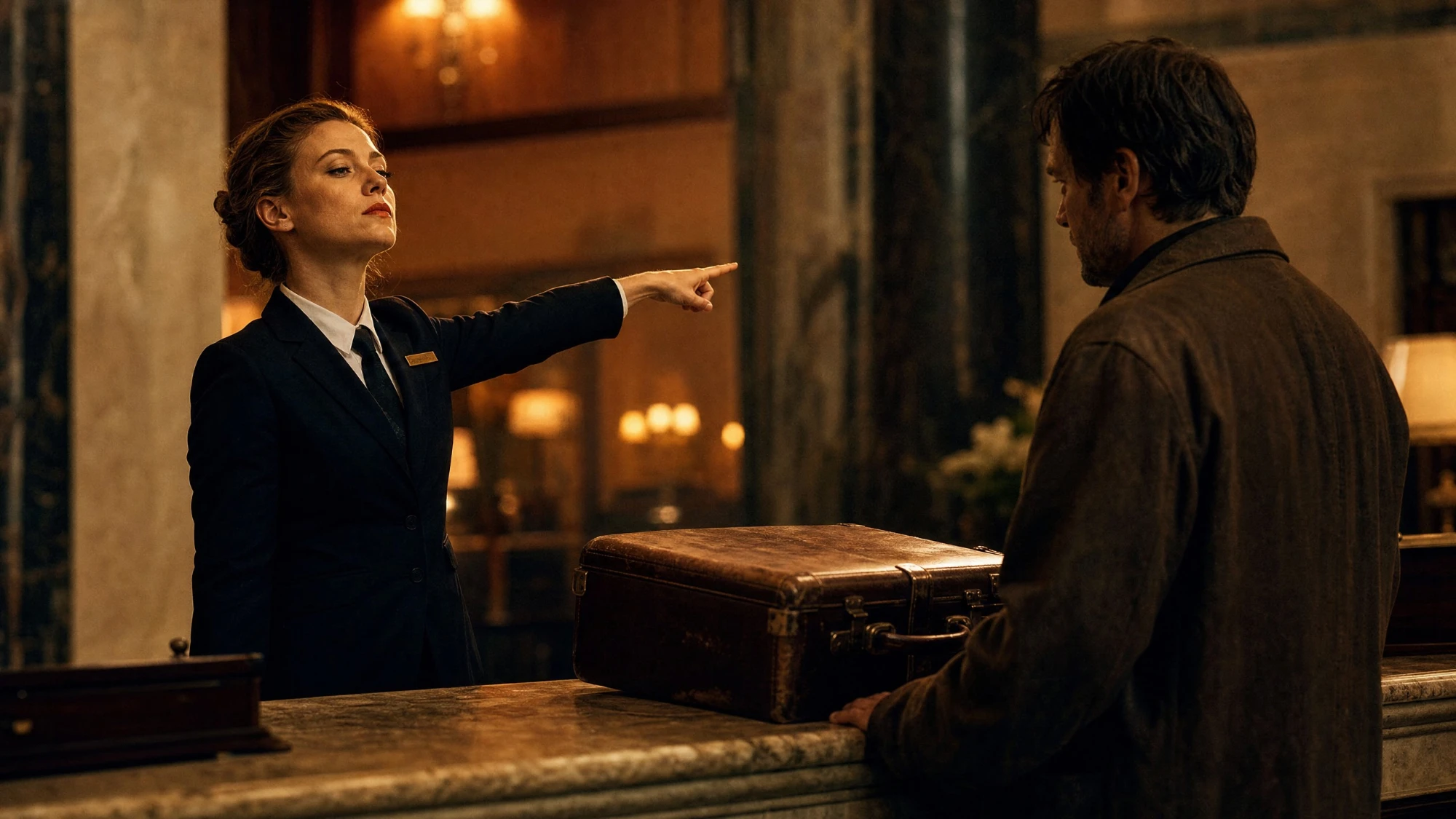
The man standing at reception looked like he’d walked in from the wrong side of the city. Coat fraying at the collar. Shoes dull with road dust. Hair uncut, slightly wild. His hands were steady, though. The kind of steady that comes from a long time not needing anyone’s approval.
The receptionist—tall, pressed uniform, name tag reading Diane—looked him over the way people look at something they’re about to ask maintenance to remove.
“I’d like to check in,” he said. His voice was even. Almost kind.
Diane’s smile came out like a weapon with perfect lipstick on it.
“I think you may have the wrong address.”
She pushed the briefcase back toward him with two fingers.
He didn’t move. “Are you sure?”
Diane’s eyes slid left. One look. That was all it took.
The security guard—built like a refrigerator, name tag reading Marcus—stepped in from the side and placed a firm hand on the man’s shoulder.
“Sir. Let’s get you back outside.”
The man let himself be walked. Didn’t flinch. Didn’t argue. The revolving door spun them both out onto the sidewalk while a couple near the check-in desk leaned in and whispered to each other.
Outside, under the amber streetlight, the man stopped.
Marcus released him. “Look, I don’t make the—”
“Give me one second.”
The man reached into his ragged coat and opened it.
Underneath was a white shirt so crisp it looked ironed ten minutes ago. A suit jacket the color of deep midnight blue. A silk tie. And clipped to his breast pocket—a laminated badge with a gold emblem above his name.
NATHANIEL COLE — EXECUTIVE DIRECTOR, COLE HOSPITALITY GROUP.
Marcus stared at it.
Then at the man’s face.
Then back at it.
“Sir,” Marcus said. The word came out differently now. Smaller.
“It’s fine,” the man said quietly. “You were doing your job.”
He walked back through the revolving doors.
Diane was already at her station, fingers hovering over the keyboard, performing busyness. She looked up when the doors opened and her expression shifted through three stages in one second—annoyance, recognition, and something that was trying very hard to become a smile.
“Sir, I—”
“Don’t.” He said it gently. Not cruelly. Just with the kind of finality that closes doors.
He set the briefcase on the counter and clicked it open.
Inside: inspection folders. Photographs. Incident reports printed in triplicate. And on top, a single sealed envelope stamped with the company’s crest.
He took out his phone.
“Send the board to the Meridian Suite. Now.”
Diane made the call.
Her hands were shaking.
He watched the elevator numbers descend—12, 11, 10—and didn’t speak.
“Sir,” Diane tried again. “I want to explain—”
“Tell me what you didn’t know.”
“I—” She stopped. Her throat worked. “I didn’t know who you were.”
“What did you think I was?”
She couldn’t answer that.
He nodded slowly. “There it is.”
The elevator opened. Five people stepped out—two women, three men, all in expensive suits, all holding tablets or folders, all going still the moment they registered who was standing at the front desk in a tattered coat over a tailored suit.
The CEO of Hotel Operations, Patricia Raines, took one step forward. Her eyes moved from Nathaniel to the briefcase to the expression on Diane’s face.
“Nathaniel. We weren’t expecting you until—”
“I know.”
He turned to face the board.
“I came as a guest. The kind of guest this hotel no longer knows how to see.”
Patricia’s jaw tightened. She looked at Diane.
Diane was staring at the floor.
“I’ve been doing this every quarter,” Nathaniel said. “Different location. Different disguise. Because my father told me that every five-star hotel eventually forgets the first star was earned by treating every person at the door like they mattered.”
He touched the lapel of the ratty coat.
“This belonged to him.”
Marcus, who had quietly moved back inside and was standing near the entrance, took his hat off.
“He wore it the night Cole Hospitality opened its first property. Thirty-two years ago. He’d just come off a double shift at a diner three blocks from here to afford the lease deposit.” Nathaniel’s voice stayed flat, but something moved behind his eyes. “The first guest who walked through that door was a man in dirty work boots who wanted a warm room. My father gave it to him at half price and carried his bag himself.”
Patricia said nothing.
No one did.
“This hotel turned away twelve guests in the last ninety days for appearance-based reasons,” Nathaniel said. He opened one of the folders and set it on the counter. “Three of them were journalists. Two were medical professionals coming off overnight shifts. One was a veteran visiting his daughter’s graduation.”
The photos were inside the folder. Diane looked once and looked away.
“All of them were escorted out. Some more politely than others.” He glanced at Marcus, who straightened, face tight with something that wasn’t pride.
Nathaniel closed the folder.
“I’m not here for a press moment. I’m not recording this for content.” He looked at each face slowly, one at a time. “I’m here because this is still my father’s hotel. His name is still in the lobby, and it still means something to me, even when it apparently means nothing to the people working underneath it.”
Patricia stepped forward. “Nathaniel, I take full responsibility for—”
“I know you do. That’s what the envelope is for.”
She looked at the sealed document in the briefcase.
“The board will review changes to hiring protocol, front-desk training requirements, and guest intake policy before the end of the month,” he said. “Human Resources will conduct interviews with all current reception staff at this location beginning Friday.”
Diane went very still.
“This isn’t punitive,” Nathaniel said. “It’s corrective. There’s a difference. My father believed in both.”
He closed the briefcase.
He looked at Diane one last time—not with anger, not with satisfaction. Just with a kind of tired clarity.
“You said I was at the wrong hotel.”
She blinked. Her eyes had gone red at the corners.
“You were right,” he said. “The hotel my father built wouldn’t have let it get this far.”
He picked up the briefcase and walked to the elevator.
Patricia followed. So did the board.
Marcus held the elevator door open and gave a small, almost imperceptible nod as Nathaniel stepped inside.
Nathaniel nodded back.
The doors closed.
The lobby stayed quiet for a long moment.
A couple near the lounge pretended to look at their phones.
A bellhop near the luggage rack was staring at a fixed point on the wall.
Diane stood at the counter alone.
She looked down at the inspection folder still lying open on the marble—at the photo on top, a grainy still from a security camera of a man in work boots being walked toward the door by someone who looked exactly like Marcus, while she stood at the desk and didn’t say a word.
She picked up the photo.
Held it.
Set it back down.
By 9:00 that evening, the local news had three calls from people who’d been in the lobby.
By 10:00, the story was running on two social platforms with the lobby footage—posted not by Nathaniel, not by the hotel, but by the couple who’d watched from the lounge and quietly recorded the whole thing on a phone resting on their cocktail table.
By 10:45, Cole Hospitality was trending.
Not because of the inspection.
Because of the coat.
At 11:00 PM, Patricia Raines sent a company-wide memo.
It began:
“Effective immediately, all Cole properties will retrain front-of-house staff on our founding principles, beginning with the first line of the original employee handbook, written by Elliot Cole in 1991:
‘Every door you open is someone’s first impression of what they deserve.'”
Diane read the memo on her phone in the parking lot before driving home.
She read that first line three times.
Then she sat in her car for a while without starting it.
Nathaniel ate dinner alone in the Meridian Suite.
He hung the tattered coat on the back of the chair across from him.
He poured one glass of water.
Then he looked at the coat and said, quietly, to no one in the room:
“I think he’d still fix it.”
He meant the hotel.
He meant all of it.
He lifted his glass.
And he believed it.
Original fictional stories. AI-assisted creative content.