Walter Kane had been sitting alone for twenty minutes when Rex Dalton walked through the door.
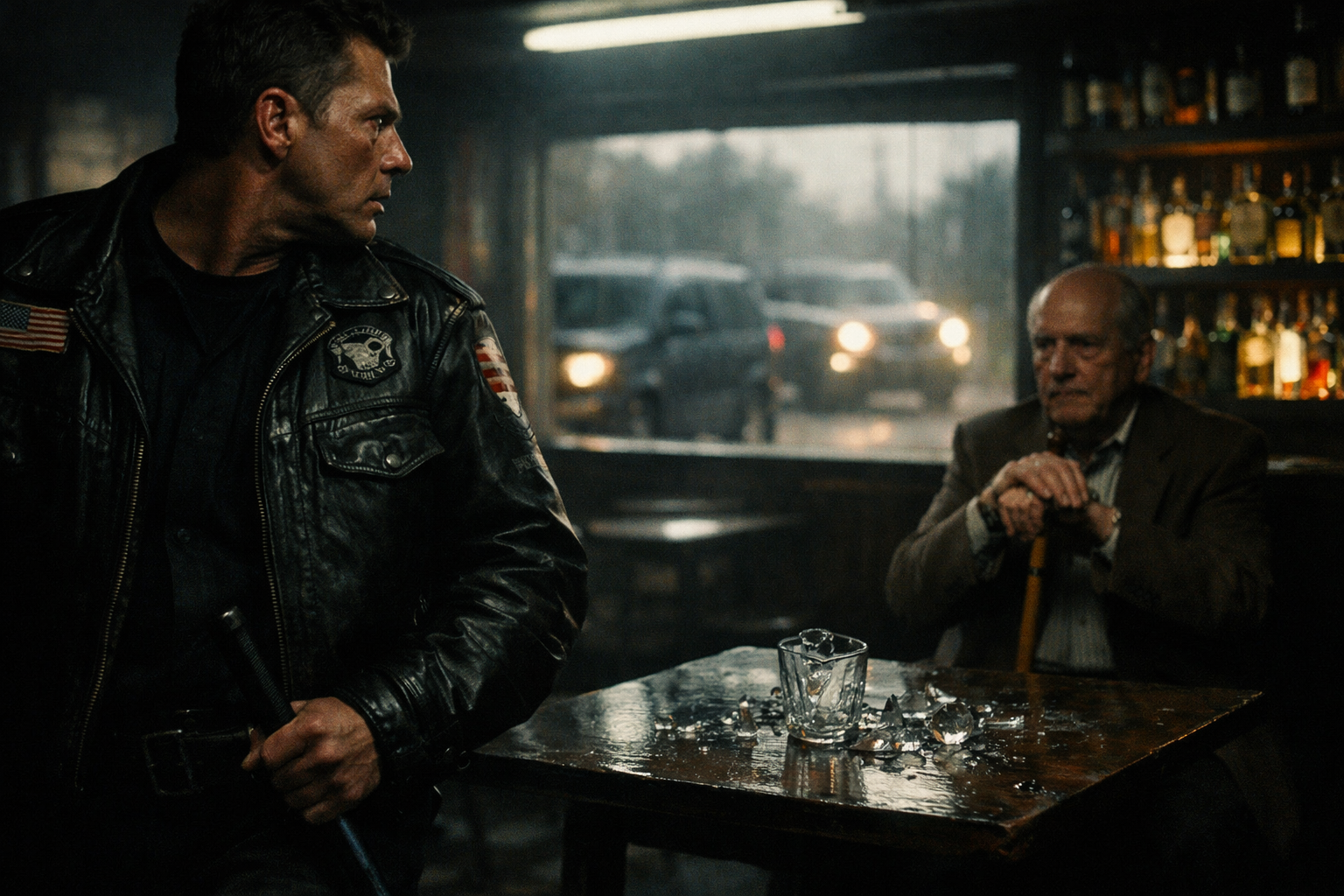
The Copper Rail smelled like old wood, fried oil, and something that hadn’t quite decided if it was a bar or a diner. Walter sat at the table closest to the wall. Brown suit, black shirt, silver hair tied back. A wooden cane leaned against his chair. A glass of water sat untouched in front of him.
He was watching the door.
Nora, behind the counter, kept glancing at him. Not from fear. From knowing.
For three months, Rex Dalton and five members of the Dalton Kings had been running The Copper Rail like a toll booth. They drank without paying full tabs. They cornered waitresses and called it friendliness. They told Nora the bar needed “protection” and named a price she couldn’t afford to refuse — and couldn’t afford to pay.
Her husband had said call the cops.
Nora knew better. Rex had friends in places where complaints got filed in drawers and never opened again.
So she’d called a number her late father had written on the back of a business card.
Walter Kane. If trouble gets bigger than the room, call him.
Walter had arrived the previous Tuesday. He’d ordered water, taken the corner table, and said six words.
“I’ll come back when he does.”
At 12:17, the front door swung open.
Rex came in first. Broad-shouldered, leather jacket thick with patches, braided mohawk, a club baton swinging from one hand like a prop he wanted people to notice. Five men followed him, boots loud on the floor, laughing at something before they’d even scanned the room.
The bar shifted. A couple near the window lowered their voices. A truck driver at the counter looked down at his plate. Nora stopped wiping the glass she’d been wiping for ten minutes.
Rex liked that. Fear made him feel taller.
Then he spotted Walter.
A slow grin spread across his face. He moved toward the corner table, baton swinging lazily.
“You lost, grandpa?”
Walter looked up without hurry. “No.”
The answer annoyed Rex. It had no fear in it.
He leaned over the table, close enough that Walter could smell leather and cigarette smoke. “This place doesn’t do quiet old men in church suits.”
Walter’s eyes moved briefly to Rex’s jacket — specifically to the silver hawk patch on the chest — then back to his face. “I’ll remember that.”
The bikers laughed. Rex lifted the baton and tapped it against the edge of Walter’s table.
Once.
Twice.
On the third strike, he swung.
The glass exploded. Water and shards sprayed across the table, soaking into Walter’s sleeve. The cane clattered to the floor. The bikers roared.
Nora made a small sound behind the counter and pressed her back against the shelves.
Walter did not move.
He looked at the broken glass. The water darkening his jacket. His cane lying on the tile.
Then he reached inside his jacket and pulled out a phone.
Rex laughed harder. “What, old man? Calling your nurse?”
Walter raised the phone to his ear. His voice was low and very calm.
“It’s me.”
The laughter thinned.
Walter’s eyes stayed on Rex.
“Bring them.”
He ended the call and reached down to pick up his cane, resting it across his knees.
Rex stared at him. “You think that scares me?”
“No,” Walter said. “But it should make you curious.”
Outside, tires screamed against the gravel lot.
Every head in the bar turned toward the windows.
One black SUV slid into the lot.
Then another.
Then a third.
Headlights cut through the dim room. Doors opened fast. Men in dark suits stepped out first, then a woman in a navy coat, two uniformed state officers, and three older men in leather jackets bearing faded silver hawk patches — not the Dalton Kings’ version. Something older.
Rex stopped smiling.
One of his crew muttered, “No way.”
Walter stood.
He wasn’t tall. He didn’t need to be. The room had already shifted toward him.
The first man in a suit entered and spoke without hesitation. “Mr. Kane, the exits are covered.”
Rex took a step back. “Who the hell are you?”
The woman in the navy coat stepped forward and opened a leather folder. “Assistant District Attorney Rebecca Miles.”
The state officers moved to flank the walls. The three older men in leather stood by the door, silent and grim. One of them had a jaw like a man who’d spent fifty years not flinching.
Rex looked from face to face searching for the joke.
There wasn’t one.
Walter turned his cane slowly in his hands and looked at Rex’s jacket. At the silver hawk stitched over his chest.
“Do you know what that patch means?”
Rex’s jaw tightened. “It means don’t touch what belongs to us.”
One of the old men near the door made a sound of pure disgust.
Walter nodded once. “That is what you were taught. Not what it meant.”
Rex’s chin went up. “You don’t know anything about me.”
Walter’s expression shifted — only slightly, only for a second. Enough.
“Your mother’s name was Elena Dalton,” he said.
Rex froze.
The whole bar seemed to lose a degree of temperature.
Walter continued, “She hated carnations, loved old Mustangs, and stitched the first silver hawk patch into your grandfather’s jacket by hand because the club couldn’t afford professional embroidery back then.”
Rex stared at him. His voice came out smaller than he wanted it to. “How do you know that?”
Walter’s voice softened — and the softness made the words hit harder.
“Because Elena was my daughter.”
The words landed like something physical.
One of Rex’s men said, “Rex—”
“Shut up,” Rex snapped.
Walter took one step forward, unhurried. “And because this cane you knocked off this table belonged to Thomas Dalton. Your grandfather. The man whose name you have been using to terrorize people who would have been under his protection.”
Rex’s face cycled through shock and landed on anger because anger was a place he knew how to stand. “My grandfather was a legend.”
“Yes,” Walter said. “He was.”
The older men in leather stepped forward. Walter gestured toward them.
“These men rode with him. Not as criminals. Not as debt collectors. The original Silver Hawks were veterans. Mechanics. Union workers. They escorted women to court when their husbands threatened them. They guarded families moving into neighborhoods that didn’t want them. They rode behind funeral cars for soldiers whose families couldn’t afford protection from protesters.”
One of the old riders removed his sunglasses and looked at Rex with something that wasn’t anger anymore — it was grief made hard.
“Your grandfather would have broken your jaw for what you’ve done to this place.”
Rex recovered. He had practice recovering. “Old men’s stories don’t keep the lights on.”
“No,” Walter said. “But money does.”
That landed clean.
Assistant District Attorney Miles opened her folder. “For fourteen months, our office has investigated the group calling itself the Dalton Kings for extortion, illegal debt collection, assault, witness intimidation, liquor-license coercion, and laundering cash through auto shops and private security fronts. We have names, dates, ledgers, and testimony from six separate business owners.”
Rex turned back to Walter, and something ugly moved behind his eyes.
“You set this up.”
Walter looked around the bar. At the wet table. At Nora standing straighter now behind the counter. At the couple near the window who hadn’t run. At the truck driver who’d turned around on his stool, watching.
“No,” Walter said. “You built this. I only let you walk into a room full of witnesses.”
Rex’s baton hand tightened.
Walter continued without raising his voice. “The Copper Rail was your grandmother’s first job in this country. She served coffee here before she ever married Thomas Dalton. When she died, he bought the building so no one could ever push its owners around.”
Rex’s eyes narrowed. “Liar.”
Walter pulled a folded deed from his jacket and placed it on the wet table between them. “The building is held by the Dalton-Kane Trust.”
Rex looked down.
“And I,” Walter said, “am the trustee.”
One of Rex’s crew backed toward the door. A state officer stepped into his path. Rex heard the movement and turned — and saw for the first time that there was nowhere to go. Every angle covered. Every exit watched.
For the first time, genuine fear moved across Rex Dalton’s face.
Walter pointed to the shelves of imported liquor behind the bar. “You thought this place was small because the sign is old. You thought Nora was helpless because she smiled while you threatened her. You thought age made me harmless because you have spent your entire life judging what people are worth by how they look from across the room.”
Rex raised his chin. Old instinct.
“But here is what you missed.” Walter’s voice dropped. “Your mother came to me before she died.”
Rex’s fingers loosened.
“My mother died in a car wreck,” he said. The words sounded automatic. Rehearsed. Like something he’d said a hundred times so he’d believe it.
“That is what your father told you.”
A new kind of silence fell over the room.
Walter looked at Rex the way a surgeon looks at an X-ray — not with cruelty, but with the full weight of knowing.
“Elena came to me with bruises on her arms and you asleep in the back seat. She wanted out. She wanted you raised away from men who confused violence with respect.”
Rex’s face twisted. “No.”
“She left a statement. She named your father. She named the men running guns through club shops. She named the officer who tipped off your father when she tried to file a report.”
Rex shook his head, jaw clenched.
“Your father found her before the hearing.”
The old rider near the door looked at the floor.
Walter’s voice went flat. “The crash was not an accident.”
Rex stared at him, breathing audibly now. “You’re lying.”
ADA Miles stepped forward. “We reopened Elena Dalton’s case six months ago after Mr. Kane provided new evidence. We have the original witness statement she filed, phone records, and testimony from a surviving witness who saw her car forced off Route 9.”
Rex looked suddenly younger. Not innocent — never innocent — but younger. Like the boy who’d been given a story about a dead mother had just watched that story come apart at every seam.
Walter reached into his jacket and removed a small evidence sleeve.
Inside: a photograph, faded with time.
Elena, smiling beside a motorcycle, one arm around an older man’s waist — Walter, younger then, with dark hair — and a baby in her other arm.
The baby had a small scar near his chin.
Rex touched his own chin without realizing he was doing it.
Walter placed the photograph on the table. His voice was quiet. “I tried to get you after she died. Your father hid you. By the time I located where you’d been placed, you were seventeen, already furious, and surrounded by men calling cruelty family.”
Rex’s mouth opened.
Nothing came out.
Then his pride surged back like something reflexive — because pride was all he had left to stand on.
“So you show up now? After everything?”
“You did not build anything,” Walter said. “You fed on fear.”
Rex looked at his men — two of whom were already being guided toward the wall by state officers. He looked at the old Silver Hawks who’d ridden with his grandfather. He looked at the broken glass, the wet table, the photograph between them.
Then he did the only stupid thing he had left.
He raised the baton.
Not high. Not a full swing. Just enough.
The nearest state officer drew his weapon.
The room froze.
Walter lifted one hand.
“No.”
The officer held. Didn’t advance.
Walter looked at Rex — not at the baton, at the man — and said the two words like they were the simplest thing in the world.
“Put it down.”
Rex’s hand shook.
For one long second, the whole room waited to find out which inheritance was going to win. The one from the men who’d raised him. Or the one from the woman he barely remembered.
The baton hit the floor.
The officers moved in.
Rex’s crew went down one by one. Some cursed. One went limp and had to be helped out. One — the youngest, barely twenty-two — sat down near the jukebox and cried quietly.
Rex didn’t fight it when they cuffed him. But he kept his eyes on Walter.
“You could’ve told me,” he said.
Walter looked back at him without anger.
“You wouldn’t have heard me until the room got quiet.”
Rex was walked outside past the black SUVs, past the old Silver Hawks standing in the afternoon light, past the bar window where his own reflection looked smaller than it had when he’d walked in.
The investigation ran for eleven months.
The Dalton Kings had extorted businesses across three counties — bars, repair shops, gas stations, roadside diners. They had targeted owners who were elderly, immigrant, widowed, or financially too fragile to fight back. Several local officers were suspended when records showed they’d ignored complaints. One sheriff’s deputy resigned before charges could be announced. Rex’s second-in-command cooperated in exchange for a reduced sentence, handing over ledgers that tied the operation to a regional trafficking and stolen-parts network.
Rex Dalton faced extortion, assault, witness intimidation, and racketeering conspiracy charges.
But the case that broke something open in him was Elena’s.
When prosecutors formally reopened his mother’s death, evidence confirmed what Walter had spent years carefully assembling. Rex’s father, Carson Dalton, had forced Elena off Route 9 the night before she was scheduled to testify. He had never been charged because the first officer on scene had pocketed her witness statement and given Carson a four-hour head start.
That officer was retired now. Living in Florida.
He was arrested in a golf shirt while watering his front lawn.
The news described Walter Kane as a mysterious power broker with law enforcement connections.
They were wrong. He was an old man who had spent decades holding pieces of truth no one else wanted to carry — waiting for a room quiet enough to set them down.
At Rex’s sentencing hearing, Walter stood when the judge allowed victim impact statements.
“My daughter wanted her son to grow up safe,” he said. “He did not. Many people failed him. I was one of them. But pain explains harm. It does not excuse it.”
He turned to face Rex directly.
“The people he threatened deserve restitution. The women he frightened deserve peace. The businesses he bled deserve more than an apology.”
Rex sat at the defense table, jaw tight, eyes lowered.
Walter’s voice hardened. “And Rex Dalton deserves the truth — even if it arrives too late to save him from consequences.”
Rex looked up.
Walter met his eyes.
“You carry your grandfather’s patch. You will not carry his name as a lie.”
The judge sentenced Rex to four years, with mandatory restitution payments and a cooperation agreement tied to dismantling the remaining network.
The Dalton Kings were gone within the year.
The Silver Hawks returned.
Not as a gang. Not as anything dangerous. As what they had been.
Older now. Some walking with canes. Some riding motorcycles polished more for memory than speed. They escorted witnesses to court, repaired cars for single mothers, and stood quietly outside small businesses that had once been too afraid to stay open after dark.
The Copper Rail survived.
Nora replaced the shattered glass tabletop but kept one small piece of the original glass in a frame behind the bar.
Under it, she placed a handwritten note:
Fear breaks loud. Courage answers quietly.
Walter still came every Tuesday at noon.
Same table.
Same water.
Same cane.
Only now, people greeted him. The truck driver bought him pie once. Nora refused to charge him for coffee even though he didn’t drink it. The old Silver Hawks sometimes took the back booth and argued about football, politics, and whose knees had gone worst.
Two years later, Rex Dalton walked into The Copper Rail again.
Thinner. Older. Released under strict supervision after cooperating with federal investigators and completing a prison violence-intervention program — a condition Walter had personally insisted be written into the agreement.
No leather vest. No baton. No crew.
Just a plain denim jacket and eyes that didn’t know where to land.
The bar went quiet.
Nora reached under the counter — not for a weapon, but for her phone.
Walter lifted one hand slightly. “It’s all right.”
Rex stopped three feet from Walter’s table.
He looked at the cane leaning against the chair.
Then at the framed glass behind the bar.
Then at the old man.
“I came to apologize,” Rex said.
Walter didn’t make it easy. “Start with Nora.”
Rex turned. Nora stared at him from behind the counter, arms crossed.
His voice was rough. “I scared you. I took money from this place. I made it feel unsafe. I’m sorry.”
Nora held his eyes for a long time.
“I don’t forgive fast,” she said.
Rex nodded. “I don’t deserve fast.”
He turned back to Walter.
“I read the full file. About my mother.”
Walter’s face softened — barely, but genuinely. “She loved you.”
Rex’s jaw tightened. “I don’t remember her.”
“I know.”
Rex swallowed. “Do I look like her?”
Walter studied him for a moment. The whole room seemed to hold still.
“Sometimes,” Walter said. “When you stop trying to look like him.”
Rex looked down at the table.
That broke something in him more gently than prison had.
Walter pointed to the chair across from him.
“Sit.”
Rex hesitated. “I don’t know if I should.”
“Neither do I,” Walter said. “Sit anyway.”
Rex sat.
Nora brought water. Not coffee. Water. She placed it in front of Rex without smiling, then walked back to the counter without a word.
Rex looked at the glass like it was a test.
Maybe it was.
Walter rested both hands on his cane. “There are rules.”
“I know.”
“No club. No threats. You show up here clean, sober, and working. You make restitution until every person on that list is paid in full.”
“I know.”
“And if you ever raise your hand in this place again,” Walter said, “I make one call.”
Rex glanced toward the window, remembering the black SUVs sliding into the gravel lot.
A small, humorless smile crossed his face. “I believe you.”
Walter looked at him steadily. “Good.”
For a while, neither of them spoke. Outside, the road stretched gray and quiet. The jukebox near the back wall played something low. One of the old Silver Hawks laughed too loudly at his own joke.
Rex finally touched the glass of water.
“My mother really stitched that patch herself?”
Walter nodded. “With terrible thread and too much pride.”
Rex looked at the table. “I ruined it.”
“No,” Walter said. “Your father did. You repeated it.”
Rex lifted his eyes. “What now?”
Walter picked up the cane — the one Rex had once knocked to the floor — and held it loosely between both hands.
“Now,” he said, “you decide if the story ends there.”
Years later, people still talked about the day the black SUVs came to The Copper Rail.
Some remembered the broken glass.
Some remembered the old man’s two-word phone call.
Some remembered Rex Dalton’s face the moment power finally turned around and looked at him.
But Nora remembered something else.
The moment after everything went silent.
The moment an old man in a brown suit stood up — not to prove he was dangerous, but to prove the room no longer belonged to fear.
Original fictional stories. AI-assisted creative content.