The Fairview Fresh Market sat on the corner of Clement and 9th, a mid-size grocery in a quiet part of the city that had never given anyone trouble. The parking lot was half full on a Tuesday afternoon — retirees, young mothers, the occasional delivery truck idling near the side entrance. Nothing happened here. That was the point of a place like this.
Arthur Ellis walked out through the automatic doors at 2:17 p.m.
Seventy-four years old. Six feet even, though the years and the hip had taken maybe half an inch. He wore a plain gray jacket, dark slacks, and a pair of shoes that had been resoled twice and still held their shape. In his left hand he carried a single paper bag — milk, soup, bread. In his right, a wooden cane, straight-grained oak, worn smooth at the handle from years of use.
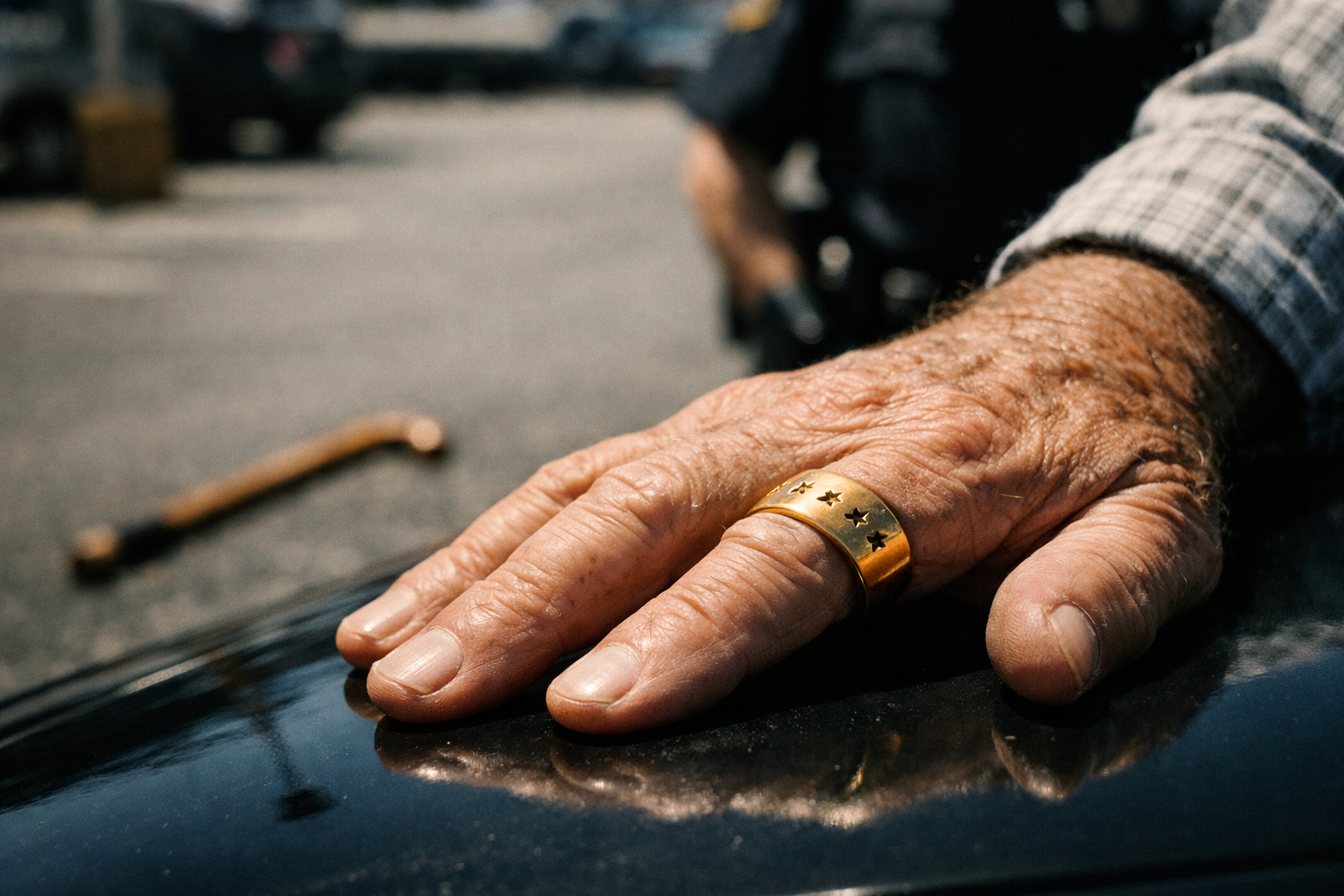
On the fourth finger of his left hand was a gold ring. Heavy, simple, with four small stars pressed into the band. He had worn it so long he no longer noticed the weight.
He had taken maybe ten steps into the lot when the patrol car pulled in fast and stopped at an angle, blocking the pedestrian lane.
Officer Dale Hayes got out.
Twenty-nine years old. Three years on the force. The kind of build that came from a gym and a mirror rather than from carrying anything real. He had a habit of parking wherever he wanted and a longer habit of deciding, before any conversation started, who he was going to like and who he wasn’t.
He looked at Arthur Ellis and decided in under two seconds.
“Hey. Hold on.”
Arthur stopped. He turned. His expression was patient in the way that men get patient after decades of having to be.
“Something wrong, Officer?”
“Where are you coming from?”
“The store,” Arthur said. He nodded toward the entrance behind him. “I bought groceries.”
Hayes walked closer, thumbs hooked in his belt. “You got a receipt for that?”
Arthur looked at him for a moment. Then he shifted the bag to his cane arm and reached into his jacket pocket with his free hand. He produced the receipt and held it out.
Hayes didn’t take it.
“You match a description we got called in,” Hayes said. “Older male, gray jacket, acting suspicious around the parking lot.”
“I was shopping,” Arthur said. “I have a receipt in my hand.”
“I’ll need you to put the bag down and keep your hands where I can see them.”
“I’m holding a receipt,” Arthur said. “With one hand. And a cane with the other. I’m not sure what you’re seeing that concerns you.”
Hayes stepped closer. “Sir, I’m not going to ask you again—”
“You haven’t asked me anything,” Arthur said. His voice stayed even. “You’ve made statements. There’s a difference.”
Something shifted in Hayes’s face. The small, ugly shift of a man who is used to being the only one in a conversation who gets to be precise.
“Put. The bag. Down.”
Arthur set the paper bag on the asphalt slowly, carefully, the way you set down something that has milk in it. He straightened up. He held the receipt out again.
“I’d like to show you this,” he said. “And then I’d like to continue to my car.”
Hayes looked at the receipt. He did not take it.
Then he kicked the cane.
Not a bump. Not an accident. A deliberate sideways kick at the base, the way you’d knock a chair out from under someone as a joke — except this was not a joke and Arthur Ellis was seventy-four years old with a hip that had been rebuilt twice and a right leg that trusted that cane the way most people trust the ground.
The cane skittered across the asphalt. Arthur’s weight shifted wrong. His right side dropped. He went down hard on one knee, then caught himself on both hands, the receipt still somehow in his fingers, pressed against the blacktop. The paper bag tipped. The milk carton split on impact. White spread across the asphalt in a slow, quiet pool.
For three full seconds the parking lot was silent.
Hayes looked down at him. He was already reaching for his phone. “You were non-compliant. I had to secure the situation.”
A woman with a cart ten feet away had stopped moving. A man loading groceries into his trunk stood with a reusable bag in each hand, frozen. Near the entrance, a teenager with a phone had already pressed record.
Arthur Ellis stayed where he was for a moment. Both palms flat on the warm asphalt. Head down. The gold ring caught the afternoon sun — four small stars, steady and bright against the blacktop.
He breathed once. Slow and deliberate.
Then he raised his head and looked up at Officer Hayes with the kind of eyes that have seen things that would end most men’s sleep permanently, and found Hayes profoundly, almost sadly, small.
He did not speak.
He did not have to.
Sergeant Victor Miller had been sitting in his cruiser outside the station when the text came in from a number he didn’t recognize. Just a photo. No caption.
An old man on his hands and knees in a parking lot. A milk spill. A cop standing over him with a phone out. And on the old man’s left hand, pressed against the asphalt — a gold ring with four stars on the band.
Miller stared at the photo for eleven seconds.
Then he got out of his car and walked directly into the Chief’s office without knocking.
Chief Delgado was on the phone. He looked up, read Miller’s face, and said into the receiver: “I’ll call you back.”
Miller set his own phone on the desk with the photo face up.
Delgado looked at it. His jaw tightened.
“Where?” he said.
“Fairview Fresh Market. Clement and 9th. Hayes’s shift.”
“Who sent you this?”
“Teenager in the lot. She got the whole thing on video. She said she didn’t know who the old man was, but she knew it was wrong, so she found the department tip line.”
Delgado stood up. He was not a man who moved fast, but he moved with complete intention.
“Pull Hayes in. Now. Don’t call it in on the open channel. You go yourself.”
“And the old man?”
Delgado looked at the photo again. At the ring. At the four stars catching the light.
“You know who that is,” Miller said.
“I know exactly who that is.” Delgado picked up his desk phone. “Which is why I’m making this call before Hayes gets anywhere near a union rep.”
Officer Hayes had just gotten back to his cruiser and was finishing his incident report — subject non-compliant, situational control measure applied, no injuries sustained — when Sergeant Miller pulled up alongside him.
Miller got out. He wasn’t in a hurry. That was the thing that made Hayes’s neck prickle.
“Sarge,” Hayes said, nodding. “Just finishing up a stop.”
“I know,” Miller said. “Get in your car and follow me back to the station. Chief wants to see you.”
Hayes frowned. “I’m mid-shift.”
“You’re done with your shift,” Miller said. “Follow me.”
Something in the flatness of it made Hayes’s report-writing instincts kick in. “Look, the subject was non-compliant. I had a description call. The situation required—”
“Hayes,” Miller said, and his voice was entirely without warmth now, “there are four separate phones worth of footage from that parking lot. The Chief has already seen two of them. Get in your car.”
Hayes got in his car.
Arthur Ellis had been helped to his feet by the woman with the cart. She was maybe forty, dark hair, still in her work clothes, and she had crouched down without asking and gotten her shoulder under his arm before he could tell her not to bother.
“I’m fine,” he said.
“You’re bleeding,” she said. Both palms were scraped from the asphalt. She pressed a folded grocery receipt against the worse one.
“I’ve had worse,” he said.
“I know,” she said, and something in her voice made him look at her more carefully. She nodded at the ring. “My father served. Twenty-two years. I know what four stars means.”
He let her help him to the bench near the entrance. She retrieved his cane. She picked up what was left in the paper bag — the soup cans were fine, the bread survived, the milk was gone entirely.
“Do you want me to call someone?” she asked.
“No,” Arthur said. Then: “Actually. Yes. Would you mind calling this number?”
He recited it from memory. She dialed, handed the phone over.
It rang once.
“Delgado.”
“Raymond,” Arthur said.
A pause. Then, very quietly: “Arthur. I already know. Miller is bringing him in now. Are you hurt?”
“My pride took the worst of it,” Arthur said. “My hands are scraped. My knee will complain tomorrow.”
“I need you to come in. Not as a complainant. As a witness. There’s a difference, and I want you to understand what I’m building here before it gets in front of anyone else.”
“I understand.”
“I’m sorry this happened.”
“Don’t be sorry,” Arthur said. “Be thorough.”
He handed the phone back to the woman. She was looking at him differently now.
“Who are you?” she asked.
Arthur picked up his cane and tested his weight on it. Solid. Good wood.
“Nobody important,” he said. “Retired.”
She looked at the ring again.
He almost smiled.
The interrogation room smelled like old coffee and floor cleaner. Officer Hayes sat at the metal table with his hands flat on the surface. He had been in this room before, on the other side of the table, and the familiarity of it was not helping him the way he’d expected.
Chief Delgado stood. Colonel Reyes — Army, liaison to the department on a joint training program — stood near the door with his arms crossed and his face completely unreadable. Sergeant Miller was to Delgado’s right. The small monitor in the corner showed four different camera angles from the Fairview parking lot.
Hayes tried first.
“Chief, I want to be clear — the subject matched a description we had called in. He was moving erratically near vehicles in the lot. Standard protocol says—”
“We checked the call,” Delgado said. “There was no description matching that individual. There was no suspicious person report for that lot at that time. We have the dispatch log.”
Hayes’s jaw tightened. “I may have been thinking of an earlier call—”
Delgado hit play on the footage.
The room watched thirty-seven seconds of video. The approach. The exchange. The receipt, clearly visible, clearly offered. The kick. The fall. The milk spreading across the asphalt. The old man’s hands on the ground.
Delgado stopped it.
“The receipt was offered to you,” Delgado said. “You did not take it. You did not examine it. You did not run his ID. You did not call in a stop. You kicked his mobility aid out from under a seventy-four-year-old man in a public parking lot and then filed a report describing him as non-compliant.”
“He was—”
“He was showing you a receipt,” Miller said from the side of the room. His voice was flat as iron. “I was in that lot four minutes after it happened. I talked to six witnesses. Not one of them saw anything that looked like non-compliance. Every one of them saw exactly what the camera recorded.”
Hayes looked at Reyes. Reyes had not moved or spoken. His presence in the room had the quality of something load-bearing.
“Who is he?” Hayes asked. “The old man. Who is he actually?”
Delgado folded his hands on the table.
“Arthur James Ellis. Retired, United States Army. Thirty-one years of service. Two combat tours. Former commanding general, Third Infantry Division. The ring on his hand that your bodycam caught clearly when he was on the ground — four stars. He retired as a four-star general, Hayes. He was buying soup and milk at a grocery store and you put him on the ground because he offered you a receipt you didn’t want to look at.”
The room was very quiet.
Hayes opened his mouth.
“Don’t,” Reyes said. It was the first word he had spoken. Quiet, precise, the tone of a man who has ended meetings with a single syllable for thirty years. “Whatever you are about to say, don’t.”
Hayes closed his mouth.
Delgado leaned forward slightly.
“You didn’t know who he was because you never asked,” he said. “You decided. Before he spoke one word, you decided what he was and what he deserved. Then you enforced that decision with your boot. That is not policing. That is ego wearing a badge.”
Hayes tried one more time. His voice was thinner now. “Chief. I didn’t know. If I had known he was a general—”
“That’s the part that concerns me most,” Delgado said. “That you think it would have been acceptable if he wasn’t.”
He nodded to Miller. Miller stepped to the monitor and brought up a second piece of footage — the bodycam. It showed Hayes’s own face as the cane made contact. The angle caught something Hayes had not realized was visible: the small, satisfied compression of his mouth in the half-second after the kick landed. Not alarm. Not reflex. Satisfaction.
Hayes stared at the screen.
“That is on record,” Delgado said. “That expression. That timing. That will be part of everything that goes forward from this room.”
He opened a folder on the table and turned it so Hayes could read the top page.
“Officer Hayes, effective immediately you are suspended without pay pending a full internal investigation. Your badge and service weapon are surrendered here. Criminal charges for assault are under active review by the district attorney’s office, and Colonel Reyes’s office has formally requested that the incident be included in the joint oversight report currently before the city council. Do you understand these terms?”
Hayes’s hands had started to shake. He pressed them flat against the table.
“Chief. I have a family. If this goes public—”
“It is already public,” Delgado said. “The footage has been viewed forty thousand times. I have three news stations waiting downstairs. The only question still being decided is whether the department’s response is adequate, and that decision is being made in this room right now.”
Hayes looked at Reyes again, something almost pleading in it.
Reyes looked back at him without expression.
“The United States Army,” Reyes said quietly, “does not forget when one of its own is put on the ground. General Ellis has served this country in conditions you cannot imagine. He asked for nothing from this department. He got on his knees on a parking lot asphalt because a man with a badge decided he could. That decision is going to follow you for the rest of your life, Officer Hayes. The only remaining question is how much of your life you have left to spend in a position where you can hurt someone else.”
Hayes stared at the table.
Delgado stood.
“Stand up.”
They walked him out through the main floor.
Delgado had made the decision deliberately. The union rep, David Kline, had watched the footage in the hallway and said only: “I can’t defend the kick. I’ll sit with him for the statement, but I won’t argue this was a good stop.” Hayes had looked at him like he’d been cut loose from the last rope.
The main floor went quiet when they came through the door. Phones were set down. Conversations stopped. The only sound was the hum of the overhead lights and, from near the side corridor, the soft, unhurried tap of a wooden cane on tile.
Arthur Ellis had arrived twenty minutes earlier. He had declined the offered chair three times. He stood near the corridor with Miller at his side, his scraped palms cleaned and wrapped in simple white gauze, his jacket straightened, his cane in his right hand and the gold ring visible on his left.
Hayes saw him and stopped walking.
Delgado did not stop. “Keep moving.”
They walked Hayes to his locker. The officers who had gathered in a loose semicircle did not speak. Hayes worked the combination with fingers that wouldn’t cooperate. It took four tries. The door swung open. Inside: a spare uniform shirt, a gym bag, a framed photo of his wife and daughter, a coffee mug with the department seal. He reached for the photo first.
“Personal items only,” Delgado said. “Department property stays.”
Hayes packed with the slowness of a man who understands that the longer this takes the longer he is still here. When the locker was empty, he closed the door. The click echoed in the silent room.
Delgado held out his hand.
Hayes removed his credentials and access card and placed them in the Chief’s palm. Delgado folded them once and put them in his pocket.
“Your badge and weapon were surrendered in the interrogation room,” Delgado said, loud enough for the floor to hear. “You are no longer a police officer of this department. Pending the outcome of the investigation and any criminal proceedings, you will not return to this building. Turn in your remaining equipment at the front desk.”
Hayes looked around at the faces watching him. He found Miller in the crowd. Miller met his eyes without flinching, without anger, without anything Hayes could use.
Hayes’s voice broke when he finally spoke.
“I didn’t know who he was.”
“I know,” Delgado said. “That stopped being a defense about thirty seconds into that parking lot footage. You start moving.”
Arthur Ellis stepped forward from the corridor as Hayes passed.
The cane tapped once on the tile. Every eye in the room shifted. Hayes looked at him last, and when he did, something in the younger man’s face finally collapsed inward — not into rage or denial, but into the awful, irreversible recognition of someone who has just understood what they’ve done.
Arthur’s voice was quiet. It carried without effort, the way the voices of men carry who have given orders in noise that would have made lesser men mute.
“I have given commands that sent young men into situations they did not survive. I have written letters to their families. I have stood at graves in weather that had no business being as peaceful as it was. I know what authority costs and what it is for. It is not for parking lots. It is not for old men with groceries. The badge you carried was paid for by people like the man you put on the ground today. That is not a metaphor. That is a fact. I hope you find something useful to do with the time you have now that it’s been taken from you.”
He did not raise his voice. He did not wait for a response.
He turned, planted the cane, and walked toward the front doors of the precinct at the same pace he had walked into the grocery store two hours ago. Miller fell in beside him. Colonel Reyes followed a step behind.
Behind them, Hayes stood in the middle of the floor with his gym bag and nothing on his chest and the weight of what the morning had cost him settling in for what would clearly be a very long stay.
Outside, the afternoon was still bright. Arthur paused at the top of the precinct steps, one hand on the railing. He looked out across the street — the ordinary Tuesday afternoon street, cars, a woman walking a dog, a coffee shop with its door propped open.
Miller opened the passenger door of his cruiser without being asked. Arthur lowered himself in, set the cane between his knees, and fastened the belt. Miller closed the door gently and walked around to the driver’s side.
Inside the precinct, Delgado turned back to the remaining officers.
“Everyone back to work,” he said. “What you saw today is what accountability looks like when it can no longer be avoided. Remember it. Remember why it had to happen in public.”
He paused.
“And remember that the man on the ground in that footage did not raise his voice once. Not in the parking lot. Not in this building. Think about what that cost him. And what it says about him that he paid it.”
Miller pulled out of the lot and onto the street. They drove in silence for half a block.
“Where to, General?” Miller asked.
Arthur looked at the city passing. The same streets. The same ordinary light on the same ordinary buildings.
“Home,” he said. “I need to replace the milk.”
Miller nodded. He drove.
Arthur watched the city go by. His palms ached under the gauze. His knee would be worse tomorrow. The memory of the asphalt under his hands, the sound of the cane skittering away, the milk spreading — those would stay a while. He knew how memory worked. He had enough of the other kind to know you don’t get to choose which ones linger.
But so would the image of the floor going quiet when he walked in. Of Delgado’s voice, precise and without apology. Of Hayes’s face at the moment the last defense ran out.
Miller glanced over once.
“You handled that with more dignity than most men could manage, sir.”
Arthur kept his eyes on the road ahead.
“Dignity isn’t a performance,” he said. “It’s what you refuse to put down even when someone kicks the thing you were leaning on. Today the department remembered what the badge is supposed to mean. That’s enough.”
They drove the rest of the way without talking.
When they reached Arthur’s house, Miller helped carry the replacement bag to the door. Arthur unlocked it himself, stepped inside, set the bag on the kitchen table.
“Thank you, Sergeant. For seeing what needed to be seen.”
Miller stood on the porch. “Anytime, sir.”
Arthur gave him a small nod. He closed the door.
Inside, he moved through the quiet rooms. Milk in the refrigerator. Soup on the counter. Cane in its place by the door. Then he sat at the kitchen table, removed the gold ring from his finger, and set it on the wood in front of him.
The four stars caught the light from the window.
He had carried that ring through things that would not fit in any sentence he had ever been willing to say at dinner tables. Today it had been on his hand when he was on his knees on a parking lot. Today it had been seen by a sergeant who still believed the department meant something. Today it had been in the room when a man was reminded that power has a cost, and the cost is accountability, and accountability does not negotiate.
Arthur Ellis slid the ring back onto his finger.
Outside, the afternoon continued. Inside, an old man sat at his kitchen table with his cane by the door and his ring on his hand, and the quiet in the house felt, for the first time in a long time, like something earned rather than merely endured.
He had survived worse than one arrogant officer with something to prove.
He had buried better men.
He had also, on more than one occasion, been the reason things got put right.
Today was one of those occasions.
That was enough.
THE END
Original fictional stories. AI-assisted creative content.