The Man Who Walked In Wrong
The lunch rush at Prairie Lantern Diner in Casper, Wyoming, had the kind of rhythm that made people comfortable.
Coffee cups settled into saucers. A country song drifted from the kitchen radio. The smell of onion soup and fresh bread held the room together like something trustworthy.
Then the door opened, and the rhythm stuttered.
He was old — late seventies at the least. His faded military jacket had been repaired along the left shoulder seam. His hands shook with the quiet persistence of long years, and his eyes moved around the room not with confidence but with something more fragile: the careful hope of a man who had learned not to expect much.
He spotted an empty booth near the back and started toward it.
“Sir. Stop right there.”
The voice belonged to Dennis Rourke — owner, centerpiece, and unofficial judge of who fit this room. He was broad and red-faced, and he did not bother lowering his voice.
The old man turned. “I’m sorry. I just wanted to sit for a moment. Maybe get something warm.”
“We serve paying customers.”
The old man swallowed. “I was hoping for a bowl of soup. I can try to pay part of it.”
A few people glanced up. A few more looked back down at their plates.
Ivy Mercer froze behind the counter, two coffee mugs in her hands. She was twenty-six, still soft around the edges, still the kind of person who noticed things she couldn’t fix quickly enough.
She started to open her mouth.
Dennis beat her to it.
“If you don’t have enough, you don’t order. That’s how it works here.”
The old man nodded as if the answer hadn’t surprised him. That was the worst part — how unsurprised he looked. Like the world had made this same face at him many times before.
“All right,” he said quietly. “I didn’t mean to bother anyone.”
He turned and walked back toward the door.
No one called out.
No one told Dennis to stop.
The bell above the entrance rang with its usual cheerfulness, and the old man stepped back into the cold, and the diner did what it always did after something uncomfortable:
It moved on.
What Pulled Up Outside
For thirty seconds, the room tried to act normal.
Silverware moved. Someone stirred sugar into their coffee. A man near the window laughed at something that wasn’t funny.
Then the man by the front glass leaned toward it.
“Who are those guys?”
Heads turned.
Motorcycles were rolling up across the street — not fast, not loud, not reckless. They came in a measured line, pulling to the curb with a calm that felt more deliberate than noise ever could. Leather vests. Heavy boots. Men with road-worn faces and a collective stillness that was harder to read than aggression.
The engines died one by one.
Fear arrived in the diner without anyone using the word.
The front door opened.
He was tall, mid-forties, dark beard shot through with gray at the chin. A worn leather vest, a thermal shirt, and the kind of face that had stopped caring what a room thought of it. He let his eyes move slowly across the diner without settling on anything yet.
Then he spoke.
“Where did he go?”
Dennis blinked. “Excuse me?”
“The older man. The one who just left.”
The hush dropped fast. Even the radio seemed to pause.
Dennis lifted his chin. “That’s not your concern.”
The biker took three measured steps forward.
“It is now.”
Ivy stopped pouring mid-cup. A woman in a corner booth tightened her grip on her purse. The biker didn’t raise his voice. He didn’t need to. The stillness in his face communicated more than volume ever could.
Dennis planted both feet. “You don’t come in here and tell me how to run my place.”
“I’m not telling you how to run anything,” the biker said. “I’m asking where he went.”
The door swung open again before Dennis answered.
Another biker entered.
Then another.
Three more behind them.
They moved to the edges of the room without a word, without touching anything, without threatening anything directly — and yet the diner became smaller in a way no one could argue with. A man by the register reached for his phone, then set it back down.
The first biker kept his eyes on Dennis.
“You turned him away because he couldn’t pay.”
“That’s right.”
The biker nodded, once, almost to himself.
“Then put it on my bill.”
What the Room Got Wrong
The words should have relaxed everything.
Instead, they made people more uncertain.
A customer at the counter murmured, “This isn’t about lunch.”
Another said, “They’re making a point.”
Dennis hardened. “I don’t want trouble in here.”
“Neither do we,” the biker replied.
Outside, more motorcycles had appeared. More men stood along the curb, quiet and patient, watching the diner with the settled focus of people who had decided something before they arrived. No one inside knew what that decision was, and the not-knowing was the most difficult part.
Ivy watched the first biker’s jaw. There was anger in him — real anger — but it was not loose. It was carried carefully, like something that meant more than this room could account for.
Dennis pointed toward the door. “I’m going to need all of you to leave.”
Nobody moved.
“He eats today,” the biker said. “That’s not a negotiation.”
The word negotiation hung in the air.
Then the bell above the entrance rang again.
The room went still before anyone turned — instinctively, the way people go still when something has shifted and they don’t yet know the shape of it.
The old man stood in the doorway.
Two bikers flanked him at a respectful distance, not guiding him, not forcing him — just making sure he didn’t walk in alone a second time.
The Table That Was Waiting
He looked around the room with the wariness of someone who had already been embarrassed once today and wasn’t sure what was happening now.
The first biker stepped back and opened a path between the tables.
When he spoke again, the hard edge had left his voice entirely.
“Sir. Your table is waiting.”
The old man blinked. “Mine?”
“Yes, sir. If you still want something warm.”
Something shifted in the room then — not a dramatic shift, not a clean one, but a real one. The tension lost its shape. It was no longer the tension of a threat. It was the tension of a room beginning to understand that it had misread something important, and that the misreading had cost someone.
Ivy grabbed a menu before Dennis said a word and walked quickly toward the back booth.
“Please,” she said softly. “Come sit down.”
The old man walked carefully, as if still waiting for someone to interrupt him. No one did.
He lowered himself into the booth with the deliberate effort of a man whose body required patience. His hands rested on the table, fingers trembling faintly.
Ivy held out the menu. He barely looked at it.
“Just soup,” he said. “Anything hot.”
“You can have more than that,” she said, before she had time to decide whether to say it.
He gave her a tired, almost embarrassed smile. “Soup is enough.”
“Then I’ll bring you the best we have.”
She turned back toward the kitchen. Dennis stood near the register, still upright, still trying to locate the moment when the room stopped answering to him.
The biker had not sat down. He stood to the side with his hands loose and his eyes on the old man — not hovering, not claiming him, but watching with the particular attention of someone protecting not just a person but a debt that had gone unpaid for a very long time.
What He Remembered
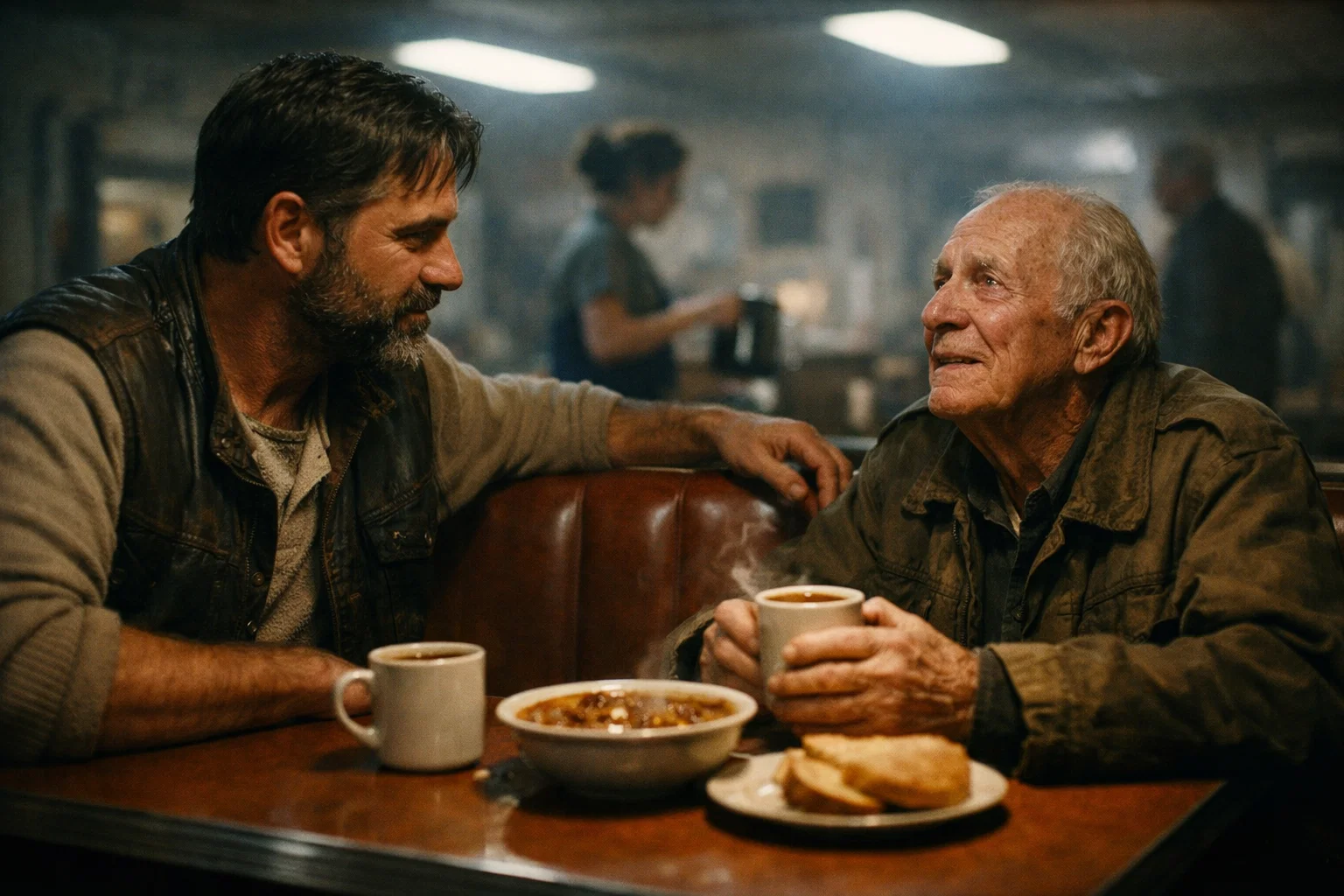
When Ivy returned with beef stew, warm bread, and coffee, the old man looked at the food for a long moment before touching it. The look wasn’t dramatic. It was just honest — the expression of a man who hadn’t expected kindness today and didn’t yet know what to do with it.
He wrapped both hands around the coffee cup and let the warmth work into his fingers.
Then he looked up at the biker.
He looked carefully this time — not a glance but a real study, the way you look at a face when something is pulling at your memory and you’re afraid of what you’ll find.
His brows came together slowly.
“I know you,” he said.
The biker said nothing.
The old man’s gaze moved to a scar near the biker’s left temple, half-hidden by gray-threaded hair.
“Texas,” the old man murmured. Then: “No. Not Texas.” His voice dropped. “Eastern Afghanistan. The ridge road.”
The biker lowered his head once.
Ivy had stopped moving. Dennis had stopped pretending to sort receipts. Even the radio had timed itself into a quiet stretch between songs.
“There was smoke everywhere,” the old man continued. His voice shook, but it wasn’t frailty — it was the weight of a memory that still lived in the body. “The convoy got hit on the pass. You were trapped. You were barely conscious.”
No one at any table spoke.
“I dragged you out before the second blast reached the truck.”
The silence that followed was not dramatic. It was not sharp. It was the silence of a room that had just understood it was standing at the edge of something much larger than a lunch dispute — and that it had very nearly watched that something walk back out into the cold.
The biker finally spoke.
“You remember.”
The old man gave a faint, almost surprised laugh. “I remember your eyes. You kept trying to stay awake. I kept telling you not to talk.”
For the first time, a small smile crossed the biker’s face.
“You said if I gave up, you’d drag me back just to scold me.”
The old man looked down. His voice went quiet. “I never knew what happened to you after that.”
“My name’s Cole Braddock,” the biker said. “I spent years looking for you. Nobody could tell me where you ended up. I only had your first name.”
The old man looked up.
“Walter Gentry,” he said.
Cole nodded, the way a man nods when he’s been carrying something for thirty years and has finally set it down somewhere real.
“You saved my life, Walter.”
The Room That Had Been Watching
Something about those four words settled over the diner with more weight than anything else said that afternoon.
Because now the room had two truths sitting side by side.
An old man who had once carried another man out of a burning vehicle — who had decided, in the worst possible moment, that a stranger’s life was worth his own risk — had been turned away from a warm meal because his coat was worn and his hands shook.
And a room full of ordinary, decent people had watched it happen and let convenience make their decision for them.
Ivy set the bread basket beside Walter’s bowl and stepped back, blinking fast.
Dennis had gone quiet. He still stood straight — pride was still holding him upright — but it was thinner now, uncertain of itself. He opened his mouth once as if to explain, then seemed to understand that there was no explanation clean enough for what the room had just heard.
Walter lifted his spoon and took his first bite.
No one applauded.
No one rushed over with rehearsed apologies.
The moment didn’t need any of that. It only needed to exist without anyone taking it away again.
What Cole Carried
Outside, the row of motorcycles sat undisturbed along the curb.
Inside, some customers had paid quietly and left. Others stayed, as if they understood they were inside a moment they would remember longer than whatever they’d come here for.
After a while, Walter looked across at Cole and said, “You didn’t need to bring all of them.”
A few of the bikers near the front smiled.
Cole said, “I didn’t bring them to scare anyone. I sent one message that I’d found the man who saved me. They came because some debts are carried by more than one person.”
Walter’s eyes glistened. “You don’t owe me that much.”
“Maybe not,” Cole said. “But we owe respect where it’s due. And we pay our debts.”
Walter was quiet for a moment.
Then he looked toward Ivy.
“That’s the best hot meal I’ve had in a long while.”
Ivy smiled through wet eyes. “You come back whenever you want.”
Dennis spoke from across the room.
His voice was lower than usual.
“He will.”
It was not an eloquent apology. It was not crafted or careful. But it was real — real enough that the room softened slightly around it.
Walter glanced over.
“Your meal is on the house,” Dennis added. He paused. “And I was wrong.”
Walter held the man’s gaze for a beat.
“Thank you,” he said.
Cole did not praise Dennis. The point had never been to humiliate him. The point had been to make sure Walter was seen — fully, completely, without condition — by the room that had decided to look the other way.
What He Left Behind
Walter rose from the booth with care.
Cole stepped back immediately, giving him space instead of help — perhaps understanding that dignity sometimes looks like letting a man stand on his own when he still can.
Walter moved toward the door.
The bikers stepped aside one by one — not surrounding him, not claiming him — simply honoring the space in front of him.
At the entrance, Walter stopped.
He turned back and looked at the room — at the customers, at the tables, at the place that had first turned him away, then watched him, then finally understood something about itself.
He gave one quiet nod.
No speech. No performance.
Then he stepped outside.
Cole followed. The others fell in behind him. Engines came to life one at a time, low and steady, moving down the street in a line until the sound faded and was gone.
Inside Prairie Lantern Diner, the silence that followed was different from the silence before.
Not fearful.
Thoughtful.
The kind of quiet that settles over a room when people have just come very close to missing something that mattered — and know it.
The Lesson That Stayed
Dennis spoke less loudly the rest of the afternoon.
Ivy noticed her customers meeting each other’s eyes differently — not with warmth exactly, but with the small, careful embarrassment of people who knew they had seen something and chosen not to act, and were still working out what that meant about them.
The most important thing in that room had never been the line of motorcycles, or the confrontation, or even the astonishing memory from a road in Afghanistan.
It had been the worth of one man — a man almost measured only by what he could not afford to pay.
Walter Gentry had walked into Prairie Lantern Diner invisible.
He left it remembered.
And somewhere between those two moments, a room full of ordinary strangers was reminded that kindness is not tested when it is easy or public or comfortable. It is tested in the exact moment when someone has nothing to offer — and the only question is what kind of people we choose to be in answer.
Some people in that room passed the test late.
But in the end, they saw it clearly.
And in the end — though he would never know the full extent of it — Walter Gentry walked back out into the afternoon carrying something he hadn’t come in with:
The certainty that he had not been forgotten.
That his life had mattered to someone enough to be searched for.
That the debt of one cold road on the other side of the world had been honored — not with money, not with ceremony, but with forty men willing to stand still in a diner in Wyoming until an old soldier got a hot meal and was called by his name.
Cole Braddock never forgot the man who told him not to close his eyes.
And now, neither would anyone else who had been in that room.
Original fictional stories. AI-assisted creative content.