The rooftop terrace of Carrara was the kind of place where a single cocktail cost more than most people’s groceries for a week. Manhattan skyline glittering behind it. A private party. Forty guests. One piano.
And one man at the center of it all — Victor Hale.
Sixty-two. Steel-gray hair. A face the financial press called “unreadable.” Net worth somewhere north of four billion, depending on the quarter. Tonight he was hosting. Smiling when required. Shaking hands like a machine built for it.
“Victor, the Zurich deal — confirmed?” a man in a navy suit asked.
“Monday morning,” Victor said. “Already signed.”
“You don’t slow down.”
“Slowing down is how people lose.”
He lifted his glass. Took a sip. Turned toward the railing — and that’s when he saw her.
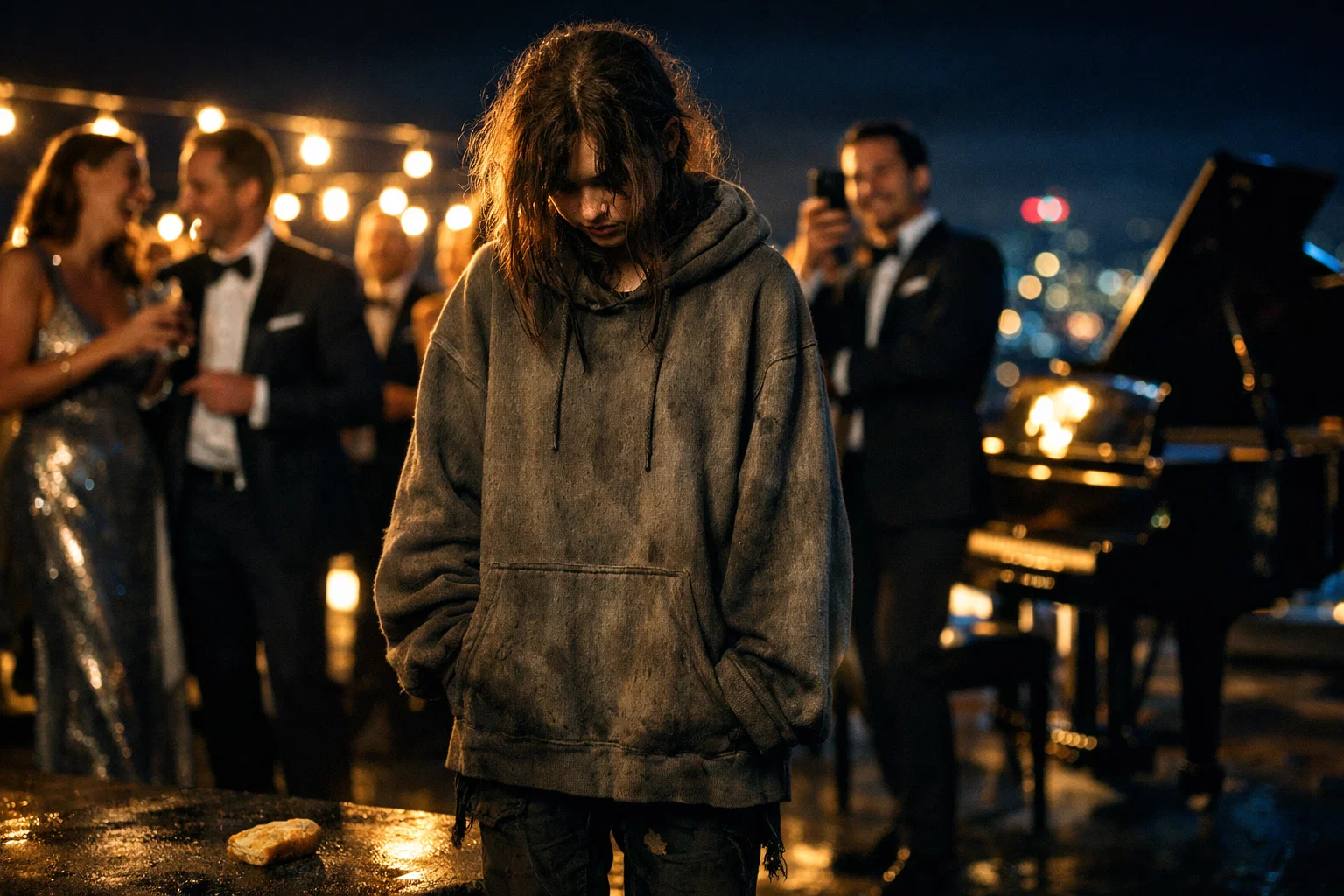
Below the terrace, on the sidewalk. A girl. Early twenties. Sitting on the curb with her arms wrapped around her knees. Dirty hoodie. No shoes. Hair matted and tangled. A cardboard sign beside her that read: ANYTHING HELPS.
Victor looked at her for exactly two seconds. Then turned back to the party.
The piano player — a hired musician in a slim black suit — shifted into Chopin. Nocturne in E-flat. Gentle. Elegant. The kind of thing that made rich people feel cultured.
“Beautiful night,” someone murmured.
It was. If you were inside the velvet rope.
The first problem started with Greg Whitfield.
Greg was a hedge fund guy. Loud. Third divorce. The kind of man who confused wealth with personality. He was four bourbons deep when he leaned over the railing and spotted the girl below.
“Hey — hey, look at this,” he said, waving over two other guests. “Street performance in progress.”
A few people glanced down.
Greg grabbed a piece of bread from the charcuterie spread, wound up like a pitcher, and threw it over the railing. It landed two feet from the girl’s shoes.
“Hey!” Greg called down. “Play something for it! Or is begging your only talent?”
Three guests laughed. A woman covered her mouth but didn’t say anything. The piano player kept playing, eyes straight ahead.
The girl didn’t look up.
Greg grabbed another piece of bread. “Come on. Dance. Sing. Give us a show.”
More laughter. Quieter now. Some guests shifted uncomfortably but stayed silent. One woman pulled out her phone, not to call someone — to record.
Victor was fifteen feet away, mid-conversation with a banker from Geneva. He heard the laughter. Heard the words. Felt something tighten behind his ribs that he hadn’t felt in a long time.
He set down his glass.
Walked toward Greg.
And then —
CRACK.
His palm came down flat on the table. Hard enough to rattle every glass on it. Hard enough to stop every conversation on the terrace.
“That’s enough,” Victor said. His voice wasn’t loud. It didn’t need to be. “Sit down.”
Greg blinked. “Victor, relax. I was just —”
“You were just humiliating a person for sport in front of my guests. At my event.” Victor’s eyes didn’t waver. “Sit. Down.”
Greg sat.
The terrace went silent. Even the piano stopped.
Victor stood at the railing for a moment. Looked down at the girl. She still hadn’t moved. Hadn’t flinched. Hadn’t looked up once during the entire scene.
That bothered him more than the bread.
Because people who don’t flinch have usually been through worse.
He went downstairs himself.
Not a security guard. Not an assistant. Him.
The girl was still sitting on the curb. Up close, she looked worse. Thin. Exhausted. A bruise on her left wrist she kept turning away from view. But her posture — back straight, chin level — that didn’t match the rest of it.
“You okay?” Victor asked.
She didn’t look up. “I’m fine.”
“You’re sitting on a sidewalk outside a restaurant where a man just threw bread at you. That’s not fine.”
She said nothing.
Victor studied her. Not her clothes. Not the dirt on her hands. Her face. Something about it — the jaw, the way her eyes sat — pulled at something deep in his memory. Something he’d buried.
“Have you eaten today?” he asked.
“You don’t have to do this,” she said quietly. “The guilt-charity thing. I’ve seen it before. Rich guy feels bad for five minutes, buys a sandwich, tells himself he’s a good person. Goes back to the party.”
Victor almost smiled. Almost. “That’s a hell of a speech.”
“It’s not a speech. It’s a pattern.”
He crouched down so he was at her level. “What’s your name?”
She hesitated. Then — “Lily.”
Something flickered in his chest. Fast. Gone before he could catch it.
“Lily,” he repeated. “Come inside.”
“No.”
“There’s food. A bathroom. Warmth. No one’s going to bother you.”
“I said no.”
He nodded. Stood up. Reached into his jacket pocket, pulled out a business card, and set it on the pavement beside her.
“If you change your mind.”
He turned to leave.
“Can you actually play?” he asked. Over his shoulder. Casual. Almost like an afterthought.
Lily froze.
“What?”
“The piano. Up there. Can you play?”
She didn’t answer for a long time. Her hands — dirt-streaked, nails cracked — curled into fists.
“I didn’t forget,” she said softly. “Even when I lost everything.”
He brought her upstairs.
The reaction was immediate. Guests stepped back. Two women whispered behind their hands. Greg Whitfield muttered something to the man beside him. The hired piano player looked confused.
Victor ignored all of it.
“The piano’s yours,” he said. “If you want it.”
Lily stood in the center of the terrace like an animal released into open ground. Eyes darting. Shoulders tight. The city lights behind her made her look like a ghost that had wandered into someone else’s story.
She walked to the piano.
Each step slow. Deliberate. Like she was remembering how to do it.
She sat on the bench.
The hired musician stepped aside without being asked.
Forty guests stared.
Lily’s hands hovered over the keys. Shaking. Dirty knuckles against polished ivory.
One note.
Soft. Tentative.
Then another.
Then —
Music.
Not just music. A flood. A breaking dam. A sound so enormous and so raw that it didn’t belong on a rooftop terrace in Manhattan. It belonged in a cathedral. A battlefield. A memory.
Rachmaninoff. Piano Concerto No. 2. The second movement. But played the way no conservatory teaches it — with fractures in the tempo, with breath in the pauses, with the kind of emotion that only comes from someone who has lived inside the music and lost everything outside of it.
The terrace went still.
Glasses stopped mid-air. A woman set down her phone. The Geneva banker stepped forward, mouth slightly open.
Greg Whitfield stared at his shoes.
Victor stood five feet from the piano. His face — the face that Forbes called “a wall” — began to crack.
Because he recognized the piece.
Not just the concerto. The interpretation. The way the left hand lingered on the lower register. The way the right hand broke slightly on the ascending phrase. The tiny pause in the third bar that no one would notice unless they’d heard it a thousand times.
Unless they’d heard it in a house in Connecticut. Twenty-three years ago. From a room down the hall. Played by a woman who taught her daughter before the daughter could read.
His hands began to shake.
“Wait,” Victor whispered.
The word barely left his mouth. His throat had closed around it.
Lily didn’t stop. Her tears fell silently. Her fingers moved with a precision that defied everything about her appearance, her condition, her life. The notes climbed. Built. Ached.
The guests felt it even without understanding it. Something was happening between the man and the girl at the piano that went deeper than the music. Deeper than the party. Deeper than the building they stood in.
Victor stepped closer. One step. Then another.
“You’re —”
“Don’t,” Lily said. Without stopping. Without looking. “Don’t say it like it just occurred to you.”
Her voice cut through the music like a blade.
“Lily —”
“Twenty-three years,” she said. Her fingers didn’t falter. “Mom waited eight of them. Did you know that? Eight years. She kept your picture on the mantle. Told me you’d come back. Told me you were ‘figuring things out.'”
Victor’s jaw tightened. The Geneva banker stepped back. A woman near the bar pressed her hand to her chest.
“She got sick when I was twelve,” Lily said. “Cancer. The kind that eats slow. Three years of it. I played piano every night because it was the only thing that made her sleep.”
The melody shifted. Darker. Minor key.
“She died when I was fifteen. No insurance. No savings. Because you took everything when you left. Every account. Every asset. She was too proud to fight it and too broken to care.”
Victor’s face had gone white.
“I went into foster care,” Lily said. “Three homes in two years. The second one, the man drank. The bruises I had at sixteen? Nobody asked about those.”
She pressed harder on the keys. The music swelled.
“I got out at eighteen. Aged out. No family. No money. No address. But I had this.” She glanced at the piano for the first time. “Because Mom made sure I had this. Every lesson. Every hour. Every night. This was the one thing they couldn’t take.”
Victor’s hand reached out — trembling — toward the piano.
“Don’t touch it,” Lily said.
He pulled back.
“I auditioned for Juilliard when I was nineteen,” she said. “I got in. Full scholarship. Did you know that?”
He shook his head. His eyes were wet.
“I lasted one semester. Because I had nowhere to live. Scholarship covered tuition, not housing. I slept in the practice rooms until security caught me. They kicked me out.”
The music slowed.
“So I ended up here. On the street. Outside your restaurant. Your party. Your life.” She finally looked at him. Eyes locked. “And a man who works for you threw bread at me like I was an animal.”
The silence on the terrace was absolute.
Victor opened his mouth. Closed it. Opened it again.
“I didn’t know,” he said. His voice was a ruin. “About your mother. About any of it. I —”
“You didn’t want to know,” Lily said. “That’s worse.”
She kept playing.
The melody changed again — lighter now, but fragile. Like glass holding its shape one second before shattering. It was the piece. The one her mother used to play every Sunday morning in the house in Connecticut. The one Victor had heard through the walls while pretending to read the paper. The one he’d never admitted he loved because admitting it meant admitting he loved the life he was planning to leave.
Victor’s composure broke.
Not loudly. Not dramatically. His shoulders dropped. His chin fell. His hand gripped the edge of the piano like it was the only solid thing left in the world.
“I was a coward,” he said.
Lily didn’t respond.
“I was twenty-nine. I had nothing. Your mother and I — we were drowning. I got an opportunity. A real one. But it was in Hong Kong. She wouldn’t leave Connecticut. Her mother was sick. She begged me to stay.”
“So you left,” Lily said.
“I told myself it was temporary. That I’d send money. Come back. That once I made it —”
“You never came back.”
“The longer I stayed away, the harder it got. The guilt — I buried it. Under work. Under deals. Under — under all of this.” He gestured at the terrace. The skyline. The empire.
“You buried us,” Lily said. “Me and Mom. That’s what you buried.”
He didn’t deny it.
The music stopped.
Lily lifted her hands from the keys. The last note hung in the air, trembling, then dissolved.
Forty people stood in silence. Some had tears on their faces. One woman was openly crying. Greg Whitfield had his hand over his mouth and hadn’t moved in five minutes.
Lily stood up from the bench.
She looked at Victor. Studied him the way he had studied her on the sidewalk. Not his suit. Not his watch. Not his empire. Him.
“I didn’t come here looking for you,” she said. “I didn’t even know this was your restaurant. I was just hungry.”
Victor nodded.
“But now that I’m here,” Lily said, “I want you to understand something. I’m not here to forgive you. I’m not here to reconnect. I’m not here to be your redemption story.”
“Then what do you want?” Victor asked.
“I want you to know what it cost,” she said. “Not you. Us. Mom and me. I want you to carry that. Because she carried it alone for fifteen years, and it killed her.”
Victor said nothing. His eyes were red. His hands were still.
Lily reached into the pocket of her hoodie and pulled out a folded, creased photograph. She set it on the piano.
“That was her last year,” Lily said. “She weighed ninety-one pounds. She still played every Sunday.”
Victor picked up the photograph. His hand shook so badly he almost dropped it.
The woman in the photo was a ghost of the woman he remembered — hollow cheeks, sunken eyes, bald from chemo — but her hands were on a piano. And she was smiling. Barely. But smiling.
Victor pressed the photograph to his chest and bent forward. A sound came out of him — raw, guttural, the kind of sound billionaires aren’t supposed to make.
The next morning, Lily’s phone rang.
Not Victor’s number. A woman named Sandra Chen, senior partner at one of the biggest trust-and-estate firms in the city.
“Lily Hale?”
“Who is this?”
“My name is Sandra Chen. I represent your father’s legal and financial interests. As of six a.m. this morning, Victor Hale has executed the following: a full, irrevocable trust in your name totaling two hundred and forty million dollars. A separate fund covering full tuition, housing, and expenses at any institution of your choice, retroactive to your original Juilliard enrollment. A deed transfer to a property in Connecticut — I’m told it’s the house your mother lived in. He purchased it back from the current owners at four times market value overnight. And a personal endowment in your mother’s name for a music scholarship at Juilliard, funded at ten million per year in perpetuity.”
Lily sat on the edge of a shelter bed. The phone pressed so hard against her ear it left a mark.
“He also asked me to tell you,” Sandra continued, “that he will not contact you. He will not visit. He will not ask for a relationship. The trust is unconditional. No strings. No meetings. No forgiveness required.”
Lily’s throat closed.
“But he did include a handwritten note,” Sandra said. “Do you want me to read it?”
Lily nodded. Then realized she was on the phone. “Yes.”
Sandra paused. Then read:
“Lily — I will carry it. Every day. For the rest of my life. I am not asking you to forgive me. I am asking you to live the life I stole from you and your mother. The house is yours. The music is yours. Everything I should have given — it’s yours now. Not because I deserve to give it. Because you deserve to have it. — Victor.”
Lily moved into the Connecticut house three weeks later.
The new owners had only lived there for two years. They hadn’t changed much. The kitchen was updated. The backyard had new landscaping. But the living room — the living room was exactly the same.
And in the corner, next to the window where the morning light came in, was a piano.
Not the original one. That had been sold years ago. But Victor had tracked it down. Bought it from a music shop in Bridgeport that had resold it twice. Had it restored. Tuned. Placed in the exact spot where it used to sit.
Lily stood in the doorway and stared at it.
She walked over. Sat on the bench. Ran her fingers over the keys.
They were the same keys her mother’s fingers had touched.
She played.
Rachmaninoff first. Then Chopin. Then the Sunday piece — the one with no title, the one her mother had written herself, the one that existed nowhere else in the world except in Lily’s hands.
The notes filled the house.
The empty rooms.
The long hallway.
The kitchen where her mother used to stand at the counter, humming along.
And for the first time in eight years, Lily didn’t play from pain.
She played from home.
Six months later, Lily performed her debut recital at Lincoln Center.
Juilliard had readmitted her. Full ride. Private housing. A practice suite reserved in her name. The scholarship her mother’s endowment created had already funded four other students — all from foster care, all with nowhere else to go.
The recital hall was full. Eight hundred seats. Standing room only.
Lily wore a simple black dress. No jewelry. No sponsor logos. Just her and the piano.
She played for forty-two minutes.
When she finished, the hall was silent for three full seconds.
Then the applause came. Thunderous. Sustained. Eight hundred people on their feet.
In the back row, alone, sat a man in a gray suit. He didn’t stand. Didn’t clap. He just sat there, photograph in his breast pocket, tears streaming silently down his face.
He left before the lights came up.
He didn’t leave a note.
He didn’t need to.
Lily already knew.
On the way out of Lincoln Center, a reporter stopped her.
“Lily — incredible performance tonight. Can you tell us what inspired the final piece? The one without a title?”
Lily looked at the camera. Smiled. Not the broken, half-real smile she’d learned on the street. A real one.
“My mother wrote it,” she said. “She never published it. Never recorded it. She just played it every Sunday morning while I sat on the bench beside her.”
“And tonight?”
Lily looked up at the sky. Manhattan glittering around her. The same city that had once watched her sit on a curb and thrown bread at her feet.
“Tonight,” she said, “I played it for her. And for every kid sitting on a sidewalk right now who thinks nobody’s listening.”
She turned and walked into the night.
Behind her, the Lincoln Center marquee read her name in white letters against black.
LILY HALE — DEBUT RECITAL
And underneath, in smaller text:
THE ELIZABETH HALE MEMORIAL CONCERT
Named for the woman who taught her everything.
Named for the woman who never stopped playing.
Even when no one was listening.
Original fictional stories. AI-assisted creative content.