The fluorescent lights in Crawford’s Market hummed the way they always did after 7 p.m. — low, persistent, like they were getting tired of the job. The evening crowd had thinned. Only a few customers moved through the aisles, and most of them weren’t paying attention to anything except their own carts.
Nobody was paying attention to the girl by the dairy case.
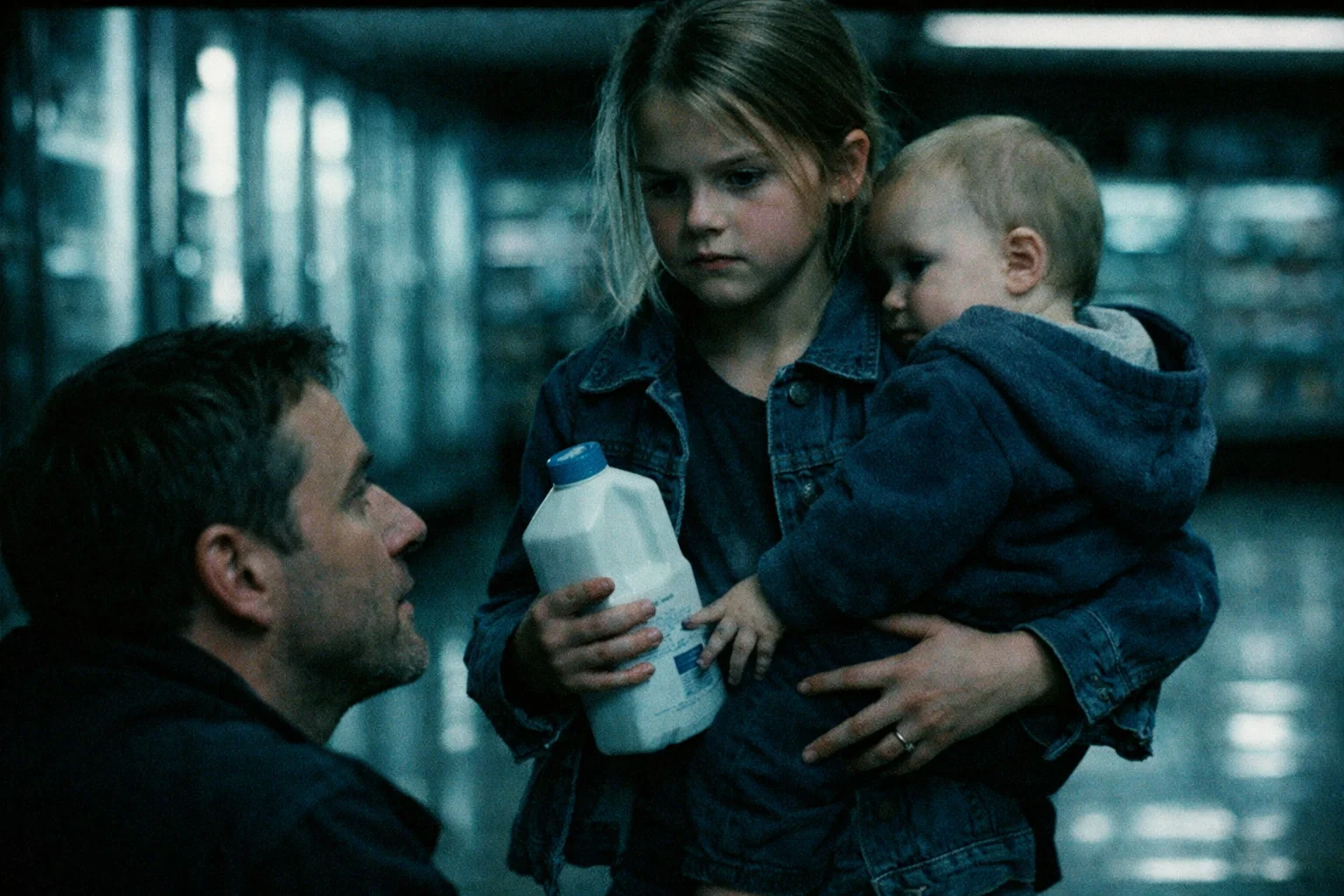
She was nine. Maybe small for nine. She had dark circles under her eyes that didn’t belong on a kid’s face, and she was holding a baby on one hip like she’d been doing it her whole life. The baby was maybe eight months old. He wasn’t screaming, just making that low, grinding cry that means a child’s been hungry long enough to stop expecting anything to change.
The girl’s name was Kayla.
She was holding a carton of whole milk, and she hadn’t moved in four minutes.
The cashier, Roy, watched her from behind the register. He was forty-three, had worked this store for eleven years, and had seen plenty of kids try to walk out with things they didn’t pay for. He picked up the phone.
The girl looked up. Straight at him. She didn’t flinch.
“I’ll pay you back,” she said. Her voice was quiet but she didn’t whisper it. She said it like a statement of fact. “When I grow up. I promise.”
Roy put the phone down, then picked it up again. He wasn’t cruel. But rules were rules, and this store wasn’t his.
“Sweetheart, you can’t do that. I’ll need you to put it back.”
“He hasn’t eaten since yesterday morning.” She shifted the baby on her hip, instinctively, without drama. Just a fact. “I’m not stealing. I’ll come back and pay.”
“How old are you?”
“Nine.”
“Where are your parents?”
A pause. Something moved across her face, too fast to name.
“Gone,” she said.
Roy looked at the baby. The baby looked back at Roy with absolute exhaustion.
He reached for the phone again. She didn’t move. She just held the milk tighter.
The bell above the entrance door rang.
Daniel Mercer had stopped at Crawford’s Market because he needed a bottle of water. That was the whole plan. He had a board meeting in the morning, a call with his attorney at nine, and a headache that had started around noon and hadn’t left. He was not stopping for anything except water.
He saw the girl immediately.
He didn’t know why she stood out — the store wasn’t crowded, but it wasn’t empty either. Maybe it was the way she was standing, like someone braced for impact but refusing to step back. Maybe it was the baby.
He slowed down.
Roy looked up from the register with visible relief at the distraction. He recognized Daniel — most people in Grover County did. Crawford’s Market was one of forty-two stores in the Mercer Retail Group.
“Mr. Mercer,” Roy said, and then didn’t say anything else, because Daniel was already walking toward the girl.
He stopped a few feet away. He didn’t rush it. He crouched down so he wasn’t towering over her — just a guy on her level, near the refrigerated dairy section.
“What’s your name?”
She looked at him for a long second. Calculating, not afraid.
“Kayla.”
“Who’s this?”
“Ben.” She tilted her chin toward the baby. “He’s eight months.”
“Is he yours?”
“He’s my brother.”
Daniel nodded. “Where do you live, Kayla?”
Another pause. Longer this time.
“Nowhere right now,” she said. “We were at Birchwood.” She said it flatly, like it was just a coordinate. “The group home on Hartley Road. But they were going to put Ben in a different placement. I’m not letting that happen.”
“So you left.”
“This morning.”
“Both of you.”
“Yes.”
Daniel looked at the milk carton in her hand. Then at Ben, who had stopped crying and was now just watching him with enormous, unfocused eyes.
“How much is the milk?”
“Three forty-nine,” Roy called from behind the register. Daniel didn’t look up.
“I don’t want you to buy it,” Kayla said immediately. “I want to pay for it myself. Later.”
“I heard you.” He studied her. “You made a promise.”
“Yes.”
“You really think you’ll keep it?”
She didn’t hesitate. “I always keep my promises.”
Something in his chest shifted. He’d heard that exact tone of voice before — certain, stripped of any performance. He’d used it himself, once, in a very different store, a very long time ago. He’d been twelve, not nine, but hunger felt the same at every age.
He stood up and looked at Roy. “Ring the milk. Put it on the store account.”
“Mr. Mercer—”
“And I need a word with you about that call you were about to make.” His voice didn’t change temperature, but Roy’s hand moved away from the phone. “Not yet.”
He walked Kayla out to the curb. She had the milk tucked under one arm and Ben balanced on her other hip. She’d accepted the purchase without comment. No thank you, no dramatics. She was already thinking ahead.
“Do you have somewhere to go tonight?” he asked.
“I’ll figure something out.”
“It’s forty degrees.”
“I know.”
He looked at her. The child looking back at him was not performing confidence — she actually had it, the kind that comes from not having the luxury of falling apart.
“What’s your plan, exactly?”
“Find somewhere warm for tonight. Tomorrow, call the number my caseworker gave me. She said there’s a woman in Dellwood who does foster — she takes siblings together. I just have to get there.”
“Dellwood is thirty miles from here.”
Kayla shrugged. “I know.”
He pulled out his phone. “I’m calling someone. Her name is Sandra. She works with me on child welfare initiatives. She can get you both somewhere safe tonight — not a group home, a house. A real one. With food.”
Kayla watched him dial. “Why?”
“Because I can.”
“That’s not a reason.”
He paused. Looked at her. Then he put the phone down for a second.
“When I was twelve,” he said, “I used to walk two miles to the diner on Route 9 every morning before school because the owner, a woman named Pat Holloway, would give me a biscuit if I swept her lot. I didn’t have money. I was embarrassed every single day. And one morning she handed me a biscuit and said, ‘You don’t owe me anything. Just pay it forward when you’re able.’ I thought it was a dumb thing to say.” He picked up the phone again. “I was wrong.”
Kayla was quiet. Ben grabbed a fistful of her jacket.
“Are you the CEO of this store?” she asked.
“Among other things.”
“You should pay your cashier more. He looked stressed.”
Daniel blinked. Then, for the first time in a long day, he laughed. A real one.
“I’ll look into that,” he said.
Sandra Reyes was at the curb in twenty-two minutes. She was a compact woman in her fifties with reading glasses pushed up on her head and the unhurried efficiency of someone who’d been doing emergency child placement for a long time.
She looked at Kayla, then at Ben, then at Daniel.
“You couldn’t have called me an hour ago?”
“I didn’t know an hour ago.”
“Of course not.” She opened the back door of her car. “Come on, sweetheart. Let’s get him fed.”
Kayla didn’t move immediately. She looked at Daniel. “What happens tomorrow?”
“I’m going to make some calls tonight,” he said. “To Birchwood. To your caseworker. I want to understand your file before anything else happens.”
“They’ll say I ran away. They’ll say I’m a problem.”
“They might.”
“They’ll try to separate us again.”
His voice didn’t waver. “I’m not going to let that happen.”
She studied him for one long moment — nine years old, forty-eight hours without real sleep, holding an infant on a curb in the cold — and something in her expression settled. Not relief, exactly. More like a decision.
She got in the car.
The calls that night lasted until past midnight.
Sandra got Ben fed, bathed, and asleep inside an hour. Kayla ate a full plate of pasta for the first time in days, then sat at Sandra’s kitchen table and didn’t speak for a long time.
Sandra didn’t push. She’d been doing this long enough to know when a child needed silence.
Around nine, Kayla asked, “Is he actually going to call Birchwood?”
“Yes.”
“People say things.”
“Daniel Mercer does what he says he’s going to do. In my experience.” Sandra poured two cups of tea. Pushed one across the table. “I’ve worked with him for six years. He doesn’t make promises he can’t keep.”
Kayla wrapped her hands around the mug. “He said the same thing about me.”
“What did he say?”
“That he believed I’d keep my promise.”
Sandra smiled. “Did that surprise you?”
“…Yes.”
“Why?”
Kayla thought about it. “Adults don’t usually believe kids.”
Sandra looked at her steadily. “Some do.”
Daniel’s call to Birchwood Group Home happened at 8:47 a.m. the next day.
What he found in the file took forty minutes to get through, and by the end of it, he wasn’t calm anymore.
Kayla and Ben had been placed at Birchwood four months ago following the death of their mother. The intake notes described Kayla as “cooperative but resistant to authority.” What the notes didn’t describe — but what the caseworker, a woman named Denise Farrow, confirmed when she came on the line — was that Birchwood’s administration had been pushing to split sibling groups to reduce operational costs. Ben had been flagged for transfer to an infant facility in a neighboring county.
Kayla had been told three days ago.
She had left the next morning.
“She’s nine years old,” Daniel said. “She took an infant and walked out in thirty-degree weather rather than let you separate them. Does that not tell you something?”
“Mr. Mercer, our protocols—”
“Your protocols flagged an eight-month-old for a transfer that would have put him forty miles from his only family.” He kept his voice even. It cost him something. “I’ve already spoken with the county director. As of this morning, the sibling separation policy at Birchwood is under review. I’d appreciate your cooperation.”
A silence.
“What happens to the children?” Denise asked.
“They stay together. That’s non-negotiable.”
It took three weeks.
Sandra became their emergency foster placement. It wasn’t supposed to be permanent — Sandra had told Daniel that clearly, and he’d told her he understood. But the weeks stretched, and Ben started sleeping through the night in Sandra’s spare room, and Kayla started doing homework at Sandra’s kitchen table, and somewhere in there the word temporary stopped being said as often.
Daniel visited on a Tuesday evening with a folder of documents.
Kayla was at the table with her math homework. She looked up, didn’t say hello, and immediately said, “What’s in the folder?”
“I need you to understand what I’m about to tell you,” he said. “All of it. Don’t nod if you’re confused — ask me.”
She put her pencil down. “Okay.”
“I’ve connected your case to a family attorney named Ruth Calloway. She’s going to represent your interests, meaning yours and Ben’s, not the state’s. The goal is to establish legal permanency for the two of you — which means finding a placement where you’re guaranteed to stay together until you’re eighteen, with a path to guardianship after.”
“Sandra?”
“That’s one option. Sandra is considering it. She’d need to formally apply for long-term foster status. There are other families Ruth is reviewing as well.”
“What if I don’t like the other families?”
“You’ll meet them first.”
“What if Sandra wants to keep us but they say no because of her age or something?”
“Sandra is fifty-four, healthy, licensed, and has a spotless record. There’s no administrative reason to reject her application.” He paused. “I’m going to be direct: the process takes time. Months, probably. It’s not fast. But it moves forward.”
Kayla was quiet for a moment. Then: “You spent a lot of time on this.”
“Yes.”
“Why?”
He looked at her. Really looked — at this kid who had walked out of a group home with an infant on her hip because the alternative was losing her brother, who had stood in a grocery store and made a promise with the steadiness of someone three times her age.
“Because what happened to you and Ben shouldn’t have happened,” he said. “And because you reminded me that doing the right thing sometimes starts with just one person deciding not to walk past.”
Kayla was quiet again. Then she picked up her pencil.
“I’m going to need help with fractions,” she said.
He pulled up a chair.
Sandra got the placement. It took four months, two home studies, and one tense hearing where Ruth Calloway calmly dismantled every bureaucratic objection the county could produce.
The day it was official, Sandra made a cake. Chocolate. Ben destroyed his slice with both hands.
Kayla ate her piece carefully, like she was still half-waiting for something to go wrong.
After dinner, she found Daniel on the back porch. She sat down next to him without asking.
“Ben said his first real word today,” she said.
“I heard. Sandra texted me.”
Kayla smiled — a real one, the kind she didn’t hand out easily. “He said ‘Kay.'”
“Of course he did.”
She looked out at the yard. The sun was going down, making the grass look gold.
“I meant what I said in the store,” she said. “I’m going to pay you back.”
“Kayla—”
“I know you don’t need the money. That’s not what I mean.” She turned to face him. “I’m going to do something. Something that matters. I don’t know what yet, but I will.”
He nodded. “I know.”
“You actually believe that.”
“I do.”
She was quiet for a moment. Then: “It’s weird when adults believe things about you that you haven’t done yet.”
“Get used to it.”
She got used to it.
She was a stubborn student — not in talent, she had plenty of that, but in her refusal to coast. She pushed herself through middle school, through high school, through a full scholarship to State that she’d spent three years working toward. Sandra was at every ceremony. Ben, growing into a loud, easy-laughing kid who shared her stubbornness but none of her quiet, was at every single one.
Daniel came when he could. He was busy — always busy — but he made it to the ones that mattered.
Kayla graduated with a degree in social work. Then a master’s. Then a law degree, because Ruth Calloway had sat across from her during that county hearing when she was nine and she’d understood, watching, that the person in the room with the most power was the one who understood the rules.
She passed the bar at twenty-six.
On the morning she got her results, the first call she made was to Ben.
The second was to Sandra.
The third was to Daniel.
“I passed,” she said when he picked up.
A pause. Then: “I know. Ruth called me.”
“She wasn’t supposed to tell you.”
“She didn’t tell me the results. She told me to be near my phone.” He let the silence sit for a second. “Congratulations, Kayla.”
She sat in her car in the parking lot of the testing center and breathed.
“I’m going to start working on child welfare policy,” she said. “Specifically sibling placement law. The loopholes that let what happened to us happen — they’re still there. I’ve been reading the legislation. There are three specific statutory gaps that—”
“Kayla.”
“What?”
“It’s eight in the morning. You just passed the bar. Take a breath.”
She laughed despite herself. “I can breathe and talk.”
“I know you can.” And she could hear the smile in his voice. “I’ll set up a meeting with the foundation’s legal team next week. They’ve been wanting someone on the policy side for two years.”
“I can find my own job.”
“I know that too. This is an offer, not an order.”
She thought about it. “Send me the job description.”
“Already did. Check your email.”
The Mercer Family Foundation had been running child welfare programs for eleven years by then — housing grants, education funds, family reunification support. It had started quietly, a single initiative, and grown into something with a staff and a budget and a board and its own administrative headaches.
Kayla joined the policy team at twenty-six.
By twenty-nine, she was running it.
She rewrote the foundation’s sibling placement advocacy framework from scratch, built a coalition with six other nonprofit organizations, and spent fourteen months — grinding, relentless months — working with two state legislators to close the statutory gaps that had allowed Birchwood to flag Ben for transfer in the first place.
The bill passed on a Thursday afternoon in March.
She was in the gallery when the vote came in. Sandra was next to her. Ben, nineteen now and studying engineering, had driven four hours to be there and was sitting on her other side, shoulder to shoulder, not saying a word, just present.
When the final tally appeared on the board, Kayla didn’t move for a long moment.
Ben elbowed her gently. “You can breathe now.”
She exhaled.
The opening of the foundation’s tenth regional support center was held on a Friday evening in April.
It was called the Kayla & Ben Hartley Center — Kayla had fought the name for six months and lost when Daniel pointed out, reasonably, that she didn’t get to decide what other people named buildings.
The hall held three hundred people. Caseworkers, foster families, former foster kids who’d aged out and found their footing, legislators, donors, journalists.
Kayla stood at the podium in a dark blazer. Her notes were on the lectern but she didn’t look at them.
“When I was nine years old,” she said, “I walked into a grocery store with my baby brother and asked a cashier to trust me. I told him I’d pay him back when I grew up.” A pause. “He almost called the police.”
Light laughter from the crowd. Not unkind.
“A stranger walked in and changed the outcome of that night.” She looked out at the room. “But here’s what I’ve spent my career understanding: most kids in that position — most kids holding a carton of milk in a store, making a promise nobody believes — they don’t have a stranger walking through the door at the right moment. They have protocols. They have case numbers. They have a system that was built to process them, not to see them.”
The room was very quiet.
“Every center we open is us trying to put more people in that doorway. Not one person, not one wealthy stranger — a system. One that is designed, on purpose, to stop and look and say: I see you. You’re not a number. Your brother is not a transfer target. You’re a person, and you get to stay together.“
She gripped the edge of the podium.
“That’s not charity. That’s what we owe each other.”
The applause started slow and built. Daniel was in the front row. He was standing before most of the room, and he didn’t look like a billionaire making a public appearance. He looked like a man who was proud.
Afterward, in the quieter anteroom off the main hall, he found her. She was standing by the window with a glass of water, finally still.
“Roy called me,” he said.
She turned. “The cashier? From Crawford’s?”
“He retired last year. He saw the news about tonight. He wanted you to know—” Daniel paused, with what looked like actual amusement— “that he still has the transaction record from that night. The three dollars and forty-nine cents.”
Kayla laughed. A full one. The kind that came from somewhere deep and real.
“I want to pay him back,” she said. “Actually pay him back this time.”
“He said the same thing you said. He doesn’t want the money.” Daniel tilted his head. “He said to tell you: paid in full.“
She was quiet.
“That’s what you told me too,” she said. “Once.”
“I remember.”
“You were wrong, you know.” She looked at him steadily. “It’s not paid in full. It’s never paid in full. That’s not how it works.” She turned back to the window, to the city lights and the cold April dark. “Someone believed in a nine-year-old who hadn’t done anything yet. The only way to pay that back is to believe in the next one. And the one after that. Forever.”
He stood beside her. Didn’t argue.
Outside, in the main hall, the noise of three hundred people carried through the walls — the laughter, the clinking of glasses, the particular sound of people who had survived hard things and found their way to a room like this one.
Ben appeared in the doorway. He was taller than both of them now, which still surprised Kayla sometimes.
“There are like forty people waiting to talk to you,” he said.
“I know.”
“One of them is a nine-year-old girl who brought her little brother. She wants to meet you.” He paused. A beat. “She said she has a question.”
Kayla set down her glass.
“Tell her I’m coming.”
She walked out of the room and into the hall, back into the noise and the light, and behind her Daniel heard the applause start up again — not for a speech this time, not for an opening, but for a woman moving through a crowd toward a child who was waiting.
The promise, made once in a small store for three dollars and forty-nine cents, had become something no one could put a price on.
It had become a door.
And it was still open.
Original fictional stories. AI-assisted creative content.