I had been living off the grid for fourteen months when the call came.
No name. No number. Just a voice I recognized from a life I had buried.
“Jordan. It’s Vasquez. Luke is gone.”
I sat in the dark of my rented room in Tucson and let that land. Luke. My younger brother. Twenty-nine years old. DEA undercover agent. The only person on earth who still sent me birthday texts even when I didn’t respond.
“Gone how,” I said.
“His handler lost contact six days ago. Nogales. He was three weeks from closing a case on Salazar’s financing network.” Vasquez paused. “Someone burned him, Jordan. From inside.”
I hung up and stared at the ceiling for exactly four minutes.
Then I packed my kit.
My name is Jordan Cole. I spent eleven years as a Paramilitary Operations Officer for the CIA’s Special Activities Center before a mission in Beirut ended with four of my teammates in body bags and me holding orders that should never have been written. I left the agency quietly. They preferred it that way.
Since then, I had taken work that didn’t come with paperwork. Problems that governments acknowledged only after they were solved. I was good at finding people who didn’t want to be found.
I had never used those skills for anything personal. I had a rule about that.
Luke being taken dissolved the rule completely.
Vasquez met me at a diner outside Nogales at 0600. He was DEA — old school, twenty years in, the kind of agent who still believed the institution was worth saving even when the institution kept proving him wrong.
He slid a manila folder across the table without a word.
I opened it.
“His cover identity was Daniel Reyes,” Vasquez said quietly. “Mid-level courier for the Salazar network. He’d been inside for eight months. The operation was clean — compartmentalized, no digital trail, only four people read in on his real identity.”
I looked at the photos. Luke in a baseball cap, laughing at something off-camera. Luke looking thin but sharp, exactly the way he always looked when he was deep in a role.
“Four people,” I said.
“Four people,” Vasquez confirmed.
I spent the next six hours working the data Vasquez had pulled. Phone logs. Financial transfers. Movement records. The kind of analysis that looks like noise until you learn how to read the silence inside it.
By noon, the silence had a name.
Frank Harlan. Deputy Director of DEA’s Southwest Division. Eighteen years of service. Commendations. A pension that should have been enough.
It wasn’t enough.
“Harlan has a wire account in the Caymans,” I said, turning my laptop toward Vasquez. “Small deposits, irregular intervals, going back four years. The pattern matches Salazar’s known financial timing. He’s been selling asset identities.”
Vasquez went very still.
“You’re telling me a Deputy Director sold my agent to a cartel.”
“I’m telling you the math says so.” I closed the laptop. “How much time does Luke have?”
Vasquez’s jaw tightened. “Salazar doesn’t keep federal agents alive past the point where they’re useful as leverage. If they haven’t moved him already—”
“Where?”
The compound was a converted ranch property twelve miles outside of town. Three structures. A main house, a storage building, and a smaller outbuilding that heat signatures suggested was occupied. Eight armed guards on rotation. Security cameras covering the perimeter but with a blind spot along the north fence line created by a collapsed mesquite tree nobody had thought to clear.
I studied the aerial imagery for forty minutes.
Then I went in at 0230.
The mesquite tree was exactly where the satellite image said it would be. I cleared the fence low and slow, moving in the shadow of the wall until I reached the outbuilding.
The door was padlocked from outside.
That told me everything I needed to know about what was inside.
I popped the lock in eight seconds and pushed the door open.
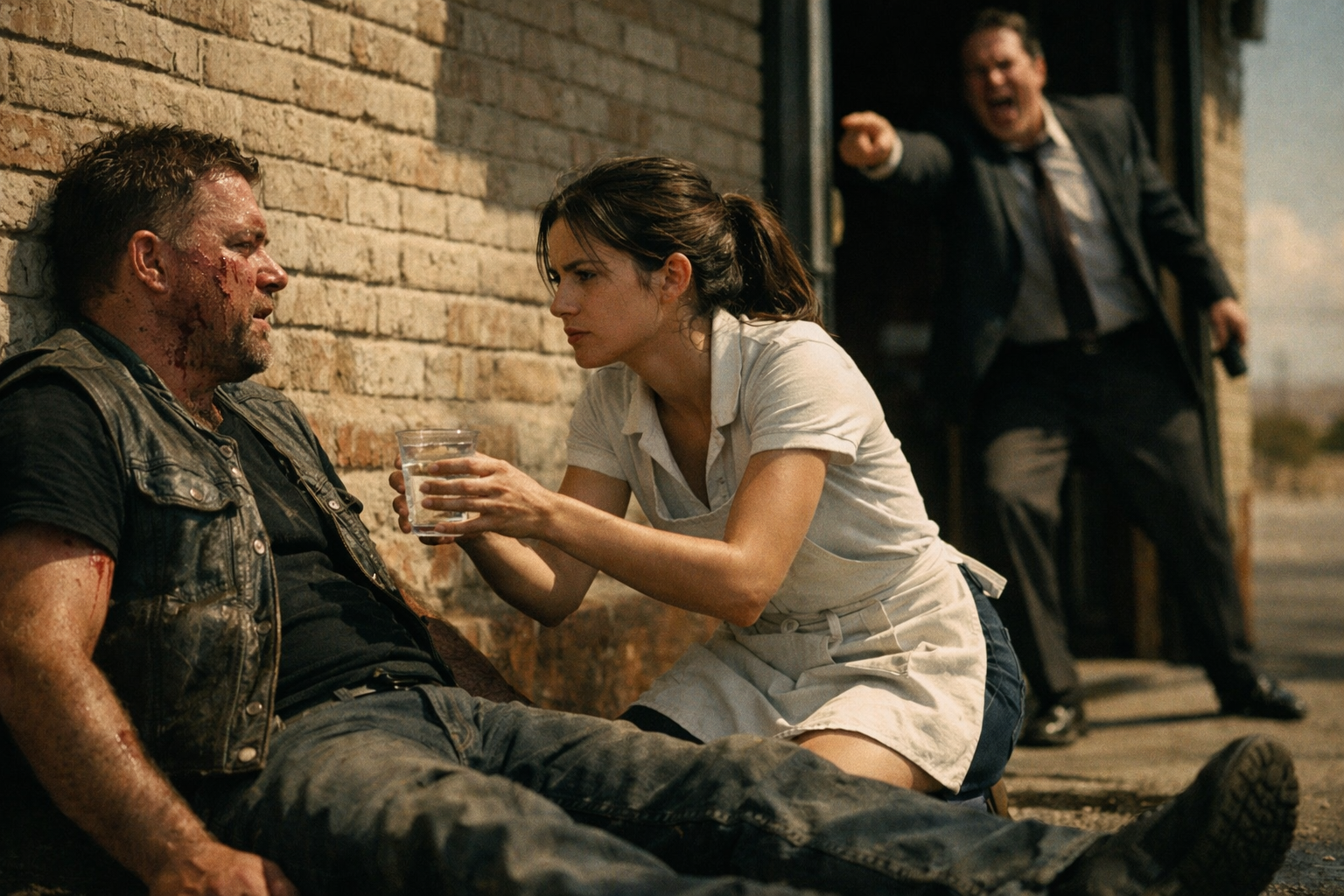
Luke was on the floor, hands zip-tied behind him, dried blood on his face from a cut above his eye. He was awake. Barely.
He looked up at me and blinked like he was trying to decide if I was real.
“Jordan,” he whispered.
“Don’t talk,” I said, crouching beside him and cutting the ties. “Can you walk?”
“Yeah.” He tried to stand and his legs buckled. I caught him. “Maybe not great.”
“You don’t need to walk great. You just need to walk.”
We were fifteen feet from the fence when the light hit us.
A guard had broken rotation. Wrong place, wrong time, or maybe someone had called ahead.
He raised his rifle.
I dropped low, pulled Luke down with me, and put the guard on the ground before he could shout. Clean. Quiet. The kind of muscle memory that never goes away no matter how long you try to bury it.
“How many?” Luke breathed.
“Seven left. But we won’t need to worry about them if we move now.”
We moved.
The fence. The darkness beyond. The truck I had staged a quarter mile out on a dirt access road that didn’t appear on any civilian map.
I got Luke into the passenger seat and drove north without headlights for the first two miles.
“Harlan sold me,” Luke said. It wasn’t a question.
“Yes.”
He was quiet for a moment. When he spoke again, his voice was controlled, but I could hear what was underneath it.
“I almost made contact three days ago. I had a dead drop arranged. I kept thinking — why isn’t anyone responding? Why isn’t the protocol working?” He stared out the window at the dark desert. “It was because the man running the protocol was the one who wanted me dead.”
“He won’t be running anything much longer,” I said.
Here is what Frank Harlan did not know:
Before I went into that compound, I sent a package.
Three hundred and forty pages of financial records, phone logs, encrypted communications, and a fourteen-page summary that even a non-specialist could follow. The package went to the FBI’s Public Corruption Unit. A copy went to a journalist at the Washington Post whose work on federal law enforcement I had followed for two years.
I had set a timer. If I didn’t send a cancellation code within six hours, the package would deliver automatically.
I never sent the cancellation code.
Vasquez called me at 0500.
“FBI hit Harlan’s house forty minutes ago,” he said. There was something in his voice I hadn’t heard before — relief, maybe, mixed with the particular exhaustion of a man who had just watched something he believed in survive a wound it shouldn’t have survived. “He’s in custody. His lawyer is already screaming, but Jordan — they have everything. The accounts, the calls, everything.”
“Good.”
“The Post is running the story at seven. His name. The account numbers. The asset list.” A pause. “Four other names came up in his records. Two are already in custody. They’re burning the whole thing down.”
“That’s how it should work,” I said.
“Luke?”
I glanced at the passenger seat. Luke was asleep, finally, his head against the window, breathing slow and even.
“He’ll be fine,” I said. “Get a medical team to the address I’m sending you. Nothing official. Someone you trust.”
“You’re not coming in.”
“No.”
“Jordan—”
“Vasquez,” I said. “You have your agent back. You have your case. Let me disappear.”
A long silence.
“Thank you,” he said finally.
The safe house was a ranch outside of Tucson owned by a former colleague who owed me a favor she had never expected to repay. I got Luke settled in a bedroom with clean sheets and an IV drip that Vasquez’s medic set up without asking questions.
I sat at the kitchen table and drank bad coffee while the sun came up.
At 7:02 AM, I pulled up the Washington Post on my phone.
DEA DEPUTY DIRECTOR ARRESTED ON FEDERAL CORRUPTION CHARGES. SOURCES SAY OFFICIAL SOLD AGENT IDENTITIES TO CARTEL FOR FOUR YEARS.
Below the headline, Frank Harlan’s official government photo. Below that, the account numbers. The call logs. The names.
The whole architecture of his betrayal, laid out in black and white for anyone to read.
Luke found me in the kitchen two hours later. He was moving slowly, favoring his left side, but his eyes were clear.
“Is it done?” he asked.
I turned the phone so he could see the headline.
He read it. Then he sat down across from me and put his head in his hands. Not crying. Just breathing. The way people breathe when something very heavy has finally been set down.
“Four years,” he said.
“Four years,” I agreed.
“How many assets did he burn?”
“Eleven names on the list. Six confirmed lost. Five made it out.” I paused. “You were going to be seven.”
Luke looked up at me. “You came alone?”
“It’s faster that way.”
“Jordan, you could have—”
“I know.”
He was quiet for a moment. Then: “Why didn’t you ever come back? After Beirut. I called you. For months.”
The question was gentle, but it landed like a stone.
“Because I didn’t know who I was anymore,” I said. “And I didn’t want you to have to figure that out with me.”
“That’s my job,” he said. “I’m your brother.”
I left two days later.
Luke was walking better. The bruises were already fading at the edges. Vasquez had arranged medical documentation and a cover story for the six days Luke had been missing — something bland and bureaucratic that would hold up under routine scrutiny.
Harlan’s lawyer was fighting the charges. He would lose. The paper trail was too clean. I had made sure of that.
Before I walked out the door, Luke caught my arm.
“Where are you going?” he asked.
I looked at him for a long moment. The kid who used to follow me around the backyard pretending to be a spy. The man who had survived six days in a cartel safe house and come out still asking questions instead of breaking.
“Somewhere that needs something fixed,” I said.
“That’s not an answer.”
“It’s the only answer I have.”
He pulled me into a hug — sudden, fierce, the kind that doesn’t leave room for argument. I held on longer than I had expected to.
“Don’t disappear for another two years,” he said into my shoulder.
“I’ll try,” I said.
It was the most honest thing I had said in a long time.
Outside, the desert morning was sharp and clean. The kind of light that makes everything look new.
I put on my sunglasses, shouldered my bag, and started walking toward the rental car at the end of the drive. Around me, the dry brush shimmered in the early heat. A hawk circled something in the distance, patient and precise.
Somewhere in Washington, Frank Harlan was sitting in a federal holding cell watching his career, his pension, and his freedom dissolve around him. The people above him were already cutting deals, throwing each other to the wolves, doing what corrupt men always do when the walls start closing in.
Somewhere in Nogales, a DEA operation that had been hemorrhaging assets for four years was finally, slowly beginning to heal.
And somewhere in the system, eleven names on a list that should have been buried were being quietly re-examined. Six were gone. But five had made it. And the people responsible for the six were being held accountable in a courtroom that did not know my name and never would.
That was enough.
I got in the car and drove south toward the next problem, the next ghost, the next name on no official list. The hawk in the desert sky banked once and disappeared into the light.
I pressed the gas and let the desert take me.
THE END.
Original fictional stories. AI-assisted creative content.