Laurel Corner Diner sat wedged between a dry cleaner and a tax prep office on Commerce Street in downtown San Antonio, two blocks from the Riverwalk and a world away from it. By noon, the place smelled like black coffee, flour tortillas, and bacon grease baked into the walls over decades. It was the kind of restaurant everyone had been to but nobody remembered choosing — you just ended up there, the way you ended up in most of the honest parts of life.
Valerie Cruz, twenty-three, had been ending up there for going on two years. She worked the floor from open to close, six days a week, and on her off hours she ran delivery orders in her Honda Civic to cover the six-hundred-dollar rent on her half of a two-bedroom apartment on the Eastside. Her feet ached before noon. She carried a folded electric bill in her apron pocket that she’d been ignoring for eleven days. And she had a habit she couldn’t shake no matter how many times it cost her: she felt other people’s pain like it belonged to her.
That was why she slowed down when she passed Table Four.
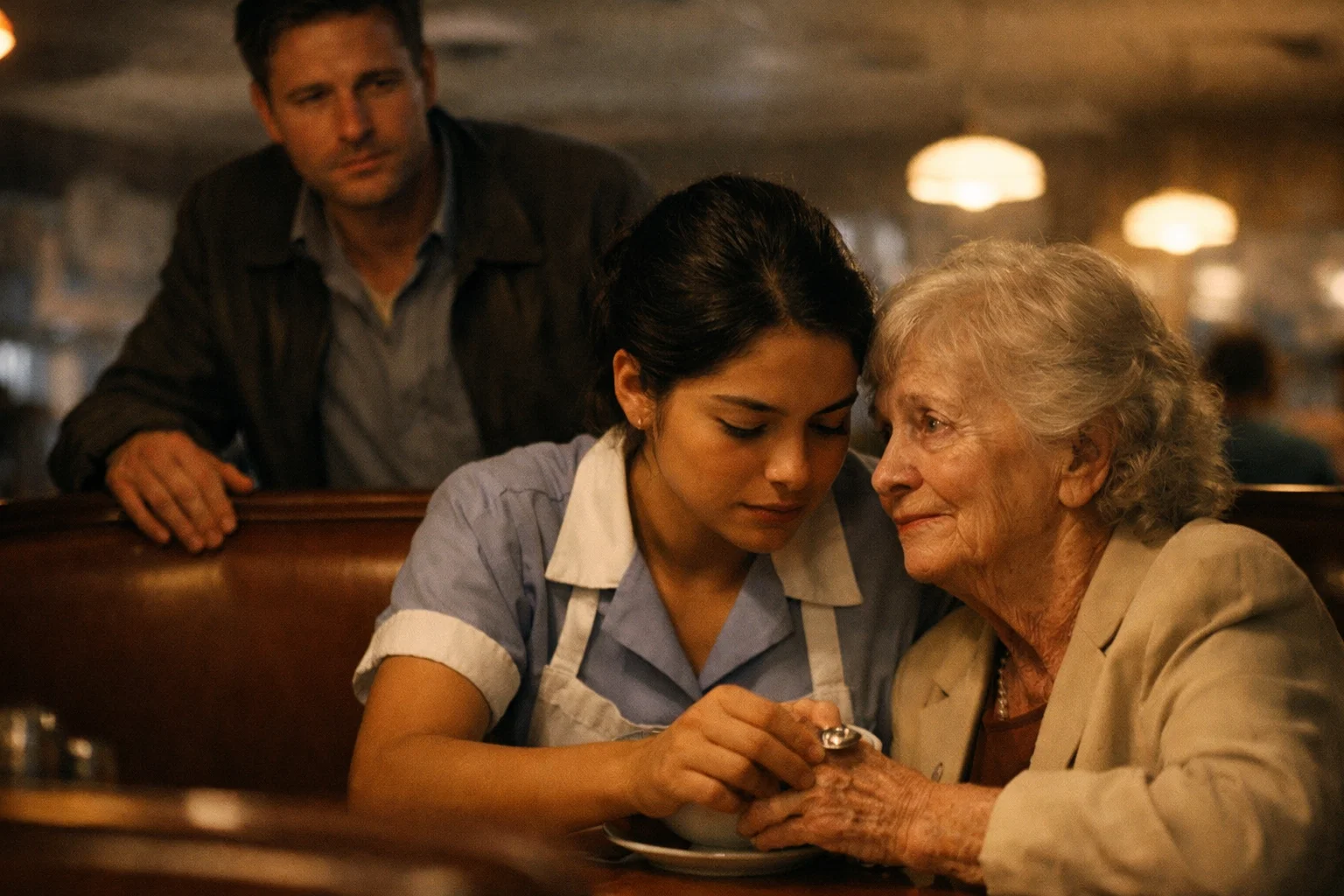
The woman at Table Four had silver hair pinned in a perfect twist and wore a pale linen blazer like she’d come from somewhere that mattered. The plate in front of her — chicken and rice soup, Valerie’s own suggestion — sat mostly untouched. The woman’s hands trembled over the bowl. She raised the spoon twice. Both times it tilted before it reached her mouth. She set it back down without expression, the way people do when they’ve long made peace with their own limitations.
Valerie had table seven’s check in one hand and a water pitcher for table nine in the other, and the man at nine had already looked up at her twice with that particular impatience that meant he was deciding whether to speak. She registered all of this.
She still stopped.
She set the pitcher on the edge of the station and crouched slightly so she was eye-level with the woman.
“Ma’am? Are you alright?”
The woman looked up. Her eyes were pale gray — tired but not defeated.
“Parkinson’s,” she said simply. “Some days are worse than others.”
Valerie’s grandmother had lived her last two years with tremors bad enough to make a cup of coffee into an obstacle course. She remembered sitting beside her at the kitchen table in Laredo, steadying the mug, pretending it was no big deal.
“Give me one second,” Valerie said.
She swung by table nine — “Right with you, sir, I’m so sorry” — dropped off table seven’s check, stepped into the kitchen and said to no one in particular: “I need a straw and a smaller spoon, please.” She came back in under three minutes. Without ceremony, she pulled the spare chair from the adjacent table and sat beside the woman.
“Try the spoon first. It gives you more control.” She wrapped both hands lightly around the woman’s to demonstrate the angle. “Like this. There you go.”
The woman got the spoon to her mouth.
She let out a breath through her nose — not quite a laugh, but close.
“Thank you, dear.”
“Don’t thank me yet. That soup’s only decent if you eat it while it’s hot.”
That made her smile. A real one — the kind that reaches the corners of the eyes.
“What’s your name?”
“Valerie.”
“Margaret,” the woman said. “But everyone calls me Maggie.”
They stayed that way for a few minutes — Valerie helping guide the rhythm, Maggie eating steadily, the noise of the diner wrapping around them like it had nothing to do with either of them. Valerie glanced up once to check on her other tables. Everything was manageable. She stayed.
She didn’t notice the man until Maggie’s eyes shifted past her shoulder.
He was standing near the far column, dark blazer, no tie, coffee in hand that he clearly wasn’t drinking. He was watching them. Watching the way you watch something you don’t entirely understand but can’t look away from.
When Valerie finally stood to check on her tables, Maggie caught her wrist — lighter than expected, but firm.
“You didn’t have to do that.”
“I know.”
“That’s why it meant something.”
Valerie squeezed the woman’s hand once and went back to work.
She didn’t see the man walk over to Maggie’s table. She didn’t hear what they said.
Forty minutes later, when she was refilling the coffee station, her manager Dale appeared at her elbow.
“The gentleman at Table Four asked about you.”
“Asked what?”
“How long you’ve worked here. Whether you’ve had any complaints.” He paused. “I kept it professional.”
Valerie looked over. The man was watching her again. This time, he didn’t look away.
She walked over herself. Direct was always better.
“Can I help you?”
He studied her for a moment. Up close, he was early forties. Sharp eyes — calculating, but not unkind.
“My name is Alex Castillo. That’s my mother.” He nodded toward Maggie. “I wanted to say thank you.”
“No thanks necessary.”
He produced a card. She looked at it: CASTILLO HOLDINGS — A. CASTILLO, CEO.
“I’d like to offer you a job. My mother has Parkinson’s. She needs a full-time companion — someone who’s actually present, not someone managing a checklist.”
Valerie picked up the card and placed it back on the table. Carefully, like it was something she’d weighed and returned.
“I appreciate it, Mr. Castillo. But I didn’t help your mother to get something out of it.”
“I know that. That’s specifically why I’m asking.”
“I’m not a caretaker. I’m a waitress.”
“What you did just now was caretaking.”
She looked at him evenly.
“I’ve got tables.”
She walked away.
Maggie watched all of this without a word. When Alex came back and sat down, she said, not looking up from her soup:
“You came on too strong.”
“I was direct.”
“There’s a difference.” She sipped her coffee. “Come back tomorrow.”
He did.
This time without a card. He arrived at opening, took a corner table, and ordered coffee and a plate he barely touched. He waited.
When Valerie came to take his order, she stopped. Looked at him. Then at Maggie, who had appeared beside him.
“Good morning, Valerie,” Maggie said warmly.
“Good morning, Mrs. Maggie.”
Alex spoke before she could turn away.
“I came to ask differently. Not an offer — a request.” He folded his hands on the table. “My mother needs someone she trusts. She trusted you in about ten minutes. That’s not something I can hire from a staffing agency.”
Valerie set down her notepad.
“I don’t have credentials.”
“You have better than credentials.”
“Like what?”
“Patience. And you actually see her.”
Maggie reached over and touched Valerie’s hand.
“He’s overly serious,” she said pleasantly. “Don’t let that fool you. He means well.” A pause. “I would simply like your company, dear. That’s all it is.”
Valerie looked from one of them to the other.
“What does it pay?”
Alex named a number.
She kept her face still, but something moved behind her eyes. It was more than triple what she earned between the diner and the deliveries.
“That’s too much,” she said.
“No. My mother is worth that. And I want you to stay because you choose to, not because you can’t afford to leave.”
A long silence.
“Three days’ notice to Dale,” she said. “Non-negotiable.”
“Fine.”
“I keep my Sunday mornings.”
“Fine.”
“And if she ever looks unhappy, I walk. Contract or not.”
Maggie laughed — a full, real laugh that made the couple at the next table glance over.
“I think you’ll do just fine,” she said.
The first two weeks were easy. Valerie learned Maggie’s rhythms — the medications, the slower mornings, the particular way she liked her tea, no sugar, slight lemon, never from a bag. She learned that Maggie watched classic films in the afternoons and narrated them quietly under her breath. That she kept a blue leather journal she never opened in front of anyone. That sometimes she sat at the kitchen table and looked out the window at nothing for a long time.
Valerie never asked what she was thinking during those moments. She just made coffee and sat nearby, and eventually Maggie would come back and start talking about something else entirely.
Alex stopped by most evenings, usually for under an hour. He was polite and efficient. He asked practical questions. He had difficulty just being present without something to do — a report open on his phone, a call to return. Like stillness made him uneasy.
Valerie mentioned this to Maggie one afternoon.
“He’s always been like that,” Maggie said. “He learned to be useful instead of close. I think it was how he protected himself.”
“From what?”
Maggie turned her teacup slowly in her hands.
“When Alex was little — very little — he had another mother. Before me.” A pause. “Her name was Clara. She worked in our house. Young woman, warm, always humming. He adored her.” She set the cup down. “And then one day she was gone. No goodbye. No note. He was three years old.”
Valerie went very still.
“What happened to her?”
“I never knew. Not the truth, at any rate. We looked — briefly. Then life moved on.” She looked at her hands. “Alex never talked about it. But you could tell he was always braced for the next loss. Like he was afraid anyone who got close would eventually disappear.”
That night, Valerie lay awake.
A woman named Clara who disappeared when a boy was three years old.
Herself at age three, handed to her grandmother in Laredo, told her mother was gone.
She closed her eyes.
It was probably nothing.
Three weeks later, Alex arrived on a Saturday afternoon looking different. Not in appearance — same blazer, same measured expression — but something underneath.
Maggie was resting. Valerie was in the kitchen reading when he came in. He poured himself a glass of water, didn’t drink it, and stood with his back to the counter.
“Can I ask you something personal?” he said.
She put down the book. “Okay.”
“Your family. Do you have any?”
She considered.
“I had a grandmother in Laredo. She raised me. She passed two years ago.” She paused. “My mother died when I was little. I don’t really remember her.”
“What was her name?”
Valerie frowned at the question.
“Clara,” she said. “Clara Morales.”
The water glass made a small sound as he set it on the counter.
“How old were you when she died?”
“Three.”
The silence that followed was a different kind of silence.
“Alex?”
“What city were you born in?”
“San Antonio. My grandmother was from Laredo, but I was born here.”
He walked to the table and sat down slowly, the way people sit when they’re managing something large.
“I need to tell you something,” he said. “And I need you to stay calm.”
She pulled her chair out and sat across from him.
“Talk.”
He told her everything.
Clara Morales had worked in Maggie’s household. She’d disappeared when Alex was three — no letter, no warning. For years, Alex had told himself she simply left. That a private investigator, three years ago, had finally located her. That Clara Morales was alive. That she lived alone in a small house outside of Boerne, sixty miles away. That she had a heart condition. That Alex had been paying her medical bills anonymously for eighteen months before he’d gathered the nerve to call her.
“She told me she’d had a daughter,” he said. “That she’d given the girl up when the child was three. That a neighbor — a woman named Gloria — took her, and she was told the girl was better off without her. That she’d never find her.”
Valerie’s voice came out smaller than she intended.
“Someone told her that?”
“A man named Ray Salgado. Maggie’s brother. He managed the family estate.” Alex pressed his knuckles against the table. “He threatened Clara. Told her if she came back for me, he’d have her arrested — accused of theft. She was twenty-two, alone, no money. She believed him.” He exhaled. “He told her the same thing about you. That you were safe with Gloria. That coming back would only hurt you.”
“And she believed that too.”
“She was already broken by the first time.” His voice was flat, not from coldness — from the effort of keeping it level. “Ray died six years ago with a clean reputation. There was nothing left to confront.”
Valerie stared at the table.
“Does Maggie know?”
“Not about Ray. Not about you.” He looked up. “She doesn’t know that you and Clara might be—” He stopped.
“Say it.”
“She doesn’t know you might be my sister.”
The word hit the room quietly and stayed there.
Valerie stood up. Walked to the window. Came back. Sat down.
“You need to tell her,” she said.
“I know.”
“Tonight.”
“I know.”
A long beat.
“Clara,” Valerie said. “She’s alive.”
“Yes.”
“She didn’t leave me.”
“No.”
Something behind Valerie’s eyes cracked open — not breaking, but releasing, the way pressure does when a seal finally gives.
“I need a minute,” she said.
“Take all the time you need.”
She went to the bathroom, closed the door, and stood at the sink with the water running and her hands flat on the porcelain and her chest doing something she hadn’t let it do in a long time.
Maggie received it the way she received most things: hands folded in her lap, eyes very still.
When Alex finished, she sat without speaking. Her face moved through something complicated and arrived at something quiet.
“Ray,” she finally said.
“Yes.”
“I gave him everything to manage.”
“I know.”
She looked at Valerie then — really looked at her, the shape of her face, the gray cast of her eyes, something in the line of her jaw.
“I see it now,” she said softly. “I don’t know why I didn’t see it in the diner.” She reached over and touched Valerie’s cheek. “You have her eyes.”
Valerie’s throat tightened.
“Mrs. Maggie—”
“We’re going to her.” Maggie looked at Alex. Not a request. “We’re going to Clara. And Valerie is coming with us.”
“Mom, you should rest—”
“Alexander James Castillo, I have been resting on a lie for forty years.” Her voice didn’t rise. It didn’t need to. “We leave in the morning.”
They left before six. The highway was dark and nearly empty.
Alex drove. Maggie sat beside him, hands folded, eyes on the windshield. Valerie sat in the back with a small bag and the particular kind of quiet that comes from having too many things to feel at once.
An hour out, Maggie said:
“She used to sing to him. When he was little, he’d only fall asleep if someone sang.” She smiled faintly at nothing in particular. “I never had the voice for it.”
Alex kept his eyes on the road.
The sky went from dark to pale gray to orange over flat ranch land. Small towns drifted by. Water towers. Clusters of live oak. The world going about its ordinary business, indifferent to what was happening inside one car on one highway.
Valerie watched the light change and thought about a woman she didn’t remember but had been carrying her whole life.
“What if she—” she started.
“She will,” Maggie said simply.
“You don’t know that.”
“No.” Maggie turned to look at her. “But I know she kept looking. A woman who keeps looking isn’t done.”
The house was a small white frame house on a quiet street in Boerne. A clay pot of rosemary by the front door. White curtains in the window. A truck in the driveway that had seen a lot of miles.
Alex knocked.
They heard slow footsteps. A latch sliding back.
Clara Morales stood in the doorway. She was sixty-two years old and looked it — silver-streaked hair, hands roughened by work, a face lined by time and by something heavier than time. She was wearing a housecoat and reading glasses pushed up on her forehead.
When she saw Alex, she made a sound that wasn’t a word.
“Hi, Mom,” he said. Just that. No performance. Just the two syllables that had been waiting almost his entire life.
Clara put one hand over her mouth. The other found the doorframe.
Then she saw Maggie.
“Oh, Maggie—” she said, and it came out broken.
Maggie stepped forward and took both her hands. “I didn’t know. I should have looked harder. I’m sorry, Clara. I’m so sorry.”
Clara shook her head, already crying — “No, no, it’s not your fault—”
And then her eyes moved past Maggie.
To Valerie.
She went very still.
Not confused. Not uncertain.
Recognition.
“My God,” Clara whispered. “Valerie?”
Valerie could barely get the words out. “How do you know my name?”
Clara moved past Maggie, past Alex.
“Because I gave it to you.”
And Valerie — who had held herself together through the whole thing, through the revelation in the kitchen, through the drive, through the dawn — came undone.
She was in Clara’s arms, and Clara’s arms were around her, and she was crying in a way she hadn’t cried since her grandmother’s funeral — deep and ragged and real, like something finally exhaling after a very long time of holding its breath.
Alex pressed a knuckle to his mouth and looked away.
Maggie stood and wept without embarrassment.
Inside, at a kitchen table with mismatched chairs and a good coffee maker, the whole truth came out.
Clara had tried to come back for Alex. Ray had threatened her directly — not with implication, but with specifics. Arrest. Accusations of theft. Permanent unemployability. She’d been twenty-two and alone and she’d believed him.
She fled. Rebuilt a small life. Worked wherever she could find it.
When Valerie was born, she kept her. She tried.
And then Ray found her again.
“He said you’d be better off,” Clara told Valerie. Her voice was level, but it cost her something to keep it that way. “He said I was doing damage just by existing. That Gloria — the woman in Laredo — would give you a real home.” She looked at her hands. “I signed the paperwork. I believed him.” A pause. “I spent the next ten years finding out that was a lie. And then ten more trying to find where you’d gone.”
“My grandmother never told me any of it,” Valerie said.
“She wasn’t a bad woman. I don’t think she knew everything Ray told her. She loved you — I believe that.” Clara looked up. “I just couldn’t get to you.”
Valerie looked at Alex.
“You paid for her surgery. Before you even said who you were.”
“She was sick.”
“You could have introduced yourself. Made it mean something for yourself.”
“I wasn’t ready to be a son yet.” He held her gaze. “I wanted to earn it first.”
The table was quiet.
Maggie reached over and covered Alex’s hand.
“You have,” she said.
He swallowed and looked at the window.
Valerie got up and walked to the far wall, where a small framed photograph hung. A girl, maybe three years old, asleep in a chair. Dark curls. A small hand curled under her cheek.
“Is that—”
“You,” Clara said. “It’s the only one I had.”
Valerie looked at the photograph for a long time.
“You kept it.”
“I kept it every single day.”
They stayed through the afternoon and into evening. Clara made tamales from scratch, and nobody mentioned that it had been a lifetime since they’d all been in the same room. Alex sat at the kitchen table and let his mother talk — really talk, stories and details he’d spent decades not knowing — and he listened the way you listen when you’ve been waiting for something your whole life without knowing what to call it.
Valerie helped in the kitchen without being asked. Maggie sat in the living room armchair and dozed off and woke up and didn’t seem troubled by any of it.
At one point, standing by the back door while the coffee brewed, just the two of them, Alex said:
“You’re going to tell me I should have done this sooner.”
“I’m not going to tell you anything.”
“You’re thinking it.”
She looked at him sideways. “I’m thinking you paid her medical bills and drove here at five in the morning and you’re standing in your mother’s kitchen holding a dish towel. You’re doing alright.”
He looked down at the dish towel in his hand like he hadn’t realized it was there.
“You’re very hard to argue with,” he said.
“That’s a family trait, apparently.”
Something shifted in his expression — something opening that he’d kept shut for a long time.
He laughed. Quietly. But real.
Over the next six weeks, the four of them fell into a rhythm that no one designed but everyone kept.
Valerie split her time between Maggie’s house and Clara’s. She stopped thinking of it as a job. Alex restructured his schedule — delegated more, logged off earlier, showed up to Maggie’s on weeknights for dinner instead of sending a quick check-in text. He visited Clara every Sunday.
Maggie’s Parkinson’s was managed, not cured. On the harder mornings, Valerie sat beside her at the kitchen table the same way she’d sat beside her in the diner — unhurried, present, steady. That part hadn’t changed. It never would.
Clara’s heart surgery came in the spring. Alex sat in the waiting room this time. Not just paying the bill — sitting there, in a plastic chair, with bad coffee, waiting. When Clara came out of recovery, he was the first face she saw.
She reached up and held his face in her hands like he was three years old again.
He let her.
Ray Salgado had died six years before, his reputation intact.
He died wrong.
Alex hired a researcher to document the full pattern of Ray’s interference — the threats, the falsified paperwork, the coercion. He brought the findings to a family law advocacy organization. He filed a formal complaint against the estate attorney who had facilitated Ray’s schemes. The documentation was used to challenge similar cases across the state — families separated by manipulation, women silenced by power they couldn’t afford to fight.
Ray got no monument. What he built got taken apart, piece by piece, by the people he thought he’d destroyed.
A year after the trip to Boerne, Alex established a foundation.
It funded support for elderly patients with neurodegenerative conditions and the workers — overwhelmingly women, overwhelmingly underpaid — who cared for them daily. It funded legal resources for families torn apart by coercive third parties. It funded the kind of quiet, persistent help that the people receiving it rarely expected and almost never got.
He named it the Clara Foundation.
When a journalist asked why that name, he kept it brief.
“Some people hold the world up with small gestures that nobody sees.” He paused. “It seemed right.”
On the day of the announcement, Valerie and Clara sat together in Maggie’s living room watching the coverage on TV.
Clara shook her head slowly.
“He didn’t have to do that.”
“No,” Valerie said. “He wanted to.”
A beat.
“He’s still too serious,” Clara said.
“Completely.”
“You’re going to have to work on that.”
“That’s a family project,” Valerie said.
Clara laughed — a warm, full sound that filled the room — and reached over to take her daughter’s hand.
Outside, the afternoon was ordinary and golden and going about its business, the way good afternoons do.
And in a diner on Commerce Street, two years before all of this, a tired waitress had stopped beside a shaking old woman and said: There’s no rush.
She hadn’t known what she was starting.
That was the point.
Life sometimes takes years to return what was stolen.
But when it does, it arrives quietly — like true kindness — changing everything without asking for anything back.
Original fictional stories. AI-assisted creative content.