The lunch crowd at Maple & Main had thinned out to almost nothing by one-thirty.
A few solo tables. A couple sharing a panini near the window. The hiss of the espresso machine going quiet between orders. The kind of afternoon that asks nothing of anyone.
Officer Dan Reeves sat in the back corner, jacket folded over the chair beside him, club sandwich untouched, phone out. Off duty meant off duty. No radio. No vest. Just jeans and a gray henley and the specific nowhere-to-be feeling of a Tuesday afternoon that belonged to him.
He’d noticed the couple when he sat down. Not because of anything loud — because of nothing at all.
The man was maybe thirty. Dark blazer, expensive watch, the kind of posture that said he was used to being the most important person in whatever room he entered. He was leaning across the small table, voice low and controlled, jaw working on each word like he was chewing glass.
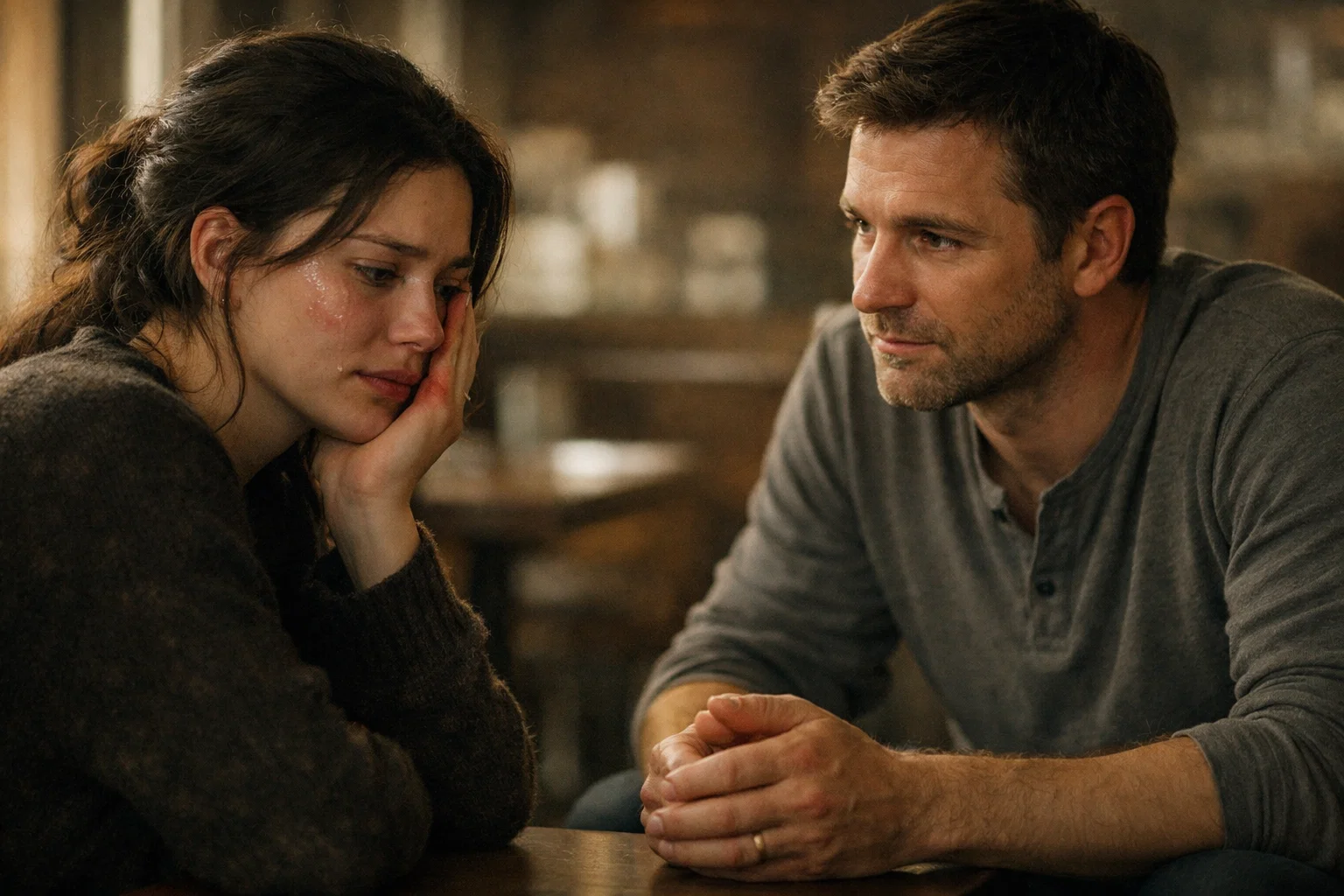
The woman across from him was younger. Mid-twenties. Dark hair pulled back, one curl loose against her cheek. She was looking at the table. Not at him. At the table.
She nodded.
She shook her head.
She said “I know” twice that Dan could hear.
He went back to his phone.
Not my business, he thought. Couples argue.
Then the chair scraped.
The sound was small — just four legs on tile — but it had weight behind it, and Dan looked up without deciding to.
The man — his name was Kyle, though Dan didn’t know that yet — had risen halfway out of his seat. His hand had crossed the table and closed around her wrist.
“You are embarrassing me,” Kyle said. Quiet. Clear. The voice of someone who wasn’t afraid of being heard.
“Let go.” The woman’s voice was flat. Controlled. The voice of someone who’d said those two words before and knew they didn’t always work.
“You always do this. Every time. In public, like you want people to—”
“Kyle. Stop.”
“Don’t tell me to stop. Don’t you dare—”
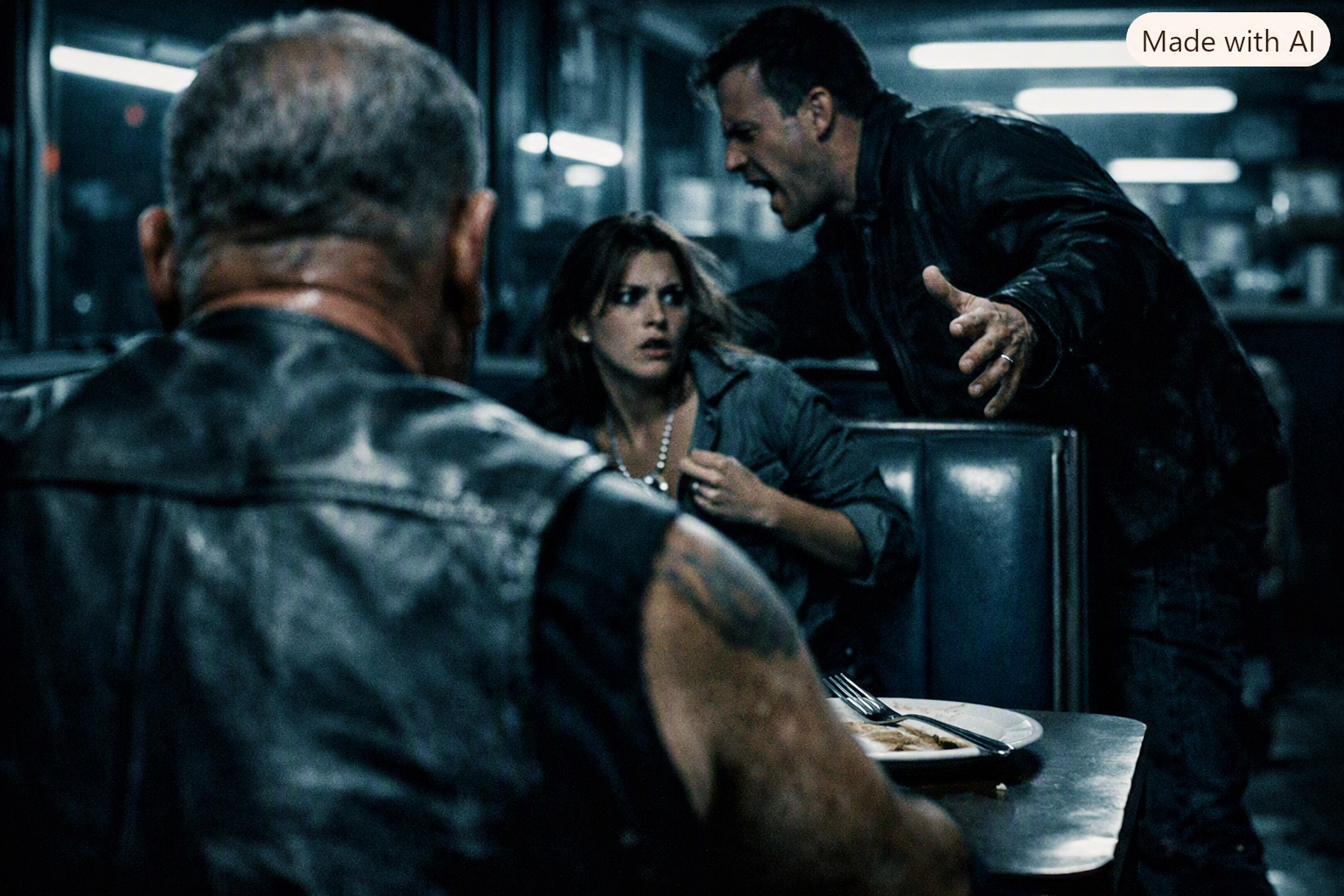
The slap was open-handed and fast. The sound cut through the café like a starter pistol.
A ceramic mug stopped halfway to someone’s lips.
The indie playlist kept going. Something soft and acoustic that had no business playing right now.
Nobody moved.
The woman — Mara, though Dan didn’t know that either — pressed her hand flat against her cheek. The mark bloomed red instantly. Her eyes went wide, then went somewhere else entirely. Somewhere internal. Somewhere far away from this table and this man and this café.
Dan was already on his feet.
He crossed the two steps between tables before Kyle had time to sit back down. His hand came down firm on Kyle’s shoulder — not a grab, just weight and presence and a clear statement about who was in charge of the next thirty seconds.
“Don’t move.”
Kyle spun. He was bigger than Dan by an inch, with the kind of shoulders that said he’d spent a lot of time making sure people noticed. “Who the hell are—”
“Hands where I can see them. Right now.”
“You don’t know what’s going on here. This is between me and my girlfriend—”
“I know exactly what’s going on.” Dan reached into his back pocket and flipped his badge wallet open on the table between them, face up, clearly visible. “I’m a police officer. I watched you strike this woman. You’re going to sit down, hands flat on the table, and you’re going to stay exactly like that until backup gets here.”
The word backup landed.
Kyle’s face went through something complicated — fury trying to hold its footing against the first cold edges of fear. He looked at the badge. He looked at Dan. He looked at the badge again.
“You’re not in uniform. You’re off duty. You can’t just—”
“I am a law enforcement officer twenty-four hours a day.” Dan’s voice didn’t rise. It didn’t have to. He kept his eyes on Kyle’s hands, not his face. “Sit. Down.”
Kyle sat.
Dan turned to Mara without fully turning his back on Kyle. The corner of his eye stayed locked on those hands.
“Are you hurt?”
Her hand was still pressed to her cheek. She looked at Dan the way people look at something unexpected — trying to classify it, figure out which category it belongs to.
“I’m okay,” she said. Automatic. Practiced.
“I need the real answer.”
She blinked. For a second it looked like the automatic answer was going to come out again. Then something shifted behind her eyes.
“My cheek,” she said quietly. “It’s happened before.”
“Has he hit you before?”
A long pause. Long enough to contain a lot of history.
“Yes.”
“Okay.” He kept his voice steady and pulled out his phone. “You’re safe right now. I promise you.”
The call to dispatch was forty seconds. Two units, four minutes out.
Dan stood between Kyle and the door and didn’t move.
Kyle had gone from bluster to quiet — the specific quiet of someone who’d just realized the situation was no longer one he could talk, charm, or intimidate his way out of. He sat with his hands flat on the table, but his jaw was working again. Processing.
The other customers in Maple & Main had stopped pretending.
A barista — twenties, apron, phone already out — was filming quietly from behind the counter. A man near the window had physically repositioned his chair. A woman in her fifties with reading glasses pushed up on her head had turned completely around in her seat, watching with an expression that was somewhere between concern and fury.
Nobody spoke.
Kyle spoke.
“You’re ruining my life over nothing,” he said, low. “She’s my girlfriend. We were having a disagreement.”
“A disagreement isn’t hitting someone.”
“I barely even—”
“You struck her across the face.” Dan still wasn’t looking at him. He was watching the front door. “In a public place. In front of witnesses.” A pause. “Anything you say right now goes in my report.”
Kyle shut up.
The silence stretched out over the music — some acoustic thing about roads and leaving that felt almost cruel given the moment.
Mara hadn’t moved. She was sitting very still, like she was afraid that if she shifted she’d tip something over. Her hand had lowered from her cheek. The mark was darkening along her cheekbone, vivid and clear.
She looked at Dan.
“Why did you stand up?” she asked quietly. “Nobody ever—”
“Because I saw it.”
“Other people saw it.”
Dan glanced around the café for just a second. The man who’d repositioned his chair. The woman with the reading glasses. The barista with her phone.
“They saw it too,” he said. “Sometimes people freeze. It doesn’t mean they don’t care.”
“You didn’t freeze.”
“It’s my job not to.”
“You’re off duty.”
“The badge doesn’t have an off switch.”
Kyle made a sound — something between a scoff and the start of a word — and Dan turned and looked at him directly for the first time.
“Not one more word,” Dan said. “I mean that.”
Kyle looked at the table.
The front door of the café swung open.
Two patrol officers stepped in — both mid-twenties, a man and a woman, hands at their belts, reading the room in the first two seconds the way good officers do. Dan recognized the woman. Torres. He’d worked two cases with her the previous spring.
She saw him across the café and her expression said of course it’s you.
Dan met her halfway and briefed her in sixty seconds flat. Timeline. The grab. The slap. Witness count. Mara’s statement about prior incidents.
Torres nodded once, crisp. Turned toward the table.
“Sir.” Her voice carried across the café without being loud. “Stand up and put your hands behind your back.”
Kyle’s head snapped up. “This is insane. She’s my girlfriend. We’ve been together for two years. You can’t just—”
“Stand up.”
“I want a lawyer. I’m calling my lawyer right now.”
“You can make that call at the station.” Torres stepped closer. “Hands behind your back.”
Kyle’s eyes moved to Mara. The look had layers in it — plea on top, warning underneath. The look that says fix this. The look that expects to be obeyed.
Mara looked back at him.
She kept her hand in her lap. She let him see her face — the mark still vivid on her cheek — and she didn’t say a single word.
Kyle stood.
The cuffs went on.
“Kyle Barton,” Torres said, steady and deliberate, “you are under arrest for domestic battery. You have the right to remain silent. Anything you say can and will be used against you in a court of law. You have the right to an attorney. If you cannot afford an attorney, one will be appointed for you.”
The rest of Maple & Main listened to every word.
Torres’s partner walked Kyle out through the front door. The afternoon sun hit them both as they stepped outside. Through the glass, the remaining customers watched him get put in the back of the patrol car.
Some of them exhaled.
The café felt different after that. Lighter, somehow, and also more serious at the same time.
Torres came back to where Mara was sitting and pulled up the chair across from her. Not the chair Kyle had been in. A different one.
“My name is Officer Torres. Are you injured?”
“My cheek. He’s—” Mara stopped. Started again. “He’s done it before.”
“Can you tell me about those times?”
“I called once. About eight months ago. The officers talked to him separately and then told me they couldn’t do anything.”
Torres’s expression didn’t change, but something went still behind her eyes. “I hear you. I want you to know that what happened here today was witnessed by a law enforcement officer and recorded on the café’s cameras. It’s different this time.”
“You keep saying that.”
“I mean it this time.”
Mara pressed her lips together. Her eyes filled but she didn’t let them spill. She nodded — once, slowly, like she was filing it away somewhere careful.
Dan had stepped back to give them space. He was standing at his own table, cold coffee in hand, watching without watching.
The woman with the reading glasses leaned over from the next table.
“Honey.” Her voice was low and direct. “I am so sorry I didn’t say something sooner.” She reached into her purse and placed a card on the table in front of Mara. “I run a legal aid clinic on Fifth. Walk-in or call — first consultation is always free. Please use it.”
Mara looked at the card.
The barista appeared from behind the counter — apron still on, phone still in her pocket — and set a fresh coffee in front of Mara without a word. Then: “On the house. Take as long as you need.”
Mara looked at Torres. At the barista. At the woman with the card. At Dan, two tables away, pretending to look at something else.
“Why are all of you—” She stopped. Restarted. “Why didn’t anyone say something before?”
“They didn’t know how,” Dan said quietly. “That’s not an excuse. It’s just what’s true.”
“You knew how.”
“I’ve had training they haven’t.”
“You’re still off duty.”
He lifted one shoulder. “The badge doesn’t clock out.”
Torres finished taking Mara’s statement. She gave her a victim advocate’s card — someone at the precinct who would walk her through options. Protective orders. Shelter resources. Relocation assistance programs most people never know about unless someone hands them the right piece of paper.
“You don’t have to make any decisions today,” Torres said. “But I want you to have the information. All of it.”
Mara tucked both cards — Torres’s and the lawyer’s — into her coat pocket.
Before Torres left, she stopped at Dan’s table.
“Witness report — can you come in today?”
“This afternoon. I’ll be there by three.”
“Good.” She glanced at the table behind him. His club sandwich, untouched, now definitively room temperature. “Your lunch is still there, Reeves.”
“I noticed.”
Torres almost smiled. “Good collar.”
She walked out into the sun.
Mara sat in the café for another forty-five minutes.
She drank the coffee the barista had brought.
She turned the legal aid card over in her hands. Front. Back. Front again.
Eventually she picked up her phone and called her sister.
“Hey. Can I come over?”
“Of course. What happened? Are you okay?”
“I’ll explain when I get there.” A pause. “I’m okay. I think I’m actually okay.”
She had said those words so many times — to so many people, in so many tones of voice, in so many versions of not okay — that they had hollowed out. Become a reflex. A thing the mouth said while the rest of her waited for whoever was asking to stop asking.
But sitting in that café, with a fresh coffee steaming in front of her and two cards in her pocket and a roomful of strangers who had, in their different ways, shown up—
For the first time in a long time, she thought it might actually be true.
Kyle Barton was processed at the 14th Precinct at two forty-seven that afternoon.
Domestic battery. One count, witnessed by an off-duty police officer, corroborated by café surveillance footage, and supported by witness statements from four additional patrons and one employee.
The intake officer flagged a prior incident report from eight months earlier — a call that had been marked “unfounded” after the responding officers spoke to Kyle alone for twelve minutes without Mara present.
This time was different.
This time there was a witness with a badge and twenty years of courtroom experience. Surveillance footage from three angles. A roomful of people who’d seen it happen. And a barista who had already uploaded a thirty-second clip to her social media before the patrol car cleared the block.
By six o’clock that evening, the video had been viewed two hundred thousand times.
By ten, it was four hundred thousand.
Kyle’s employer — a regional property management firm whose name appeared in the building management of eleven commercial properties across the metro area — called him the following morning at eight forty-five.
The call lasted six minutes.
He was placed on immediate unpaid leave pending an internal review.
At Kyle’s arraignment, the judge set bail at fifteen thousand dollars and issued an emergency protective order. Kyle was barred from contacting Mara directly or indirectly, and from coming within five hundred feet of her residence.
Kyle’s attorney entered a not guilty plea and suggested the incident had been “taken out of context.”
The DA’s office, reviewing Officer Reeves’ four-page written statement alongside the café footage and the prior incident report, did not find that argument compelling.
They began preparing for trial.
With the help of the legal aid attorney — whose card she had not thrown away — Mara filed for a permanent protective order.
It was granted eleven days later.
She also applied for emergency relocation assistance through a domestic violence program the victim advocate had told her about. Most people never find out these programs exist. Mara now knew.
She moved three weeks after that.
New apartment. Her sister helped her carry boxes on a Saturday morning. When the last box was in and the truck was back, Mara stood in the middle of the empty living room and just breathed.
“You okay?” her sister asked from the doorway.
“Yeah,” Mara said.
She meant it.
Dan Reeves filed his witness report on a Tuesday afternoon. Four pages. He was precise about the timeline — the initial contact, the grab, the strike, the distance between himself and the parties, the exact words spoken by all three of them.
Exact words matter in court. Dan had been a cop long enough to know that.
He testified at the preliminary hearing. Eleven minutes on the stand.
He was asked once whether he was certain of what he’d witnessed.
“I was two feet away,” he said. “I’m certain.”
Kyle’s attorney tried to press the point about Dan being off duty and therefore potentially biased as a witness.
The judge looked at the attorney over her reading glasses and asked him to move on.
He moved on.
Four months later, Torres found Dan in the break room at the 14th, pouring coffee.
“Barton took the deal,” she said.
Dan turned. “What did he get?”
“Guilty plea on domestic battery. Twelve months probation. Mandatory batterer intervention program.” She leaned against the counter. “Permanent protective order stays in effect. And the conviction stands. On his record. Permanently.”
“Good.”
“Mara submitted a written impact statement.” Torres paused for a second. “I read it.”
Dan drank his coffee and waited.
“She wrote about the café,” Torres said. “About looking up and seeing someone stand between her and the door.” She looked at him. “She wrote that it was the first time she believed it could actually stop.”
Dan didn’t say anything.
Some moments ask to be received quietly. The wrong response isn’t a wrong word — it’s any word at all.
He drank his coffee.
Torres straightened up. “She’s doing okay, from what the advocate says. New place. Lawyer who calls her back. Her sister’s nearby.”
“Good.”
“You know what the wild part is?” Torres half-smiled. “The barista’s clip got picked up by two local news stations. They did a whole segment on bystander intervention. The café owner said they had more business that week than they’d had in a year.”
“Because a woman got hit in their dining room?”
“Because somebody did something.” She shrugged. “People remember that.”
Dan finished his coffee and rinsed the mug in the sink.
Kyle Barton was a convicted domestic abuser. That was the record now. That was what followed him — to every background check, every job application, every form that asked the question.
Permanent.
And Mara — in her new apartment, with her sister’s number at the top of her contacts and a lawyer who actually called her back and a court order that meant something — was safe.
That was the job.
Whether you were in uniform or not.
Original fictional stories. AI-assisted creative content.